The Evolution of Level 2+ Automation and the BlueCruise Promise
The automotive industry is currently locked in a high-stakes race toward autonomous driving, but the immediate battleground is Level 2+ Advanced Driver Assistance Systems (ADAS). Among the premier contenders, Ford BlueCruise has emerged as a formidable rival to General Motors’ Super Cruise and Tesla’s Autopilot. Unlike systems that merely offer lane-centering and adaptive cruise control, BlueCruise provides true hands-free driving on pre-qualified sections of divided highways, which Ford dubs “Blue Zones.”
But how does this system perform in the unpredictable real world, and more importantly, what does its rapid iteration signal for the future of smart driving? In this real-world review and industry outlook, we put Ford BlueCruise to the test on a multi-state highway journey to evaluate its current capabilities, its limitations, and its role in shaping the software-defined vehicle landscape.
Real-World Highway Performance: The 500-Mile Test
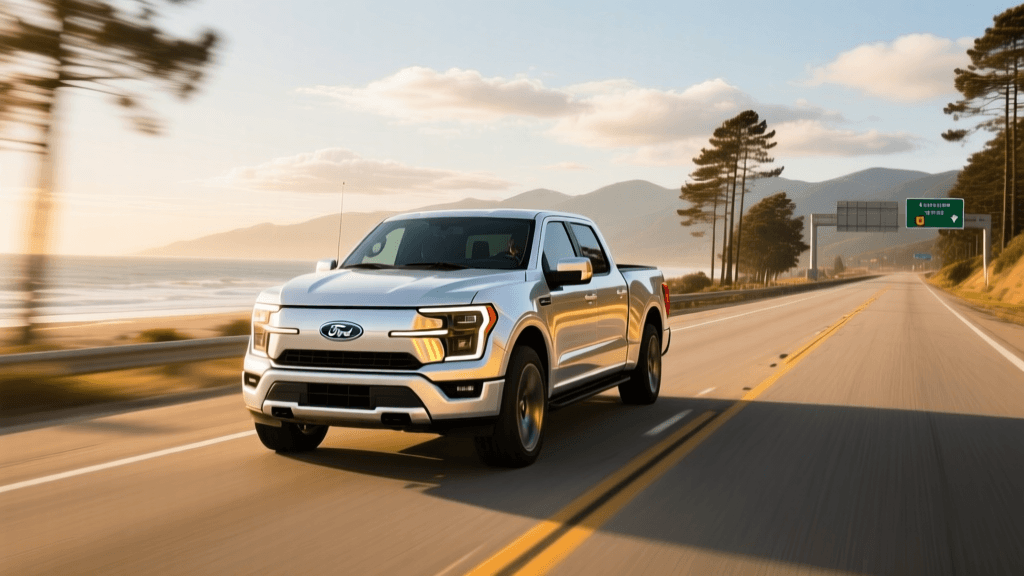
Our real-world evaluation took place in a Ford F-150 Lightning equipped with the latest iteration of BlueCruise, covering over 500 miles across heavily trafficked interstate corridors. The transition into hands-free mode is remarkably intuitive. Once the vehicle enters a mapped Blue Zone, a visual indicator on the digital instrument cluster turns blue, and the system prompts the driver to remove their hands from the steering wheel.
In steady-state highway cruising, BlueCruise is exceptional. The lane-centering algorithm is assertive yet smooth, avoiding the “ping-pong” effect that plagues lesser ADAS suites. When encountering large semi-trucks in adjacent lanes, the system executes subtle, within-lane offsets to provide a psychological and physical buffer for the driver—a feature that mimics human defensive driving habits. Furthermore, the adaptive cruise control seamlessly manages stop-and-go traffic, bringing the heavy EV pickup to a complete halt and resuming motion without requiring driver intervention, provided the stop is brief.
However, the real-world test also exposed the system’s boundaries. In complex construction zones where lane markings are faded or contradicted by temporary orange barrels, BlueCruise can become hesitant, occasionally alerting the driver to take over immediately. While the system is highly capable on sweeping interstate curves, tight, unmapped off-ramps or sudden lane drops still require the driver to be fully engaged and ready to assume manual control at a moment's notice.
Driver Monitoring: The Infrared Gatekeeper
A critical differentiator for BlueCruise—and a major indicator of future industry standards—is its Driver Monitoring System (DMS). Unlike Tesla, which historically relied on steering wheel torque sensors and basic cabin cameras, Ford utilizes an infrared camera mounted on the steering column. This camera tracks the driver’s eye gaze and head position, ensuring that eyes remain on the road even when hands are off the wheel.
According to research from the Insurance Institute for Highway Safety (IIHS), robust driver monitoring is essential to prevent automation complacency, a leading cause of accidents involving partial automation. In our testing, the infrared DMS proved incredibly resilient. It accurately tracked our attention through polarized sunglasses, in harsh midday glare, and during pitch-black night driving. If the system detects your eyes drifting to a smartphone or closing for too long, it issues a multi-stage escalation of warnings, eventually slowing the vehicle to a halt if the driver remains unresponsive. This strict adherence to safety protocols aligns closely with the guidelines set forth by the National Highway Traffic Safety Administration (NHTSA) regarding the safe deployment of automated vehicle technologies.
BlueCruise vs. The Competition: Feature Breakdown
To understand where BlueCruise sits in the current ADAS hierarchy, we must compare it directly to its closest rivals. Below is a structured comparison of the top Level 2+ systems available today.
| Feature | Ford BlueCruise (v1.3/1.4) | GM Super Cruise (w/ LiDAR) | Tesla Autopilot / FSD |
|---|---|---|---|
| Hands-Free Capability | Yes (Pre-mapped Blue Zones) | Yes (Pre-mapped Highways) | No (Hands-on required by law/software) |
| Driver Monitoring | Infrared Eye-Tracking Camera | Infrared Eye-Tracking Camera | Steering Torque + Basic Cabin Camera |
| Lane Change | Hands-Free (v1.4) / On Intent | Hands-Free Automatic | On Turn Signal (Auto on FSD) |
| Predictive Speed Assist | Yes (Slows for curves/traffic) | Limited | Yes (via Vision AI) |
| Post-Trial Cost | $75/mo or $800/yr | $25/mo (after 3 yrs) | $99/mo or $8,000 upfront (FSD) |
Future Trends: What BlueCruise 1.3 and 1.4 Signal for the Industry
Ford’s rapid over-the-air (OTA) updates to BlueCruise highlight a massive shift in how vehicles are engineered and sold. The introduction of BlueCruise 1.3 brought “Predictive Speed Assist,” which uses map data and cameras to automatically slow the vehicle for upcoming sharp curves or heavy traffic. Version 1.4 pushes the envelope further by introducing hands-free lane changes, allowing the vehicle to autonomously pass slower traffic and re-enter the cruising lane.
From an industry outlook perspective, these updates signal the bridge between Level 2+ and Level 3 autonomy. Automakers are heavily incentivized to perfect Level 2+ systems because the legal liability remains with the driver. By utilizing advanced sensor fusion—combining high-definition mapping, radar, and high-resolution cameras—Ford is gathering billions of miles of real-world driving data. This data is the lifeblood for training the neural networks that will eventually power true Level 3 and Level 4 autonomous systems. The Ford BlueCruise Official Technology Hub frequently outlines how OTA updates continuously refine these machine-learning models based on aggregated fleet data.
Industry Outlook: The Software-Defined Vehicle and ADAS Subscriptions
Perhaps the most significant trend illuminated by BlueCruise is the financialization of ADAS through Software-as-a-Service (SaaS) models. Ford is transitioning from a one-time hardware purchase to a recurring revenue model. While early adopters received complimentary trial periods (often one to three years depending on the model), the ongoing cost of $75 per month or $800 annually represents a massive profit center for legacy automakers.
This subscription model ensures that automakers can continue to fund the expensive R&D required for autonomous driving long after the vehicle has left the dealership lot. For consumers, this means your car can literally improve over time, gaining new capabilities via cloud updates, but it also introduces the reality of “bricked” features if you choose to stop paying the monthly fee. Future industry consolidation will likely see automakers bundling these subscriptions with insurance, maintenance, and charging networks to create inescapable ecosystem lock-ins.
Actionable Advice for Prospective Buyers
If you are considering a vehicle equipped with BlueCruise, here is practical advice to maximize your investment and understand the real-world costs:
- Trim Selection: BlueCruise is not standard across all trims. For the F-150, you typically need the Lariat trim or higher, paired with the “High” equipment package. For the Mustang Mach-E, look for the Premium or GT trims with the BlueCruise prep package.
- Windshield Replacement Costs: The complex array of cameras and sensors mounted behind the rearview mirror requires precise calibration. If your windshield cracks, expect to pay a premium (often $800 to $1,200+) for OEM glass and dealer recalibration. Ensure your auto insurance policy includes comprehensive glass coverage with a low deductible.
- Map Updates and Connectivity: BlueCruise relies on an embedded modem to download fresh HD map data and OTA updates. Ensure your Ford Pass Connect subscription remains active; without cellular connectivity, the system cannot verify Blue Zones or receive the latest software patches.
- Resale Value Implications: Because the hardware is tied to the VIN, the vehicle retains its BlueCruise capability upon resale. However, the new owner will need to initiate their own subscription once the original promotional trial expires. Factor this into your total cost of ownership calculations.
Conclusion
Ford BlueCruise represents a highly polished, deeply pragmatic approach to the future of highway driving. It does not promise the moon, nor does it attempt to navigate chaotic city streets without a steering wheel. Instead, it masters the most fatiguing aspect of driving: the long, monotonous interstate haul. As the industry pivots toward software-defined revenue models and incremental, safety-first autonomy, BlueCruise stands as a benchmark for how legacy automakers can successfully compete with Silicon Valley disruptors. It is a glimpse into a near-future where the car is not just a mode of transport, but an continuously evolving, intelligent co-pilot.