The Urban ADAS Problem: Why City Driving Breaks Your Sensors
While highway cruising is the comfort zone for most Advanced Driver Assistance Systems (ADAS), the urban jungle is their ultimate stress test. City driving introduces a chaotic mix of jaywalking pedestrians, erratic cyclists, faded lane markers, tight construction zones, and complex intersections. According to the Insurance Institute for Highway Safety (IIHS), pedestrian detection and low-speed automatic emergency braking (AEB) systems are critical for urban safety, yet they frequently struggle with the visual clutter of city environments.
For smart drivers, simply turning these systems on isn't enough. You must understand how to troubleshoot their urban quirks—from phantom braking under overpasses to sensor blindness in heavy rain. Below, we rank the top ADAS suites for city driving by brand and provide actionable troubleshooting steps to solve their most common metropolitan glitches.
Ranking the Best ADAS Brands for City Driving (and How to Fix Their Flaws)
1. Honda Sensing: The Pedestrian Detection Champion
Honda Sensing consistently ranks at the top for urban environments due to its highly responsive Collision Mitigation Braking System (CMBS) and excellent pedestrian/cyclist recognition. The latest iterations utilize a wider field-of-view camera and a broader radar range, making it exceptional for bustling downtown intersections.
The Urban Glitch: Overzealous false positives. Honda's CMBS is notorious for phantom braking when detecting metallic objects like manhole covers, roadside guardrails, or parked cars on tight city corners.
Troubleshooting & Fix: First, access your vehicle's settings and adjust the CMBS sensitivity or 'Following Distance' to the shortest acceptable urban setting. Second, ensure the radar emitter (usually located behind the front Honda emblem) is free of thick road grime or ice. If phantom braking persists on specific routes, lightly resting your foot on the brake pedal signals the system that the driver is engaged, which often cancels the false-positive braking sequence before it jerks the car to a halt.
2. Toyota Safety Sense (TSS 3.0): The Intersection Master
Toyota Safety Sense 3.0 introduced Intersection Support, which can detect oncoming vehicles and pedestrians when you are making a left or right turn at an urban junction. This feature alone makes TSS 3.0 a top-tier choice for city dwellers.
The Urban Glitch: Lane Tracing Assist (LTA) confusion. In cities with faded paint, overlapping construction lines, or cobblestone streets, TSS 3.0 can 'hunt' for the lane, aggressively tugging the steering wheel back and forth.
Troubleshooting & Fix: Do not rely on LTA for low-speed city centering. Instead, disable LTA in the multi-information display when entering dense urban grids and rely solely on the Dynamic Radar Cruise Control (DRCC) for stop-and-go traffic. Furthermore, keep the windshield area directly in front of the rearview mirror (where the monocular camera is housed) meticulously clean. A single bug splatter or smear of road salt can cause the camera to misinterpret shadows as lane boundaries.
3. Subaru EyeSight: The Low-Speed Braking Specialist
Subaru’s stereo-camera EyeSight system acts like two human eyes, providing excellent depth perception. This makes it incredibly effective at low-speed, pre-collision braking in stop-and-go city traffic, accurately judging the distance to the bumper ahead without relying heavily on radar.
The Urban Glitch: Sensor blindness due to environmental factors. Because EyeSight relies entirely on optical cameras mounted near the rearview mirror, it is highly susceptible to sun glare at dawn/dusk and heavy, blinding rain.
Troubleshooting & Fix: When the system alerts you with an 'EyeSight Disabled' warning due to glare or rain, the immediate fix is to increase your manual following distance and disable cruise control. Long-term, ensure your windshield wipers are streak-free. If you need a windshield replacement, be prepared for a mandatory EyeSight recalibration. According to industry repair data, Subaru stereo-camera recalibration typically costs between $250 and $400 at a dealership, requiring specialized targets and a perfectly flat floor.
4. Tesla Autopilot / FSD: The Vision-Based Navigator
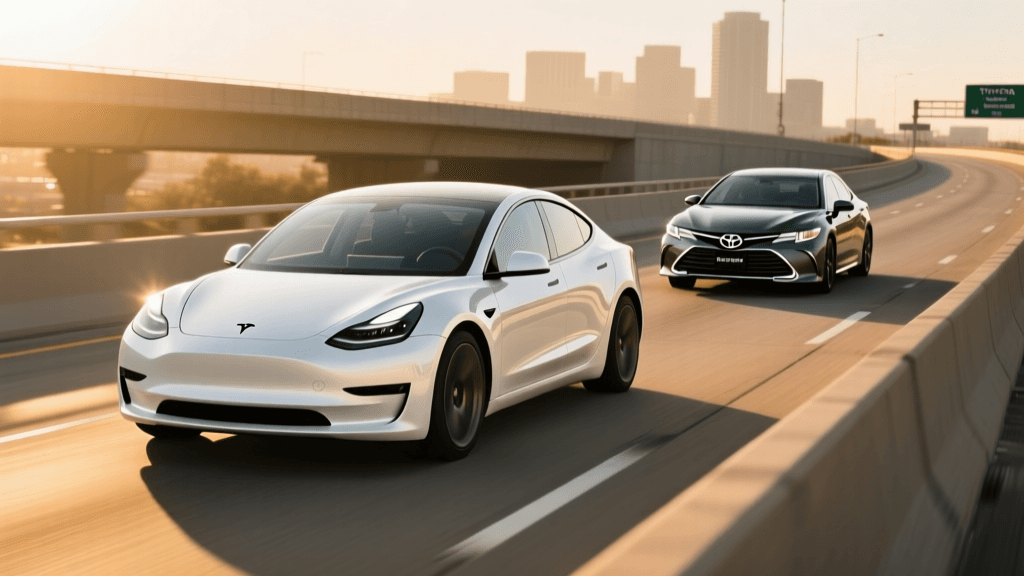
Tesla’s vision-only approach attempts to map the city in 3D, offering features like Traffic Light and Stop Sign Control. In well-mapped, clearly marked cities, it can handle stop-and-go traffic with minimal intervention.
The Urban Glitch: Phantom braking under shadows and overpasses. The National Highway Traffic Safety Administration (NHTSA) has extensively documented incidents where vision-based systems mistake the dark shadow of an overpass or a bridge for a physical obstacle, slamming on the brakes at 30+ mph.
Troubleshooting & Fix: Keep all eight exterior cameras spotless; use a microfiber cloth and an automotive glass cleaner (avoid ammonia-based products that degrade camera housing seals). When approaching known shadow-heavy overpasses, hover your foot over the brake and apply slight steering torque to signal driver engagement, which can soften the system's aggressive braking response. Always ensure your Tesla is running the latest over-the-air (OTA) software, as Tesla frequently patches specific phantom-braking scenarios via neural network updates.
5. Hyundai SmartSense: The Stop-and-Go Smoother
Hyundai’s SmartSense suite offers a remarkably smooth Stop & Go function in heavy urban congestion, and its Forward Collision-Avoidance Assist (FCA) with Junction Turning is highly competitive with Toyota and Honda.
The Urban Glitch: Aggressive acceleration and braking in tight traffic. The system can sometimes leave too large of a gap in stop-and-go traffic, inviting other drivers to cut in, which then triggers harsh emergency braking.
Troubleshooting & Fix: Utilize the steering wheel controls to adjust the Smart Cruise Control following distance to 'Level 1' or 'Level 2' in heavy city traffic to prevent aggressive cut-ins. Additionally, check your tire pressure; Hyundai's ADAS algorithms factor in wheel speed and traction, and under-inflated tires can cause micro-slippage that confuses the stop-and-go radar logic.
Comparison Chart: Urban ADAS Performance & Troubleshooting Quick-Fixes
| ADAS Suite | Best Urban Feature | Common City Glitch | Troubleshooting Fix | Avg. Recalibration Cost |
|---|---|---|---|---|
| Honda Sensing | Pedestrian/Cyclist CMBS | False alerts from metal plates | Adjust sensitivity; tap brake to cancel | $150 - $300 |
| Toyota TSS 3.0 | Intersection Turn Support | LTA hunting on faded lines | Disable LTA in cities; clean camera zone | $200 - $350 |
| Subaru EyeSight | Stereo low-speed AEB | Blindness in glare/heavy rain | Streak-free wipers; manual override | $250 - $400 |
| Tesla Autopilot | Traffic Light Recognition | Phantom braking in shadows | Clean 8 cameras; apply steering torque | N/A (OTA/Shop labor) |
| Hyundai SmartSense | Smooth Stop & Go | Harsh braking from cut-ins | Reduce follow distance gap setting | $150 - $250 |
Universal Troubleshooting Steps for City ADAS Glitches
Research by AAA highlights that the vast majority of ADAS failures and erratic behaviors in urban settings are not due to software bugs, but rather physical sensor degradation. If your system is acting up in the city, run through this universal troubleshooting checklist:
- The 12-Inch Radar Rule: Most front-facing millimeter-wave radars are mounted in the lower grille. Ensure there is a 12-inch clearance free of thick mud, ice, or aftermarket bumper covers. Even a thin layer of winter road salt can scatter radar waves, causing the system to 'see' ghost vehicles in adjacent lanes.
- Avoid Ceramic Coatings on Camera Lenses: While ceramic coatings are great for paint, applying hydrophobic ceramic sprays directly to ADAS camera lenses can cause light refraction. This tricks the camera into seeing 'fog' even on clear days, disabling lane-keep and traffic-sign recognition.
- Post-Alignment Calibration: Did you recently hit a pothole—a common city hazard—and get a wheel alignment? Any change to the vehicle's thrust angle requires a dynamic or static ADAS recalibration. If your steering wheel is straight but the car pulls slightly, the ADAS will constantly fight the steering rack, leading to premature lane-departure warnings and jerky steering corrections.
- Battery Voltage Checks: City driving with constant stop-and-go, heated seats, and infotainment usage can strain the 12V battery. ADAS modules are highly sensitive to voltage drops. If your system randomly throws an 'Unavailable' error upon starting the car in the city, have your 12V battery load-tested; it may be failing to provide the stable 12.5V required for sensor boot-up.
Conclusion: Mastering Your Urban Co-Pilot
No ADAS system is infallible, especially in the unpredictable environment of a modern city. Honda Sensing and Toyota Safety Sense currently lead the pack for urban intersection and pedestrian safety, while Tesla and Hyundai offer compelling, albeit flawed, stop-and-go solutions. By understanding the specific physical limitations of your brand's sensors and applying these targeted troubleshooting steps, you can eliminate the frustration of phantom braking and sensor blindness, turning your ADAS from a chaotic nuisance into a reliable urban co-pilot.