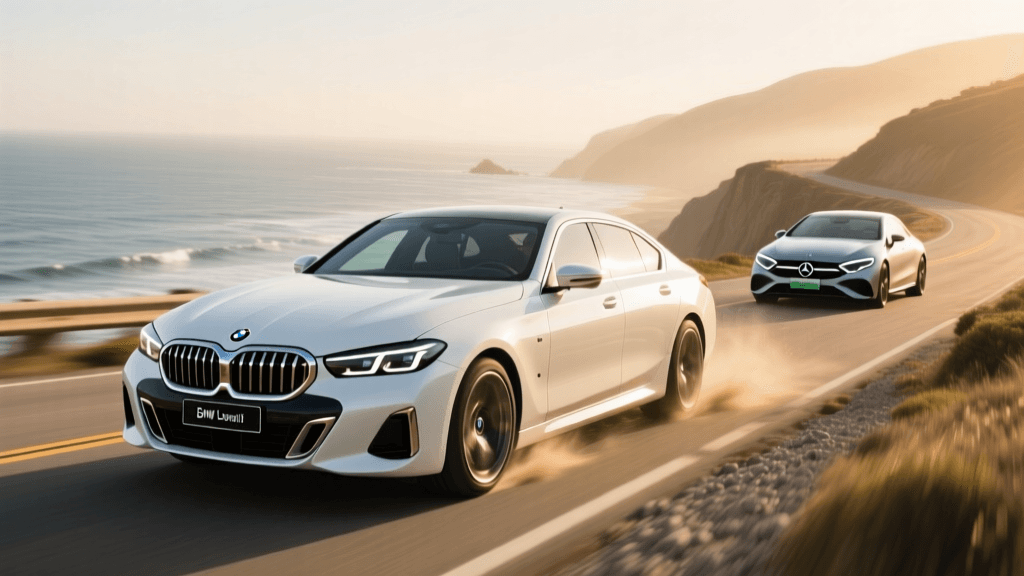
The Battle of the German Titans: BMW vs. Mercedes-Benz
When shopping for a luxury vehicle equipped with advanced driver assistance systems (ADAS), the marketing jargon can be overwhelming. Automakers frequently use terms like "autonomous," "self-driving," and "pilot" to describe their technology, leading to widespread confusion among consumers. Nowhere is this more evident than in the comparison between the BMW Driving Assistant Professional and the Mercedes-Benz Drive Pilot. Both are flagship ADAS suites from German engineering giants, yet they operate on fundamentally different philosophies and legal frameworks.
In this deep dive, we are busting the most pervasive myths surrounding these two systems. We will clarify the critical differences between SAE Level 2 and Level 3 automation, expose common buyer mistakes, and provide actionable advice on how to choose the right system for your daily commute.
Myth 1: Both Systems Offer "Level 3" Autonomous Driving
The Myth: Because both systems allow the car to steer, accelerate, and brake independently on the highway, they are both considered Level 3 autonomous vehicles.
The Reality: This is perhaps the most dangerous misconception in the automotive market today. According to the SAE International J3016 standard, the definitive framework for driving automation levels, there is a massive legal and technical chasm between Level 2 and Level 3.
- BMW Driving Assistant Professional: This is a highly advanced Level 2 system. Even with the newer "Highway Assistant" feature (available on models like the i7 and X7), the driver remains legally and operationally responsible for the vehicle at all times. The system requires continuous supervision.
- Mercedes-Benz Drive Pilot: This is a certified Level 3 system. When engaged under specific conditions, the car assumes full legal and operational responsibility. You are no longer the driver; you are a passenger.
Assuming both systems offer the same level of autonomy is a critical error that can lead to severe accidents and legal liabilities.
Myth 2: You Can Take Your Eyes Off the Road in Both Cars
The Myth: High-end luxury ADAS suites allow you to read a book, watch a movie, or take a nap while the car handles the highway driving.
The Reality: The rules of engagement for driver monitoring are vastly different between the two brands.
BMW's Approach: Hands-Off, Eyes-On
With the latest iteration of BMW's Driving Assistant Professional featuring Highway Assistant, the system utilizes a capacitive steering wheel. This means you can take your hands off the wheel at speeds up to 85 mph. However, you must keep your eyes on the road. An infrared driver monitoring camera tracks your gaze. If you look at your phone or close your eyes, the system will issue escalating warnings and eventually disengage. You cannot legally or safely watch a movie in a BMW using this system.
Mercedes-Benz's Approach: Eyes-Off (Conditionally)
Mercedes-Benz Drive Pilot allows true "eyes-off" driving. When the system is active, the central infotainment screen unlocks streaming services, web browsing, and gaming. You can legally watch a movie or reply to emails. However, this is strictly limited to traffic jams on approved highways at speeds under 40 mph (with over-the-air updates planned to increase this threshold). If the car encounters a complex scenario or the speed limit increases, it will issue a handover request, giving you roughly 10 seconds to take back control.
Myth 3: Mercedes Drive Pilot Works Everywhere
The Myth: If you pay for the Drive Pilot subscription, your Mercedes will drive itself on any road, in any weather, nationwide.
The Reality: Level 3 autonomy is bound by a strict Operational Design Domain (ODD). The National Highway Traffic Safety Administration (NHTSA) heavily scrutinizes these ODDs because Level 3 shifts liability to the manufacturer. Mercedes-Benz will only allow Drive Pilot to engage if all of the following conditions are met:
- You are on a pre-mapped, divided highway (currently limited to specific highways in Nevada and California in the US).
- It is daytime with clear weather (no heavy rain, snow, or fog).
- Traffic is congested, and speeds are below the system's maximum threshold.
- The vehicle's LiDAR, radar, and camera sensors are clean and unobstructed.
If you take your S-Class off the approved geofenced map, or if it starts raining heavily, the Drive Pilot button will simply not illuminate. The car reverts to standard Level 2 ADAS, and you are back in charge.
Common Mistakes Buyers Make When Choosing ADAS
Research from the Insurance Institute for Highway Safety (IIHS) shows that drivers frequently overestimate the capabilities of partial automation, leading to misuse. When comparing BMW and Mercedes, buyers often make the following costly mistakes:
1. Misunderstanding the Liability Shift
Many buyers assume that if *any* advanced system crashes, the automaker's insurance will cover it. This is false. In a BMW with Driving Assistant Professional, you are always liable. The system is an assistant, not a chauffeur. In a Mercedes with Drive Pilot, the automaker assumes liability, but only if the system was engaged within its ODD and the driver responded to handover requests in time. If you ignore a 10-second handover warning in a Mercedes, liability shifts back to you.
2. Ignoring Hardware Generations
Not all "Driving Assistant Professional" packages are created equal. A 2019 BMW 3 Series with this package relies on older radar and camera hardware, requiring you to keep a hand on the wheel to prove engagement. A 2024 BMW i7 with the same package name includes the new Highway Assistant hardware, allowing hands-off driving. Buyers shopping the used market must verify the exact hardware generation, not just the software package name.
3. Overvaluing Level 3 for Daily Commutes
Buyers often spend thousands on the Mercedes Drive Pilot subscription expecting it to revolutionize their 80-mph cross-country road trips. In reality, Drive Pilot's current utility is limited to stop-and-go traffic jams on specific mapped routes. For high-speed, open-highway cruising, BMW's Level 2 Highway Assistant (which works up to 85 mph on almost any divided highway) is actually more practical for the average American road trip.
Feature Comparison: BMW DAP vs. Mercedes Drive Pilot
| Feature / Metric | BMW Driving Assistant Pro (Highway Assistant) | Mercedes-Benz Drive Pilot |
|---|---|---|
| SAE Automation Level | Level 2 (Advanced Partial Automation) | Level 3 (Conditional Automation) |
| Legal Liability | Driver is always responsible | Mercedes-Benz assumes responsibility (when active) |
| Max Operating Speed | Up to 85 mph (Highway Assistant) | Up to 40 mph (Traffic Jam Chauffeur) |
| Hands-Off Steering |
Actionable Advice: Which System is Right for You?
Choosing between BMW and Mercedes-Benz requires an honest assessment of your driving habits, your local infrastructure, and your risk tolerance.
Choose BMW Driving Assistant Professional if:
- You take frequent long-distance road trips: BMW's ability to handle hands-off, eyes-on driving at speeds up to 85 mph makes it vastly superior for cross-country travel on open interstates.
- You live outside of NV or CA: Since Mercedes' Level 3 system is geofenced, buyers in states like Texas, New York, or Florida will get zero Level 3 benefits, making BMW's universally available Level 2 system a better value.
- You want to avoid recurring subscriptions: While BMW is moving toward subscription models for some features, the core hardware and foundational ADAS capabilities are generally bundled into the vehicle's purchase price or a one-time package fee, whereas Mercedes relies heavily on annual subscriptions for Drive Pilot.
Choose Mercedes-Benz Drive Pilot if:
- You endure brutal, stop-and-go commutes: If you live in Los Angeles or Las Vegas and spend hours crawling in traffic under 40 mph on approved highways, Drive Pilot can legitimately give you back hours of your life to work or relax.
- You want the legal safety net of Level 3: For risk-averse drivers who want the peace of mind that the automaker accepts liability during system operation, Mercedes is currently the only game in town in the US market.
- You value cutting-edge tech prestige: Owning a certified Level 3 vehicle is a status symbol. The inclusion of automotive-grade LiDAR and the legal certification represents the absolute bleeding edge of consumer automotive technology.
Conclusion
The transition from driver-assistance to true autonomy is not a single leap, but a series of heavily regulated, highly conditional steps. BMW's Driving Assistant Professional represents the absolute pinnacle of Level 2 technology, offering broad usability, high-speed competence, and predictable liability. Mercedes-Benz Drive Pilot represents the historic crossing into Level 3, offering true eyes-off freedom and shifted liability, but strictly confined to a narrow operational domain.
By busting these common myths, you can look past the marketing brochures and make an informed decision. Always read the fine print in your owner's manual regarding the Operational Design Domain, keep your sensors clean, and remember: until a vehicle is certified as Level 4 or 5, your greatest safety feature is still your own situational awareness.