The 2026 VW Hybrid Tiguan at a Glance
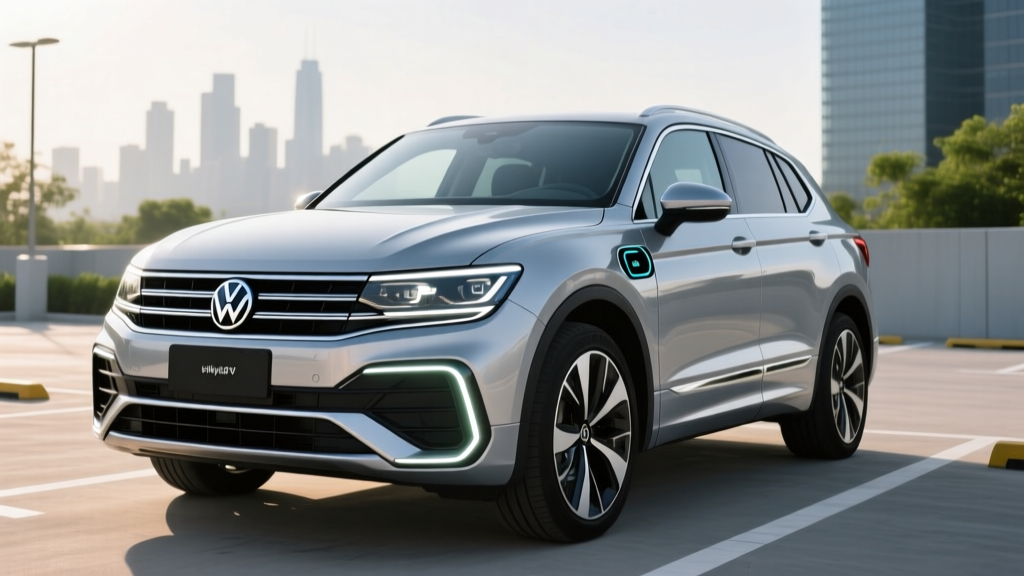
The Volkswagen Tiguan eHybrid returns for 2026 as a plug-in hybrid (PHEV) compact SUV aimed at buyers who want meaningful electric-only commuting without giving up the flexibility of a gas engine for longer trips. With a redesigned third-generation platform, a larger battery pack, and VW's latest EA211 evo2 turbocharged engine, the 2026 Tiguan eHybrid is the most capable electrified Tiguan Volkswagen has offered in the US market.
If you've been searching for a VW hybrid Tiguan, the eHybrid is currently the only electrified option in the lineup. Volkswagen does not sell a conventional (non-plug-in) hybrid Tiguan in the United States for the 2026 model year. That makes the eHybrid the default choice for Tiguan shoppers seeking any form of electrification — and it's a compelling one if your daily driving falls within its electric-only envelope.
| Powertrain | 1.5L turbo I4 + electric motor (PHEV) |
| Combined Horsepower | 245 hp / 295 lb-ft torque |
| Battery (Usable) | 19.7 kWh (NMC lithium-ion) |
| EPA Electric Range | 33 miles |
| EPA MPGe (EV Mode) | 85 MPGe combined |
| EPA MPG (Gas Only) | 35 city / 34 highway / 35 combined |
| Total Combined Range | ~440 miles |
| Level 2 Charge Time (0–100%) | ~2 hr 45 min at 7.2 kW |
| DC Fast Charging | Not available |
| 0–60 mph | ~7.2 seconds |
| Drivetrain | Front-wheel drive (FWD) |
| Base MSRP (SE R-Line) | $40,490 |
| Battery Warranty | 8 years / 100,000 miles |
HEV vs PHEV: What the VW Hybrid Tiguan Actually Is
Before evaluating the Tiguan eHybrid, it's important to understand the distinction between the two main hybrid architectures available in the broader market:
Conventional Hybrid (HEV)
Uses a small battery (typically 1–2 kWh) charged entirely by regenerative braking and the gas engine. You never plug it in. Electric-only driving is limited to brief low-speed moments. Examples: Toyota RAV4 Hybrid, Honda CR-V Hybrid.
Typical MPG: 38–42 combined
Plug-in Hybrid (PHEV)
Uses a larger battery (15–25 kWh) that you charge by plugging in. Delivers 25–45 miles of true electric-only driving before the gas engine takes over seamlessly. The Tiguan eHybrid is a PHEV.
Typical MPGe: 80–105 combined (EV mode)
The 2026 Tiguan eHybrid is firmly a PHEV. Volkswagen does not currently offer a conventional (self-charging) hybrid Tiguan in the US. If you want a VW with hybrid technology that requires no plug-in routine, you would need to look at the discontinued Golf GTE (never sold in the US) or consider competitors like the Toyota RAV4 Hybrid. But if you have access to a standard 120V or 240V outlet and want to drive on electricity most weekdays, the Tiguan eHybrid's PHEV architecture is designed exactly for that use case.
Fuel Economy: EPA Ratings and Real-World MPG
The EPA rates the 2026 Tiguan eHybrid at 85 MPGe combined when operating in electric mode and 35 MPG combined (35 city / 34 highway) once the battery is depleted and the 1.5L turbo engine takes over. Per fueleconomy.gov, these figures place the Tiguan eHybrid among the more efficient PHEV compact SUVs, though it trails the Toyota RAV4 Prime's 94 MPGe and 38 MPG gas-only rating.
| Mode | City | Highway | Combined |
|---|---|---|---|
| Electric (MPGe) | 90 | 80 | 85 |
| Gas Only (MPG) | 35 | 34 | 35 |
Real-World MPG: What to Actually Expect
EPA ratings are a useful baseline, but real-world efficiency depends heavily on your driving patterns, climate, and whether you're charging regularly.
- Commuter scenario (daily charging): If your round-trip commute is under 30 miles and you charge nightly, you'll operate in EV mode nearly 100% of the time, effectively using zero gasoline for daily driving. Expect real-world electric efficiency around 2.8–3.2 kWh/mile, consistent with the 85 MPGe rating.
- Gas-only highway driving: Once the battery is depleted on a road trip, expect 32–34 MPG at 70–75 mph — slightly below the EPA highway rating of 34 MPG, which is typical for boxy compact SUVs at sustained highway speeds.
- Cold-weather impact: In temperatures below 35°F, expect electric-only range to drop by 20–30%, reducing the 33-mile EPA figure to roughly 23–26 miles. The gas engine may engage sooner to provide cabin heat unless you precondition while plugged in.
- City driving on gas: Hybrids and PHEVs often match or exceed EPA city ratings in stop-and-go traffic thanks to regenerative braking. Expect 34–37 MPG in urban driving once the battery is depleted.
Electric-Only Range and Charging Details
The 2026 Tiguan eHybrid carries a 19.7 kWh usable NMC (nickel manganese cobalt) lithium-ion battery pack. The EPA rates it at 33 miles of electric-only range — enough to cover the average American's one-way commute (roughly 16 miles each way per Census Bureau data) without engaging the gas engine.
Real-world expectation: 28–33 miles in mild weather (55–75°F) with mixed city/highway driving. In cold weather (below 35°F), expect 23–26 miles. Highway-only driving at 70+ mph may yield 25–28 miles even in moderate temperatures, as higher speeds increase energy consumption significantly.
Charging Speed and Options
The Tiguan eHybrid charges exclusively via AC — there is no DC fast-charging capability. This is standard for most PHEVs in this class (the Toyota RAV4 Prime and Chrysler Pacifica PHEV are rare exceptions with optional DC fast charging).
| Charging Level | Power | 0–100% Time | Connector |
|---|---|---|---|
| Level 1 (120V household) | ~1.4 kW | ~14 hours | J1772 |
| Level 2 (240V home/public) | 7.2 kW | ~2 hr 45 min | J1772 |
For most PHEV owners, Level 1 charging from a standard 120V outlet is sufficient for overnight replenishment if daily electric-only driving stays under 30 miles. A full Level 2 home charger installation ($500–$1,500 depending on electrical panel proximity) will cut charge time to under three hours, making midday top-ups practical if you have workplace or home access.
Powertrain and Performance
The 2026 Tiguan eHybrid pairs Volkswagen's latest EA211 evo2 1.5-liter turbocharged four-cylinder engine with an electric motor integrated into the six-speed DSG automatic transmission. Combined output is 245 horsepower and 295 lb-ft of torque, routed exclusively to the front wheels.
The engine alone produces approximately 177 hp, while the electric motor contributes up to 115 hp. Because peak outputs don't occur at the same RPM, the combined system rating is 245 hp rather than a simple sum. This is a meaningful improvement over the outgoing Tiguan's 184-hp 2.0L turbo, and it makes the eHybrid the quickest Tiguan variant short of the performance-oriented R model.
The 0–60 mph sprint takes approximately 7.2 seconds, which is competitive with the segment. The electric motor's instant torque delivery makes the Tiguan eHybrid feel particularly responsive around town and during highway merging — situations where turbo lag in conventional gas models can be noticeable.
One trade-off worth noting: the eHybrid is front-wheel drive only. If all-wheel drive is a priority for snow or inclement weather, you'll need to look at the gas-only Tiguan 4MOTION models or competitors like the Toyota RAV4 Prime (which offers AWD via a rear electric motor).
Pricing, Trims, and Tax Credit Eligibility
The 2026 VW Tiguan eHybrid is offered in two trims:
- SE R-Line eHybrid: $40,490 MSRP (including destination)
- SEL R-Line eHybrid: $44,290 MSRP (including destination)
Both trims come well-equipped with features like adaptive cruise control, lane-keeping assist, a 12.9-inch infotainment display, wireless Apple CarPlay/Android Auto, and heated front seats. The SEL adds leather upholstery, a panoramic sunroof, a head-up display, and a Harman Kardon premium audio system.
Federal Tax Credit: §30D Eligibility
The 2026 Tiguan eHybrid may qualify for the IRS §30D Clean Vehicle Credit, which provides up to $3,750 for qualifying PHEVs (the full $7,500 requires meeting both critical-mineral and battery-component sourcing requirements, and many VW PHEVs currently qualify for only the $3,750 battery-component half). However, eligibility is subject to several conditions:
- MSRP cap: Vehicle MSRP must not exceed $80,000 for SUVs — both Tiguan eHybrid trims qualify.
- Buyer income cap: Modified AGI must not exceed $150,000 (single) / $300,000 (joint).
- Battery sourcing: Must meet critical-mineral and/or battery-component thresholds per current-year IRS guidance. Check fueleconomy.gov for the latest Tiguan eHybrid credit amount.
- Point-of-sale transfer: As of 2024, buyers can transfer the credit to the dealer for an upfront price reduction at purchase.
- US assembly: The 2026 Tiguan is assembled in Puebla, Mexico — this does not disqualify it from §30D (the US-assembly requirement was removed for vehicles purchased after certain legislative updates), but verify current rules with a tax professional.
Always confirm current-year eligibility on irs.gov or consult a qualified tax professional before relying on the credit in your purchase decision. Rules and sourcing certifications can change between model years.
Battery Longevity, Warranty, and Replacement Cost
The Tiguan eHybrid's 19.7 kWh NMC battery is liquid-cooled, which is a significant advantage for longevity. Active thermal management keeps cell temperatures within an optimal range during charging and discharging, reducing the degradation that plagues passively-cooled packs (like those in some earlier-generation PHEVs from other manufacturers).
Expected Degradation
Based on data from similar VW Group PHEV powertrains (the Golf GTE, Passat GTE, and Audi A3 e-tron), expect the Tiguan eHybrid battery to retain approximately 85–90% of original capacity after 5 years / 60,000 miles under normal use. PHEV batteries experience less stress than full EV batteries because they operate in a narrower state-of-charge window — the car's software maintains a buffer at the top and bottom to protect cell health.
Replacement Cost
If the battery does require out-of-warranty replacement (unlikely within the first 8–10 years based on current degradation data), expect a cost in the range of $6,000–$9,000 including parts and labor at a VW dealership. This is lower than full EV battery replacements because PHEV packs are physically smaller. Independent hybrid battery specialists may offer refurbished replacements for $3,500–$5,500.
Reliability Outlook
Volkswagen's PHEV powertrain has been in production across multiple models since 2015 (Golf GTE, Passat GTE, various Audi TFSI e models). The fundamental architecture is well-proven. The primary reliability concerns in earlier iterations were related to software glitches and DSG transmission behavior rather than battery failures. The 2026 model benefits from several generations of refinement. Volkswagen's overall brand reliability has improved in recent JD Power and Consumer Reports assessments, though it still trails Toyota and Honda in long-term dependability rankings.
Who Should Buy the VW Hybrid Tiguan?
Choose the Tiguan eHybrid if:
- Your daily round-trip commute is under 30 miles and you can charge at home overnight
- You want a premium-feeling compact SUV with German driving dynamics and a quiet, well-insulated cabin
- You take road trips several times a year and don't want to plan around DC fast-charging infrastructure
- You want to reduce fuel consumption significantly without the upfront cost premium of a full EV
- Front-wheel drive is acceptable for your climate
Consider a full EV instead if:
- You have reliable home Level 2 charging and your daily driving rarely exceeds 200 miles
- You want to eliminate oil changes, spark plugs, and transmission fluid entirely
- You qualify for the full $7,500 federal credit on a competing EV (e.g., Hyundai Ioniq 5, Tesla Model Y)
- You want access to HOV lane stickers (available in some states for EVs but not always PHEVs)
Consider a conventional hybrid instead if:
- You cannot charge at home or work (apartment living, no garage outlet)
- You want maximum MPG without any plug-in routine
- You prefer the lower base price of a Toyota RAV4 Hybrid (~$33,000) or Honda CR-V Hybrid (~$36,000)
Pros
- 33 miles EV range covers most daily commutes
- 245 hp makes it the quickest non-R Tiguan
- Quiet, refined cabin with premium materials
- Liquid-cooled battery for long-term durability
- 35 MPG on gas after battery depletion — competitive for the class
- Level 1 (120V) charging sufficient for overnight top-ups
Cons
- No DC fast charging — limits road-trip EV-mode utility
- FWD only — no AWD option unlike RAV4 Prime
- $40,490 starting price is steep vs. gas-only Tiguan ($31,000s)
- Only 33 miles electric range trails RAV4 Prime (42 mi)
- Partial ($3,750) tax credit, not the full $7,500
- Cargo space slightly reduced vs. gas Tiguan due to battery placement
Competitor Comparison
| Spec | VW Tiguan eHybrid | Toyota RAV4 Prime | Ford Escape PHEV |
|---|---|---|---|
| EV Range | 33 mi | 42 mi | 37 mi |
| Combined HP | 245 | 302 | 210 |
| Gas MPG | 35 | 38 | 40 |
| AWD Available | No | Yes (std) | No |
| DC Fast Charge | No | No | No |
| Base MSRP | $40,490 | $44,515 | $39,500 |
| Battery Warranty | 8yr/100k | 10yr/150k | 8yr/100k |
Frequently Asked Questions
How many MPG does the VW hybrid Tiguan get?
The 2026 Tiguan eHybrid gets 85 MPGe combined in electric mode and 35 MPG combined (35 city / 34 highway) when operating on gasoline alone after the battery is depleted. In real-world city driving with regenerative braking, some owners report 36–37 MPG on gas.
How far can the Tiguan eHybrid go on electric only?
The EPA rates it at 33 miles of electric-only range. In real-world conditions, expect 28–33 miles in mild weather and 23–26 miles in cold weather (below 35°F). Highway driving at sustained speeds above 70 mph will reduce range to roughly 25–28 miles.
Does the VW Tiguan eHybrid qualify for a tax credit?
It may qualify for up to $3,750 under the IRS §30D Clean Vehicle Credit, depending on current-year battery sourcing certifications. The full $7,500 credit requires meeting both critical-mineral and battery-component requirements. Buyer income caps ($150K single / $300K joint) and the $80,000 SUV MSRP cap also apply. Verify on fueleconomy.gov before purchasing.
Is the Tiguan hybrid reliable?
VW's PHEV powertrain has been in production since 2015 across multiple models and has proven fundamentally sound. The liquid-cooled battery pack and 8-year/100,000-mile warranty provide strong protection. Long-term reliability of the DSG transmission and electronics is the more common concern, though recent model years have shown improvement. Toyota's RAV4 Prime carries a stronger reliability reputation and a 10-year/150,000-mile battery warranty.
How much does it cost to replace the Tiguan hybrid battery?
Out-of-warranty replacement is estimated at $6,000–$9,000 at a VW dealership. However, PHEV batteries are smaller and experience less stress than full EV batteries, and current degradation data suggests 85–90% capacity retention after 5 years. Most owners will never need a replacement within the vehicle's typical ownership period.
Can I charge the Tiguan eHybrid at a public fast charger?
No. The Tiguan eHybrid does not support DC fast charging. It charges via AC only, using a J1772 connector at Level 1 (120V) or Level 2 (240V) stations. This is normal for most PHEVs — the smaller battery makes DC fast charging less practical and less commonly offered.
Hybrid vs PHEV vs EV — which should I choose?
If you can charge at home and your daily driving is under 35 miles, the Tiguan eHybrid (PHEV) lets you commute on electricity while retaining gas-engine flexibility for road trips. If you can't charge at home, a conventional hybrid (HEV) like the RAV4 Hybrid is simpler and still delivers 38–42 MPG. If you have home charging, rarely drive more than 250 miles in a day, and want the lowest operating cost and minimal maintenance, a full EV like the Hyundai Ioniq 5 or VW ID.4 may be a better long-term fit.