The 2026 VW Hybrid SUV Lineup at a Glance
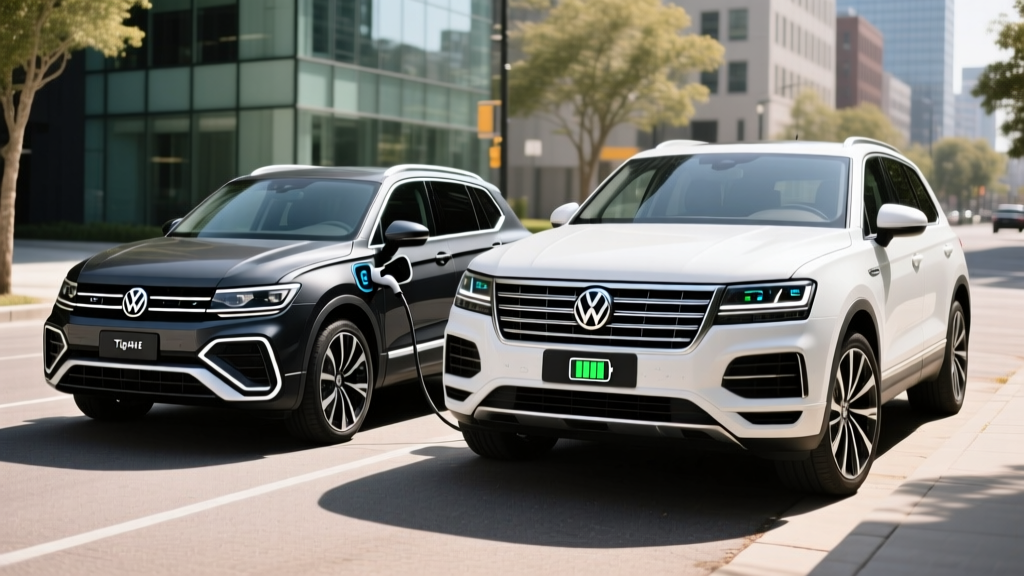
Volkswagen's electrified SUV strategy for the U.S. market centers on two distinct approaches: the Tiguan eHybrid (a plug-in hybrid, or PHEV) and the Touareg hybrid (a conventional hybrid, or HEV). If you've been searching for VW hybrid SUVs, these are the models to know — and they serve very different buyers.
The Tiguan eHybrid targets commuters who can charge at home and want daily electric-only driving with the fallback of a gas engine for road trips. The Touareg hybrid is a premium midsize SUV that uses a conventional hybrid powertrain to boost MPG without ever needing a plug. Understanding the difference between these two architectures is the single most important step in choosing the right VW hybrid SUV.
HEV vs. PHEV — What's the Difference?
| Feature | Conventional Hybrid (HEV) — Touareg | Plug-In Hybrid (PHEV) — Tiguan eHybrid |
|---|---|---|
| Plugs in? | No — charges via regenerative braking & engine | Yes — Level 1 or Level 2 AC charging |
| Electric-only range | None (electric motor assists engine only) | EPA est. 33 miles |
| Battery size | ~1.0 kWh (small buffer) | 19.7 kWh usable (NMC chemistry) |
| Fuel economy | EPA est. 26 MPG combined | 94 MPGe (electric+gas), 35 MPG gas-only |
| Ideal for | Drivers without home charging access | Commute-and-charge-at-home households |
2026 Volkswagen Tiguan eHybrid: The Plug-In Option
The Tiguan eHybrid is the volume player in VW's PHEV SUV lineup. Built on the MQB Evo platform, it pairs a turbocharged 1.5-liter four-cylinder engine with an electric motor integrated into the six-speed DSG transmission. The result is a combined output of 241 horsepower and 295 lb-ft of torque — enough for a 0–60 mph time of approximately 7.4 seconds.
Electric-Only Range and Total Range
The Tiguan eHybrid's 19.7 kWh (usable) lithium-ion NMC battery delivers an EPA-estimated 33 miles of electric-only driving. That covers the average American one-way commute of roughly 16 miles with room to spare, meaning many owners will burn zero gasoline on daily errands and school runs.
Once the battery depletes, the Tiguan operates as a conventional hybrid, returning an EPA-estimated 35 MPG combined (37 city / 33 highway). Total combined range — electric plus a full 13.2-gallon tank — exceeds 480 miles.
Charging the Tiguan eHybrid
The Tiguan eHybrid supports AC charging only — there is no DC fast-charging capability, which is typical for compact PHEVs.
| Charging Level | Power | Time (0–100%) | Notes |
|---|---|---|---|
| Level 1 (120V household outlet) | ~1.4 kW | ~14 hours | Emergency/top-up only |
| Level 2 (240V home or public AC) | 3.6 kW (onboard charger max) | ~5 hours | Standard home charger setup |
| DC Fast Charge | Not supported | N/A | CCS/NACS DC stations cannot charge this vehicle |
For most PHEV owners, a Level 2 home charger installed in the garage or driveway is the practical baseline. Overnight charging easily replenishes the battery for the next morning's commute. A Level 2 installation typically costs $800–$2,000 depending on your electrical panel and run length — we break this down in our Level 2 charger cost guide.
2026 Volkswagen Touareg Hybrid: The Premium HEV
The Touareg hybrid takes a different approach. It uses a conventional hybrid system — no plug required — to improve fuel economy over the standard gas-only Touareg. A 3.0-liter turbocharged V6 is paired with a mild-hybrid 48-volt system and a small electric motor integrated into the drivetrain, producing a combined 335 horsepower and 369 lb-ft of torque.
Fuel Economy Breakdown
| Model | City MPG | Highway MPG | Combined MPG |
|---|---|---|---|
| 2026 Touareg Hybrid | 23 | 29 | 26 |
| 2026 Touareg (gas-only baseline) | 20 | 26 | 22 |
| 2026 Tiguan eHybrid (gas-only mode) | 37 | 33 | 35 |
The Touareg hybrid's 26 MPG combined represents roughly an 18% improvement over the non-hybrid V6 Touareg. While that's modest compared to smaller hybrids, it's meaningful for a 5,000-pound luxury SUV with genuine towing capability (7,700 lbs when properly equipped).
Full Spec Comparison: Tiguan eHybrid vs. Touareg Hybrid
| Specification | 2026 Tiguan eHybrid (PHEV) | 2026 Touareg Hybrid (HEV) |
|---|---|---|
| Powertrain | 1.5L turbo I4 + electric motor | 3.0L turbo V6 + 48V mild-hybrid |
| Combined HP | 241 hp | 335 hp |
| Combined Torque | 295 lb-ft | 369 lb-ft |
| 0–60 mph | 7.4 sec | 5.9 sec |
| Transmission | 6-speed DSG | 8-speed automatic |
| Drivetrain | FWD (AWD available) | AWD standard (4Motion) |
| Battery (usable) | 19.7 kWh NMC | ~1.0 kWh (48V system) |
| Electric-Only Range | 33 mi (EPA est.) | None |
| Fuel Economy | 94 MPGe / 35 MPG gas-only | 26 MPG combined |
| Total Range | ~480+ mi | ~520 mi |
| Towing Capacity | 1,500 lbs | 7,700 lbs |
| Cargo Volume | 33.0 cu ft (rear seats up) | 37.4 cu ft (rear seats up) |
| Starting MSRP | $39,990 | $58,495 |
Pricing, Trims, and Tax Credit Eligibility
Tiguan eHybrid Pricing
- SE eHybrid: $39,990
- SEL Premium eHybrid: $44,490
Touareg Hybrid Pricing
- SE Hybrid: $58,495
- SEL Premium Hybrid: $65,995
Federal Tax Credit Status (2026)
Key eligibility requirements for the Tiguan eHybrid credit:
- MSRP must be ≤ $80,000 for SUVs (both trims qualify)
- Buyer modified AGI: ≤ $150,000 single / $300,000 joint
- Battery critical-mineral and component sourcing thresholds must be met (check fueleconomy.gov for current certification)
- Point-of-sale transfer is available at participating dealers — reducing your purchase price directly
Some states offer additional rebates for PHEVs. California's CVRP, for example, has historically provided $1,000–$1,500 for qualifying plug-in hybrids, though funding availability varies. Check your state energy office for current programs.
Battery Warranty, Reliability, and Replacement Costs
- Tiguan eHybrid HV battery: 8 years / 100,000 miles (whichever comes first), with a capacity retention threshold of 70% of original capacity. If the battery degrades below this threshold within the warranty period, VW will repair or replace it at no cost.
- Touareg 48V hybrid battery: 8 years / 100,000 miles, covered under the same hybrid-component warranty.
Long-Term Reliability Outlook
VW's hybrid systems have shown improvement over the earlier-generation PHEVs (the 2016–2020 e-Golf and first-gen Tiguan PHEV sold in Europe). The 1.5L EA211 evo2 engine in the Tiguan eHybrid uses a Miller-cycle combustion strategy for efficiency and has proven durable in European-market Golf GTE applications since 2023.
For the Touareg's 48V mild-hybrid system, the primary concern is the belt-driven starter-generator (BSG) — a component that replaces the traditional alternator. Replacement outside warranty runs $1,200–$1,800 including labor, though failure rates remain low based on Audi Q7/Q8 data (which shares this powertrain architecture).
Battery Replacement Costs (Out of Warranty)
Should the Tiguan eHybrid's 19.7 kWh high-voltage battery require replacement after the warranty expires, expect a dealer-installed cost of $6,500–$8,500 based on current VW parts pricing and comparable PHEV battery replacements across the industry. The Touareg's smaller 48V battery is significantly cheaper to replace — approximately $1,500–$2,500.
In practice, PHEV batteries from major manufacturers are lasting well beyond their warranty periods. Data from Consumer Reports and fleet operators show most modern NMC PHEV packs retain 80–85% capacity at 10 years / 120,000 miles when not regularly DC-fast-charged or stored at extreme states of charge.
Who Should Choose Which VW Hybrid SUV?
The Decision Framework
Choose the Tiguan eHybrid (PHEV) if:
- You have access to Level 2 home charging (garage or driveway with 240V)
- Your daily round-trip commute is under 30 miles
- You want to minimize gasoline use without committing to a full EV
- You prioritize lower running costs and a lower purchase price
- You don't need heavy towing capability
Choose the Touareg Hybrid (HEV) if:
- You cannot charge at home (apartment, street parking, no garage)
- You need genuine towing capacity (up to 7,700 lbs)
- You want a premium midsize SUV with more power and cargo space
- You prefer zero behavior change — just drive it like a normal car
- You take frequent long road trips where PHEV electric range is irrelevant
Consider a full EV (like the VW ID.4) instead if:
- Your daily driving is predictable and under 250 miles
- You have reliable home Level 2 charging
- You want the lowest per-mile fuel cost (~$0.04–$0.06/mi on home electricity vs. $0.14–$0.18/mi for hybrid gas)
- You qualify for the full $7,500 federal tax credit on a qualifying BEV
Pros and Cons: VW Hybrid SUVs
✓ Pros
- Tiguan eHybrid offers 33 miles of usable electric range — covers most commutes
- Both models eliminate range anxiety with gas-engine fallback
- Tiguan eHybrid starts under $40K — competitive in the PHEV SUV segment
- Touareg hybrid delivers V6 power (335 hp) with a 4 MPG improvement over gas-only
- No DC charging dependency — both models work with basic home AC power
- 8-year/100,000-mile hybrid battery warranty on both
✗ Cons
- Tiguan eHybrid limited to 3.6 kW AC charging — no DC fast charge option
- Touareg hybrid is expensive ($58K+) and doesn't qualify for federal PHEV credit
- Tiguan towing limited to 1,500 lbs — not suitable for boat or camper trailers
- Neither model offers the per-mile cost savings of a full BEV on home charging
- VW's hybrid reliability track record is shorter than Toyota/Hyundai's
- Partial federal tax credit ($3,750 max) on Tiguan — not the full $7,500
Frequently Asked Questions
How many MPG do VW hybrid SUVs get?
The 2026 Tiguan eHybrid achieves an EPA-estimated 35 MPG combined when operating on gasoline alone (37 city / 33 highway), and 94 MPGe when factoring in electric-only driving. The Touareg hybrid returns 26 MPG combined (23 city / 29 highway). Real-world results for both models tend to track close to EPA estimates, with city driving often yielding slightly better numbers thanks to regenerative braking.
How far can the Tiguan eHybrid go on electric only?
The EPA-estimated electric-only range is 33 miles. In real-world conditions, expect 28–31 miles in mild weather and 22–26 miles in cold weather (below 35°F). Highway-speed electric driving reduces range further. For a typical 16-mile one-way commute, the Tiguan eHybrid can complete the round trip on electricity alone in most conditions.
Do VW hybrid SUVs need to be plugged in?
Only the Tiguan eHybrid (PHEV) benefits from being plugged in — it charges its 19.7 kWh battery via a Level 1 or Level 2 AC connection. The Touareg hybrid (HEV) never needs to be plugged in; its small 48V battery charges automatically through regenerative braking and the engine.
Are VW hybrid SUVs reliable? What does battery replacement cost?
VW's current-generation hybrid systems have shown improved reliability over earlier iterations. The hybrid battery in both models is covered by an 8-year/100,000-mile warranty. Out-of-warranty replacement for the Tiguan eHybrid's high-voltage pack runs $6,500–$8,500; the Touareg's 48V battery is $1,500–$2,500. Modern PHEV batteries typically retain 80–85% capacity at 120,000+ miles.
Does the Tiguan eHybrid qualify for the federal tax credit?
The Tiguan eHybrid may qualify for a partial federal tax credit of up to $3,750 under IRS §30D, depending on current battery-sourcing compliance. The full $7,500 credit requires meeting both critical-mineral and battery-component thresholds. Buyer income caps apply ($150K single / $300K joint filers), and the MSRP must remain under $80,000. The Touareg hybrid, as a conventional HEV, does not qualify for any federal plug-in vehicle credit. Always verify current eligibility at fueleconomy.gov before purchasing.
Should I buy a VW hybrid SUV or a full EV like the ID.4?
If you have reliable home charging and your daily driving stays under 250 miles, the VW ID.4 (EPA range up to 275 miles, potentially eligible for the full $7,500 credit) will deliver lower per-mile fuel costs and zero tailpipe emissions. Choose a VW hybrid SUV if you lack consistent charging access, regularly drive more than 250 miles in a day, tow heavy loads (Touareg), or simply want the flexibility of a gas engine without range planning.