Quick Verdict: A Proven Hybrid That Still Delivers in 2026
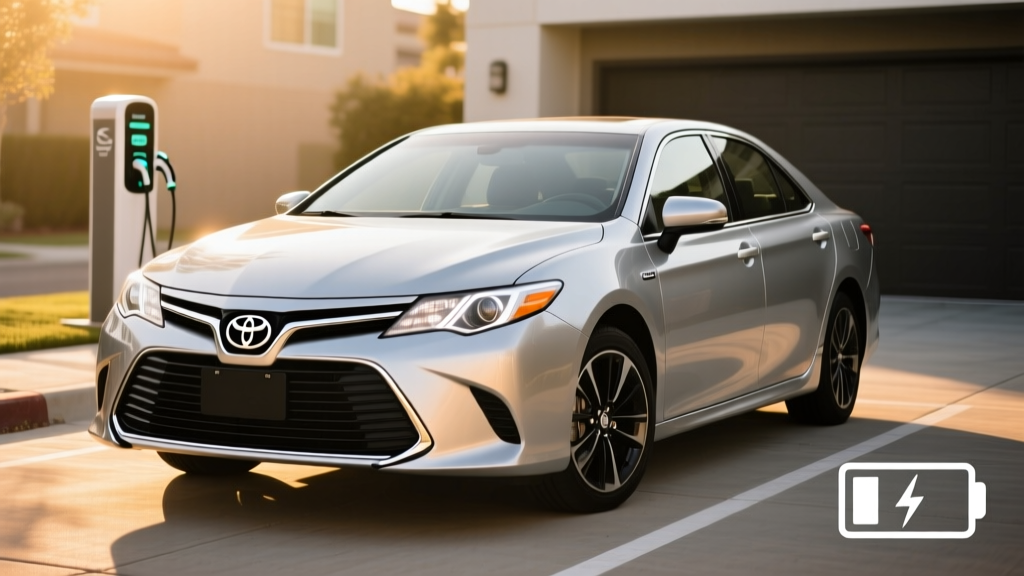
The 2012 Toyota Camry LE Hybrid is a conventional hybrid electric vehicle (HEV) — not a plug-in. It requires no charging infrastructure, runs on gasoline, and uses a small battery recharged through regenerative braking and the engine. Over a decade after its debut, this midsize sedan remains one of the most practical used-hybrid purchases available, with EPA-rated fuel economy that still competes with brand-new models.
For buyers in 2026 weighing a used hybrid against a new EV or gas car, the Camry LE Hybrid offers a compelling middle ground: zero range anxiety, no charging setup, and fuel costs roughly half those of a comparable gas-only midsize sedan. The key questions revolve around battery health on a 14-year-old vehicle, replacement costs, and whether the fuel savings still justify the purchase.
| Specification | 2012 Camry LE Hybrid |
|---|---|
| Powertrain Type | Conventional Hybrid (HEV) |
| Engine | 2.5L 4-cylinder Atkinson-cycle |
| Electric Motor | Permanent-magnet synchronous (front axle) |
| Combined Horsepower | 200 hp (net system output) |
| Hybrid Battery | 1.6 kWh (usable ~0.9 kWh), NiMH |
| EPA City MPG | 43 mpg |
| EPA Highway MPG | 39 mpg |
| EPA Combined MPG | 41 mpg |
| Fuel Tank Capacity | 17.0 gallons |
| Total Driving Range | ~697 miles (EPA combined) |
| 0–60 mph | ~7.6 seconds |
| Original MSRP (2012) | ~$25,900 |
| Typical 2026 Used Price | $8,000–$12,500 (varies by mileage/condition) |
| Hybrid Battery Warranty (Original) | 8 years / 100,000 miles (10 yr/150,000 mi in CARB states) |
HEV vs PHEV vs EV: Where Does the Camry Hybrid Fit?
Before evaluating this specific model, it's critical to understand what the 2012 Camry LE Hybrid is — and what it is not. This is a conventional hybrid (HEV), meaning:
- No plug, no charging cable. The battery recharges automatically through regenerative braking and the gasoline engine.
- No electric-only driving range. The electric motor assists the gas engine and enables brief low-speed EV mode, but the car cannot operate on electricity alone for meaningful distances.
- No federal tax credit. The §30D Clean Vehicle Credit applies only to plug-in vehicles (BEVs and PHEVs with sufficient battery capacity). Conventional hybrids like this Camry do not qualify.
| Feature | HEV (This Camry) | PHEV (e.g., RAV4 Prime) | BEV (e.g., Tesla Model 3) |
|---|---|---|---|
| Plug-in Required? | No | Yes (Level 1/2) | Yes (Level 2/DC) |
| Electric-Only Range | N/A (~1 mi EV mode) | 25–42 miles typical | 250–360 miles (EPA) |
| Fuel Source | Gasoline only | Gasoline + electricity | Electricity only |
| Federal Tax Credit | None | Up to $7,500 (if eligible) | Up to $7,500 (if eligible) |
| Home Charging Needed? | No | Recommended | Essential |
| Maintenance | Engine + hybrid system | Engine + hybrid + EV system | Minimal (no engine) |
The 2012 Camry LE Hybrid is best understood as a more efficient gas car, not a stepping stone to electrification. If you want electric-only commuting, you need a PHEV or BEV. If you want maximum fuel savings with zero lifestyle change, this HEV delivers.
Fuel Economy: EPA Numbers vs Real-World MPG
| Driving Condition | EPA Estimate | Real-World Expectation |
|---|---|---|
| City | 43 mpg | 40–47 mpg |
| Highway (65–75 mph) | 39 mpg | 35–40 mpg |
| Combined | 41 mpg | 38–43 mpg |
Toyota's Hybrid Synergy Drive system excels in stop-and-go traffic, where regenerative braking recovers energy and the electric motor handles low-speed acceleration. Many owners report exceeding the EPA city estimate in moderate climates — 45–47 mpg is achievable in warm-weather urban driving with gentle throttle inputs.
Highway driving tells a different story. At sustained 75 mph speeds, the aerodynamic drag of a midsize sedan works against the hybrid advantage. The gasoline engine does most of the work, and fuel economy drops to the mid-to-upper 30s. Cold weather further reduces efficiency — expect a 3–5 mpg penalty in winter conditions as the engine runs more frequently to maintain cabin heat and battery temperature.
According to fueleconomy.gov, the 2012 Camry Hybrid's combined 41 mpg translates to an estimated annual fuel cost of approximately $1,350 (at 15,000 miles/year and $3.50/gallon), compared to roughly $2,100 for a comparable 2012 Camry LE with the 2.5L gas-only engine rated at 25 mpg combined.
Powertrain Deep Dive: How the Hybrid System Works
The 2012 Camry LE Hybrid pairs a 2.5-liter Atkinson-cycle four-cylinder engine (156 hp, 156 lb-ft torque) with a permanent-magnet electric motor integrated into the transaxle. The combined system output is 200 net horsepower — competitive with the gas-only V6 Camry of that era, but with dramatically better fuel economy.
The Atkinson-cycle engine sacrifices some low-end torque for higher thermal efficiency. The electric motor fills that torque gap, providing instant response from a stop. The result is smooth, linear acceleration that feels quicker than the 7.6-second 0–60 time suggests.
The nickel-metal hydride (NiMH) hybrid battery pack contains 1.6 kWh of total capacity, with roughly 0.9 kWh usable. This is not a traction battery in the EV sense — it's a buffer that stores recovered braking energy and delivers short bursts of electric assist. The battery never fully charges or fully depletes; the hybrid control system keeps it in a narrow state-of-charge window (roughly 40–80%) to maximize longevity.
Toyota's e-CVT (electronically controlled continuously variable transmission) uses a planetary gearset rather than belts or pulleys. This design has proven exceptionally durable — there are no friction bands, clutch packs, or traditional transmission fluid to replace. The e-CVT is essentially maintenance-free for the life of the vehicle.
Hybrid Battery Longevity: Warranty, Degradation, and Replacement Cost
Original Hybrid Battery Warranty: 8 years / 100,000 miles (standard) or 10 years / 150,000 miles in CARB states (California, New York, Massachusetts, and others adopting CARB emissions standards).
2026 Status: For a 2012 model year vehicle, the original factory hybrid battery warranty has expired regardless of mileage.
Battery degradation is the single largest concern for used-hybrid buyers. Here's what the data shows:
- NiMH longevity: Toyota's NiMH hybrid batteries have demonstrated remarkable durability. Fleet data and owner surveys consistently show 150,000–200,000+ miles before significant capacity loss triggers a replacement. Many first-generation Prius taxis exceeded 300,000 miles on the original battery.
- What "degradation" means for an HEV: Unlike an EV where battery loss directly reduces driving range, a hybrid battery losing 20–30% capacity still functions. The car compensates by running the engine slightly more often. You may notice a 1–3 mpg decrease and more frequent engine cycling, but the car remains fully operational.
- Warning signs: A failing hybrid battery triggers a check engine light with codes P0A80 (replace hybrid battery) or P0A7F (hybrid battery pack deterioration). You may also see reduced fuel economy, the engine running constantly, or the battery charge indicator swinging between full and near-empty rapidly.
Battery Replacement Costs in 2026
If the hybrid battery does fail, replacement options include:
- New OEM battery (Toyota dealer): $2,500–$3,500 installed. This is the most expensive option but guarantees a factory-fresh pack with a new warranty (typically 3 years/36,000 miles on the replacement part).
- Refurbished/remanufactured battery: $1,200–$2,000 installed. These use tested and reconditioned NiMH modules. Quality varies by supplier — look for warranties of at least 1–3 years.
- Individual module replacement: $400–$800 at a hybrid specialist shop. Only the failed modules are swapped. This is the most cost-effective option but requires a technician who can diagnose and balance individual cells.
- Used/salvage battery: $500–$1,000 installed. Risky — you're inheriting someone else's degradation curve. Only recommended as a budget stopgap.
For context, a $2,500 battery replacement on a vehicle you purchased for $10,000 still represents strong value. The Camry LE Hybrid's fuel savings over a gas-only equivalent average roughly $750/year at 15,000 miles driven — meaning the battery replacement pays for itself in about 3.3 years of continued driving.
Ownership Costs and Tax Credit Reality
Let's address tax credits directly: the 2012 Camry LE Hybrid does not qualify for any federal tax credit. Under IRS §30D rules, the Clean Vehicle Credit is available only for new plug-in electric vehicles (BEVs and qualifying PHEVs) with sufficient battery capacity. Conventional hybrids have never qualified for this credit. Some states historically offered rebates for hybrids, but most of these programs have transitioned to plug-in vehicles exclusively. Check your state's current incentive programs, but do not expect a credit for a used HEV purchase.
Here's a realistic 5-year ownership cost projection for a 2012 Camry LE Hybrid purchased in 2026:
| Cost Category | 5-Year Estimate | Notes |
|---|---|---|
| Purchase Price | $10,000 | Average private-party, ~110k miles |
| Fuel (15,000 mi/yr) | $6,750 | At 41 mpg combined, $3.50/gal |
| Insurance | $5,500 | ~$1,100/yr average for older sedan |
| Maintenance | $3,000 | Oil, brakes, tires, fluids |
| Potential Battery Replacement | $0–$2,500 | Not guaranteed; budget for possibility |
| Estimated 5-Year Total | $25,250–$27,750 | ~$5,050–$5,550/year |
For comparison, a gas-only 2012 Camry LE (25 mpg combined) would cost approximately $10,500 in fuel over the same period — nearly $4,000 more. The hybrid's fuel savings are substantial and consistent.
Reliability and Known Issues
The 2012 Camry LE Hybrid benefits from Toyota's reputation for hybrid reliability, which is well-earned. The Hybrid Synergy Drive system has been in production since 1997 (Prius), and by 2012 the technology was in its third generation with extensive real-world validation.
Strengths:
- e-CVT transmission is virtually bulletproof — no belts, no clutch packs, no traditional transmission failures
- Regenerative braking extends brake pad life significantly — many owners report 80,000–100,000 miles on original pads
- The Atkinson-cycle engine is under-stressed and proven durable past 200,000 miles with basic maintenance
- Toyota's hybrid system has fewer wear items than a conventional powertrain (no starter motor, no alternator, no accessory drive belt)
Known issues to watch for:
- Inverter coolant pump: Some 2012–2014 Camry Hybrids experienced inverter coolant pump failures. Toyota issued a warranty enhancement program for this component. Verify whether the recall/service campaign was completed.
- Brake actuator: The electro-hydraulic brake actuator can fail at higher mileages (150,000+). Replacement cost is $1,200–$1,800. Listen for unusual brake pedal feel or a buzzing noise from the brake system.
- 12V auxiliary battery: Like all hybrids, the Camry has a standard 12V battery that powers electronics. If it dies, the car won't start even if the hybrid battery is full. Replace every 4–5 years proactively.
According to NHTSA records, the 2012 Camry Hybrid received a 5-star overall safety rating, with 5 stars in frontal crash and side crash tests.
Who Should Buy the 2012 Camry LE Hybrid in 2026?
Pros
- 41 mpg combined — still competitive with 2026 hybrids
- No charging infrastructure needed
- Proven, durable powertrain with massive service network
- Low purchase price on the used market ($8k–$12.5k)
- Comfortable midsize sedan with strong safety ratings
- Regenerative braking extends brake component life
- Smooth, quiet operation in EV mode at low speeds
Cons
- Original hybrid battery warranty has expired
- NiMH battery is older tech (heavier, less energy-dense than lithium)
- No federal tax credit or most state incentives
- Infotainment and tech features are dated by 2026 standards
- Highway MPG drops to mid-30s at sustained high speeds
- No DC fast charging or plug-in capability
- Insurance and repair costs rise as vehicle ages
Choose the 2012 Camry LE Hybrid if:
- You want maximum fuel efficiency with zero lifestyle changes (no charging, no range planning)
- You drive primarily in city/suburban conditions where hybrid efficiency peaks
- Your budget is under $13,000 and you need reliable daily transportation
- You lack access to home or workplace charging (apartment, street parking)
- You want a proven vehicle with any Toyota dealer able to service it
Look at a PHEV or BEV instead if:
- You have home charging access and want electric-only commuting
- You want to qualify for federal or state tax incentives
- You want modern tech features, ADAS, and smartphone integration
- You're ready to transition away from gasoline entirely
- You want lower long-term maintenance costs (BEVs have fewer moving parts)
Frequently Asked Questions
How many MPG does the 2012 Camry LE Hybrid get?
The EPA rates it at 43 city / 39 highway / 41 combined mpg. In real-world driving, city mileage often exceeds the EPA estimate (45–47 mpg in warm weather), while sustained highway driving at 75 mph drops to 35–38 mpg. Cold weather reduces all figures by 3–5 mpg.
Does the 2012 Camry Hybrid need to be plugged in?
No. This is a conventional hybrid (HEV), not a plug-in hybrid (PHEV). The battery recharges automatically through regenerative braking and the gasoline engine. You fuel it exactly like any other gas car.
How far can it drive on electric power alone?
The 2012 Camry LE Hybrid has an EV mode button that allows electric-only driving at very low speeds (under ~25 mph) for roughly one mile or less on a fully charged hybrid battery. This is not a meaningful electric-only range — it's designed for creeping through parking lots or driveways. For practical electric-only commuting, you need a PHEV with 25+ miles of electric range.
Is the hybrid battery reliable, and what does replacement cost?
Toyota's NiMH hybrid batteries have demonstrated 150,000–200,000+ mile lifespans in real-world use. On a 2012 model, the battery is 14 years old, so age-related degradation is a factor regardless of mileage. If replacement is needed, expect $1,200–$3,500 depending on whether you choose refurbished, individual module replacement, or new OEM. The car remains drivable (with reduced efficiency) even as the battery degrades gradually.
Does the 2012 Camry Hybrid qualify for any tax credit?
No. The federal §30D Clean Vehicle Credit applies only to plug-in electric vehicles. Conventional hybrids like the Camry LE Hybrid have never qualified. Some states previously offered hybrid rebates, but most have ended or transitioned to plug-in vehicle programs. Check IRS.gov for current federal credit rules and your state's energy office for local incentives.
How does the Camry Hybrid compare to a new 2026 hybrid?
The 2026 Camry LE Hybrid (all-new generation) achieves an EPA-estimated 51 mpg combined — 10 mpg better than the 2012 model. It also features lithium-ion battery chemistry, modern ADAS (Toyota Safety Sense 3.0), and current infotainment. However, a 2026 model starts around $30,000. The 2012 model at $10,000–$12,500 offers roughly 80% of the fuel savings at roughly one-third the purchase price, making it a strong value proposition for budget-conscious buyers.
What maintenance does the hybrid system require?
Very little beyond standard car maintenance. The hybrid battery, electric motor, and e-CVT require no scheduled service. The inverter coolant should be inspected and replaced per Toyota's maintenance schedule (typically every 100,000 miles). The engine still needs regular oil changes (every 5,000–10,000 miles with synthetic), and the air filter, cabin filter, and tires need standard replacement intervals. Brake pads last significantly longer than on gas-only models due to regenerative braking.