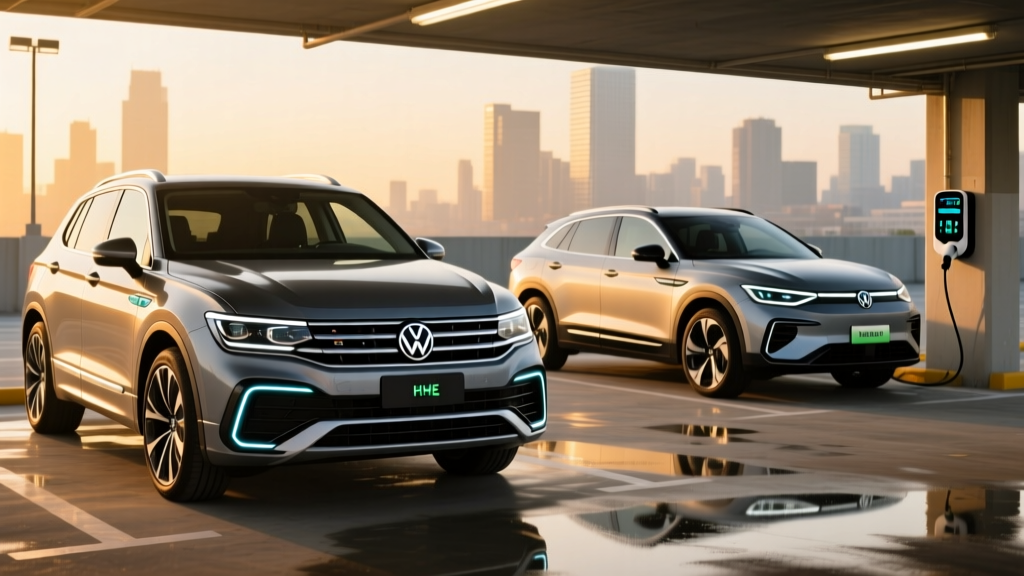
Volswagen's hybrid strategy in the US has been uneven. While the Golf GTE and Passat GTE sold in Europe for years, American buyers were largely left with the Touareg hybrid (discontinued in 2017) and a long gap before plug-in options returned. For 2026, VW is recommitting to electrification on this side of the Atlantic with the redesigned Tiguan eHybrid (PHEV) and a conventional hybrid variant of the Tiguan, giving buyers two distinct paths to lower fuel consumption without going full battery-electric.
This guide breaks down the 2026 VW hybrid lineup with exact EPA figures, real-world efficiency expectations, battery specs, charging times, pricing, and tax-credit eligibility — so you can determine whether a VW hybrid fits your garage or whether a full EV or competing PHEV makes more sense.
2026 VW Hybrid Lineup at a Glance: HEV vs PHEV
Before diving into specs, it's essential to understand the two hybrid architectures VW offers:
Conventional Hybrid (HEV)
- No plug required. The battery recharges via regenerative braking and the engine.
- Smaller battery (~1–2 kWh) — cannot drive on electric power alone at meaningful speeds or distances.
- Primary benefit: improved MPG over a gas-only equivalent, especially in city driving.
Plug-In Hybrid (PHEV)
- Requires plug-in charging to unlock full electric-only range (Level 1 or Level 2).
- Larger battery (~13–20 kWh usable) — enables 20–40 miles of zero-emission driving.
- Primary benefit: EV-like daily commuting with a gas engine for longer trips, eliminating range anxiety.
For 2026, VW's US hybrid lineup centers on the Tiguan nameplate. The conventional Tiguan Hybrid (HEV) serves as the volume model, while the Tiguan eHybrid (PHEV) targets commuters who can charge at home and want EV-like daily driving without committing to a full BEV like the ID.4.
2026 VW Tiguan Hybrid (HEV): MPG, Powertrain & Pricing
The 2026 Tiguan Hybrid pairs VW's updated EA211 1.5-liter turbocharged four-cylinder engine with a mild-hybrid system featuring a 48-volt belt-driven starter-generator and a small lithium-ion battery pack. This is not a full series-parallel hybrid like a Toyota RAV4 Hybrid — it's a mild-hybrid assist system (MHEV) that improves efficiency by enabling engine-off coasting, smoother stop-start, and brief torque fill.
| Specification | Value |
|---|---|
| Engine | 1.5L turbo I-4 + 48V mild-hybrid assist |
| Combined Horsepower | ~174 hp (engine) + electric assist |
| Transmission | 7-speed DSG automatic |
| Drivetrain | FWD standard, 4MOTION AWD available |
| EPA MPG (City / Highway / Combined) | 28 / 34 / 30 (FWD est.) |
| Base MSRP | $33,590 (SE trim, FWD) |
| Federal Tax Credit (§30D) | Not eligible — mild hybrid does not qualify |
Real-World MPG vs EPA
Conventional and mild hybrids often beat their EPA city estimates in stop-and-go traffic, where regenerative braking recaptures energy most frequently. Expect the Tiguan Hybrid to deliver 31–33 MPG combined in mixed suburban driving, with highway figures potentially dipping to 30–31 MPG at sustained 75+ mph speeds where the electric assist provides minimal benefit. In cold weather (below 32°F), expect a 5–8% reduction due to increased engine warm-up time and cabin heating demands.
2026 VW Tiguan eHybrid (PHEV): Electric Range, Charging & Specs
The Tiguan eHybrid is the more compelling option for buyers who can charge at home. Based on the redesigned third-generation Tiguan platform (MQB Evo), the eHybrid uses a larger traction battery and a more powerful electric motor integrated into the transmission housing, enabling genuine electric-only commuting.
| Specification | Value |
|---|---|
| Engine | 1.5L turbo I-4 + electric motor (integrated in DSG) |
| Combined System Horsepower | 241 hp (combined) |
| Combined Torque | 295 lb-ft |
| Battery (Usable Capacity) | 19.7 kWh (NMC lithium-ion) |
| EPA Electric-Only Range | ~32 miles (est.) |
| EPA MPGe (Electric + Gas) | ~80 MPGe (est.) |
| Charge-Depleting MPG (Gas Only) | ~30 MPG combined |
| Total Combined Range | ~440 miles (electric + gas) |
| Level 2 Charging (240V, 7.2 kW) | ~2.75 hours (0–100%) |
| Level 1 Charging (120V, 1.4 kW) | ~14 hours (0–100%) |
| DC Fast Charging | Not available |
| 0–60 mph | ~6.8 seconds |
| Drivetrain | FWD (AWD not offered on eHybrid) |
| Base MSRP | $41,490 (SE eHybrid) |
Real-World Electric Range Expectations
The EPA-estimated 32-mile electric range assumes moderate temperatures (65–75°F), flat terrain, and speeds under 55 mph. In practice:
- Summer city commuting (AC on): 28–31 miles
- Highway at 70 mph (electric mode): 22–25 miles
- Winter (30°F, cabin heat): 20–24 miles — battery chemistry and cabin heating reduce usable range by 25–35%
If your round-trip commute is under 25 miles and you charge nightly, you'll burn almost no gasoline on weekdays. The Tiguan eHybrid's 19.7 kWh battery provides a practical buffer for most suburban commutes.
Charging the Tiguan eHybrid
The Tiguan eHybrid uses a standard J1772 connector for Level 1 (120V household outlet) and Level 2 (240V home or public charger). It does not support DC fast charging — a common limitation among PHEVs. At a 7.2 kW Level 2 home charger, a full charge takes approximately 2 hours and 45 minutes. Most PHEV owners charge overnight on Level 1 or install a Level 2 unit for faster top-ups between errands.
Federal Tax Credit Eligibility for VW PHEVs
Under current IRS §30D rules, the 2026 Tiguan eHybrid may qualify for up to $3,750 of the federal plug-in electric vehicle tax credit — not the full $7,500. The credit amount depends on whether the vehicle meets critical-mineral sourcing and battery-component manufacturing requirements, which shift annually. Key eligibility factors:
- Vehicle MSRP cap: SUVs/vans/pickups must be under $80,000 — the Tiguan eHybrid clears this easily at ~$41,490.
- Buyer income cap: Modified AGI must not exceed $150,000 (single), $225,000 (head of household), or $300,000 (joint filers).
- Battery sourcing: Critical minerals and battery components must meet escalating US/free-trade-area thresholds. For 2026, the critical-mineral requirement is 80% and battery-component requirement is 100% North American manufacture/assembly to qualify for the full $7,500. VW's supply chain may meet only one threshold, yielding $3,750.
- Point-of-sale transfer: You can elect to transfer the credit to the dealer at purchase, reducing your out-of-pocket cost immediately rather than waiting for a tax refund.
- Battery capacity: Must be at least 7 kWh — the Tiguan's 19.7 kWh pack easily qualifies.
Always verify current eligibility on IRS.gov Clean Vehicle Credits and confirm with your tax professional before purchase. State incentives vary — check fueleconomy.gov for your state's rebates.
Battery Warranty, Degradation & Replacement Cost
VW Hybrid Battery Warranty
Volkswagen covers the Tiguan eHybrid's high-voltage battery for 8 years or 100,000 miles (whichever comes first), with a capacity-retention threshold of 70%. If the battery degrades below 70% of its original 19.7 kWh capacity within the warranty period, VW will repair or replace it at no cost.
The conventional Tiguan Hybrid's 48V mild-hybrid battery is covered under the standard 4-year/50,000-mile new-vehicle warranty, as it is not classified as a hybrid traction battery under federal emissions-warranty rules.
Battery Degradation Reality
NMC lithium-ion PHEV batteries typically degrade 8–15% over the first 8 years under normal use, depending on climate and charging habits. The Tiguan eHybrid's 19.7 kWh pack should retain approximately 17–18 kWh of usable capacity after 8 years, still providing 25+ miles of electric range. VW's thermal management system (liquid cooling) helps mitigate degradation in hot climates.
Out-of-Warranty Replacement Cost
If the eHybrid battery requires replacement after the warranty expires, expect costs between $6,000 and $9,000 including parts and labor, based on current VW PHEV battery pricing in Europe and comparable US-market PHEVs. This is significantly less than a full-EV battery replacement ($12,000–$20,000) due to the smaller pack size.
2026 VW Tiguan Hybrid vs Competitors
| Vehicle | Type | EPA Combined MPG / MPGe | EV Range (mi) | Starting MSRP |
|---|---|---|---|---|
| 2026 VW Tiguan Hybrid (HEV) | MHEV | 30 MPG | N/A | $33,590 |
| 2026 VW Tiguan eHybrid (PHEV) | PHEV | 80 MPGe / 30 MPG (gas) | 32 | $41,490 |
| 2026 Toyota RAV4 Hybrid | HEV | 39 MPG | N/A | $33,425 |
| 2026 Toyota RAV4 Prime | PHEV | 94 MPGe / 38 MPG (gas) | 42 | $44,590 |
| 2026 Hyundai Tucson PHEV | PHEV | 80 MPGe / 33 MPG (gas) | 33 | $39,590 |
| 2026 Ford Escape PHEV | PHEV | 105 MPGe / 40 MPG (gas) | 37 | $38,500 |
The Tiguan eHybrid is competitive on electric range and power (241 hp outmuscles most rivals), but the Toyota RAV4 Prime dominates on combined electric range (42 miles) and gas-mode efficiency (38 MPG). The Ford Escape PHEV offers the best MPGe and gas-mode MPG in this segment. VW's advantage lies in interior quality, driving dynamics, and the Tiguan's third-row seat option — rare in the compact PHEV SUV class.
Who Should Buy a VW Hybrid — and Who Shouldn't?
Choose the VW Tiguan Hybrid (HEV) If:
- You cannot charge at home and want better MPG without any behavior change
- You primarily drive in the city (mild-hybrid assist shines in stop-and-go)
- You want VW build quality and a third-row option at a mainstream price
- You're not ready to manage plug-in charging routines
Choose the VW Tiguan eHybrid (PHEV) If:
- You have home Level 2 (or even Level 1) charging and a commute under 30 miles round-trip
- You want EV-like daily driving but need gas-engine flexibility for road trips
- You want 241 hp and responsive electric torque in a compact SUV
- You want to reduce fuel consumption without committing to a full BEV like the ID.4
When a Full EV (Like the VW ID.4) Is Better
If your daily driving exceeds 32 miles and you charge at home reliably, the VW ID.4 (EPA 275-mile range, ~$39,735 base, eligible for the full $7,500 federal credit) will deliver lower per-mile energy costs, zero tailpipe emissions, and no gasoline maintenance. PHEVs make sense only when you regularly exceed electric range or lack consistent charging access.
When a Competing Hybrid Is Better
If maximum fuel efficiency is your priority and you don't need a third row or premium interior, the Toyota RAV4 Hybrid (39 MPG combined) or RAV4 Prime PHEV (42-mile range, 94 MPGe) offers superior efficiency and a proven reliability track record at comparable pricing.
Frequently Asked Questions
How many MPG does the 2026 VW Tiguan Hybrid get?
The 2026 VW Tiguan Hybrid (mild-hybrid HEV) is EPA-estimated at 28 city / 34 highway / 30 combined MPG (FWD). Real-world mixed driving typically yields 31–33 MPG combined. The Tiguan eHybrid (PHEV) achieves approximately 30 MPG combined when the battery is depleted and running on gasoline alone.
How far can the Tiguan eHybrid go on electric only?
The 2026 Tiguan eHybrid has an EPA-estimated ~32 miles of electric-only range. In real-world conditions, expect 22–31 miles depending on temperature, speed, and terrain. Highway driving at 70 mph reduces range to roughly 22–25 miles, while city commuting in mild weather can approach the full 32 miles.
Does the VW Tiguan eHybrid qualify for a federal tax credit?
The Tiguan eHybrid may qualify for up to $3,750 of the federal §30D clean vehicle credit, depending on battery-component and critical-mineral sourcing compliance for the 2026 tax year. Buyer income caps apply ($150K single / $300K joint). The conventional Tiguan Hybrid (mild-hybrid) does not qualify for any federal EV credit. Verify current eligibility at IRS.gov.
Is the VW hybrid battery reliable and what does replacement cost?
VW's PHEV battery is covered for 8 years / 100,000 miles with a 70% capacity-retention guarantee. NMC lithium-ion PHEV batteries typically degrade 8–15% over 8 years, meaning the Tiguan eHybrid should retain ample range within the warranty period. Out-of-warranty replacement is estimated at $6,000–$9,000 — lower than full-EV battery replacement due to the smaller 19.7 kWh pack.
Hybrid vs PHEV vs EV — which VW should I choose?
HEV (Tiguan Hybrid): Best if you can't charge at home and want modest MPG gains with no plug-in routine.
PHEV (Tiguan eHybrid): Best if you have home charging, a sub-30-mile commute, and want EV-like daily driving with gas-engine backup for road trips.
Full EV (ID.4): Best if you charge at home, drive more than 32 miles daily, and want the lowest per-mile cost and zero tailpipe emissions. The ID.4 also qualifies for the full $7,500 federal credit.
Can the Tiguan eHybrid DC fast charge?
No. Like most PHEVs, the Tiguan eHybrid does not support DC fast charging. It charges via J1772 at up to 7.2 kW on Level 2 (full charge in ~2.75 hours) or 1.4 kW on Level 1 (full charge in ~14 hours). This is sufficient for overnight home charging but means you cannot rapidly recharge on a road trip — once the battery depletes, the vehicle operates as a conventional hybrid.
Does the Tiguan Hybrid need to be plugged in?
No. The conventional Tiguan Hybrid (mild-hybrid HEV) has no plug and no meaningful electric-only range. Its 48V system recharges through regenerative braking and the engine. Only the Tiguan eHybrid (PHEV) requires plug-in charging to access its 32-mile electric range.
Final Verdict
VW's 2026 hybrid lineup fills a gap that has existed for nearly a decade in the US market. The Tiguan Hybrid (HEV) offers modest efficiency gains for buyers who want a no-compromise, no-plug experience, though it trails the RAV4 Hybrid on MPG. The Tiguan eHybrid (PHEV) is the more compelling product — 32 miles of electric range covers most commutes, 241 hp provides genuine acceleration punch, and the $41,490 starting price undercuts the RAV4 Prime by over $3,000.
The deciding factor is your charging situation. If you can install a Level 2 charger at home and your daily driving stays within the eHybrid's electric envelope, the Tiguan eHybrid delivers the best of both worlds. If you can't charge at home, stick with the conventional Hybrid or consider a class-leading HEV like the RAV4 Hybrid for better fuel economy.