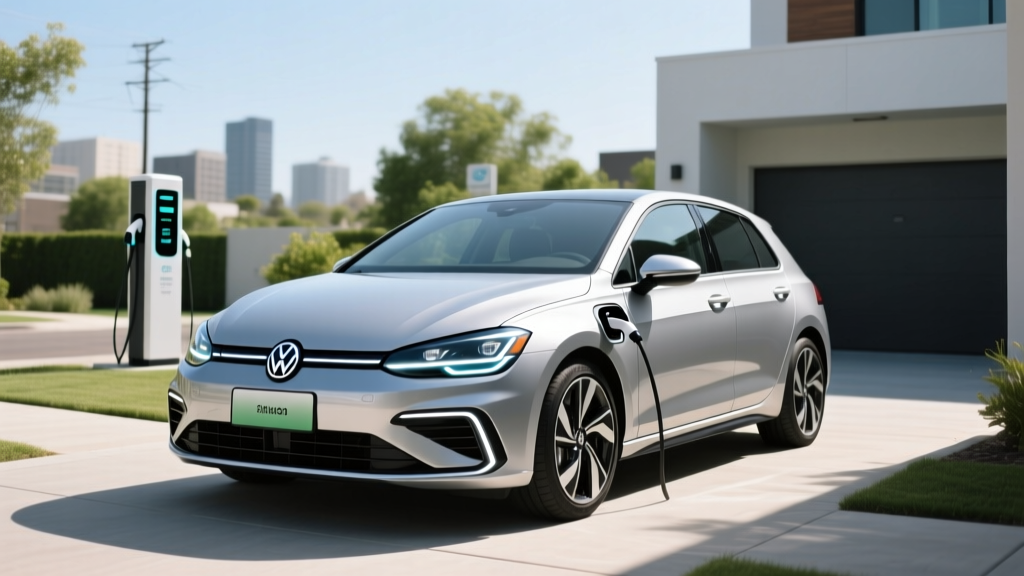
The Volkswagen Golf GTE has long been the hot hatch for buyers who want electric commuting without range anxiety. For 2026, the VW Golf PHEV returns with a revised powertrain, a larger battery, and the same practical hatchback formula that made the Golf an icon. But with full EVs dropping in price and conventional hybrids getting more efficient, where does the plug-in Golf GTE actually fit in 2026? We break down the real-world MPG, electric-only range, charging logistics, and federal tax credit eligibility to help you decide.
HEV vs PHEV: What the VW Golf GTE Actually Is
Before diving into specs, it is essential to distinguish between a conventional hybrid (HEV) and a plug-in hybrid (PHEV), because Volkswagen sells the Golf in different electrified forms depending on your market.
Conventional Hybrid (HEV) vs Plug-In Hybrid (PHEV)
| Feature | HEV (e.g., Golf eHybrid) | PHEV (Golf GTE) |
|---|---|---|
| Plugs in? | No — charges via regen and engine | Yes — Level 2 AC charging |
| Electric-only range | ~1 mile at low speed | ~37 miles (EPA est.) |
| Battery size | ~1.1 kWh | 19.7 kWh (usable) |
| Federal tax credit | No | Up to $3,750 (§30D) |
| Best for | No home charging access | Home chargers with short commutes |
The Golf GTE is a PHEV. You plug it in to unlock its full electric range and efficiency benefits. The conventional eHybrid variant does not require plugging in but offers minimal electric-only driving.
2026 VW Golf GTE Powertrain and Performance
The 2026 Golf GTE pairs a 1.5-liter turbocharged four-cylinder engine with an electric motor integrated into the six-speed DSG automatic transmission. Combined output lands at 245 horsepower and 295 lb-ft of torque — enough to hit 0-60 mph in approximately 6.5 seconds. That puts it in the same performance territory as the gasoline GTI, which is no accident: the GTE was designed as the electrified counterpart to VW's iconic hot hatch.
| Spec | Value |
|---|---|
| Engine | 1.5L turbocharged I4 + electric motor |
| Combined HP | 245 hp |
| Combined Torque | 295 lb-ft |
| Transmission | 6-speed DSG automatic |
| 0-60 mph | ~6.5 seconds |
| Battery (usable) | 19.7 kWh (NMC lithium-ion) |
| EV Range (EPA est.) | 37 miles |
| Total Range | ~440 miles |
| MPGe (EV mode) | 110 MPGe |
| Base MSRP | $35,490 |
Fuel Economy: Real-World MPG vs EPA Estimates
How many MPG does the VW Golf GTE get? The answer depends heavily on whether you charge it regularly.
| Mode | City | Highway | Combined |
|---|---|---|---|
| Charge-sustaining (gas engine) | 33 MPG | 30 MPG | 31 MPG |
| EV mode (electricity) | 110 MPGe combined | ||
Real-world note: If you plug in nightly and your commute is under 35 miles round-trip, you may go weeks without the engine turning on. In that scenario, your effective "MPG" is essentially infinite for daily driving — you are burning zero gasoline. Over a mix of charged and uncharged driving, owners typically report 45-60 MPG equivalent when charging regularly. If you never plug in, expect the EPA's 31 MPG combined figure — or slightly better in city driving thanks to regenerative braking, which recaptures energy that conventional brakes waste as heat.
Charging the Golf GTE: Level 2 and What You Need to Know
One of the most common questions from PHEV shoppers is about charging logistics. The 2026 Golf GTE supports Level 2 AC charging at up to 3.6 kW via a J1772 connector. It does not support DC fast charging — this is typical for PHEVs, whose smaller batteries do not justify the cost and weight of DC fast-charge hardware.
| Level | Power | 0-100% Time | Miles of EV Range/Hour |
|---|---|---|---|
| Level 1 (120V household) | ~1.4 kW | ~14 hours | ~3 miles/hr |
| Level 2 (240V, 16A) | 3.6 kW | ~5.5 hours | ~8 miles/hr |
| DC Fast Charge | Not supported | N/A | N/A |
For most PHEV owners, a standard 120V outlet is sufficient if you drive under 30 electric miles per day — it replenishes roughly 30 miles of EV range overnight. A Level 2 home charger is a nice upgrade if you make multiple short trips throughout the day and want the battery topped up between drives. Installation for a basic Level 2 circuit typically runs $500-$1,500 depending on your electrical panel's capacity and the distance from the panel to your parking spot. Consult a licensed electrician for a site-specific quote.
Battery Warranty, Longevity, and Replacement Cost
Battery lifespan is the top concern for any hybrid or PHEV buyer. Volkswagen covers the Golf GTE's high-voltage battery with an 8-year/100,000-mile warranty (10 years/150,000 miles in California and states that follow CARB emissions rules). The warranty guarantees the battery will retain at least 70% of its original capacity during the coverage period.
- 8 years / 100,000 miles (federal states)
- 10 years / 150,000 miles (CARB states: CA, NY, MA, WA, OR, CO, and others)
- Minimum capacity retention: 70% during warranty period
- Out-of-warranty replacement estimate: $6,000-$9,000 (parts + labor)
Source: Volkswagen USA. Actual replacement costs vary by dealer and region.
In practice, PHEV batteries degrade more slowly than full EV batteries because the system uses a smaller portion of total capacity per cycle (shallow cycling). Data from earlier-generation Golf GTE models in Europe suggests 5-8% degradation over 5 years and 60,000 miles — well within warranty thresholds. The 19.7 kWh NMC battery uses proven chemistry, and VW's thermal management keeps the pack within safe temperature limits during charge and discharge.
Pricing and Federal Tax Credit Eligibility
The 2026 VW Golf GTE starts at an MSRP of $35,490. A single well-equipped trim is offered, including adaptive cruise control, a 10-inch infotainment display, wireless Apple CarPlay/Android Auto, and heated front seats.
Does the VW Golf GTE qualify for a tax credit? Under current IRS §30D rules, the Golf GTE qualifies for up to $3,750 in federal tax credit — not the full $7,500. The reduced amount is because the GTE's battery meets the critical minerals requirement but does not fully satisfy the battery component sourcing threshold under the Inflation Reduction Act's phased rules for 2026.
- Vehicle MSRP cap: $55,000 for sedans/hatchbacks — the GTE at $35,490 qualifies ✓
- Buyer income cap: AGI must not exceed $150,000 (single) / $300,000 (joint) ✓ (buyer-dependent)
- Battery sourcing: Partial compliance — yields $3,750 of the possible $7,500
- Point-of-sale transfer: Yes — you can apply the credit as a down payment reduction at the dealer
- Battery capacity: Must be ≥7 kWh — the GTE's 19.7 kWh qualifies ✓
Always verify current eligibility on IRS.gov before purchasing, as sourcing requirements tighten annually and manufacturer qualification can change.
Who Should Buy the Golf GTE vs a Full EV or Gas Car?
Choose the VW Golf GTE (PHEV) if:
- Your daily commute is under 35 miles round-trip and you can charge at home
- You take regular road trips beyond 200 miles and do not want to plan around charging stops
- You want one vehicle that covers both electric commuting and gas-powered long-distance driving
- You live in an area with limited public DC fast-charging infrastructure
Choose a full EV (e.g., VW ID.4, Hyundai Ioniq 5) if:
- You have reliable home Level 2 charging and your daily driving is under 250 miles
- You want to eliminate gasoline entirely and minimize maintenance (no oil changes, fewer moving parts)
- You qualify for the full $7,500 federal tax credit on a qualifying BEV
Choose a conventional hybrid (HEV) or gas car if:
- You cannot charge at home or at work (apartment, street parking)
- Your budget is under $30,000 and you want lower upfront cost
- You drive very low annual miles and a gas car's fuel cost is negligible
Pros
- 37-mile EV range covers most commutes gas-free
- 245 HP — genuinely quick for a hatchback
- 440+ miles total range eliminates road-trip anxiety
- Hatchback cargo versatility (27.8 cu ft behind rear seats)
- $3,750 federal tax credit at point of sale
- Proven VW build quality and parts availability
Cons
- No DC fast charging — road-trip EV top-ups not possible
- Only $3,750 credit, not the full $7,500
- 3.6 kW Level 2 charge rate is slow compared to some PHEVs (Toyota RAV4 Prime: 6.6 kW)
- EV range drops significantly in cold weather (22-26 mi below 40°F)
- Higher starting price than a gas Golf GTI (~$32,000)
- US availability may be limited by market allocation
Frequently Asked Questions
How far can the 2026 VW Golf GTE drive on electric only?
The EPA estimates 37 miles of electric-only range. Real-world driving at moderate temperatures yields 30-34 miles. Cold weather and sustained highway speeds above 70 mph reduce this to approximately 22-26 miles.
How many MPG does the Golf GTE get when the battery is depleted?
In charge-sustaining mode (battery depleted, running on the gas engine), the EPA rates the GTE at 31 MPG combined — 33 city / 30 highway. City driving often exceeds the EPA estimate thanks to regenerative braking.
Is the VW Golf GTE reliable?
VW's PHEV powertrain has been in production since 2015 across multiple models (Golf GTE, Passat GTE). The DSG transmission and 1.5L turbo engine are well-established. The primary reliability variable is long-term battery degradation, which VW's 8-10 year warranty covers to 70% capacity. Out-of-warranty battery replacement is estimated at $6,000-$9,000.
Does the Golf GTE qualify for the $7,500 federal tax credit?
No. Under 2026 IRS §30D rules, the Golf GTE qualifies for up to $3,750 — half the maximum — because it meets the critical minerals requirement but not the full battery component sourcing threshold. Verify current eligibility at IRS.gov before purchase.
Do I need to install a Level 2 charger for the Golf GTE?
No. A standard 120V household outlet (Level 1) adds roughly 3 miles of EV range per hour, which is sufficient for commuters driving under 30 electric miles daily. A Level 2 charger ($500-$1,500 installed) is a worthwhile upgrade if you make multiple trips per day and want faster replenishment.
Hybrid vs PHEV vs EV — which should I choose?
If you can charge at home and commute under 35 miles, the Golf GTE PHEV gives you electric daily driving with gas-engine backup for long trips. If you want zero gasoline and have charging access, a full EV like the VW ID.4 offers lower running costs. If you cannot charge at home, a conventional HEV (non-plug-in hybrid) is the most practical choice.
Sources: EPA Fuel Economy, IRS §30D Clean Vehicle Credits, Volkswagen USA. Specifications reflect 2026 model year as published; confirm with your local dealer. Tax credit rules subject to change — consult a tax professional for personal eligibility.