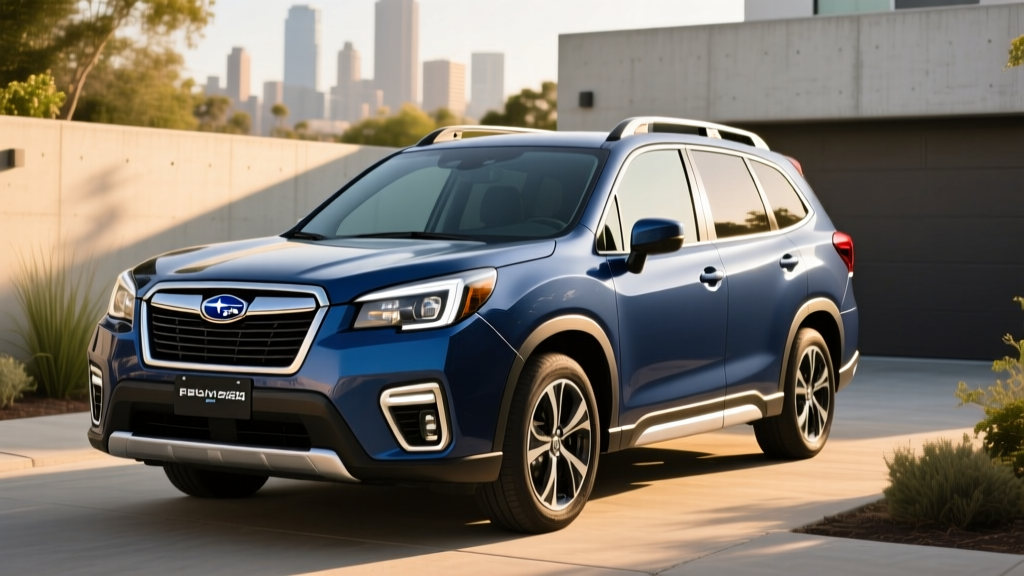
The Subaru Forester has long been the default compact SUV for outdoorsy buyers who want standard all-wheel drive and excellent visibility. For 2025, Subaru introduced a sixth-generation Forester and, with it, a new hybrid variant that pairs a 2.5-liter flat-four with Toyota's proven hybrid synergy drive system. The top-of-the-line 2025 Subaru Forester Touring Hybrid adds premium Nappa leather, a 360-degree camera, and Subaru's latest EyeSight safety suite on top of a powertrain that promises mid-30s MPG without ever needing to plug in.
This is a conventional hybrid (HEV), not a plug-in hybrid (PHEV). That distinction matters for your daily routine, your fuel budget, and your expectations at the pump. Below, we break down every number that matters — EPA MPG, real-world efficiency, powertrain output, pricing, warranty, and how the Touring Hybrid stacks up against both full EVs and gas-only compact SUVs.
2025 Subaru Forester Touring Hybrid: Core Specs at a Glance
| Specification | 2025 Forester Touring Hybrid |
|---|---|
| Powertrain | 2.5L flat-4 + electric motor (HEV) |
| Combined Horsepower | 194 hp (net system) |
| Engine Output | 163 hp / 169 lb-ft torque |
| Electric Motor Output | ~83 kW (111 hp) assist |
| Transmission | Lineartronic CVT (e-CVT hybrid variant) |
| Drivetrain | Symmetrical AWD (standard) |
| EPA MPG (City / Hwy / Combined) | 35 / 34 / 35 MPG |
| Fuel Tank Capacity | 13.2 gallons |
| Total Driving Range | ~462 miles |
| 0–60 mph (est.) | ~8.2 seconds |
| Ground Clearance | 8.7 inches |
| Cargo Volume (rear seats up/down) | 26.9 / 60.5 cu ft |
| Towing Capacity | 1,500 lbs |
| Hybrid Battery Warranty | 8 years / 100,000 miles |
| Base MSRP (Touring Hybrid) | $41,995 |
Fuel Economy: EPA Numbers vs. Real-World MPG
The EPA rates the 2025 Subaru Forester Hybrid at 35 MPG combined (35 city / 34 highway), according to data published on fueleconomy.gov. That is a meaningful improvement over the gas-only Forester, which returns 26 MPG combined (25 city / 28 highway) — a 35% efficiency gain from the hybrid system.
How Many MPG Does the Forester Hybrid Actually Get?
In real-world driving, conventional hybrids like the Forester tend to exceed their EPA city estimate because regenerative braking captures energy that a gas car wastes as heat. Owners who do a lot of stop-and-go city and suburban driving frequently report 36–38 MPG in mixed urban use. Highway-only driving at 75+ mph tends to dip slightly below the EPA highway number — expect 31–33 MPG on long interstate runs where aerodynamic drag dominates and the electric motor provides less assist.
| Driving Scenario | EPA Estimate | Real-World Expectation |
|---|---|---|
| City (stop-and-go, under 45 mph) | 35 MPG | 36–38 MPG |
| Highway (steady 70–80 mph) | 34 MPG | 31–33 MPG |
| Combined mixed driving | 35 MPG | 33–36 MPG |
| Cold weather (below 32°F) | — | 30–33 MPG |
HEV vs. PHEV: Understanding What the Forester Hybrid Is (and Isn't)
The 2025 Forester Hybrid is a conventional hybrid electric vehicle (HEV). It charges its own small battery through regenerative braking and the gasoline engine. You never plug it in. There is no electric-only driving range to speak of — the electric motor assists the gas engine during acceleration and enables brief low-speed electric creep, but the engine is always the primary power source.
A plug-in hybrid (PHEV), by contrast, has a larger battery (typically 12–20 kWh) that you charge from a wall outlet or public charger, enabling 25–40 miles of pure electric driving before the gas engine kicks in. Subaru does not currently offer a Forester PHEV in the US market.
- HEV (Forester Hybrid): No plug. Self-charging. ~1 kWh battery. No electric-only range. 35 MPG always.
- PHEV (e.g., Toyota RAV4 Prime): Plug-in required for full benefit. ~18 kWh battery. 42 miles electric-only, then 38 MPG as hybrid.
- BEV (e.g., Tesla Model Y): Plug-in required. 60–80+ kWh battery. 280–330 miles electric-only. Zero gas.
Powertrain Deep Dive: Toyota Hybrid Tech in a Subaru
Subaru partnered with Toyota to develop the hybrid system for the 2025 Forester. Under the hood sits Subaru's naturally aspirated 2.5-liter boxer (flat-four) engine producing 163 hp and 169 lb-ft of torque. This is paired with an electric motor-generator integrated into the e-CVT transmission, contributing up to roughly 83 kW of assist. Net system output is 194 horsepower.
The hybrid battery pack is a nickel-metal hydride (NiMH) unit — the same chemistry Toyota has used for decades in the Prius and RAV4 Hybrid. It is compact, positioned under the rear seats, and does not intrude on cargo space. NiMH batteries are less energy-dense than lithium-ion but have an extraordinarily long track record for longevity and thermal stability.
Acceleration is adequate rather than thrilling. The 0–60 mph time lands around 8.2 seconds, which is competitive with the gas-only Forester but noticeably slower than turbocharged rivals like the Mazda CX-50 Turbo. The e-CVT delivers smooth, linear power without the shift-shock of a traditional automatic, and Subaru's Symmetrical AWD is standard across all trims — no front-wheel-drive base model here.
Pricing, Trims, and Tax Credit Eligibility
The 2025 Subaru Forester Touring Hybrid carries an MSRP of $41,995, including destination. This positions it at the premium end of the Forester lineup but still below luxury compact SUVs. Standard equipment on the Touring Hybrid includes:
- Nappa leather-trimmed upholstery
- Harman Kardon premium audio (9 speakers)
- 12.3-inch digital instrument cluster
- 360-degree surround-view monitor
- Heated and ventilated front seats, heated rear seats
- Wireless Apple CarPlay and Android Auto
- EyeSight Driver Assist Technology (adaptive cruise, lane centering, pre-collision braking)
- Starlink Safety & Security connected services
Does the Forester Hybrid Qualify for a Federal Tax Credit?
No. The 2025 Subaru Forester Hybrid is a conventional HEV and does not qualify for the federal §30D Clean Vehicle Credit, which applies only to plug-in electric vehicles (BEVs and PHEVs) that meet battery sourcing, MSRP, and buyer income requirements as outlined by the IRS. Conventional hybrids are also excluded from most state-level EV rebates.
However, the Forester Hybrid's fuel savings versus the gas model partially offset the higher purchase price. At 35 MPG combined vs. 26 MPG for the gas Forester, and assuming $3.40/gallon regular and 15,000 miles/year, the hybrid saves roughly $500–$550 annually in fuel. Over a typical 8-year ownership period, that is approximately $4,000–$4,400 in savings — nearly recovering the hybrid price premium.
Battery Warranty, Reliability, and Replacement Cost
Is the Forester Hybrid Reliable?
The hybrid system in the 2025 Forester is derived from Toyota's fourth-generation Hybrid Synergy Drive, which powers millions of vehicles globally including the RAV4 Hybrid, Camry Hybrid, and Highlander Hybrid. This is one of the most extensively validated hybrid systems in automotive history. Toyota and Subaru NiMH hybrid batteries routinely last 150,000–200,000+ miles with minimal capacity loss.
Subaru as a brand has had mixed reliability scores in recent years, primarily related to infotainment glitches and some CVT concerns in older models. The hybrid variant's e-CVT, however, is mechanically simpler than Subaru's traditional Lineartronic CVT — it uses a planetary gearset rather than a belt-and-pulley design, which historically has proven more durable.
Hybrid Battery Replacement Cost
If the hybrid battery does require replacement outside of warranty, expect a cost in the range of $2,000–$4,000 for a new OEM pack, plus labor. Refurbished or aftermarket NiMH packs are available for $1,000–$2,000. Given the proven longevity of this chemistry and the 8–10 year warranty coverage, most original owners will never face this expense.
Who Should Choose the Forester Hybrid vs. a Full EV or Gas SUV?
Choose the Forester Hybrid If:
- You want AWD and mid-30s MPG without changing your fueling habits
- You lack access to home or workplace charging (apartment, street parking)
- You regularly drive in cold climates where EV range drops significantly
- You take long road trips into rural areas with sparse charging infrastructure
- You want the lowest-risk path to better fuel economy
Consider a PHEV or Full EV If:
- You can install a Level 2 home charger (240V outlet)
- Your daily commute is under 40 miles round-trip (PHEV covers it on electricity)
- You want to qualify for the §30D federal tax credit (up to $7,500 for eligible BEVs/PHEVs)
- You want zero tailpipe emissions in daily driving
- You're willing to plan charging stops on road trips (BEV)
- No home charging + cold climate + road trips: Forester Hybrid (HEV) is the pragmatic choice.
- Home charging + short commute + want tax credit: A PHEV like the Toyota RAV4 Prime or a BEV like the Hyundai Ioniq 5 may save more long-term.
- Budget-first buyer, low annual miles: The gas-only Forester (26 MPG combined) still makes financial sense at $33,695 base.
Pros and Cons of the 2025 Forester Touring Hybrid
Pros
- 35 MPG combined — 35% better than gas Forester
- Standard Symmetrical AWD on every trim
- Toyota-derived hybrid system with proven longevity
- 8.7 inches of ground clearance for trail capability
- Excellent outward visibility and spacious cabin
- No plug-in charging required — zero lifestyle change
- Strong EyeSight safety suite standard
Cons
- No federal tax credit eligibility (HEV)
- 1,500-lb towing capacity — below many rivals
- 0–60 in ~8.2 seconds — adequate, not quick
- Touring Hybrid at $41,995 is a significant price premium
- NiMH battery (not lithium-ion) — heavier, less energy-dense
- No PHEV variant available for electric-only commuting
- CVT drone under hard acceleration
Frequently Asked Questions
How many MPG does the 2025 Subaru Forester Touring Hybrid get?
The EPA rates it at 35 MPG city, 34 MPG highway, and 35 MPG combined. Real-world driving typically yields 33–38 MPG depending on driving style, terrain, and temperature. City-heavy routes favor the hybrid system; sustained highway speeds above 75 mph reduce efficiency slightly.
Can the Forester Hybrid drive on electric power alone?
Only for very brief, low-speed moments (parking lot speeds under ~15 mph). This is a conventional hybrid, not a plug-in. The electric motor primarily assists the gas engine during acceleration and captures energy during braking. There is no meaningful electric-only range.
Does the 2025 Forester Hybrid qualify for any tax credit?
No. Federal §30D tax credits apply only to plug-in vehicles (BEVs and PHEVs). Conventional hybrids like the Forester Hybrid are not eligible. Some states or utilities may offer minor rebates for fuel-efficient vehicles, but these vary by jurisdiction — check your state's energy office or IRS guidelines for current rules.
Is the hybrid battery reliable and what does replacement cost?
Yes. The NiMH hybrid battery uses Toyota-proven chemistry with a track record spanning over 25 years across millions of vehicles. Subaru warranties the pack for 8 years/100,000 miles (10 years/150,000 miles in CARB states). Replacement cost, if ever needed outside warranty, is approximately $2,000–$4,000 for an OEM pack.
How does the Forester Hybrid compare to the Toyota RAV4 Hybrid?
Both use similar Toyota-derived hybrid systems with NiMH batteries and e-CVT transmissions. The RAV4 Hybrid returns 39 MPG combined (vs. 35 MPG for the Forester) and offers a PHEV variant (RAV4 Prime). The Forester counters with better outward visibility, more rear headroom, standard AWD across all trims, and slightly more ground clearance (8.7" vs. 8.1").
Should I buy the Forester Hybrid or wait for a Subaru PHEV or EV?
If you need a vehicle now and lack home charging, the Forester Hybrid delivers immediate fuel savings with zero infrastructure investment. Subaru has announced plans for additional electrified models, but no Forester PHEV or BEV has been confirmed for the US market as of the 2025 model year. Waiting carries opportunity cost in fuel savings you could be capturing today.