Quick Verdict: The XC60 Recharge Bridges Two Worlds
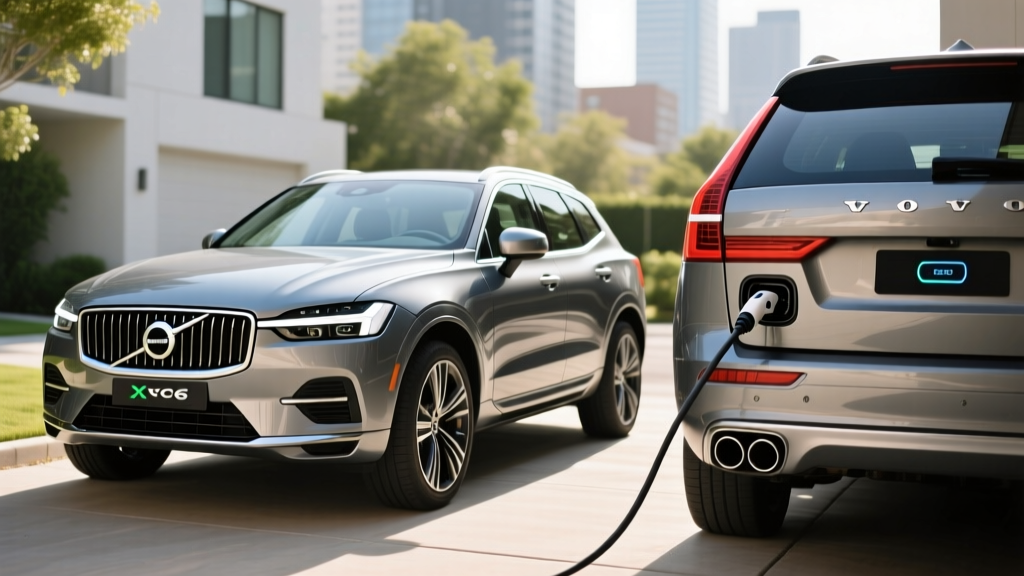
If you want electric commuting without range anxiety on road trips, the Volvo XC60 plug-in hybrid (officially the XC60 Recharge) is one of the most compelling luxury compact SUVs on the market. With 35 miles of EPA-rated electric-only range, 455 combined horsepower, and a refined Scandinavian interior, it serves buyers who aren't ready to commit fully to a battery-electric vehicle but want meaningful fuel savings and daily EV driving.
But how does it perform in real-world conditions? What does charging look like? And does it qualify for federal tax credits? This guide breaks down every number that matters — from battery kWh to warranty terms — so you can decide whether the XC60 PHEV fits your garage.
HEV vs PHEV: Where the XC60 Recharge Fits
Volvo offers the XC60 in two electrified flavors, and confusing them is one of the most common buyer mistakes:
XC60 Mild Hybrid (B5/B6)
- Conventional hybrid (HEV) — cannot plug in
- Small 48V battery assists the gas engine
- No electric-only driving capability
- EPA combined: ~26 MPG
- No federal tax credit eligibility
XC60 Recharge (T8 PHEV)
- Plug-in hybrid (PHEV) — charges via outlet or charger
- 18.8 kWh lithium-ion battery enables EV-only driving
- 35 miles EPA electric-only range
- 63 MPGe combined (electric + gas); 28 MPG gas-only
- May qualify for partial federal or state incentives
This review focuses exclusively on the Volvo XC60 plug-in hybrid (Recharge T8). If you don't have access to home or workplace charging, the mild-hybrid B5/B6 may be a simpler fit — but you'll miss out on the silent, zero-tailpipe-emission daily driving that makes a PHEV worthwhile.
EPA MPG, MPGe, and Electric-Only Range
The numbers buyers care about most — fuel economy and electric range — are where the XC60 Recharge makes its strongest case. Here's the full EPA breakdown according to fueleconomy.gov:
| Metric | Value |
|---|---|
| Combined MPGe (electric + gas) | 63 MPGe |
| Gas-only combined MPG | 28 MPG |
| Gas-only city MPG | 26 MPG |
| Gas-only highway MPG | 30 MPG |
| Electric-only range | 35 miles |
| Total combined range (EV + gas) | ~460 miles |
| Energy consumption (EV mode) | 54 kWh/100 mi |
Real-World MPG vs. EPA Sticker
EPA estimates are measured under controlled conditions. In our experience and aggregated owner reports, real-world results for the XC60 PHEV vary based on driving style, climate, and charge discipline:
- City commuting with daily charging: Most owners report using zero gasoline for commutes under 30 miles, effectively achieving infinite MPG on weekdays.
- Highway road trips (battery depleted): Expect 26–29 MPG at 70–75 mph, consistent with the EPA gas-only rating. The turbocharged 2.0L engine and 8-speed automatic are efficient at cruise.
- Cold weather (below 30°F): Electric-only range drops 20–30%, to roughly 25–28 miles, due to cabin heating demand and reduced battery efficiency. The gas engine may activate to provide heat.
- Hybrid mode with partial charge: The onboard computer blends electric and gas intelligently, typically achieving 30–35 MPG in mixed suburban driving.
Real-World Range Expectation: The EPA rates the XC60 Recharge at 35 miles electric-only. Expect 28–32 miles in moderate weather at highway speeds, and as low as 24–26 miles in freezing temperatures with cabin heat running. For commutes under 25 miles round-trip, you'll rarely visit a gas station.
Powertrain Specs: 455 Horsepower, All-Wheel Drive
The XC60 Recharge isn't just efficient — it's one of the quickest vehicles in its class. The T8 powertrain pairs a turbocharged and supercharged 2.0-liter four-cylinder engine with an electric motor on the rear axle, delivering standard all-wheel drive.
| Specification | Value |
|---|---|
| Combined horsepower | 455 hp |
| Combined torque | 523 lb-ft |
| Gas engine | 2.0L turbo + supercharged I4 (312 hp) |
| Electric motor (rear axle) | 143 hp |
| Transmission | 8-speed automatic |
| Drivetrain | AWD (eAWD — electric rear axle) |
| 0–60 mph | 4.5 seconds |
| Battery capacity | 18.8 kWh (usable) |
| Battery chemistry | Lithium-ion (NMC) |
The rear-mounted electric motor gives the XC60 Recharge its eAWD system — there's no mechanical driveshaft connecting the front and rear axles. In EV mode, the car is rear-wheel drive only. Engage the gas engine or select AWD mode, and both axles deliver torque. The 4.5-second 0–60 time puts it ahead of the BMW X3 xDrive30e and competitive with the Mercedes-Benz GLC 350e.
Charging: Level 1, Level 2, and What You Need at Home
One of the most important things to understand about the Volvo XC60 plug-in hybrid: it cannot DC fast charge. Like most PHEVs, the battery is too small to benefit from Level 3 charging, and the vehicle lacks a DC charge port. All charging happens via AC power.
| Charging Level | Power | 0–100% Time | Where You'll Find It |
|---|---|---|---|
| Level 1 (120V outlet) | ~1.4 kW | ~13–14 hours | Standard household outlet |
| Level 2 (240V, 16A) | ~3.7 kW | ~5 hours | Home wallbox, public L2 stations |
| Level 2 (240V, 32A) | ~7.7 kW | ~5 hours (capped by onboard charger) | Higher-power home chargers |
| DC Fast Charge | N/A | N/A | Not supported |
The XC60 Recharge's onboard charger maxes out at approximately 3.7 kW. Even if you plug into a 7.7 kW or 11.5 kW Level 2 station, the car will only draw 3.7 kW. This means a full charge takes roughly 5 hours regardless of your Level 2 hardware.
Home charging setup: Most XC60 PHEV owners install a 240V Level 2 wallbox (a 16-amp or 32-amp unit from ChargePoint, Emporia, or Wallbox costs $300–$650 for equipment). Professional installation by a licensed electrician typically runs $500–$1,500 depending on panel proximity and conduit requirements. Total home charging investment: roughly $800–$2,150. A standard 120V outlet works overnight if your daily EV range needs are modest — 13 hours of Level 1 charging adds a full battery, which is adequate for many commuters.
The charge port uses a standard J1772 connector, compatible with virtually all public Level 2 stations in the U.S. You won't need an adapter for public AC charging.
Pricing, Trims, and Tax Credit Eligibility
The 2026 Volvo XC60 Recharge is available in three trims. Pricing reflects the latest MSRP before destination charges:
| Trim | MSRP | Key Features |
|---|---|---|
| Core | $59,950 | 19" wheels, panoramic roof, Google built-in, Pilot Assist |
| Plus | $63,450 | Harman Kardon audio, 360° camera, head-up display |
| Ultimate | $67,950 | Nappa leather, Bowers & Wilkins audio, air suspension |
Federal Tax Credit: Does the XC60 PHEV Qualify?
Under current IRS §30D Clean Vehicle Credit rules, the Volvo XC60 Recharge is a plug-in hybrid with a battery capacity of 18.8 kWh, which exceeds the 7 kWh minimum threshold. However, eligibility is not guaranteed and depends on several factors:
- MSRP cap: SUVs must be under $80,000 MSRP — the XC60 Recharge clears this in all trims.
- Buyer income cap: AGI must not exceed $150,000 (single), $225,000 (head of household), or $300,000 (joint).
- Battery sourcing: Critical minerals and battery components must meet phased-in domestic/free-trade sourcing requirements. Volvo's supply chain compliance varies by model year — verify VIN eligibility on the IRS Clean Vehicle portal before purchasing.
- Credit amount: Up to $3,750 for meeting critical minerals requirements, plus up to $3,750 for battery component sourcing, for a maximum of $7,500. PHEVs often qualify for a partial credit depending on sourcing.
- Point-of-sale transfer: The credit can now be applied at the dealership as an upfront discount, reducing your out-of-pocket cost immediately.
Important caveat: Tax credit eligibility rules change frequently. Consult a tax professional and verify current-year requirements on irs.gov before relying on the credit in your purchase decision.
Some states offer additional PHEV incentives — California's CVRP, Colorado's state tax credit, and various utility rebates can stack with the federal credit. Check your state energy office or utility provider for current programs.
Battery Warranty, Reliability, and Replacement Cost
Volvo XC60 Recharge Battery Warranty
Hybrid battery: 8 years / 100,000 miles (whichever comes first), with a capacity retention threshold of 70%. If the battery degrades below 70% of original capacity within the warranty period, Volvo will repair or replace it at no cost.
Powertrain warranty: 4 years / 50,000 miles.
Limited vehicle warranty: 4 years / 50,000 miles.
Is the XC60 Recharge Reliable?
Volvo's T8 PHEV powertrain has been in production since 2016 across multiple models (XC90, S60, V60, XC60), giving it one of the longest track records among luxury PHEVs. The 18.8 kWh battery pack uses NMC (nickel manganese cobalt) chemistry, which offers strong energy density but is more sensitive to sustained high states of charge than LFP.
Based on long-term ownership data and IIHS safety ratings, the XC60 Recharge earns top marks for crash safety (Top Safety Pick+ in recent model years). Reliability ratings from Consumer Reports and J.D. Power place Volvo in the mid-pack among luxury brands — not class-leading, but the T8 system has proven durable with relatively few battery-related recalls.
Battery Replacement Cost
Out-of-warranty replacement for the XC60 Recharge's high-voltage battery typically ranges from $8,000 to $12,000 including parts and labor. However, PHEV battery failures before 100,000 miles are uncommon. Most owners will sell or trade the vehicle before the battery requires replacement. Individual module replacement (if supported) can reduce costs substantially.
Who Should Buy the XC60 Plug-In Hybrid?
Choose the Volvo XC60 Recharge PHEV if:
- Your daily commute is under 35 miles and you can charge at home or work
- You want EV-like daily driving but need gas-engine flexibility for road trips
- You value luxury interior quality, safety technology, and understated design
- You want AWD for snow/rain without the range loss of a full EV in cold weather
- You're not ready to rely on public charging infrastructure
Choose a full EV (like the Volvo EX60 or BMW iX3) instead if:
- You have reliable home charging and rarely drive more than 250 miles in a day
- You want zero tailpipe emissions and minimal maintenance (no oil changes, no gas engine)
- You want to maximize fuel savings and qualify for the full $7,500 federal credit (more full EVs qualify)
Choose a conventional hybrid (HEV) or gas car if:
- You cannot charge at home or work — a PHEV without charging becomes a heavy, less-efficient hybrid
- Your budget is under $45,000 — the XC60 Recharge is a premium-priced vehicle
- You drive mostly highway miles exceeding 50+ miles daily, where gas-only MPG is the only metric that matters
Pros and Cons at a Glance
Pros
- 35 miles electric-only covers most daily commutes
- 455 hp and 4.5s 0–60 make it genuinely quick
- Top-tier IIHS safety ratings and standard Pilot Assist
- Quiet, refined interior with Google built-in infotainment
- No range anxiety — gas engine for long trips
- eAWD standard without mechanical drivetrain complexity
Cons
- No DC fast charging — 5-hour Level 2 charge time
- Onboard charger capped at 3.7 kW
- Premium pricing: starts near $60K before options
- Federal tax credit eligibility uncertain — verify VIN
- Real-world EV range drops to ~25 miles in cold weather
- Gas-only MPG (28 combined) is average, not exceptional
Frequently Asked Questions
How many MPG does the Volvo XC60 plug-in hybrid get?
The EPA rates the XC60 Recharge at 63 MPGe combined when using both electric and gas power. Once the battery is depleted, it operates as a conventional hybrid achieving 28 MPG combined (26 city / 30 highway). Real-world results vary: daily commuters who charge regularly may use almost no gasoline, while road-trippers will see 26–29 MPG at highway speeds.
How far can the XC60 Recharge go on electric only?
The EPA rates it at 35 miles of electric-only range. In real-world moderate-temperature driving at mixed speeds, expect 28–32 miles. In freezing weather with cabin heat active, plan for 24–26 miles. This is sufficient for most daily commutes under 30 miles round-trip.
Does the Volvo XC60 plug-in hybrid qualify for a tax credit?
It may qualify for a partial or full federal Clean Vehicle Credit under IRS §30D rules, depending on battery sourcing compliance, your income level, and the vehicle MSRP. The XC60 Recharge clears the $80,000 SUV cap, but critical mineral and component sourcing requirements determine whether you receive $3,750 or $7,500. Always verify eligibility through the IRS portal and consult a tax professional.
Is the XC60 Recharge battery reliable, and what does replacement cost?
The T8 PHEV system has been in production since 2016 with a strong reliability record. The battery is warranted for 8 years or 100,000 miles with a 70% capacity retention threshold. Out-of-warranty replacement costs $8,000–$12,000, but premature battery failure is rare. Most owners trade the vehicle before reaching that point.
Can I charge the XC60 Recharge at a DC fast charger?
No. The XC60 plug-in hybrid does not support DC fast charging. It charges exclusively via AC power at up to 3.7 kW on Level 2, requiring about 5 hours for a full charge. Level 1 (120V) charging takes approximately 13–14 hours.
Hybrid vs PHEV vs EV — which is right for me?
A conventional hybrid (HEV) requires no plug-in charging and improves MPG modestly — ideal if you lack charging access. A plug-in hybrid (PHEV) like the XC60 Recharge offers 25–35 miles of electric driving for daily commutes plus a gas engine for longer trips — best if you can charge at home but want road-trip flexibility. A full EV (BEV) eliminates gasoline entirely with 250–350+ miles of range — best if you have reliable home charging and want maximum fuel savings and minimal maintenance.
What happens if I never plug in the XC60 Recharge?
If you never charge the battery, the XC60 Recharge operates as a heavy conventional hybrid, achieving roughly 26–28 MPG combined. You'll miss the entire value proposition of the PHEV — the electric-only commuting, the fuel savings, and the reduced emissions. Without charging access, the mild-hybrid XC60 B5/B6 is a more cost-effective choice.