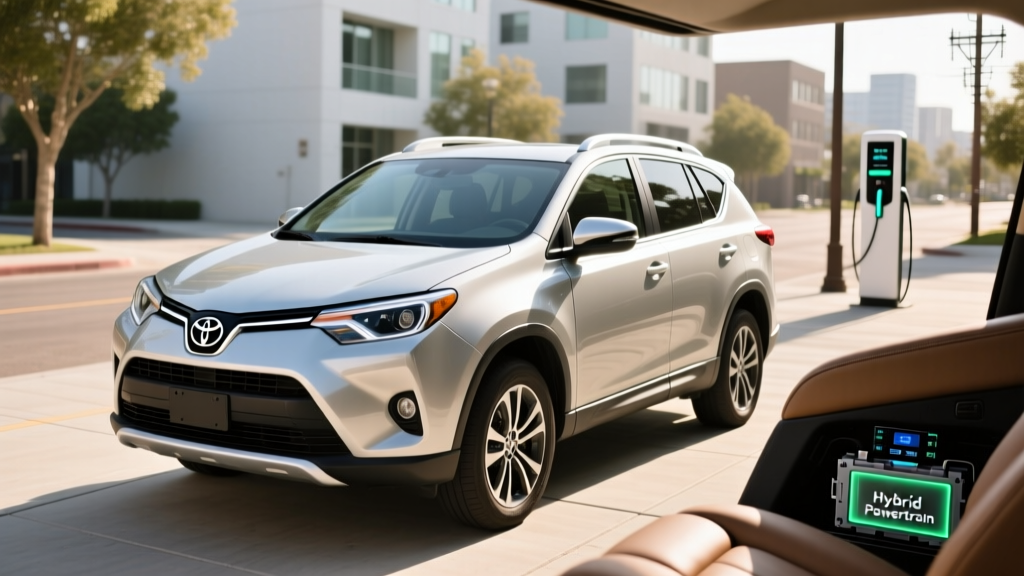
The 2016 Toyota RAV4 Hybrid Limited was the first model year Toyota offered a hybrid version of its best-selling compact SUV, and nearly a decade later it remains one of the most sought-after used hybrid vehicles on the market. With its proven 2.5-liter Atkinson-cycle powertrain, standard all-wheel drive, and the Limited trim's premium features, this SUV continues to deliver exceptional fuel economy without requiring any change in driving habits — no plug, no range anxiety, no learning curve.
If you're shopping the used market in 2026 and considering a 2016 RAV4 Hybrid Limited, this guide covers everything you need: real-world MPG versus EPA estimates, hybrid battery longevity and replacement costs, what the Limited trim actually includes, and how this HEV stacks up against modern plug-in hybrids and full EVs.
HEV vs PHEV vs EV: Where the 2016 RAV4 Hybrid Fits
Before diving into specs, it's essential to understand what you're buying. The 2016 RAV4 Hybrid is a conventional hybrid electric vehicle (HEV). It cannot be plugged in. It charges its small battery pack through regenerative braking and the gasoline engine. This is fundamentally different from a plug-in hybrid (PHEV) like the current RAV4 Prime, or a battery-electric vehicle (BEV) like the Toyota bZ4X.
HEV vs PHEV vs EV — Quick Distinction
| Feature | HEV (2016 RAV4 Hybrid) | PHEV (RAV4 Prime) | BEV (bZ4X) |
|---|---|---|---|
| Plugs in? | No | Yes | Yes |
| Electric-only range | ~0.5 mi at low speed | 42 mi (EPA) | 222-252 mi (EPA) |
| Battery size | ~1.6 kWh (NiMH) | 18.1 kWh (Li-ion) | 71.4 kWh (Li-ion) |
| Fuel required? | Yes — always | Yes (backup) | No |
| Home charging needed? | No | Recommended | Essential |
The HEV approach means zero infrastructure requirements. You fuel up at any gas station and the hybrid system handles the rest. For buyers without home charging access or who regularly drive in areas with sparse EV charging networks, this simplicity is a major advantage.
Fuel Economy: EPA Ratings vs Real-World MPG
The headline number for the 2016 RAV4 Hybrid is its EPA-rated fuel economy, which remains competitive even against 2026 model-year compact SUVs.
| Cycle | EPA Rating | Real-World Expectation |
|---|---|---|
| City | 34 MPG | 33–37 MPG |
| Highway | 31 MPG | 28–32 MPG |
| Combined | 32 MPG | 30–34 MPG |
Source: fueleconomy.gov
Toyota's hybrid system excels in stop-and-go city driving, where the electric motor handles low-speed propulsion and the engine shuts off at stops. Many owners report exceeding the EPA city estimate, with 35–37 MPG in warm-weather urban commutes. Highway fuel economy tends to fall slightly below the EPA sticker, especially at sustained speeds above 70 mph where the aerodynamic drag of an SUV works against efficiency.
Real-World MPG Factors
- Cold weather: Expect 2–4 MPG reduction in winter. The engine runs more frequently to provide cabin heat and maintain battery temperature.
- Highway speed: At 75–80 mph, real-world highway MPG drops to 27–29. Hybrids shine at lower speeds.
- Terrain: Mountain driving reduces economy, but regenerative braking on descents partially recovers energy.
- Battery age: A healthy hybrid battery maintains near-original MPG. A degraded battery forces the engine to work harder — watch for MPG drops as a diagnostic signal.
With a 15.9-gallon fuel tank, the 2016 RAV4 Hybrid delivers approximately 500 miles of total range on a fill-up under mixed driving conditions.
Powertrain and Performance Specs
The 2016 RAV4 Hybrid pairs a 2.5-liter Atkinson-cycle four-cylinder engine with Toyota's Hybrid Synergy Drive system. The Limited trim comes exclusively with electronic on-demand AWD (AWD-i), which uses a separate rear-mounted electric motor to power the rear wheels when traction is needed.
| Specification | Value |
|---|---|
| Engine | 2.5L Atkinson-cycle I4 |
| Gas engine output | 150 hp / 152 lb-ft torque |
| Front electric motor | 105 kW (141 hp) |
| Rear electric motor (AWD-i) | 50 kW (67 hp) |
| Net combined horsepower | 194 hp |
| Transmission | eCVT (planetary gearset) |
| 0–60 mph | 7.8 seconds |
| Drivetrain | AWD-i (electronic on-demand) |
| Hybrid battery | ~1.6 kWh, Nickel-Metal Hydride (NiMH) |
| Towing capacity | 1,750 lbs |
The eCVT is not a traditional belt-driven CVT — it uses a planetary gearset that seamlessly blends power from the engine and electric motors. This design has proven exceptionally durable, with no belts or clutches to wear out. The 194 net horsepower provides confident highway merging and passing, and the electric motor's instant torque makes the RAV4 Hybrid feel quicker off the line than its gas-only counterpart (which produces 176 hp).
Limited Trim: What You Get for the Money
The Limited was the top trim for the 2016 RAV4 Hybrid, and it came loaded with features that still hold up well in 2026. When new, it carried an MSRP of approximately $34,510 (including destination). Here's what that included:
- SofTex synthetic leather seats with heated front seats and driver memory
- Navigation system with 7-inch touchscreen and Entune Audio Plus
- Toyota Safety Sense P (TSS-P): Pre-Collision System with Pedestrian Detection, Lane Departure Alert with Steering Assist, Automatic High Beams, and Full-Speed Range Dynamic Radar Cruise Control
- Blind Spot Monitor with Rear Cross-Traffic Alert
- Power liftgate
- 18-inch alloy wheels
- Smart Key with push-button start
- LED headlights and daytime running lights
The inclusion of TSS-P is particularly significant for a 2016 model year vehicle. Toyota was ahead of most competitors in making active safety features standard, even on a nine-year-old vehicle, this suite provides forward collision warning with automatic emergency braking and adaptive cruise control — features some budget compact SUVs still charge extra for.
Hybrid Battery Longevity, Warranty, and Replacement Cost
The number-one concern for any used hybrid buyer is battery health. Here's what you need to know about the 2016 RAV4 Hybrid's NiMH battery pack.
Hybrid Battery Warranty & Lifespan
Original warranty: 8 years / 100,000 miles (10 years / 150,000 miles in California and states adopting CARB standards).
Expected lifespan: Toyota's NiMH hybrid batteries routinely last 150,000–200,000+ miles with minimal degradation. The 2016 model uses proven NiMH chemistry that is less susceptible to thermal degradation than early lithium-ion packs.
2026 status: The original 8-year/100,000-mile warranty has expired for most 2016 models. However, California-emissions-state vehicles may still have coverage under the 10-year/150,000-mile provision through 2026.
Replacement cost in 2026: A new OEM hybrid battery from Toyota runs approximately $2,500–$3,500 installed at a dealership. Refurbished or reconditioned battery packs are available from independent hybrid specialists for $1,200–$2,000 installed. Individual module replacement (only the failed cells) can bring costs as low as $400–$800 at a qualified hybrid shop.
How to check battery health before buying:
- Use an OBD-II scanner with hybrid-specific software (such as the Dr. Prius app) to read battery block voltage variance. Healthy packs show less than 0.3V difference between blocks.
- Check for dashboard hybrid system warning lights.
- Look for a sudden drop in MPG — a degrading battery forces the engine to compensate.
- Review maintenance records. The hybrid system requires no scheduled maintenance, but a history of dealer inspections provides confidence.
According to NHTSA records, the 2016 RAV4 Hybrid has very few complaints related to hybrid battery failure. Toyota's hybrid system, refined since the 2001 Prius, is among the most reliable powertrains ever produced.
Used Pricing and Tax Credit Eligibility
As of early 2026, the 2016 Toyota RAV4 Hybrid Limited trades in the used market at the following approximate prices:
- 70,000–90,000 miles: $18,000–$22,000
- 90,000–120,000 miles: $15,000–$18,000
- 120,000–150,000+ miles: $12,000–$15,000
Prices vary by region, condition, and color. Hybrid versions consistently command a $1,500–$3,000 premium over equivalent gas-only 2016 RAV4 Limited models — a premium justified by the fuel savings and AWD-i system.
Tax Credit Reality for Used 2016 RAV4 Hybrid
Federal §30D new-vehicle credit: Not applicable — this credit applies only to new vehicle purchases.
Federal used-EV credit (§25E): This credit provides up to $4,000 (30% of sale price, capped at $4,000) for qualifying used EVs and PHEVs purchased from a dealer. However, conventional hybrids (HEVs) do not qualify. The 2016 RAV4 Hybrid is a self-charging HEV and is not eligible for this credit.
State incentives: Most state EV incentives also exclude conventional hybrids. A small number of states previously offered hybrid rebates, but these have largely expired or transitioned to PHEV/BEV-only programs. Check your state's current energy office or DMV website for specifics.
Source: IRS.gov — Clean Vehicle Credits
Who Should Buy the 2016 RAV4 Hybrid Limited vs a PHEV or EV?
Choosing between a used HEV, a new PHEV, or a full EV depends on your driving patterns, charging access, and budget. Here's a practical decision framework:
Decision Framework
Choose the 2016 RAV4 Hybrid (HEV) if:
- You lack access to home or workplace charging
- Your budget is under $22,000
- You want zero behavior change — just gas up and drive
- You drive a mix of city and highway and want 32+ MPG without thinking about it
- You live in a region with extreme cold where EV range loss is a concern
Choose a PHEV (like a used RAV4 Prime or new 2026 PHEV) if:
- You can charge at home (Level 2 or even Level 1 overnight)
- Most daily driving is under 30–40 miles round-trip
- You want electric-only commuting with gas backup for road trips
- You can benefit from the federal tax credit (up to $7,500 for new PHEVs meeting §30D sourcing and income requirements)
Choose a full EV (BEV) if:
- You have reliable home Level 2 charging
- Your daily driving is predictable and within the vehicle's range
- You want the lowest per-mile fuel cost and minimal maintenance
- You're ready to plan around DC fast charging on road trips
For apartment dwellers, street parkers, and anyone in a charging desert, the 2016 RAV4 Hybrid remains one of the smartest used-vehicle buys available. It delivers 30%+ fuel savings over the gas RAV4 with no infrastructure dependency, no plug-in routine, and Toyota's legendary hybrid reliability.
Pros and Cons at a Glance
Pros
- 32 MPG combined — 34 city — excellent for an AWD SUV
- No plug-in required; zero charging infrastructure needed
- Standard AWD-i with independent rear electric motor
- Toyota Safety Sense P standard (AEB, adaptive cruise, lane assist)
- Proven NiMH battery with 150k–200k+ mile lifespan
- Limited trim well-equipped (nav, heated seats, power liftgate)
- Strong resale value and low depreciation curve
Cons
- No electric-only driving range (EV mode limited to ~0.5 mi at low speed)
- No federal or state tax credits for used HEV purchase
- 7-inch infotainment screen feels dated by 2026 standards
- No Apple CarPlay or Android Auto (added in 2019 refresh)
- Original hybrid battery warranty has expired for most vehicles
- Rear cargo space slightly reduced vs gas model (battery placement)
- Towing limited to 1,750 lbs
Frequently Asked Questions
How many MPG does the 2016 Toyota RAV4 Hybrid get?
The EPA rates it at 34 city / 31 highway / 32 combined MPG. In real-world driving, city MPG often exceeds 34 (up to 37 in warm weather), while sustained highway driving above 70 mph may yield 27–29 MPG. Cold weather reduces economy by roughly 2–4 MPG across the board.
Does the 2016 RAV4 Hybrid need to be plugged in?
No. This is a conventional hybrid (HEV), not a plug-in hybrid. The battery charges itself through regenerative braking and the gasoline engine. You never need to plug it in, and there is no charging port on the vehicle.
Is the 2016 RAV4 Hybrid reliable, and what does battery replacement cost?
Extremely reliable. Toyota's Hybrid Synergy Drive is one of the most proven powertrains in automotive history. The NiMH battery typically lasts 150,000–200,000+ miles. If replacement is needed, expect $2,500–$3,500 for a new OEM battery or $1,200–$2,000 for a refurbished unit. Independent hybrid shops can sometimes replace individual failed modules for $400–$800.
Does the 2016 RAV4 Hybrid qualify for any tax credit?
No. Conventional hybrids are not eligible for the federal §30D new-vehicle credit or the §25E used clean-vehicle credit. These credits are reserved for plug-in vehicles (PHEVs and BEVs) that meet specific battery capacity, sourcing, MSRP, and buyer income requirements. Some states previously offered hybrid incentives, but most have been discontinued.
How does the 2016 RAV4 Hybrid compare to the RAV4 Prime PHEV?
The RAV4 Prime (introduced for 2021) is a plug-in hybrid with 42 miles of electric-only range, a larger 18.1 kWh lithium-ion battery, 302 combined horsepower, and available federal tax credits when purchased new. It also costs significantly more — even used 2021–2022 RAV4 Primes command $35,000–$42,000. The 2016 Hybrid is the budget-friendly, no-plug alternative for buyers who want Toyota hybrid efficiency without the PHEV price premium.
What should I check before buying a used 2016 RAV4 Hybrid?
Prioritize a hybrid battery health check using an OBD-II scanner (Dr. Prius app or equivalent) to read block voltage variance. Confirm no hybrid system warning lights are present. Check for consistent MPG readings on the trip computer. Verify TSS-P functionality (adaptive cruise, pre-collision system). As with any 9-year-old vehicle, review maintenance records, check for timing chain wear indicators, and inspect suspension components.