Quick Verdict: The XC60 Hybrid Bridges Two Worlds
The Volvo XC60 Recharge T8 plug-in hybrid occupies a narrow but compelling lane: it delivers genuine electric-only commuting range for daily driving while keeping a turbocharged gas engine for road trips where charging infrastructure remains unreliable. For 2025–2026 model years, Volvo equips the XC60 Recharge with a 18.8 kWh battery pack (usable capacity approximately 14.9 kWh), yielding an EPA-rated 35 miles of electric-only range and a combined 56 MPGe when blending electric and gas operation. Once the battery depletes, the 2.0-liter turbocharged four-cylinder and electric motor cooperate to return an EPA-estimated 28 MPG combined in hybrid mode.
At a starting MSRP around $59,050 for the Core trim and climbing past $72,000 for the Ultra, the XC60 Recharge commands a premium over the mild-hybrid XC60 B5 — but it also produces 455 combined horsepower and qualifies for partial federal tax incentives that narrow the gap. This guide breaks down every number that matters before you sign.
HEV vs PHEV: What the XC60 Hybrid Actually Is
Volvo's XC60 lineup includes two electrified flavors, and confusing them is the most common buyer mistake:
| Feature | XC60 B5 (Mild Hybrid / HEV) | XC60 Recharge T8 (PHEV) |
|---|---|---|
| Powertrain type | Mild hybrid (48V system) | Plug-in hybrid (high-voltage + gas) |
| Plug-in charging required? | No — regenerates internally | Yes — plug in for electric range |
| Electric-only driving | Not possible (assist only) | Up to 35 miles EPA |
| Battery capacity | ~0.5 kWh (48V buffer) | 18.8 kWh gross / ~14.9 kWh usable |
| Combined horsepower | 247 hp | 455 hp |
| EPA combined | 26 MPG | 56 MPGe (blended) / 28 MPG (gas only) |
| Federal tax credit eligible | No | Up to $3,750 (varies by sourcing) |
The B5's 48-volt mild-hybrid system smooths stop-start and provides marginal torque fill — it cannot propel the car on electricity alone. The Recharge T8 is a true plug-in hybrid (PHEV) with a high-voltage battery, an integrated electric motor on the rear axle, and the ability to drive on pure electric power at highway speeds. If your search for an "XC60 hybrid" is motivated by electric-only commuting, the T8 Recharge is the model you want.
Range, MPG, and Real-World Efficiency
| Metric | EPA Estimate | Real-World Expectation |
|---|---|---|
| Electric-only range | 35 miles | 28–33 miles (highway or cold weather) |
| Blended MPGe | 56 MPGe | Depends on charging frequency |
| Gas-only city MPG | 27 MPG | 28–32 MPG (regen assists in stop-and-go) |
| Gas-only highway MPG | 28 MPG | 25–27 MPG at 75+ mph |
| Gas-only combined MPG | 28 MPG | 26–29 MPG typical mixed driving |
| Total range (full tank + full charge) | ~470 miles | ~420–460 miles real-world |
Electric-only range in practice: The EPA's 35-mile figure assumes moderate temperatures and mixed driving. In winter conditions below 40°F, expect that number to drop to roughly 25–28 miles due to cabin heating demands and reduced battery efficiency. Conversely, gentle city driving in mild weather can push past 37 miles before the engine wakes up.
Hybrid-mode MPG honesty: Once the battery is depleted, the T8 operates as a conventional hybrid. The EPA's 28 MPG combined is accurate for suburban driving, but sustained highway speeds above 70 mph push the figure toward 25–26 MPG — the XC60's aerodynamic profile and ~4,700 lb curb weight work against it. City drivers often exceed the EPA estimate thanks to aggressive regenerative braking recapturing energy at every stoplight.
Powertrain, Performance, and Battery Specs
| Specification | XC60 Recharge T8 AWD |
|---|---|
| Engine | 2.0L turbocharged 4-cylinder (310 hp / 295 lb-ft) |
| Rear electric motor | 143 hp / 228 lb-ft |
| Combined system output | 455 hp / 523 lb-ft |
| Transmission | 8-speed automatic |
| Drivetrain | AWD (engine drives front, motor drives rear) |
| 0–60 mph | 4.5 seconds |
| Battery (gross / usable) | 18.8 kWh / ~14.9 kWh |
| Battery chemistry | NMC (nickel manganese cobalt) |
| Onboard charger (Level 2) | 3.7 kW (single-phase) |
| Level 2 charge time (0–100%) | ~5 hours |
| DC fast charging | Not supported |
| Fuel tank capacity | 15.9 gallons |
| Curb weight | ~4,722 lbs |
The T8's powertrain architecture is worth understanding: the gasoline engine powers the front wheels exclusively, while the rear-mounted electric motor drives the rear axle. There is no mechanical connection between front and rear — AWD is managed electronically. This means in Pure (electric-only) mode, the XC60 Recharge is effectively rear-wheel drive, which you'll notice on slippery surfaces.
Charging limitations: The 3.7 kW onboard charger is the XC60 Recharge's most significant compromise. A full Level 2 charge takes approximately 5 hours, meaning you can't fully replenish during a quick stop. More critically, the XC60 Recharge does not support DC fast charging — there is no CCS or NACS port for rapid top-ups. For a PHEV with 35 miles of range, this is acceptable for home-centric users but frustrating if you were hoping to charge at a highway fast-charging station.
Pricing, Trims, and Tax Credit Eligibility
| Trim | 2025 MSRP (est.) | Key Features |
|---|---|---|
| Core | $59,050 | 19" wheels, panoramic roof, Google built-in, Pilot Assist |
| Plus | $62,850 | Harman Kardon audio, 360° camera, head-up display |
| Ultra | $67,550 | Bowers & Wilkins audio, air suspension, 20" wheels |
| Polestar Engineered | $72,350 | Öhlins dampers, 22" wheels, gold brake calipers, chassis tuning |
Federal tax credit (§30D): The XC60 Recharge T8 is assembled in Ghent, Belgium, which creates complications under the Inflation Reduction Act's final-assembly requirement. As of current IRS guidelines, vehicles must undergo final assembly in North America to qualify for the full §30D credit of up to $7,500. The XC60 Recharge does not meet this requirement, meaning it is generally ineligible for the federal new-vehicle EV tax credit.
However, some buyers may still benefit from:
- State-level PHEV incentives — states like California, Colorado, and New York offer rebates for PHEVs regardless of assembly location (check your state's energy office for current programs).
- Utility company rebates — many electric utilities offer $250–$500 for installing a Level 2 home charger, which benefits PHEV owners equally.
- Employer or local municipality incentives — increasingly common in metro areas with clean-air mandates.
Battery Longevity, Warranty, and Replacement Costs
High-voltage battery degradation is the top concern for PHEV buyers, and Volvo addresses it with industry-standard coverage:
- Hybrid battery warranty: 8 years / 100,000 miles (whichever comes first)
- Capacity retention guarantee: Volvo warrants the battery to retain at least 70% of original capacity during the warranty period
- Powertrain warranty: 4 years / 50,000 miles (standard Volvo coverage)
- Complimentary scheduled maintenance: 3 years / 36,000 miles
Real-world degradation data: The XC60 T8's 18.8 kWh NMC battery operates with a substantial buffer — only about 14.9 kWh is usable — which protects longevity by preventing deep discharge and overcharge stress. Based on owner reports from earlier T8 models (2018–2022 with smaller 11.6 kWh packs), most batteries retain 90%+ capacity after 5 years of daily cycling. The larger 18.8 kWh pack should experience even less relative stress since daily commuting uses a shallower portion of total capacity.
Out-of-warranty replacement cost: If the battery fails after warranty expiration, expect a replacement cost between $8,000 and $12,000 including parts and labor at a Volvo dealer. Third-party hybrid battery rebuilders may offer repairs for $4,000–$6,000, though availability for newer T8 packs is still limited. For context, the 12V auxiliary battery (a separate, conventional battery that powers electronics) typically costs $200–$400 to replace every 4–6 years.
Reliability outlook: Volvo's T8 powertrain has been in production since 2016 and is now in its third generation. The primary reliability concerns in earlier models (electric motor inverter faults, software glitches in the hybrid control module) have been largely addressed through software updates and hardware revisions. According to IIHS, the XC60 earns top safety marks, and the hybrid system adds minimal mechanical complexity beyond the standard powertrain since the electric motor replaces the traditional rear differential.
Charging at Home: What You Need to Know
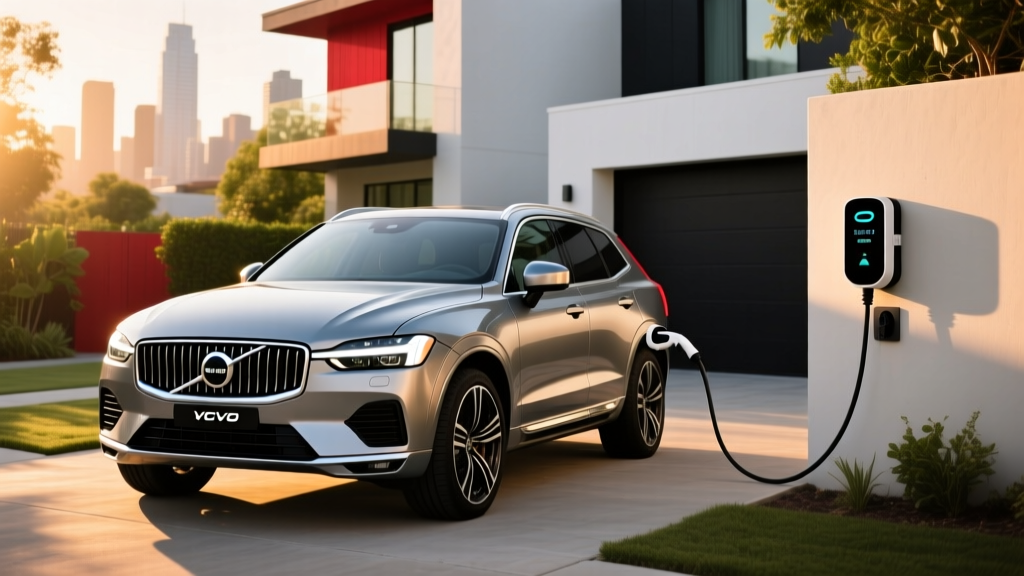
The XC60 Recharge uses a standard J1772 connector for Level 1 and Level 2 AC charging. Here's what each level delivers:
| Charging Level | Power | Time to Full Charge | Setup Required |
|---|---|---|---|
| Level 1 (120V outlet) | ~1.4 kW | ~12–14 hours | Standard household outlet; included cord |
| Level 2 (240V) | 3.7 kW (car-limited) | ~5 hours | 240V outlet or hardwired station; electrician install |
| DC Fast Charge | N/A | N/A | Not supported on XC60 Recharge |
Key insight: Even if you install a 48-amp Level 2 charger capable of delivering 11.5 kW, the XC60 Recharge will only draw 3.7 kW because that's the maximum its onboard charger can accept. You don't need an expensive high-amperage station — a basic 16-amp, 240V circuit is sufficient and will cost significantly less to install.
Home installation cost: A dedicated 240V/20A circuit for PHEV charging typically runs $500–$1,500 if your electrical panel has capacity and the outlet is near the parking spot. If a panel upgrade (100A to 200A) is needed, add $1,500–$3,000. Always get a quote from a licensed electrician before committing.
Cost per mile on electricity: At the national average electricity rate of ~$0.16/kWh, fully charging the 14.9 kWh usable battery costs about $2.38, which covers 28–33 real-world electric miles — roughly $0.07–$0.09 per mile. Compare that to gasoline at $3.50/gallon and 28 MPG, which works out to $0.125 per mile. Electric commuting in the XC60 Recharge saves approximately 40–45% on fuel cost per mile.
XC60 Hybrid vs Full EV vs Gas: Which Fits You?
Choose the XC60 Recharge T8 (PHEV) if:
- Your daily commute is under 35 miles round-trip and you can charge at home nightly
- You take 3+ road trips per year where charging infrastructure is unreliable
- You want electric commuting without committing to full EV range planning
- You value the 455 hp performance upgrade over the B5 mild hybrid
Choose a full EV (like the Volvo EX60 or Tesla Model Y) if:
- You have reliable home charging and your longest regular trip is under 250 miles
- You want to eliminate oil changes, spark plugs, and transmission fluid entirely
- You want access to the full $7,500 federal tax credit (on qualifying models)
- You prioritize lowest total cost of ownership over 5–8 years
Choose the XC60 B5 (mild hybrid/gas) if:
- You cannot install a home charger (apartment, street parking, no garage)
- Your budget is under $55,000 and the T8 premium doesn't justify itself
- You drive mostly highway miles where the PHEV's electric range offers minimal benefit
Pros and Cons at a Glance
Pros
- 35 miles electric-only covers most commutes
- 455 hp makes it one of the quickest compact luxury SUVs
- No range anxiety — gas engine for long trips
- Premium interior with Google built-in infotainment
- Standard AWD with independent front/rear power
- 8-year/100,000-mile hybrid battery warranty
Cons
- 3.7 kW onboard charger limits Level 2 speed
- No DC fast charging capability
- Ineligible for $7,500 federal tax credit (non-US assembly)
- $10,000+ premium over the B5 mild hybrid
- Electric range drops to ~25 miles in cold weather
- Cargo space slightly reduced vs B5 (battery packaging)
Frequently Asked Questions
How many MPG does the Volvo XC60 hybrid get?
The XC60 Recharge T8 PHEV achieves an EPA-estimated 56 MPGe when blending electric and gasoline operation. Once the battery is depleted, it returns 27 MPG city / 28 MPG highway / 28 MPG combined as a conventional hybrid. The mild-hybrid XC60 B5 achieves 24 city / 30 highway / 26 combined MPG.
How far can the XC60 Recharge go on electric only?
The EPA rates the XC60 Recharge T8 at 35 miles of electric-only range. Real-world results vary: expect 28–33 miles in mixed driving, 25–28 miles in cold weather or at highway speeds, and potentially 36+ miles during gentle city driving in mild temperatures.
Does the XC60 hybrid qualify for a federal tax credit?
No. The XC60 Recharge is assembled in Ghent, Belgium, and does not meet the IRS §30D final-assembly-in-North-America requirement. It is ineligible for the federal new clean vehicle credit of up to $7,500. State and utility incentives may still apply — check your local programs.
Is the XC60 hybrid reliable, and what does battery replacement cost?
The T8 powertrain has been in production since 2016 and is now in its third generation with improved reliability. Volvo warranties the hybrid battery for 8 years / 100,000 miles with a 70% capacity retention guarantee. Out-of-warranty battery replacement costs approximately $8,000–$12,000 at a dealer, though most PHEV batteries outlast their warranty periods with minimal degradation.
Can the XC60 Recharge DC fast charge?
No. The XC60 Recharge supports only Level 1 (120V) and Level 2 (240V) AC charging via a J1772 connector. Its 3.7 kW onboard charger means a full Level 2 charge takes about 5 hours. DC fast charging is not available on any current XC60 Recharge model.
Should I buy the XC60 Recharge PHEV or a full EV?
If you can charge at home and your daily driving is under 35 miles, the XC60 Recharge lets you commute on electricity while retaining gas-engine flexibility for road trips. If you have reliable charging access and rarely exceed 250 miles between stops, a full EV like the Volvo EX90 or Tesla Model Y offers lower operating costs, stronger tax incentives, and zero tailpipe emissions — but requires trip planning for longer journeys.
What's the difference between the XC60 B5 and XC60 Recharge T8?
The B5 is a mild hybrid with a 48-volt system that assists the gas engine but cannot drive on electricity alone (247 hp, 26 MPG combined). The T8 Recharge is a plug-in hybrid with a high-voltage battery and rear electric motor enabling 35 miles of electric-only driving, 455 combined hp, and 56 MPGe. The T8 costs approximately $10,000–$13,000 more depending on trim.