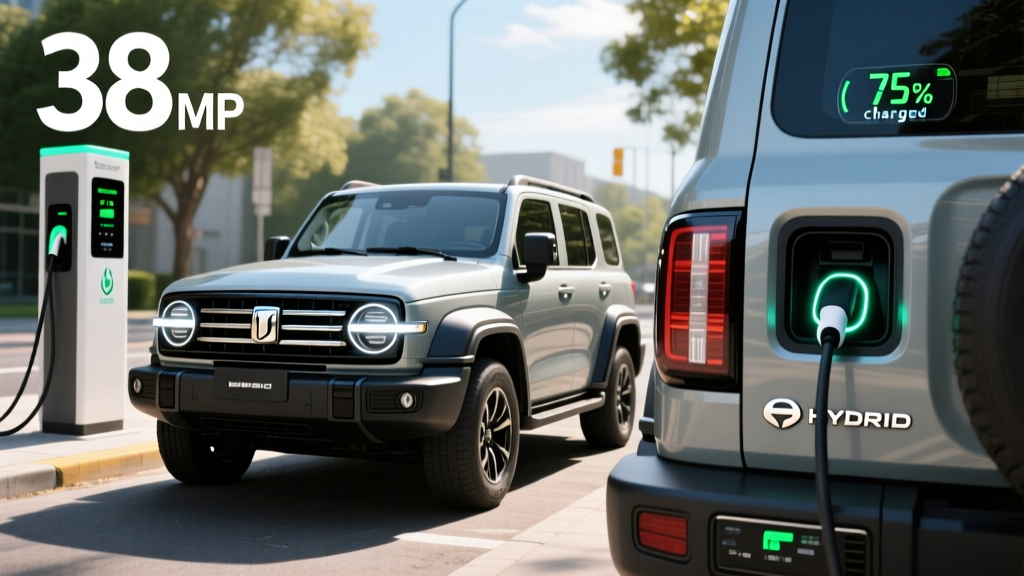
The Tank 300 Hybrid is Great Wall Motor's (GWM) answer to buyers who want serious off-road capability without the punishing fuel bills of a body-on-frame SUV. Sold in select global markets under GWM's Tank sub-brand, the hybrid variant pairs a turbocharged engine with an electric motor to cut consumption while retaining the rugged DNA the Tank 300 is known for. For US-based shoppers researching the "hybrid tank" concept — whether referring to the Tank 300 HEV, the Tank 500 Hi4-T PHEV, or the broader idea of a fuel-efficient rugged SUV — this guide breaks down the exact numbers that matter.
Before we get into specs, it's essential to distinguish between the two hybrid configurations GWM offers under the Tank badge: a conventional hybrid (HEV) that never needs plugging in, and a plug-in hybrid (PHEV) that can drive on electric-only power for a meaningful distance. They solve different problems.
HEV vs PHEV: Which Tank Hybrid Are You Looking At?
| Attribute | Tank 300 HEV (Conventional Hybrid) | Tank 500 Hi4-T (Plug-in Hybrid) |
|---|---|---|
| Plugs in? | No — charges via regenerative braking and engine | Yes — Level 2 AC charging capable |
| Electric-only range | None (motor assists engine only) | ~62 miles (WLTP); ~50 miles estimated EPA |
| Battery size | ~1.8 kWh (small buffer) | 37.1 kWh (NMC chemistry) |
| Best for | Drivers without home charging access | Drivers with home charging who commute short distances |
| Tax credit eligible (US)? | No — §30D requires plug-in capability | Potentially, if sold in US and meets sourcing rules |
Powertrain and Performance Specs
The Tank 300 HEV uses a 2.0-liter turbocharged four-cylinder engine paired with an integrated electric motor and a 9-speed automatic transmission. Combined output is approximately 300 horsepower and 470 lb-ft of torque — a meaningful bump over the conventional gas-only Tank 300's 220 hp. The electric motor fills in the torque curve at low RPMs, which is exactly where you want immediate response during off-road crawling or merging onto a highway.
The larger Tank 500 Hi4-T PHEV steps up to a 2.0T engine with a more powerful electric motor integrated into a 9HAT (hybrid automatic transmission). Combined output reaches 402 hp and 553 lb-ft of torque. The bigger battery and motor allow genuine electric-only driving at highway speeds, not just low-speed assist.
| Specification | Tank 300 HEV | Tank 500 Hi4-T PHEV |
|---|---|---|
| Engine | 2.0L Turbo I4 | 2.0L Turbo I4 |
| Combined HP | ~300 hp | ~402 hp |
| Combined Torque | ~470 lb-ft | ~553 lb-ft |
| Transmission | 9-speed automatic | 9HAT automatic |
| Drivetrain | 4WD with locking diffs | 4WD with locking diffs |
| 0-60 mph (est.) | ~7.8 sec | ~6.5 sec |
| Towing capacity | ~5,500 lbs | ~6,600 lbs |
| Battery (usable) | ~1.8 kWh | ~37.1 kWh (NMC) |
Fuel Economy: EPA MPG and Real-World Expectations
Because GWM does not currently sell vehicles in the United States, official EPA fuel economy figures are not published on fueleconomy.gov. However, based on WLTP testing and real-world reviews from Australian and Southeast Asian markets (where the Tank 300 HEV is sold), we can estimate US-equivalent figures.
| Metric | Tank 300 HEV (Estimated EPA) | Tank 300 Gas-Only (Baseline) |
|---|---|---|
| City MPG | ~26 mpg | ~18 mpg |
| Highway MPG | ~24 mpg | ~20 mpg |
| Combined MPG | ~25 mpg | ~19 mpg |
For the Tank 500 Hi4-T PHEV, fuel economy depends entirely on how often you charge. On electric-only power, it consumes roughly 38-42 kWh/100 miles (equivalent to ~80 MPGe). Once the battery is depleted, it operates as a heavy hybrid SUV at an estimated 22-24 mpg combined. If you charge nightly and commute under 50 miles, you may use gasoline only on weekend road trips.
Electric-Only Range and Total Range (PHEV)
The Tank 500 Hi4-T's 37.1 kWh battery delivers approximately 62 miles of electric-only range under WLTP testing. EPA estimates tend to run 15-20% lower, putting a realistic US-equivalent figure at around 50 miles of electric driving. That covers most daily commutes without burning a drop of fuel.
Total combined range — electric plus a full tank of gasoline — reaches roughly 500-550 miles. The Tank 300 HEV, with no electric-only capability but a standard fuel tank, achieves a total range of approximately 400-440 miles depending on driving conditions.
Charging Capabilities (PHEV Only)
The Tank 500 Hi4-T supports AC Level 2 charging at up to 7 kW, which replenishes the 37.1 kWh battery from empty to full in approximately 5.5 hours. This is typical for PHEVs in this class — overnight charging on a home Level 2 station is the intended workflow.
Notably, the Tank 500 Hi4-T does not support DC fast charging. This is common for PHEVs: the smaller battery (relative to a full BEV) makes DCFC infrastructure cost-prohibitive, and the 5.5-hour Level 2 charge is fast enough for overnight use. If you need rapid charging capability, a full battery-electric vehicle is a better fit.
| Charging Level | Power | Miles of Range Added per Hour | Full Charge Time (0-100%) |
|---|---|---|---|
| Level 1 (120V household) | ~1.4 kW | ~4-5 miles/hr | ~26 hours |
| Level 2 (240V home station) | ~7 kW | ~20-25 miles/hr | ~5.5 hours |
| DC Fast Charge | Not supported | N/A | N/A |
Pricing and Tax Credit Eligibility
As of early 2026, GWM has not announced US pricing for any Tank-branded vehicle. In Australia, the Tank 300 HEV starts at approximately AUD $55,000 (roughly USD $36,000 at current exchange rates), while the Tank 500 Hi4-T PHEV starts around AUD $75,000 (~USD $49,000). US pricing, if introduced, would likely land in similar territory after accounting for market-specific equipment and tariffs.
Regarding the federal §30D tax credit: conventional hybrids like the Tank 300 HEV do not qualify — the credit is reserved for plug-in electric vehicles (BEVs and PHEVs) that meet battery sourcing, MSRP cap, and buyer income requirements outlined by the IRS. The Tank 500 Hi4-T PHEV could theoretically qualify for up to $7,500 if GWM sold it in the US and it met critical mineral and battery component sourcing requirements — but since GWM is a Chinese manufacturer, current trade restrictions and tariff structures make US availability uncertain at best. Always consult a tax professional for eligibility specific to your situation.
- Vehicle must be a plug-in EV (BEV or PHEV) — conventional HEVs excluded
- MSRP cap: $80,000 for SUVs/pickups/vans; $55,000 for sedans
- Buyer income cap: $300,000 joint / $225,000 head of household / $150,000 single (modified AGI)
- Battery critical minerals and components must meet phased-in sourcing thresholds
- Credit can be transferred to dealer at point of sale for immediate price reduction
Battery Warranty, Reliability, and Replacement Cost
GWM provides an 8-year/160,000 km (~100,000 mile) warranty on the hybrid battery pack in markets where the Tank 300 HEV and Tank 500 Hi4-T are sold. This is consistent with the hybrid battery warranty standards set by Toyota, Hyundai, and other established manufacturers. The warranty typically guarantees the battery will retain at least 70% of its original capacity during the coverage period.
Reliability data for GWM's hybrid powertrain is still accumulating, as the Tank 300 HEV launched in export markets in 2023-2024. Early owner reports from Australia suggest no systemic issues, though the sample size remains small compared to Toyota's decades of hybrid data. GWM's 2.0T engine is a proven design shared across multiple models.
Hybrid Tank vs Full EV vs Gas: Which Fits You?
The decision between a hybrid tank-style SUV, a full battery-electric vehicle, and a conventional gas rig comes down to three questions: Can you charge at home? How far do you drive daily? And how often do you go off-grid?
- You cannot install a home charger (apartment, street parking)
- You want better fuel economy with zero behavior change
- You regularly tow or go off-road and need instant torque assist
- You want a proven, low-complexity powertrain
- You have home Level 2 charging and commute under 50 miles daily
- You want electric-only weekday driving but gas-powered weekend road trips
- You value the combined 400+ hp for towing and off-road performance
- You have reliable home and/or workplace charging
- Your daily driving is under 250 miles and you can plan road-trip charging
- You want the lowest per-mile energy cost and minimal maintenance
- You want to qualify for the full §30D federal tax credit
- You drive in extreme cold regularly (below 0°F) where hybrid/EV efficiency drops significantly
- You frequently travel to areas with no charging infrastructure
- Upfront purchase price is your primary constraint
Tank 300 HEV Pros
- 30%+ fuel economy improvement over gas-only Tank 300
- No charging infrastructure needed
- Strong low-end torque from electric motor assist
- Proven body-on-frame off-road capability with locking differentials
- 8-year hybrid battery warranty
Tank 300 HEV Cons
- Not available in the US market as of 2026
- No electric-only driving capability
- Still a body-on-frame SUV — rides firmer than crossovers
- Hybrid premium adds ~$4,000-$5,000 over gas-only model
- Limited long-term reliability data vs. Toyota/Honda hybrids
Frequently Asked Questions
How many MPG does the Tank 300 Hybrid get?
Estimated at approximately 25 mpg combined (26 city / 24 highway) based on WLTP data and comparable vehicles. Real-world city driving with frequent stops may yield 27-29 mpg due to regenerative braking, while sustained highway driving at 75+ mph may drop to 22-23 mpg. These are estimates — official EPA data is unavailable since GWM does not sell in the US.
How far can the Tank 500 PHEV go on electric only?
The Tank 500 Hi4-T delivers approximately 62 miles of electric-only range under WLTP testing, which translates to an estimated 50 miles under EPA-equivalent conditions. This covers most daily commutes. Once the battery depletes, the vehicle operates as a conventional hybrid at roughly 22-24 mpg combined.
Does the Tank 300 Hybrid need to be plugged in?
No. The Tank 300 HEV is a conventional hybrid that charges its small battery through regenerative braking and the gasoline engine. You never plug it in. The larger Tank 500 Hi4-T is a plug-in hybrid (PHEV) that benefits from being plugged in for electric-only range but can also operate without plugging in as a standard hybrid.
Is the Tank hybrid powertrain reliable?
GWM's hybrid system is relatively new, so long-term data is limited compared to Toyota's 25+ years of hybrid production. However, the architecture follows proven hybrid principles: a small battery with shallow charge cycles (HEV) or a larger battery with robust thermal management (PHEV). The 8-year/100,000-mile hybrid battery warranty provides meaningful protection. Hybrid battery replacement, if ever needed, would likely cost $2,000-$4,000 for the HEV and $8,000-$14,000 for the PHEV.
Does the Tank Hybrid qualify for a US tax credit?
The conventional Tank 300 HEV does not qualify for the federal §30D tax credit because it is not a plug-in vehicle. The Tank 500 Hi4-T PHEV could theoretically qualify if sold in the US, but GWM's Chinese manufacturing origin creates complications with battery sourcing requirements and potential tariffs. As of 2026, no Tank vehicle is available in the US market. Check IRS.gov for current credit rules.
Can I import a Tank 300 Hybrid to the United States?
Importing a vehicle not certified by NHTSA and EPA for US sale is extremely difficult for individual consumers. The vehicle must meet all Federal Motor Vehicle Safety Standards (FMVSS) and emissions certifications. GWM has not pursued US homologation for the Tank 300, making personal import impractical and likely illegal for road use.
How does the Tank 300 HEV compare to the Toyota 4Runner Hybrid?
The 2025+ Toyota 4Runner Hybrid (i-FORCE MAX) offers a similar body-on-frame hybrid concept with approximately 27 mpg combined, 326 hp, and Toyota's extensive hybrid reliability track record. The 4Runner is widely available in the US with full warranty support and dealer networks, making it the practical choice for American buyers. The Tank 300 HEV offers competitive specs but no US availability.