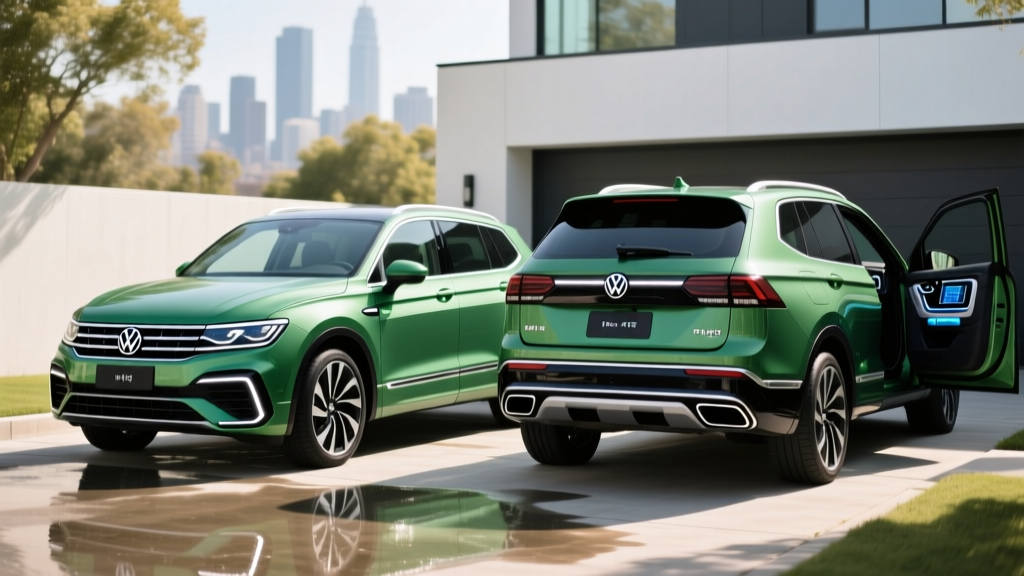
If you have been searching for a Volkswagen hybrid SUV, the 2026 model year finally brings credible electrified options to VW's utility-vehicle lineup. After years of offering only mild-hybrid assistance in the U.S. market, Volkswagen now sells plug-in hybrid (PHEV) versions of its best-selling SUVs — the compact Tiguan and the three-row Atlas — bridging the gap between a conventional gas car and a full battery-electric vehicle like the ID.4.
This guide breaks down every 2026 Volkswagen hybrid SUV available in the United States, with exact EPA figures, real-world expectations, battery specs, warranty coverage, and tax-credit eligibility. Whether you want short electric commutes or long-distance flexibility without range anxiety, we will help you decide which VW hybrid — if any — fits your driving life.
HEV vs PHEV: Understanding Volkswagen's Hybrid Strategy
Before we get to the specific models, it is critical to understand the two types of hybrid powertrains Volkswagen uses, because they behave very differently in daily ownership.
Conventional Hybrid (HEV)
A standard hybrid pairs a gasoline engine with a small electric motor and a tiny battery (typically 1–2 kWh). It never plugs in. The battery recharges through regenerative braking and the engine. You get a modest MPG boost — usually 5–10 MPG over a gas-only equivalent — with zero change to your fueling routine.
Plug-In Hybrid (PHEV)
A plug-in hybrid carries a much larger battery (13–20+ kWh usable) and a more powerful electric motor. You plug it in to a wall outlet or Level 2 charger to unlock 30–40 miles of pure electric driving. Once the battery depletes, it operates like a conventional hybrid. PHEVs qualify for federal tax credits that HEVs do not.
For the 2026 model year, Volkswagen's U.S. hybrid SUV lineup is exclusively PHEV. The Tiguan eHybrid and the newly introduced Atlas PHEV both use plug-in architectures. If you want a VW SUV that never needs plugging in, you are looking at a conventional gas model — there is no standalone HEV in VW's current American SUV range.
2026 Volkswagen Tiguan eHybrid: Specs, Range, and Real-World MPG
The Tiguan is Volkswagen's volume compact SUV, and the eHybrid variant adds meaningful electric capability without sacrificing cargo space or all-wheel-drive availability.
| Specification | 2026 Tiguan eHybrid |
|---|---|
| Powertrain | 1.5L turbo I-4 + electric motor (PHEV) |
| Combined Horsepower | 245 hp (system net) |
| Battery (usable) | 19.7 kWh, NMC lithium-ion |
| EPA Electric-Only Range | ~38 miles |
| EPA Combined MPGe (electric + gas) | ~84 MPGe |
| EPA MPG (charge-sustaining / gas-only) | 35 city / 34 hwy / 35 combined |
| Total Combined Range | ~440 miles (electric + gas tank) |
| Level 2 Charging (0–100%) | ~2 hr 45 min at 7.2 kW |
| DC Fast Charging | Not available |
| 0–60 mph | ~7.5 seconds |
| Starting MSRP | $40,990 (SE R-Line eHybrid) |
Real-World MPG vs. EPA Estimates
The EPA's charge-sustaining MPG figure of 35 combined applies once the battery is depleted and the Tiguan operates purely as a hybrid. In real-world testing, PHEVs like the Tiguan eHybrid tend to exceed EPA city estimates when the battery is engaged because electric-only driving replaces the least efficient low-speed engine operation. Expect 37–40 MPG equivalent in mixed city driving if you start with a full charge and your trip is under 40 miles. On sustained highway runs at 75 mph with a depleted battery, expect 32–34 MPG — slightly below the EPA sticker, which is typical for turbocharged PHEVs at highway speed.
Real-World Range Note: The EPA rates the Tiguan eHybrid at ~38 miles electric-only. In moderate temperatures (60–75°F) with gentle driving, expect 35–40 real-world miles. In winter conditions (below 35°F) or at sustained highway speeds above 70 mph, expect that figure to drop to 26–30 miles due to cabin heating demands and aerodynamic drag.
2026 Volkswagen Atlas PHEV: Three-Row Plug-In Hybrid
The Atlas PHEV is the headline addition to VW's 2026 lineup — a three-row, seven-seat plug-in hybrid that directly targets families who want electric weekday commuting without giving up the road-trip flexibility of a large SUV.
| Specification | 2026 Atlas PHEV |
|---|---|
| Powertrain | 2.0L turbo I-4 + electric motor (PHEV) |
| Combined Horsepower | 285 hp (system net) |
| Battery (usable) | 19.7 kWh, NMC lithium-ion |
| EPA Electric-Only Range | ~33 miles |
| EPA Combined MPGe | ~77 MPGe |
| EPA MPG (charge-sustaining / gas-only) | 30 city / 28 hwy / 29 combined |
| Total Combined Range | ~430 miles |
| Level 2 Charging (0–100%) | ~3 hr at 7.2 kW |
| DC Fast Charging | Not available |
| 0–60 mph | ~7.8 seconds |
| Starting MSRP | $51,490 (SE w/ Technology PHEV) |
The Atlas PHEV is heavier than the Tiguan, which explains the slightly lower electric-only range and gas-only MPG. However, for a three-row SUV, 33 miles of electric range covers the average American's one-way commute with margin, meaning many owners will burn almost no gasoline on weekdays if they charge at home overnight.
Charging the Volkswagen PHEV Lineup: What You Need at Home
Neither the Tiguan eHybrid nor the Atlas PHEV supports DC fast charging. This is typical for PHEVs — the battery is small enough that Level 2 AC charging is sufficient for overnight replenishment.
| Charging Level | Power | Time (0–100%) | Miles of EV Range Added/Hour |
|---|---|---|---|
| Level 1 (120V household outlet) | ~1.4 kW | ~14 hours | ~4–5 miles |
| Level 2 (240V home charger) | 7.2 kW | ~2 hr 45 min (Tiguan) / ~3 hr (Atlas) | ~14–16 miles |
| DC Fast Charging | N/A | Not supported | N/A |
A standard 120V outlet will technically recharge either PHEV overnight, but barely — you will wake up with roughly 80–90% battery if you plug in for 10 hours. For reliable daily full charges, a Level 2 home charger is strongly recommended. Installation costs for a 240V/32A circuit typically range from $500 to $1,500 depending on your electrical panel's proximity to the garage. (Always consult a licensed electrician for final specifications.)
Federal Tax Credit Eligibility for VW Hybrid SUVs
Under the current IRS §30D clean vehicle credit rules, only plug-in hybrids qualify — conventional HEVs do not. Both the Tiguan eHybrid and Atlas PHEV meet the battery-capacity threshold (at least 7 kWh), but full credit eligibility depends on several factors:
- MSRP Cap: SUVs must have an MSRP at or below $80,000. Both VW PHEVs clear this.
- Buyer Income Cap: Modified AGI must not exceed $150,000 (single), $225,000 (head of household), or $300,000 (joint).
- Battery Component Sourcing: A percentage of battery components must be manufactured or assembled in North America, and critical minerals must meet sourcing thresholds. These percentages increase annually. Verify current-year compliance on the IRS qualified-vehicle list.
- Point-of-Sale Transfer: You may transfer the credit to the dealer at purchase for an immediate price reduction, or claim it on your federal tax return.
- Credit Amount: Up to $7,500 if both the critical-minerals and battery-component requirements are met; $3,750 if only one is satisfied.
Important: Volkswagen's PHEV battery sourcing has historically been international. As of early 2026, check the fueleconomy.gov tax credit lookup for the specific model and trim to confirm whether it qualifies for $3,750 or the full $7,500. This list updates regularly, and eligibility can change mid-year.
Battery Warranty, Lifespan, and Replacement Costs
Hybrid and PHEV battery longevity is one of the most common concerns among buyers transitioning from gas vehicles. Here is what Volkswagen provides:
VW PHEV Battery Warranty
Coverage: 8 years / 100,000 miles (whichever comes first)
Capacity Retention Threshold: VW warrants the high-voltage battery against defects and excessive capacity loss, typically defined as dropping below 70% of original usable capacity during the warranty period.
Out-of-Warranty Replacement Cost: $6,000–$9,000 (parts and labor, estimated based on comparable VW Group PHEV packs). This cost is expected to decline as battery production scales.
In practice, modern NMC lithium-ion PHEV batteries degrade slowly. Based on long-term data from similar VW Group PHEV platforms (the European Golf GTE and Passat GTE), expect roughly 8–12% capacity loss over 8 years of typical use — meaning your 38-mile electric range might become 33–35 miles after a decade. This is a gradual reduction, not a sudden failure.
The gasoline engine and conventional drivetrain components carry VW's standard 4-year/50,000-mile new-vehicle warranty and 5-year/60,000-mile powertrain warranty. The hybrid-specific components (electric motor, power electronics, onboard charger) fall under the 8-year/100,000-mile hybrid-system warranty.
Who Should Buy a Volkswagen Hybrid SUV — and Who Should Look Elsewhere
Choose a VW PHEV If:
- Your daily round-trip commute is under 35 miles and you can charge at home overnight.
- You take regular road trips exceeding 200 miles and do not want to plan around DC fast chargers.
- You want a Volkswagen interior, driving dynamics, and dealer network but are not ready for a full EV.
- You live in an apartment or area with limited public charging infrastructure.
Choose a Full EV (Like the ID.4) If:
- You have reliable home Level 2 charging and want zero gasoline expenses.
- Your daily driving is under 200 miles and you rarely take 400+ mile road trips.
- You want the full $7,500 federal tax credit (the ID.4, built in Chattanooga, TN, has stronger sourcing compliance).
- You want lower long-term maintenance costs (no oil changes, fewer moving parts).
Stick With a Gas SUV If:
- You cannot install a home charger and have no convenient Level 2 access.
- Your budget is strictly under $35,000 and the PHEV premium does not pencil out for your mileage.
- You drive fewer than 8,000 miles per year — the fuel savings will not offset the higher purchase price.
Tiguan eHybrid vs. Atlas PHEV: Which VW Hybrid SUV Fits You?
| Attribute | Tiguan eHybrid | Atlas PHEV |
|---|---|---|
| Seating | 5 passengers | 7 passengers |
| Electric Range | ~38 mi | ~33 mi |
| Gas-Only MPG (combined) | 35 | 29 |
| Cargo (behind 2nd row) | ~33 cu ft | ~20 cu ft |
| System Horsepower | 245 hp | 285 hp |
| Starting MSRP | $40,990 | $51,490 |
| Best For | Couples, small families, commuters | Larger families needing three rows |
Tiguan eHybrid Pros & Cons
Pros: Strong electric range for a compact PHEV; efficient gas-only operation; lower entry price; good cargo space for its class.
Cons: No DC fast charging; only 5 seats; PHEV premium over gas Tiguan is ~$7,000.
Atlas PHEV Pros & Cons
Pros: Three rows + plug-in capability is rare in this segment; 285 hp is ample for a loaded family hauler; 33 miles covers most school-and-commute loops.
Cons: Over $51K starting price; reduced cargo room vs. gas Atlas due to battery placement; 29 MPG gas-only is modest for a hybrid.
Frequently Asked Questions
How many MPG does a Volkswagen hybrid SUV get?
The 2026 Tiguan eHybrid achieves an EPA-estimated 35 MPG combined (35 city / 34 highway) when operating on gasoline alone after the battery is depleted. The larger Atlas PHEV returns 29 MPG combined (30 city / 28 highway) in gas-only mode. When the battery is charged, both vehicles achieve significantly higher MPGe ratings by using electric power for low-speed and short-trip driving.
How far can a Volkswagen PHEV go on electric only?
The Tiguan eHybrid provides approximately 38 miles of EPA-rated electric-only range, while the Atlas PHEV delivers about 33 miles. Real-world range varies: expect 35–40 miles from the Tiguan in mild weather and 26–30 miles in cold conditions. Both ranges comfortably cover the average U.S. one-way commute of 16 miles, as reported by the Census Bureau.
Does the Volkswagen hybrid SUV qualify for a tax credit?
Yes, both the Tiguan eHybrid and Atlas PHEV may qualify for a federal clean-vehicle tax credit of up to $7,500 under IRS §30D, subject to buyer income limits, MSRP caps, and battery-sourcing requirements. Conventional hybrids (HEVs) do not qualify. Because sourcing rules tighten annually, verify the current credit amount for your specific trim on fueleconomy.gov before purchasing. Consult a tax professional for personal eligibility.
Is the Volkswagen PHEV battery reliable, and what does replacement cost?
Volkswagen covers the PHEV high-voltage battery for 8 years or 100,000 miles against defects and excessive degradation (below 70% capacity). Based on data from VW Group's PHEV platforms in Europe, batteries typically lose 8–12% capacity over a decade of normal use. Out-of-warranty replacement is estimated at $6,000–$9,000 including labor, though this cost is expected to decrease as battery manufacturing scales and cell prices continue their long-term decline.
Do I have to plug in a Volkswagen hybrid SUV?
Yes — if you choose the PHEV versions (Tiguan eHybrid or Atlas PHEV), plugging in is how you unlock the electric-only range and the fuel savings that justify the purchase premium. You can drive them without ever plugging in (they function as conventional hybrids), but you will miss the 33–38 miles of electric driving and will see MPG figures closer to the gas-only ratings. If you cannot plug in at home or work, a conventional gas SUV may be a better financial fit.
Hybrid vs PHEV vs EV — which Volkswagen SUV fits my lifestyle?
If you can charge at home and want zero gas for daily driving plus long-trip flexibility, a PHEV is the ideal bridge. If you want the lowest operating cost and have predictable driving under 250 miles, the all-electric Volkswagen ID.4 (EPA range up to 291 miles) eliminates gasoline entirely. If you cannot charge at home and simply want a slight MPG bump, VW does not currently offer a non-plug-in HEV in the U.S. — you would need to look at competitors like the Toyota RAV4 Hybrid (39 MPG combined) or Honda CR-V Hybrid (40 MPG combined).