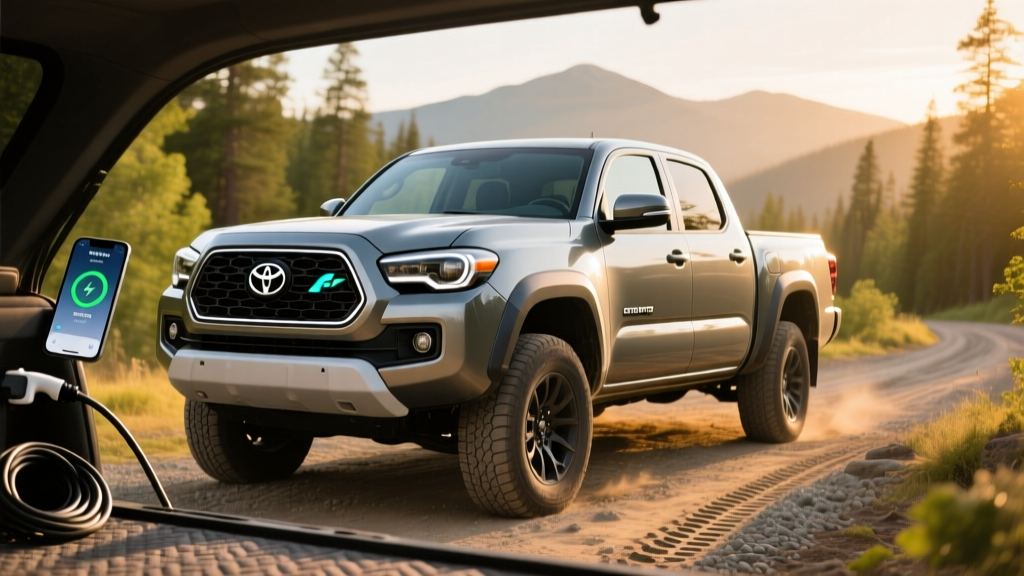
The Toyota Tacoma has long been the midsize truck benchmark for reliability, but the introduction of the i-FORCE MAX hybrid powertrain changed the conversation. The Tacoma Hybrid pairs a turbocharged four-cylinder with an electric motor to deliver V6-rivaling power while squeezing out fuel economy numbers that traditional truck buyers never thought possible. For 2026, the Tacoma Hybrid remains the only conventional hybrid in the midsize pickup segment, giving it a unique value proposition for buyers who want electrified efficiency without plugging in.
This guide breaks down everything you need to know about the Toyota Tacoma Hybrid — from EPA MPG figures and real-world fuel economy to the i-FORCE MAX powertrain specs, battery warranty details, and whether any federal tax credits apply. We'll also stack it up against full EVs and plug-in hybrids to help you decide which electrified truck actually fits your life.
2026 Toyota Tacoma Hybrid: Quick Specs at a Glance
| Specification | 2026 Tacoma Hybrid (i-FORCE MAX) |
|---|---|
| Powertrain Type | Conventional Hybrid (HEV) — no plug-in required |
| Engine | 2.4L turbocharged 4-cylinder + electric motor |
| Combined Horsepower | 326 hp |
| Combined Torque | 465 lb-ft |
| Transmission | 8-speed automatic |
| EPA MPG (City / Hwy / Combined) | 24 / 27 / 25 MPG (4WD crew cab) |
| Fuel Tank Capacity | 21.1 gallons |
| Total Driving Range | ~527 miles (EPA combined estimate) |
| Towing Capacity (max) | 6,000 lbs |
| Payload Capacity (max) | 1,709 lbs |
| Hybrid Battery Warranty | 10 years / 150,000 miles |
| Starting MSRP | ~$41,000 (TRD Sport i-FORCE MAX) |
| Federal Tax Credit (§30D) | Not eligible (HEV, not a PHEV or BEV) |
HEV vs. PHEV: What Kind of Hybrid Is the Tacoma?
A common source of confusion is whether the Tacoma Hybrid needs to be plugged in. It does not. The Tacoma i-FORCE MAX is a conventional hybrid (HEV), meaning it generates all its own electricity through regenerative braking and the gasoline engine. There is no charging port, no electric-only driving mode for meaningful distances, and no need for home charging infrastructure.
Here's how the two hybrid architectures compare:
| Feature | Conventional Hybrid (HEV) | Plug-In Hybrid (PHEV) |
|---|---|---|
| Plug-in charging? | No — self-charging via regen + engine | Yes — has a charging port |
| Electric-only range | ~1 mile or less at low speed | Typically 20-50 miles |
| Battery size | Small (~1-2 kWh) | Larger (10-20+ kWh) |
| Federal tax credit | No | Up to $7,500 (if eligible under §30D) |
| Example | Toyota Tacoma Hybrid | Toyota RAV4 Prime, Ford Escape PHEV |
The Tacoma Hybrid is designed for truck buyers who want better fuel economy and more torque without changing their fueling habits. If you want electric-only commuting capability, you'd need to look at a PHEV truck (currently very limited in availability) or a full battery-electric vehicle like the Ford F-150 Lightning or Rivian R1T.
Fuel Economy: EPA Ratings vs. Real-World MPG
According to fueleconomy.gov, the 2026 Toyota Tacoma Hybrid with 4WD and the crew cab body style earns the following EPA estimates:
| Driving Cycle | EPA Estimate | Real-World Expectation |
|---|---|---|
| City | 24 MPG | 23-27 MPG (hybrids often exceed EPA city in stop-and-go traffic) |
| Highway | 27 MPG | 24-26 MPG (aerodynamic drag and speed reduce hybrid advantage) |
| Combined | 25 MPG | 23-26 MPG depending on driving mix |
Why Hybrids Often Beat EPA City Estimates
Conventional hybrids like the Tacoma i-FORCE MAX shine in city driving. Regenerative braking recaptures energy during frequent stops, and the electric motor handles low-speed acceleration where gasoline engines are least efficient. Many Tacoma Hybrid owners report 26-28 MPG in predominantly urban driving — a notable improvement over the EPA city sticker.
Highway driving tells a different story. At sustained speeds above 65 mph, the electric motor contributes less, and the truck's boxy aerodynamics work against efficiency. Towing a trailer will drop fuel economy further — expect 16-19 MPG combined when pulling a 4,000-5,000 lb load, based on real-world owner reports.
How Does This Compare to the Gas-Only Tacoma?
The non-hybrid 2026 Tacoma with the standard i-FORCE 2.4L turbo (without the electric motor) earns approximately 20 city / 26 highway / 22 combined MPG with 4WD. The hybrid's advantage is most pronounced in city driving, where it gains roughly 4 MPG. Combined, the improvement is about 3 MPG — meaningful over the life of the truck but not dramatic. The bigger practical benefit is the torque: 465 lb-ft from the hybrid vs. 310 lb-ft from the standard turbo four.
The i-FORCE MAX Powertrain: How It Works
The i-FORCE MAX powertrain sandwiches an electric motor between the 2.4-liter turbocharged inline-four engine and the 8-speed automatic transmission. This "P2" hybrid architecture means the motor can assist the engine, provide brief torque fill during shifts, and enable engine-off coasting in certain conditions.
Key powertrain numbers:
- Engine output: 278 hp / 317 lb-ft (gas engine alone)
- Electric motor output: ~48 hp / ~184 lb-ft
- Combined system output: 326 hp / 465 lb-ft
- Hybrid battery: ~1.87 kWh nickel-metal hydride (NiMH), located under the rear seat
The peak combined torque of 465 lb-ft arrives at just 1,700 RPM, which gives the Tacoma Hybrid a strong, responsive feel from a stop and solid low-speed pulling power for trailering. Toyota engineered this system for torque, not for electric-only range — the battery is small and designed for rapid charge/discharge cycles rather than sustained EV driving.
There is no DC fast charging capability and no Level 2 charging port. The hybrid battery charges exclusively through regenerative braking and the gasoline engine. This is a key advantage for buyers who lack access to home or workplace charging — you get hybrid efficiency gains without any infrastructure changes.
Pricing, Trims, and Tax Credit Eligibility
The 2026 Toyota Tacoma Hybrid i-FORCE MAX is available across multiple trims, with pricing starting around $41,000 for the TRD Sport and climbing to approximately $57,000+ for the fully loaded TRD Pro or Trailhunter variants. Here's a general pricing overview:
- TRD Sport i-FORCE MAX: ~$41,000 MSRP
- TRD Off-Road i-FORCE MAX: ~$44,500 MSRP
- Limited i-FORCE MAX: ~$52,000 MSRP
- TRD Pro i-FORCE MAX: ~$57,500 MSRP
- Trailhunter i-FORCE MAX: ~$55,000 MSRP
Federal Tax Credit: Does the Tacoma Hybrid Qualify?
No. The Tacoma Hybrid is a conventional hybrid (HEV), not a plug-in hybrid or battery-electric vehicle. The IRS §30D New Clean Vehicle Credit applies only to PHEVs and BEVs that meet battery sourcing, critical mineral, MSRP cap, and buyer income requirements. Since the Tacoma Hybrid has no plug and no meaningful electric-only range, it does not qualify for the federal EV tax credit.
Some states may offer separate incentives for hybrid vehicles, though these are increasingly rare as programs shift focus to PHEVs and BEVs. Check your state's energy or environmental agency for current programs.
Total Cost of Ownership Consideration
Without a tax credit, the Tacoma Hybrid's value proposition rests on fuel savings and capability. At 25 MPG combined vs. 22 MPG combined for the gas model, and assuming $3.50/gallon fuel and 15,000 miles per year, the hybrid saves roughly $280 annually in fuel costs. Over a 10-year ownership period, that's about $2,800 in savings — which partially offsets the ~$2,000-$3,000 price premium for the i-FORCE MAX powertrain depending on trim. The real financial benefit comes from the hybrid's stronger resale value, as Toyota hybrids historically command premium used prices.
Battery Warranty, Reliability, and Replacement Cost
Toyota Hybrid Battery Warranty: 10 years or 150,000 miles (whichever comes first), transferable to subsequent owners. This covers the hybrid battery pack and related hybrid system components.
Toyota's hybrid system reliability is among the best-documented in the automotive industry. The Prius has accumulated billions of real-world miles since 2000, and the NiMH and lithium-ion hybrid batteries Toyota uses have proven remarkably durable. Many Toyota hybrid vehicles surpass 200,000 miles on the original hybrid battery.
What If the Hybrid Battery Fails?
Hybrid battery replacement for the Tacoma i-FORCE MAX is expected to cost between $3,000 and $5,000 (parts and labor) if needed outside of warranty coverage. However, the 10-year/150,000-mile warranty provides substantial protection, and the small NiMH battery in a conventional hybrid undergoes far less stress than the large lithium-ion packs in BEVs or PHEVs — it never fully depletes or fully charges, which extends cycle life significantly.
For comparison, a BEV battery replacement can cost $10,000-$20,000+. The Tacoma Hybrid's small, conservatively managed battery is one of the lowest-risk electrified components on the road.
Overall Reliability Outlook
The Tacoma nameplate carries strong reliability expectations, and the i-FORCE MAX hybrid system shares architecture with Toyota's proven Tundra Hybrid (introduced for 2022), which has shown solid early durability data. The 8-speed automatic transmission is a conventional torque-converter unit, avoiding the complexity of CVTs. According to NHTSA, the Tacoma maintains competitive safety ratings, and Toyota Safety Sense 3.0 comes standard across all trims.
Who Should Choose the Tacoma Hybrid vs. an EV or Gas Truck?
Choose the Tacoma Hybrid if:
- You want a midsize truck with strong low-end torque for towing and off-road use
- You drive a mix of city and highway miles and want modest fuel savings without plugging in
- You lack access to home Level 2 charging or public charging infrastructure
- You value Toyota's proven hybrid reliability and long warranty coverage
- You want the most torque available in a midsize truck without going to a full-size platform
Choose a full EV truck (e.g., Rivian R1T, Ford F-150 Lightning) if:
- You have reliable home Level 2 charging and want to eliminate gasoline costs entirely
- Your daily driving is under 250 miles and you want zero tailpipe emissions
- You want the instant torque, frunk storage, and V2L/V2H capabilities unique to BEVs
- You qualify for the §30D federal tax credit (up to $7,500) and want to reduce purchase cost
Choose the gas-only Tacoma if:
- You're on a tighter budget and the ~$2,000-$3,000 hybrid premium doesn't justify the fuel savings
- You primarily drive highway miles where the hybrid efficiency advantage is smallest
- You plan to keep the truck 3-5 years and won't recoup the hybrid premium in fuel savings
Pros and Cons of the Tacoma Hybrid
Pros
- 465 lb-ft of torque from 1,700 RPM — best-in-class midsize truck torque
- No plug-in charging required — works with existing gas station infrastructure
- 10-year/150,000-mile hybrid battery warranty
- 24 MPG city (up from ~20 MPG in the gas-only model)
- Available across popular trims (TRD Sport, Off-Road, Limited, Pro, Trailhunter)
- Proven Toyota hybrid system architecture with strong reliability track record
Cons
- No federal tax credit eligibility (HEV, not PHEV/BEV)
- Only ~3 MPG combined improvement over the gas model
- No meaningful electric-only driving capability
- Hybrid premium adds $2,000-$3,000 to MSRP depending on trim
- Highway MPG advantage is minimal — most gains come in city driving
- Fuel savings alone may not fully offset the hybrid price premium within 5 years
Frequently Asked Questions
How many MPG does the Toyota Tacoma Hybrid get?
The 2026 Toyota Tacoma Hybrid with 4WD earns an EPA-estimated 24 city / 27 highway / 25 combined MPG. In real-world city driving with frequent stops, many owners report 26-28 MPG thanks to regenerative braking. Highway fuel economy tends to run slightly below the EPA estimate at 24-26 MPG, and towing will reduce combined economy to approximately 16-19 MPG.
Does the Tacoma Hybrid need to be plugged in?
No. The Tacoma Hybrid is a conventional hybrid (HEV), not a plug-in hybrid. It charges its small hybrid battery through regenerative braking and the gasoline engine. There is no charging port and no need for any home charging equipment.
How far can the Tacoma Hybrid drive on electric power alone?
Less than one mile at very low speeds. The i-FORCE MAX system is designed for torque assist and efficiency, not electric-only driving. If you want meaningful electric-only range (20-50 miles), you need a plug-in hybrid (PHEV) or a full battery-electric vehicle.
Is the Tacoma Hybrid reliable, and what does battery replacement cost?
Toyota's hybrid systems are among the most reliable electrified powertrains available, with decades of proven durability across millions of vehicles. The hybrid battery is covered by a 10-year/150,000-mile warranty. If replacement is needed outside warranty, expect $3,000-$5,000 — significantly less than a BEV battery replacement.
Does the Tacoma Hybrid qualify for any federal tax credit?
No. The IRS §30D New Clean Vehicle Credit applies only to plug-in hybrids (PHEVs) and battery-electric vehicles (BEVs). The Tacoma Hybrid is a conventional hybrid (HEV) and does not qualify. Check your state's energy agency for any local hybrid incentives, though these are increasingly uncommon.
Hybrid vs. PHEV vs. EV — which truck is right for me?
If you can't charge at home and want a truck that works exactly like a gas vehicle but with better city MPG and more torque, the Tacoma Hybrid (HEV) is the right call. If you have home charging and want 20-50 miles of electric-only commuting with a gas backup, look for a PHEV truck (options are currently very limited). If you have home charging, drive under 250 miles daily, and want zero tailpipe emissions plus the lowest per-mile fuel cost, a full EV truck like the Rivian R1T or F-150 Lightning makes sense — especially if you qualify for the $7,500 federal tax credit.
How much does the i-FORCE MAX hybrid system add to the Tacoma's price?
The hybrid powertrain premium varies by trim but typically adds $2,000 to $3,000 over the equivalent gas-only model. Since the hybrid is bundled with higher trim levels (TRD Sport and above), the actual price difference also includes additional standard equipment.