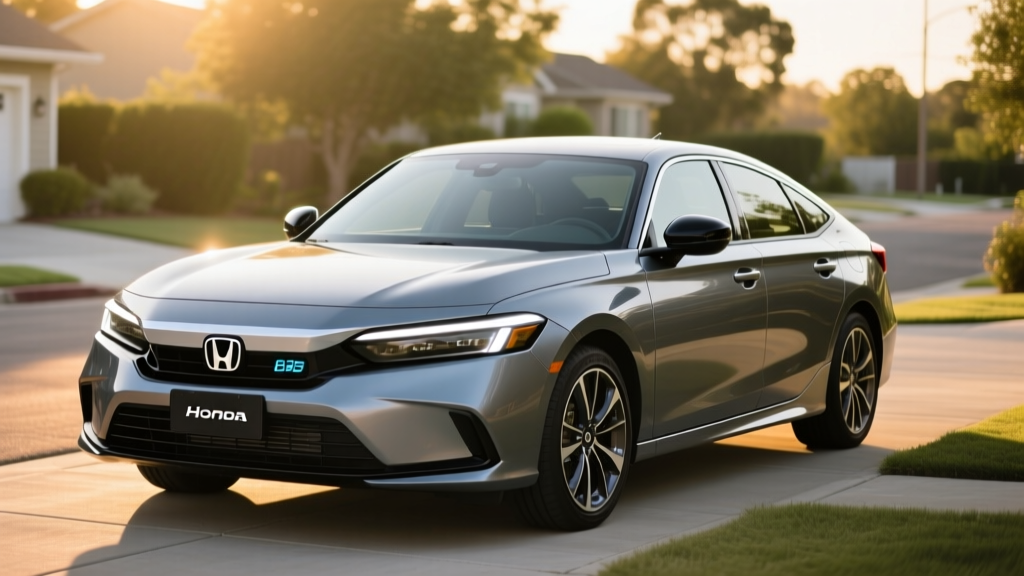
The 2025 Honda Civic Sedan Hybrid arrives at a moment when buyers are recalibrating their expectations. Full battery-electric vehicles have seen price corrections and shifting tax-credit rules, while gasoline prices remain volatile. The Civic Hybrid threads a practical needle: it delivers near-50 MPG without requiring a plug, a lifestyle change, or a charging infrastructure gamble. But how does Honda's two-motor hybrid system actually perform when you're stuck in rush-hour traffic or cruising at 75 mph on the interstate? And what does long-term ownership look like for the hybrid battery?
We've analyzed EPA data, Honda's powertrain specifications, and real-world driving patterns to give you the exact numbers you need before signing a purchase agreement.
HEV vs. PHEV: Where the Civic Hybrid Fits
Before we get into the Civic's specific numbers, it's critical to clarify what this car is — and what it isn't.
Conventional Hybrid (HEV) — What the Civic Is
- No plug required. The gasoline engine and regenerative braking recharge the small battery.
- Battery size: Typically under 1.5 kWh — designed for short electric assist, not standalone driving.
- Refueling: Gas station only, same as a conventional car.
- Best for: Drivers without home charging access, apartment dwellers, those who want zero behavior change.
Plug-in Hybrid (PHEV) — What the Civic Is NOT
- Requires plug-in charging to access electric-only range (typically 20–40 miles).
- Battery size: Usually 10–20 kWh.
- May qualify for federal tax credits under IRS §30D (up to $7,500, with strict sourcing and income rules).
- Best for: Drivers with home/workplace charging who want short commutes on electricity with gas backup.
The 2025 Honda Civic Sedan Hybrid is a conventional HEV. You will never plug it in. You fuel it at any gas station. Honda does not currently offer a PHEV variant of the Civic sedan in the US market.
Fuel Economy: EPA Ratings and Real-World MPG
Honda's two-motor hybrid system in the Civic is optimized for city driving, where the electric motor handles low-speed propulsion and the gasoline engine acts primarily as a generator. This architecture is fundamentally different from parallel hybrids that mechanically link the engine to the wheels at all speeds.
| Trim | City MPG | Highway MPG | Combined MPG |
|---|---|---|---|
| Sport Hybrid | 50 | 47 | 49 |
| Sport Touring Hybrid | 50 | 47 | 49 |
Source: EPA Fuel Economy
Real-World MPG vs. EPA Sticker
The Civic Hybrid's series-dominant architecture means city MPG often meets or exceeds the EPA estimate in stop-and-go traffic, where regenerative braking recaptures energy and the engine runs at its most efficient RPM as a generator. Expect 48–52 MPG in urban commuting.
Highway driving is a different story. At sustained 70–80 mph speeds, the engine must directly drive the wheels and overcome aerodynamic drag — the hybrid system provides less benefit. Expect 42–46 MPG on the highway, roughly 5–10% below the EPA highway sticker. Cold weather (below 40°F) will reduce fuel economy by an additional 5–8% due to increased engine warm-up time and cabin heating demands.
Powertrain Specs: Honda's Two-Motor Hybrid System
The 2025 Civic Hybrid uses Honda's fourth-generation two-motor hybrid system, pairing a 2.0-liter Atkinson-cycle four-cylinder engine with two electric motors and a lithium-ion battery pack.
| Specification | Value |
|---|---|
| Engine | 2.0L Atkinson-cycle 4-cylinder |
| Engine Horsepower | 143 hp @ 6,000 rpm |
| Engine Torque | 134 lb-ft @ 4,500 rpm |
| Electric Drive Motor | 181 hp / 232 lb-ft |
| Combined System Output | 200 hp / 232 lb-ft |
| Transmission | Direct-drive (no traditional CVT or gears) |
| Drivetrain | Front-wheel drive |
| 0–60 mph | ~7.2 seconds (est.) |
| Hybrid Battery Type | Lithium-ion |
| Hybrid Battery Capacity | ~1.0 kWh (usable) |
The key insight here is that the electric drive motor produces more torque than the gasoline engine. In most city driving scenarios, the gasoline engine is generating electricity rather than directly turning the wheels. The engine only mechanically connects to the drivetrain at higher cruising speeds via a lock-up clutch. This is why the Civic Hybrid feels responsive off the line — you're driving an electric car that happens to carry its own generator.
At 200 combined horsepower, the Civic Hybrid has a meaningful advantage over the non-hybrid Civic's 1.5L turbocharged engine (180 hp). The hybrid is genuinely quicker in real-world passing maneuvers and highway merging, a rarity for hybrids that traditionally traded performance for efficiency.
Pricing, Trims, and Tax Credit Eligibility
The 2025 Civic Hybrid is offered in two trims, both positioned as sport-oriented models rather than base economy cars:
| Trim | MSRP | Key Features |
|---|---|---|
| Sport Hybrid | $29,845 | 18" wheels, sport pedals, heated front seats, 7" display, Honda Sensing suite |
| Sport Touring Hybrid | $32,845 | Leather seats, Bose 12-speaker audio, wireless CarPlay/Android Auto, 9" display, navigation, wireless charging |
Prices include destination charge. Source: Honda Automobiles
Federal Tax Credit: Does the Civic Hybrid Qualify?
No. The 2025 Honda Civic Hybrid is a conventional HEV, not a plug-in electric vehicle. It does not qualify for the IRS §30D Clean Vehicle Credit (up to $7,500), which is reserved for battery-electric vehicles (BEVs) and plug-in hybrids (PHEVs) that meet battery-sourcing, critical-mineral, MSRP cap, and buyer income requirements.
Conventional hybrids like the Civic are also ineligible for most state EV rebates and HOV lane stickers, which increasingly require plug-in capability. Check IRS.gov for current §30D rules if you're cross-shopping a PHEV or BEV alternative.
The pricing positions the Civic Hybrid at roughly a $2,000–$3,000 premium over comparable non-hybrid Civic trims. At 49 MPG combined versus the gas Civic's ~35 MPG combined, the fuel savings typically pay back the premium in 3–5 years depending on annual mileage and local fuel prices — without factoring in the hybrid's stronger acceleration.
Battery Warranty, Lifespan, and Replacement Cost
Hybrid battery longevity remains the single most common concern among first-time hybrid buyers. Here's what Honda provides and what real-world data shows:
Honda Hybrid Battery Warranty
- Coverage: 8 years / 100,000 miles (10 years / 150,000 miles in CARB states including California, New York, Massachusetts, and others)
- What's covered: Hybrid battery pack, hybrid control unit, and related hybrid-system components
- Capacity threshold: Honda warrants against defects and abnormal loss of capacity — unlike EV batteries, there is no published minimum State of Health percentage
The Civic's hybrid battery is small (~1.0 kWh usable) and operates within a narrow state-of-charge window — typically between 30% and 70%. Honda's battery management system never allows full charges or full discharges, which is the primary reason hybrid batteries outlast early-generation EV batteries in terms of calendar life.
Real-world lifespan data: Honda's hybrid systems (across Accord, CR-V, and Civic) have demonstrated strong longevity. Reports of hybrid battery failure before 150,000 miles are uncommon. Many Honda hybrid owners reach 200,000+ miles on the original battery pack.
Replacement cost if out of warranty: A replacement hybrid battery pack for the Civic Hybrid typically ranges from $2,000 to $3,500 including labor at a Honda dealer. Third-party refurbished packs can reduce this to $1,200–$2,000. This is dramatically less than a full EV battery replacement ($10,000–$20,000+) because the hybrid pack is small and modular.
Driving Dynamics and Daily Ownership
The Civic Hybrid's driving character differs from the gas Civic in ways that matter for daily commuting:
Acceleration feel: The electric motor's 232 lb-ft of torque is available from near-zero RPM, giving the Civic Hybrid strong initial acceleration that feels more like an EV than a traditional hybrid. The transition between electric-only, series-hybrid, and direct-engine drive modes is nearly imperceptible from the driver's seat.
Regenerative braking: Steering-wheel-mounted paddle selectors let you adjust regen intensity across four levels. At the highest setting, the Civic Hybrid approaches one-pedal driving in city traffic, though it will not come to a complete stop without the brake pedal — unlike many full EVs.
Noise: Under gentle acceleration, the Civic Hybrid runs in EV mode and is whisper-quiet. Under hard acceleration, the 2.0L engine revs at a fixed RPM as a generator, producing a droning sound that some drivers find disconnected from vehicle speed. This is inherent to the series-hybrid design, not a defect.
Cargo and interior: The hybrid battery is packaged under the rear seats, preserving the Civic sedan's 14.8 cubic feet of trunk space. There is no cargo penalty compared to the gas Civic.
Who Should Choose the Civic Hybrid vs. a PHEV or Full EV?
Choose the Civic Hybrid If:
- You live in an apartment or lack access to home/workplace charging
- You want 45–50 MPG with zero behavior change — no plugs, no apps, no charging networks
- Your daily commute is longer than 30 miles round-trip (where a PHEV's electric range runs out)
- You want a sub-$33,000 vehicle with strong reliability history and low maintenance costs
- You take frequent road trips and don't want to plan around DC fast-charging stops
Consider a PHEV Instead If:
- You have home Level 2 charging and a commute under 30 miles round-trip
- You want electric-only daily driving with gas backup for road trips
- You qualify for the §30D federal tax credit (income and sourcing requirements apply)
- Models like the Toyota Prius Prime (44 mi electric range) or Hyundai Tucson PHEV (33 mi) fit your needs
Consider a Full EV Instead If:
- You have reliable home charging and want the lowest per-mile fuel cost (~$0.04–$0.06/mi vs. ~$0.08–$0.10/mi for the Civic Hybrid)
- You want zero tailpipe emissions and minimal drivetrain maintenance (no oil changes, no spark plugs)
- Your budget accommodates a $35,000–$45,000 EV after the $7,500 federal credit (e.g., Chevy Equinox EV, Hyundai Ioniq 5, Tesla Model 3)
Pros, Cons, and the Bottom Line
Pros
- EPA-estimated 49 MPG combined — among the highest of any non-PHEV sedan
- 200 hp combined output makes it quicker than the gas Civic
- No plug-in charging required — zero lifestyle change
- Strong 8-year/100,000-mile hybrid battery warranty (10 years in CARB states)
- Preserves full trunk space — no cargo compromise
- Honda Sensing ADAS suite standard on all trims
- Low estimated battery replacement cost ($2,000–$3,500) if needed out of warranty
Cons
- No federal tax credit eligibility (HEV, not PHEV or BEV)
- Only available in Sport and Sport Touring trims — no base-price hybrid option
- Engine drone under hard acceleration (series-hybrid characteristic)
- Highway MPG falls 5–10% below EPA estimate at sustained 75+ mph
- No all-wheel-drive option (unlike some hybrid competitors)
- Premium over gas Civic ($2,000–$3,000) requires fuel savings to recoup
The 2025 Honda Civic Sedan Hybrid is not revolutionary — it's a refinement of a proven architecture applied to one of America's best-selling compact sedans. For buyers who want maximum fuel efficiency without the charging logistics of a PHEV or the range planning of a full EV, it delivers exactly what it promises: near-50 MPG, respectable acceleration, and the ownership simplicity of a gas car with dramatically lower fuel bills.
Frequently Asked Questions
How many MPG does the 2025 Honda Civic Hybrid get?
The EPA rates the 2025 Civic Hybrid at 50 MPG city, 47 MPG highway, and 49 MPG combined for both Sport Hybrid and Sport Touring Hybrid trims. In real-world driving, city MPG often meets or exceeds the EPA estimate, while sustained highway driving above 70 mph typically yields 42–46 MPG.
Does the Honda Civic Hybrid need to be plugged in?
No. The Civic Hybrid is a conventional hybrid (HEV), not a plug-in hybrid. The gasoline engine and regenerative braking recharge the small lithium-ion battery. You fuel it exclusively at gas stations.
Does the 2025 Civic Hybrid qualify for any federal tax credit?
No. The IRS §30D Clean Vehicle Credit applies only to plug-in electric vehicles (BEVs and PHEVs) that meet battery sourcing, MSRP cap, and buyer income requirements. Conventional hybrids like the Civic Hybrid are not eligible. Check IRS.gov for current rules.
How long will the Civic Hybrid battery last, and what does replacement cost?
Honda warrants the hybrid battery for 8 years/100,000 miles (10 years/150,000 miles in CARB states). Real-world data from Honda's hybrid lineup suggests most packs last 150,000–200,000+ miles. Out-of-warranty replacement costs approximately $2,000–$3,500 at a dealer, or $1,200–$2,000 with a refurbished pack.
Is the Civic Hybrid faster than the gas Civic?
Yes. The Civic Hybrid produces 200 combined horsepower and 232 lb-ft of torque (from the electric motor), compared to the gas Civic 1.5T's 180 hp and 177 lb-ft. The hybrid's electric torque delivery makes it noticeably quicker in city driving and highway merging, with an estimated 0–60 mph time of around 7.2 seconds versus roughly 7.5 seconds for the turbo gas model.
Is the Honda Civic Hybrid reliable?
Honda's hybrid systems have demonstrated strong reliability across multiple model lines. The fourth-generation two-motor system has fewer moving parts than a conventional automatic transmission (no multi-speed gearbox, no traditional CVT belt). IIHS has tested the Civic sedan favorably for crash safety. Long-term reliability data from sources like Consumer Reports consistently rates Honda hybrids at or above average for the compact car segment.
Should I buy the Civic Hybrid or wait for a PHEV version?
Honda has not announced a PHEV variant of the Civic sedan for the US market as of 2025. If you need plug-in electric range, consider cross-shopping the Toyota Prius Prime (PHEV, 44 miles electric-only, ~$33,000) or looking at compact PHEV crossovers. If your priority is simple, efficient, plug-free driving, the Civic Hybrid is available now with no wait.