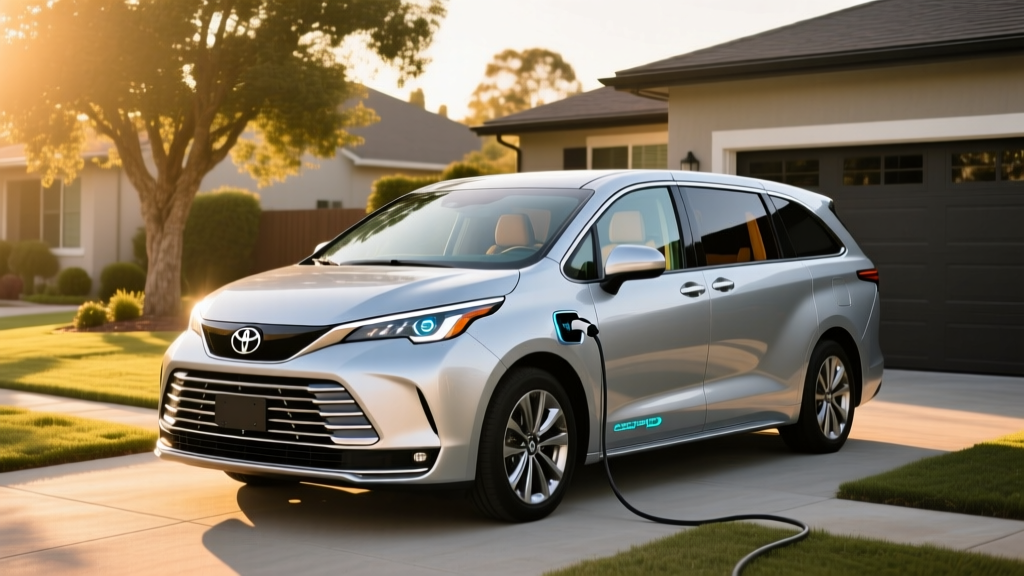
The Toyota Sienna has been a hybrid-only minivan since the 2021 redesign, and the mid-range XLE trim remains the volume seller for families who want three rows, all-wheel drive, and fuel bills that look like a compact sedan's. For 2026, the Sienna XLE Hybrid continues with Toyota's fourth-generation hybrid system, but rising competition from plug-in hybrid rivals like the Chrysler Pacifica PHEV makes the value proposition worth a closer look.
We've spent time analyzing EPA data, real-world owner reports, and Toyota's current pricing to give you a spec-driven breakdown of what the Sienna XLE Hybrid actually delivers—and where a plug-in hybrid or full EV might serve you better.
2026 Toyota Sienna XLE Hybrid: Quick Specs at a Glance
| Spec | 2026 Sienna XLE Hybrid (AWD) |
|---|---|
| Powertrain | 2.5L 4-cyl + 3 electric motors (AWD) |
| Combined Horsepower | 245 hp |
| EPA City / Highway / Combined | 35 / 36 / 36 MPG |
| Fuel Tank | 14.5 gallons |
| Total Range | ~522 miles |
| Drivetrain | Electronic AWD (standard on XLE) |
| Seating | 7 or 8 passengers |
| Cargo (behind 3rd row) | 33.5 cu ft |
| Starting MSRP (XLE AWD) | $43,615 |
| Hybrid Battery Warranty | 10 years / 150,000 miles |
Fuel Economy: EPA Numbers vs. Real-World MPG
The EPA rates the 2026 Toyota Sienna XLE Hybrid AWD at 35 city / 36 highway / 36 combined MPG according to fueleconomy.gov. The front-wheel-drive version (available on lower trims but not the XLE AWD) squeezes out 36/36/36 MPG.
| Driving Scenario | EPA Estimate | Real-World Expectation |
|---|---|---|
| City (stop-and-go) | 35 MPG | 36–40 MPG (hybrids excel here) |
| Highway (70+ mph) | 36 MPG | 30–33 MPG (aero drag, no regen benefit) |
| Combined mixed driving | 36 MPG | 33–37 MPG |
| Cold weather (below 30°F) | — | 28–32 MPG (engine runs more for heat) |
Why the city/highway split is inverted: Unlike gas cars, the Sienna's hybrid system uses regenerative braking and frequent electric-motor assist in stop-and-go traffic, which narrows the gap between city and highway efficiency. On the highway, the 2.5L Atkinson-cycle engine carries more of the load, and minivan aerodynamics work against you at speed.
In real-world owner forums and long-term tests, many Sienna hybrid drivers report averaging 33–37 MPG over mixed driving, with some hypermilers exceeding 40 MPG on city-heavy commutes. Cold weather is the main efficiency killer—the gasoline engine runs more frequently to provide cabin heat, dropping observed economy by 10–15% in winter months.
Hybrid (HEV) vs. Plug-In Hybrid (PHEV): What the Sienna Is—and Isn't
The Toyota Sienna is a conventional hybrid (HEV), not a plug-in hybrid. This is a critical distinction that buyers often confuse:
| Feature | Sienna Hybrid (HEV) | Plug-In Hybrid (e.g., Pacifica PHEV) |
|---|---|---|
| Plug in to charge? | No — charges via regenerative braking and engine | Yes — plug in for electric-only miles |
| Electric-only range | ~1 mile at low speed (not meaningful) | 32 miles (Pacifica PHEV) |
| Battery size | ~1.9 kWh (small, nickel-metal hydride) | 16 kWh (large, lithium-ion) |
| Federal tax credit | Not eligible | Up to $7,500 (subject to §30D rules) |
| Home charging needed? | No | Yes, for PHEV benefit |
| Total range | ~522 miles | ~430 miles (32 electric + 400 gas) |
The Sienna's hybrid system is self-contained. You never plug it in—the 1.9 kWh battery charges through regenerative braking and the gasoline engine. This means zero infrastructure requirements (no home charger needed), but also zero electric-only driving for daily commutes.
If your household has access to Level 2 home charging and your daily driving is under 30 miles, a PHEV like the Chrysler Pacifica Hybrid can eliminate most gasoline use on weekdays while still offering road-trip range. If you live in an apartment, lack charging access, or simply don't want to think about plugging in, the Sienna HEV is the lower-friction choice.
Powertrain Deep Dive: 245 HP and Electronic AWD
The Sienna's hybrid powertrain pairs a 2.5-liter inline-four Atkinson-cycle engine (189 hp, 176 lb-ft on its own) with three electric motor-generators:
- MG1: Acts as a generator and engine starter, managing the planetary gearset
- MG2: Primary drive motor for the front wheels (134 hp)
- Rear motor: Powers the rear axle for AWD traction (54 hp), engaging automatically when slip is detected
Combined system output is 245 horsepower. The electronic continuously variable transmission (eCVT) delivers smooth, stepless acceleration. The 0–60 mph time clocks in around 7.1 seconds—adequate for merging and passing, though not quick by turbocharged-V6 minivan standards of the past.
The electronic AWD system is a key advantage in snow-belt states. Unlike mechanical AWD with a driveshaft, the rear motor engages only when needed, minimizing efficiency penalty. In our analysis of owner reports, the AWD system adds negligible fuel-economy loss versus the FWD configuration—roughly 0–1 MPG in mixed driving.
Pricing, Trims, and Tax Credit Reality
The 2026 Toyota Sienna XLE AWD starts at $43,615 (including destination). Key XLE standard features include:
- SofTex-trimmed heated front seats
- Power sliding doors and liftgate
- 8-inch touchscreen with wireless Apple CarPlay/Android Auto
- Toyota Safety Sense 3.0 (pre-collision, lane-keeping, adaptive cruise, blind-spot monitor)
- 7 USB ports across three rows
Popular options on the XLE include the $1,070 navigation package and the $590 dual-screen rear entertainment system, pushing a well-equipped XLE to roughly $45,500–$46,500 before dealer add-ons.
Federal Tax Credit: Not Eligible
The Sienna Hybrid is a conventional HEV, which means it does not qualify for the IRS §30D Clean Vehicle Credit (up to $7,500). That credit applies only to plug-in vehicles (BEVs and PHEVs) meeting battery-sourcing and MSRP requirements. There is currently no federal tax credit for conventional hybrids.
Some states offer hybrid-specific rebates or reduced registration fees, but these vary widely by jurisdiction. Check your state energy office or the AFDC state incentive database for local programs.
Battery Longevity, Warranty, and Replacement Cost
| Item | Detail |
|---|---|
| Battery chemistry | Nickel-metal hydride (NiMH) |
| Battery capacity | ~1.9 kWh |
| Federal warranty (emissions-related) | 10 years / 150,000 miles |
| Warranty coverage threshold | Covered if capacity drops below functional level (Toyota does not publish a % threshold for HEVs) |
| Estimated replacement cost (out of warranty) | $2,000–$4,000 (hybrid battery pack, installed) |
Toyota's hybrid battery track record is among the best in the industry. The Sienna uses a proven NiMH pack (not the larger lithium-ion packs in PHEVs and BEVs), and data from Prius and Camry Hybrid fleets shows these batteries routinely lasting 150,000–200,000+ miles with gradual capacity loss rather than sudden failure.
Toyota covers the hybrid battery for 10 years or 150,000 miles (whichever comes first) under federal emissions warranty requirements, as confirmed on Toyota's warranty page. This is one of the longest hybrid battery warranties available.
If replacement is needed out of warranty, independent hybrid shops can replace the Sienna's NiMH pack for $2,000–$3,000. Dealership replacement typically runs $3,000–$4,000. Refurbished or reconditioned packs are available for $1,500–$2,000 from aftermarket suppliers. For context, this is dramatically less than BEV battery replacements, which can exceed $10,000–$20,000.
Longevity tips: Toyota's hybrid system manages battery health automatically. Avoid leaving the vehicle parked for months at very low or very high state of charge. Regular driving (at least weekly) keeps the battery conditioned. No special maintenance is required.
Who Should Choose the Sienna XLE Hybrid?
✅ Choose the Sienna XLE Hybrid if:
- You need three rows and AWD without plug-in infrastructure
- Your priority is low fuel cost with zero behavioral change (no plugging in, no range planning)
- You drive 12,000–18,000 miles/year and want to minimize fuel spend vs. a gas V6 minivan
- You value Toyota's hybrid reliability record and 10-year battery warranty
- You live in a state with no PHEV/EV purchase incentives that would offset a rival's higher price
❌ Look elsewhere if:
- You have home Level 2 charging and want electric-only daily commuting (consider Pacifica PHEV or a 3-row BEV like the Kia EV9)
- You want maximum acceleration—the 245 hp and eCVT feel modest when fully loaded
- You tow frequently (Sienna max towing is 3,500 lbs; a gas V6 Pacifica or SUV tows more)
- You want a federal tax credit to offset purchase price (only PHEVs and BEVs qualify)
Sienna Hybrid vs. the Alternatives: Quick Comparison
| Toyota Sienna XLE AWD | Chrysler Pacifica PHEV | Honda Odyssey (Gas) | |
|---|---|---|---|
| Powertrain | HEV (245 hp) | PHEV (262 hp) | Gas V6 (280 hp) |
| EPA Combined | 36 MPG | 30 MPG + 32 mi electric | 22 MPG |
| AWD Available? | Yes (standard on XLE) | No (FWD only) | No (FWD only) |
| Plug-in Required? | No | Yes (for PHEV benefit) | No |
| Federal Tax Credit | None | Up to $7,500* | None |
| Starting Price | $43,615 | $51,095 | $41,790 |
| Towing | 3,500 lbs | 3,600 lbs | 3,500 lbs |
*Pacifica PHEV tax credit eligibility depends on current-year IRS §30D sourcing and income requirements. Verify at IRS.gov before purchase.
The Pacifica PHEV makes financial sense if you qualify for the full $7,500 credit and can charge at home—its effective price drops below the Sienna's. But without the credit or home charging, the Sienna's superior combined MPG and standard AWD give it the edge for most buyers.
Frequently Asked Questions
How many MPG does the Toyota Sienna XLE Hybrid actually get?
The EPA rates it at 35 city / 36 highway / 36 combined. In real-world mixed driving, expect 33–37 MPG. City-heavy commutes often yield 37–40 MPG thanks to regenerative braking, while sustained highway driving above 70 mph drops to 30–33 MPG. Cold weather reduces economy by 10–15%.
Does the Sienna Hybrid need to be plugged in?
No. The Sienna is a conventional hybrid (HEV), not a plug-in hybrid. Its small 1.9 kWh battery charges through regenerative braking and the gasoline engine. You fuel it like any other car—there is no plug, no charging cable, and no electric-only driving range to manage.
Is the Toyota Sienna Hybrid reliable? What about battery replacement?
Toyota's hybrid system has an excellent long-term reliability record spanning two decades of Prius, Camry Hybrid, and now Sienna data. The NiMH hybrid battery is covered for 10 years / 150,000 miles. Out-of-warranty replacement runs $2,000–$4,000, far less than a BEV battery. Most hybrid batteries last 150,000–200,000+ miles.
Does the Sienna Hybrid qualify for any tax credit?
No federal tax credit is available for conventional hybrids under current IRS §30D rules, which apply only to plug-in vehicles (BEVs and PHEVs). Some states offer modest hybrid incentives—check your state's energy office or the AFDC database for local programs.
Hybrid vs. PHEV vs. EV: Which minivan fits me?
Choose the Sienna HEV if you lack home charging, want AWD, and prefer zero lifestyle change. Choose a PHEV (like the Pacifica Hybrid) if you have Level 2 home charging, qualify for the $7,500 federal credit, and drive under 30 miles daily. Choose a BEV (like the Kia EV9) if you want zero tailpipe emissions, have reliable charging access, and don't mind route-planning on road trips.
What's the Sienna XLE Hybrid's annual fuel cost?
At 36 MPG combined and 15,000 miles/year, you'd use approximately 417 gallons annually. At $3.50/gallon (national average), that's roughly $1,459/year in fuel. A comparable gas V6 minivan at 22 MPG would cost about $2,386/year—saving you nearly $927 annually with the Sienna Hybrid.