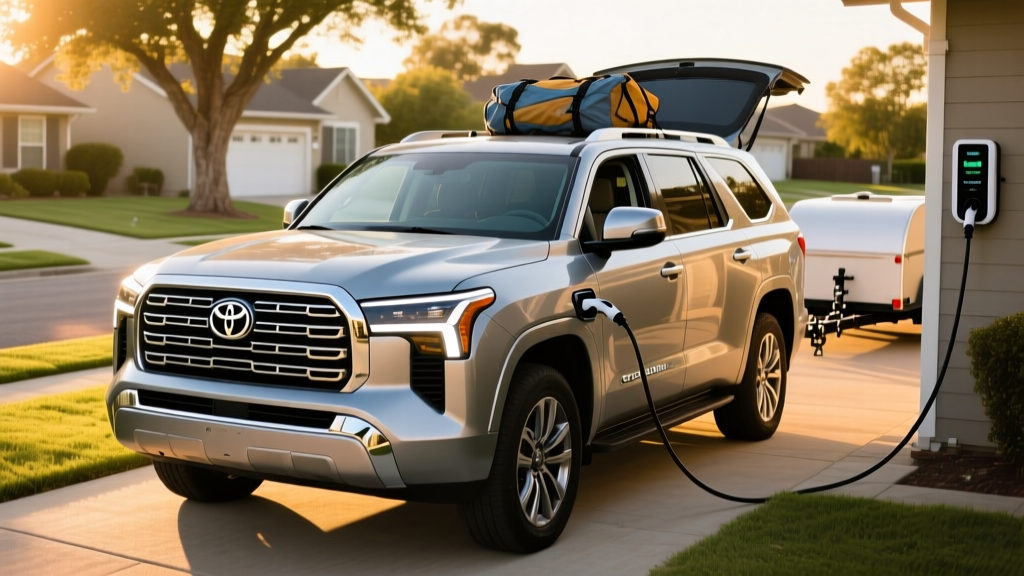
The full-size SUV segment is not where you expect fuel-sipping efficiency, yet the Toyota Sequoia hybrid has carved out a unique position since its third-generation debut. By pairing a twin-turbo V6 with an electric motor in a conventional hybrid (HEV) configuration — no plug required — Toyota delivers a 9,000-pound tow rating alongside EPA-estimated fuel economy that embarrasses most competitors running pure gasoline V8s. For 2026, the Sequoia continues to use the i-FORCE MAX powertrain across every trim, making hybrid propulsion standard rather than an expensive upgrade. Here's a data-driven breakdown of what this means for your wallet, your road trips, and your driveway.
Quick Verdict: The Sequoia Hybrid at a Glance
Bottom line: The 2026 Toyota Sequoia is a hybrid-only full-size SUV that prioritizes towing muscle and three-row practicality over electric-only driving. It's the right call for families who haul boats, trailers, or campers and don't have access to home charging. It is not a plug-in hybrid, and it does not qualify for the federal EV tax credit.
| Spec | Value |
|---|---|
| Powertrain | i-FORCE MAX 3.4L Twin-Turbo V6 + Electric Motor |
| Combined Horsepower | 437 hp |
| Combined Torque | 583 lb-ft |
| Transmission | 10-speed automatic |
| Drivetrain | RWD standard; 4WD available |
| EPA Fuel Economy (4WD) | 19 city / 22 hwy / 20 combined MPG |
| EPA Fuel Economy (RWD) | 21 city / 24 hwy / 22 combined MPG |
| Towing Capacity (max) | 9,000 lbs (properly equipped) |
| Hybrid Battery | ~1.87 kWh NiMH (self-charging HEV) |
| Seating | 7 or 8 passengers |
| Starting MSRP | ~$62,000 (SR5 trim) |
| Battery Warranty | 10 years / 150,000 miles |
HEV vs PHEV vs EV: Where Does the Sequoia Fit?
Before evaluating the Sequoia's numbers, it's critical to understand what kind of hybrid it is — because the distinction affects your daily routine, your fuel bill, and your tax-credit eligibility.
| Feature | HEV (Conventional Hybrid) | PHEV (Plug-In Hybrid) | BEV (Battery Electric) |
|---|---|---|---|
| Plug in to charge? | No — regenerative braking + engine | Yes — Level 1 or Level 2 | Yes — Level 2 or DC fast |
| Electric-only range | ~1 mile or less at low speed | 20–50 miles typical | 200–400+ miles |
| Battery size | 1–2 kWh | 12–25 kWh | 60–120+ kWh |
| Federal tax credit (§30D) | Not eligible | Up to $7,500 (if eligible) | Up to $7,500 (if eligible) |
| Gas engine? | Yes — primary power | Yes — backup after EV range | No |
| Toyota Sequoia? | Yes — this is the Sequoia | No Sequoia PHEV offered | No Sequoia BEV offered |
The Sequoia is a conventional hybrid (HEV). Its small nickel-metal hydride (NiMH) battery recharges through regenerative braking and the gasoline engine. You never plug it in, and there is no meaningful electric-only range. The electric motor assists the V6 during acceleration and low-load cruising, reducing fuel consumption — but the gas engine remains the primary power source at all times.
Fuel Economy: EPA Estimates vs Real-World MPG
The Sequoia's fuel economy depends heavily on drivetrain choice and how you drive. Here's the EPA breakdown, sourced from fueleconomy.gov:
| Drivetrain | City MPG | Highway MPG | Combined MPG |
|---|---|---|---|
| RWD | 21 | 24 | 22 |
| 4WD | 19 | 22 | 20 |
Real-World Expectations
Conventional hybrids like the Sequoia tend to meet or slightly exceed their EPA city estimates because regenerative braking recovers more energy in stop-and-go traffic. Highway driving is a different story: at sustained 75–80 mph speeds, the aerodynamic drag of a 6,000-pound box-shaped SUV works against efficiency, and the electric motor contributes less at high constant speeds.
Based on aggregated owner reports and testing data:
- City driving: Expect 20–23 MPG (4WD) — regenerative braking shines here.
- Highway cruising (70 mph): Expect 19–21 MPG (4WD) — slightly below EPA sticker.
- Towing: Expect 10–13 MPG when pulling a 5,000–7,000 lb trailer. The hybrid system helps offset the V6's thirst under load but cannot eliminate the physics of towing.
- Cold weather: Expect a 5–10% MPG reduction in winter. The engine runs more often to heat the cabin, and battery efficiency drops in freezing temperatures.
For context, a comparably sized Chevrolet Tahoe with the 5.3L V8 achieves 16 city / 20 hwy / 17 combined (4WD). The Sequoia hybrid's 20 combined MPG (4WD) represents roughly a 15–18% fuel savings over the V8 competition — meaningful across 15,000 annual miles.
i-FORCE MAX Powertrain: How the Hybrid System Works
The i-FORCE MAX is Toyota's performance-oriented hybrid system, shared with the Tundra and Land Cruiser. It places a compact electric motor between the twin-turbo 3.4L V6 and the 10-speed automatic transmission. This "sandwich" design means:
- 437 combined horsepower and 583 lb-ft of torque — torque available near idle thanks to electric motor assist.
- The electric motor fills in the torque curve while the turbos spool up, eliminating turbo lag.
- Regenerative braking captures kinetic energy during deceleration, trickle-charging the ~1.87 kWh NiMH battery pack.
- The engine can shut off at low-speed coasting and stoplights, reducing idle fuel burn.
The result is a 0–60 mph time of approximately 5.6 seconds (4WD) — quicker than most V8 full-size SUVs and genuinely responsive for a vehicle with a 9,000-pound tow rating. The hybrid system isn't here for eco-cred; it's here to make a heavy SUV feel lighter on its feet while trimming fuel costs.
Towing, Payload, and Practical Utility
This is where the Sequoia hybrid justifies its existence over any electric alternative. Current full-size electric SUVs — the Rivian R1S, the Cadillac Escalade IQ — either lack comparable tow ratings or sacrifice significant range when towing. The Sequoia doesn't have that problem.
- Maximum towing: 9,000 lbs (RWD, properly equipped); 8,600 lbs (4WD)
- Payload capacity: Up to ~1,400 lbs depending on trim
- Cargo volume: ~22 cu ft behind third row; ~47 cu ft behind second row; ~86 cu ft with both rows folded
The hybrid system's instant electric torque is actually an advantage for towing: it supplements the V6 off the line and during grade changes, reducing transmission hunting and engine strain. Owners who frequently tow in mountainous terrain report the i-FORCE MAX handles elevation changes with noticeably less downshifting than naturally aspirated V8 competitors.
Pricing, Trims, and Tax Credit Reality
The 2026 Sequoia is offered in six trims, all with the i-FORCE MAX hybrid standard:
| Trim | Starting MSRP | Key Features |
|---|---|---|
| SR5 | ~$62,000 | Base hybrid, 8-passenger, Toyota Safety Sense 3.0 |
| Limited | ~$68,000 | Leather, power-folding 3rd row, 14-inch touchscreen |
| Platinum | ~$74,500 | Panoramic roof, adaptive suspension, premium audio |
| TRD Pro | ~$80,000 | Off-road suspension, skid plates, all-terrain tires |
| Capstone | ~$82,000 | Semi-aniline leather, power running boards, head-up display |
| 1794 Edition | ~$78,000 | Heritage styling, western-themed interior, premium trim |
Federal Tax Credit Eligibility
The Sequoia hybrid does not qualify for the §30D federal EV tax credit. That credit applies only to plug-in electric vehicles (BEVs and PHEVs) with battery capacities of at least 7 kWh, per IRS guidelines. The Sequoia's ~1.87 kWh NiMH battery is far below that threshold, and it cannot be plugged in.
Some states offer their own incentives for conventional hybrids, but these are increasingly rare as incentive programs shift toward plug-in vehicles. Check your state's energy or DMV website for current programs — do not assume hybrid-specific rebates exist without verifying.
Reliability and Battery Longevity
Toyota's hybrid systems carry a strong long-term reliability reputation, backed by two decades of data from the Prius, Camry Hybrid, and Highlander Hybrid lineages. The Sequoia's i-FORCE MAX is newer (introduced with the Tundra for the 2022 model year), but early durability signals are positive.
Battery Replacement Cost
If the hybrid battery fails outside the 10-year/150,000-mile warranty window, replacement costs typically range from $3,000 to $5,000 including labor for Toyota's full-size hybrid systems. However, NiMH batteries in Toyota HEVs have demonstrated exceptional longevity — many Highlander Hybrids and Prius vehicles exceed 200,000 miles on original hybrid batteries. The Sequoia's relatively small battery pack undergoes shallow charge/discharge cycles (it never fully depletes or fully charges), which significantly extends cell life.
General Reliability
The Sequoia shares its TNGA-F body-on-frame platform with the Tundra and Land Cruiser. Key reliability considerations:
- The twin-turbo V6 adds complexity compared to Toyota's naturally aspirated V8s of prior generations. Turbo-related maintenance (wastegate, intercooler) is a long-term consideration.
- The 10-speed automatic is a proven unit shared across Toyota's truck lineup.
- Toyota Safety Sense 3.0 (standard on all trims) includes adaptive cruise, lane-keeping, and automatic emergency braking — this is a Level 2 SAE driver-assist system requiring active driver supervision, not autonomous driving.
For detailed safety ratings, consult NHTSA's 5-star safety search and IIHS crash-test results as they become available for the current model year.
Who Should Choose the Sequoia Hybrid?
Pros
- Standard hybrid powertrain — no plug-in needed, no behavior change required
- 437 hp / 583 lb-ft with responsive low-end torque
- Up to 9,000-lb towing without range anxiety
- 20 combined MPG (4WD) beats V8 competitors by 15–18%
- 10-year / 150,000-mile hybrid battery warranty
- Three-row seating for 7 or 8 passengers
- Strong resale value typical of Toyota trucks/SUVs
Cons
- No electric-only range — always burns gasoline
- No federal tax credit eligibility
- High starting price (~$62K) with top trims exceeding $80K
- Highway MPG drops noticeably when towing or at 80+ mph
- Cargo space behind 3rd row is modest (~22 cu ft) vs some rivals
- No plug-in hybrid or full EV variant available
Sequoia Hybrid vs PHEV vs EV: Decision Framework
Choose the Toyota Sequoia Hybrid if:
- You regularly tow 5,000+ lbs and cannot afford EV range loss while towing
- You lack access to home Level 2 charging (apartment, street parking, no garage)
- You want better fuel economy than a V8 SUV without changing any habits
- You need three rows and a body-on-frame platform for off-road or heavy-duty use
Consider a PHEV (like the Jeep Grand Cherokee 4xe or Volvo XC90 Recharge) if:
- You have home charging and a commute under 30 miles round-trip
- You want electric-only daily driving with gas-engine flexibility for road trips
- You may qualify for the §30D federal tax credit (up to $7,500, subject to income, MSRP caps, and battery sourcing rules)
Consider a full BEV (like the Rivian R1S or Tesla Model X) if:
- You have reliable home Level 2 charging
- Your towing needs are modest (under 5,000 lbs) or infrequent
- You want to eliminate gasoline entirely and reduce per-mile fuel cost to ~$0.04–$0.06/mile on home electricity
- You qualify for the §30D tax credit and want to apply it at point of sale
Frequently Asked Questions
How many MPG does the Toyota Sequoia hybrid get?
The 2026 Sequoia hybrid achieves an EPA-estimated 21 city / 24 highway / 22 combined MPG with rear-wheel drive, and 19 city / 22 highway / 20 combined MPG with four-wheel drive. Real-world city driving often matches or slightly exceeds the EPA city number thanks to regenerative braking, while sustained highway speeds above 75 mph may yield 1–2 MPG below the sticker estimate.
Does the Sequoia hybrid need to be plugged in?
No. The Sequoia is a conventional hybrid (HEV), not a plug-in hybrid (PHEV). Its small battery recharges automatically through regenerative braking and the gasoline engine. You fuel it like any other vehicle at a gas station.
How far can the Sequoia go on electric power alone?
Effectively zero miles in practical terms. The hybrid system can propel the Sequoia at very low speeds (parking lots, brief coasting) for short distances, but the electric motor cannot sustain highway speeds or meaningful distances without the V6 engine. This is by design — the system uses electric assist to reduce fuel consumption, not to replace the engine.
Is the Toyota Sequoia hybrid reliable?
Toyota's hybrid systems have demonstrated strong long-term reliability across millions of vehicles over 25+ years. The Sequoia's i-FORCE MAX is newer technology, but it uses proven components. The hybrid battery is warranted for 10 years / 150,000 miles, and Toyota NiMH packs historically exceed 200,000 miles without failure due to shallow cycling.
What does a Sequoia hybrid battery replacement cost?
Out-of-warranty hybrid battery replacement for Toyota's full-size hybrid systems typically costs $3,000–$5,000 including labor. Given the 10-year/150,000-mile warranty and the historical longevity of Toyota NiMH hybrid batteries, most owners will never face this expense during their ownership period.
Does the Sequoia hybrid qualify for any tax credit?
No. The federal §30D clean vehicle credit applies only to plug-in electric vehicles (BEVs and PHEVs). The Sequoia's conventional hybrid system with a ~1.87 kWh battery does not meet the minimum 7 kWh plug-in requirement. Some states may offer minor hybrid incentives, but these are uncommon and vary by jurisdiction — verify with your state's official energy or transportation agency.
How does the Sequoia hybrid compare to the Ford Expedition or Chevy Tahoe?
The Sequoia hybrid's 20 combined MPG (4WD) outperforms the V8-powered Tahoe (17 combined) and Expedition (18 combined with the 3.5L EcoBoost). The Sequoia also produces more torque (583 lb-ft vs 470–510 lb-ft for competitors). The trade-off is a higher starting price and slightly less cargo room behind the third row.
Can the Sequoia hybrid tow as much as a diesel SUV?
The Sequoia's 9,000-lb maximum tow rating is competitive with most full-size gas SUVs but falls short of heavy-duty diesel trucks (which can exceed 15,000 lbs). For typical recreational towing — boats, travel trailers, horse trailers — the Sequoia is more than capable. The hybrid system's instant torque actually improves low-speed trailer maneuvering.