Quick Verdict: The RAV4 Prime Still Sets the PHEV Benchmark
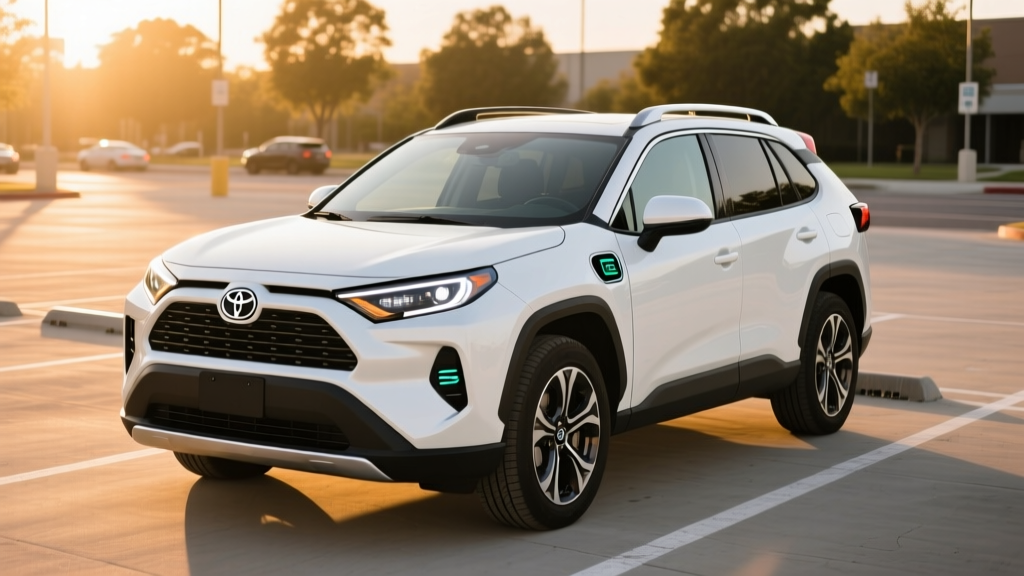
The 2026 Toyota RAV4 PHEV (badged as the RAV4 Prime) remains one of the most compelling plug-in hybrids on the market for buyers who want meaningful electric-only commuting without range anxiety on road trips. With 42 miles of EPA-rated electric-only range, 302 combined horsepower, and standard all-wheel drive, it bridges the gap between a conventional hybrid and a full battery-electric vehicle better than almost anything in its class.
For 2026, Toyota continues the RAV4 Prime with minor packaging updates. The fundamental formula is unchanged: an 18.1 kWh lithium-ion battery paired with a 2.5-liter four-cylinder engine and dual electric motors delivering confident acceleration and genuine daily EV usability — if you can charge at home.
| Spec | Value |
|---|---|
| EPA Electric-Only Range | 42 miles |
| EPA Combined MPGe (Electric Mode) | 94 MPGe |
| EPA MPG (Hybrid Mode, Combined) | 38 MPG |
| EPA MPG (City / Highway — Hybrid Mode) | 40 city / 36 highway |
| Battery Capacity (Gross / Usable) | 18.1 kWh / ~14.5 kWh usable |
| Battery Chemistry | Lithium-ion (NMC) |
| Combined System Horsepower | 302 hp |
| 0–60 mph | 5.7 seconds |
| Drivetrain | AWD (eAWD, rear electric motor) |
| Level 2 Charge Time (240V, 3.3 kW onboard) | ~5.5 hours (0–100%) |
| Level 2 Charge Time (240V, 6.6 kW onboard — available) | ~2.5 hours (0–100%) |
| DC Fast Charging | Not available |
| Battery Warranty | 10 years / 150,000 miles |
| Base MSRP (SE trim) | $44,515 |
| XSE Premium Trim MSRP | $48,390 |
HEV vs. PHEV: Understanding What You're Buying
Toyota sells two electrified versions of the RAV4, and confusing them is a common mistake. Here's the critical distinction:
| Feature | RAV4 Hybrid (HEV) | RAV4 Prime (PHEV) |
|---|---|---|
| Plug-In Charging | No — self-charging via engine and regen | Yes — plug in at home or Level 2 station |
| Electric-Only Range | None (electric assist only at low speed) | 42 miles EPA |
| Combined MPG (Hybrid Mode) | 41 MPG combined | 38 MPG combined |
| Combined Horsepower | 219 hp | 302 hp |
| 0–60 mph | 7.4 seconds | 5.7 seconds |
| Battery Size | 1.6 kWh (small buffer) | 18.1 kWh |
| Base MSRP | ~$33,425 | $44,515 |
| Federal Tax Credit Eligibility | Not eligible (§30D requires plug-in) | Eligibility varies — see below |
The conventional RAV4 Hybrid is ideal if you cannot charge at home. It never needs to be plugged in — the gasoline engine and regenerative braking keep its small battery charged. The RAV4 Prime (PHEV) demands home charging access to justify its price premium; without regular plug-in charging, you're simply carrying around extra battery weight and paying for capability you never use.
Electric-Only Range and Daily Usability
The EPA rates the 2026 RAV4 Prime at 42 miles of electric-only range. In real-world conditions, expect:
- Ideal conditions (mild weather, city/suburban driving under 45 mph): 40–45 miles — many owners report matching or slightly exceeding the EPA estimate in stop-and-go driving where regenerative braking recaptures energy.
- Highway driving (65–75 mph, sustained): 32–36 miles. Higher speeds drain the battery faster, as the electric motor works harder against aerodynamic drag.
- Cold weather (below 32°F / 0°C): 28–34 miles. Battery chemistry becomes less efficient in cold temperatures, and cabin heating draws significant power. The RAV4 Prime uses a heat pump to mitigate this, but expect a 20–25% range reduction in deep winter.
For context, the average American commute is approximately 37 miles round-trip according to FHWA data. If your daily driving falls under 40 miles and you charge overnight at home, the RAV4 Prime functions as a de facto EV on weekdays — you might visit a gas station only for longer weekend trips.
When the battery depletes, the RAV4 Prime seamlessly transitions to hybrid mode, operating like a conventional RAV4 Hybrid. Total combined range (electric + gasoline) exceeds 520 miles, eliminating any range anxiety on road trips.
Charging: What You Need to Know Before You Buy
The RAV4 Prime does not support DC fast charging. This is a deliberate engineering choice — the 18.1 kWh battery is small enough that overnight Level 2 charging is sufficient for daily needs, and adding DC fast-charge hardware would add cost and weight.
| Charging Method | Power | Time (0–100%) | Practical Notes |
|---|---|---|---|
| Level 1 (120V household outlet) | ~1.2 kW | ~12 hours | Emergency/trickle only — too slow for daily use |
| Level 2 (240V, standard 3.3 kW onboard charger) | 3.3 kW | ~5.5 hours | Standard on SE trim; overnight charge works fine |
| Level 2 (240V, upgraded 6.6 kW onboard charger) | 6.6 kW | ~2.5 hours | Available on XSE Premium; useful for mid-day top-ups |
Most RAV4 Prime owners install a 240V Level 2 home charger. A standard NEMA 14-50 outlet installation typically costs $500–$1,500 depending on your electrical panel's proximity to the garage and whether a panel upgrade (to 200A service) is needed. Budget $300–$600 for a quality Level 2 EVSE (ChargePoint Home Flex, Emporia Level 2, or similar). Total home charging setup: $800–$2,500 in most cases.
Cost per "fill-up" on electricity is remarkably low. At the US average residential rate of ~$0.17/kWh, fully recharging the RAV4 Prime's usable 14.5 kWh costs roughly $2.47 — equivalent to about $0.06 per electric mile. Compare that to a 25 MPG gas car at $3.40/gallon: roughly $0.14 per mile.
Powertrain and Performance
The 2026 RAV4 Prime's powertrain pairs a 2.5-liter Atkinson-cycle four-cylinder gasoline engine (177 hp on its own) with two electric motors — one on the front axle and one on the rear — for a combined system output of 302 horsepower. This makes it the quickest RAV4 in the lineup and one of the faster compact SUVs in its price bracket.
The eAWD system uses the rear electric motor to provide all-wheel drive without a mechanical driveshaft, reducing weight and packaging complexity. Traction is confident in rain and light snow, though this is not a hardcore off-road system.
The 0–60 mph time of 5.7 seconds is genuinely quick for a family SUV. Power delivery is smooth and immediate, as the electric motors provide instant torque from a standstill. Highway passing is effortless.
Fuel Economy: EPA Numbers vs. Real-World Results
| Mode | City | Highway | Combined |
|---|---|---|---|
| Electric Mode (MPGe) | — | — | 94 MPGe |
| Hybrid Mode (MPG) | 40 | 36 | 38 |
Real-world MPG observations: In hybrid mode (battery depleted), owners frequently report 36–42 MPG combined depending on conditions. City driving tends to yield higher numbers because regenerative braking recaptures energy that would otherwise be lost. Highway cruising at 75+ mph can drop to 33–35 MPG. These figures align closely with EPA data on fueleconomy.gov.
Compared to the conventional RAV4 Hybrid (41 MPG combined), the Prime is slightly less efficient in hybrid-only mode due to the additional ~300 lbs of battery weight. However, the Prime's ability to drive 42 miles on electricity means your actual gasoline consumption over a typical week of commuting may be near zero.
Pricing, Trims, and Federal Tax Credit Eligibility
The 2026 RAV4 Prime starts at $44,515 for the SE trim (including destination charge). The XSE trim starts around $47,390, and a fully loaded XSE Premium with options can approach $52,000.
Federal §30D Tax Credit — Does the RAV4 Prime Qualify?
Under current IRS rules, the RAV4 Prime may qualify for up to $3,750 of the federal plug-in vehicle tax credit, but full $7,500 eligibility is unlikely due to battery component and critical mineral sourcing requirements that took effect in 2024 and have tightened through 2026. Key eligibility criteria:
- MSRP cap: SUVs must be under $80,000 MSRP — the RAV4 Prime clears this easily.
- Buyer income cap: Modified AGI must not exceed $150,000 (single) / $300,000 (joint).
- Battery sourcing: A percentage of critical minerals and battery components must be sourced from the US or free-trade-agreement countries. Toyota's supply chain partially qualifies, typically yielding $3,750 rather than the full $7,500.
- Point-of-sale transfer: As of 2024, eligible buyers can transfer the credit to the dealer for an upfront price reduction rather than waiting for tax-time.
Source: IRS.gov — Clean Vehicle Credits. Tax rules change frequently. Consult a tax professional to confirm your personal eligibility before purchasing.
After a potential $3,750 credit, the effective starting price drops to approximately $40,765 — still a significant premium over the RAV4 Hybrid, but more palatable when you factor in fuel savings and the performance advantage.
Reliability and Battery Longevity
Toyota Hybrid Battery Warranty
Toyota covers the RAV4 Prime's hybrid battery for 10 years or 150,000 miles (whichever comes first) against defects and excessive capacity loss. The broader vehicle carries a 3-year/36,000-mile basic warranty and 5-year/60,000-mile powertrain warranty.
Toyota's hybrid battery track record is among the best in the industry. Prius batteries routinely last 200,000+ miles with gradual, manageable degradation. The RAV4 Prime's larger battery operates with a conservative state-of-charge buffer (using roughly 14.5 of its 18.1 kWh), which reduces stress and extends lifespan.
What does battery replacement cost? If the high-voltage battery fails outside of warranty, replacement costs typically range from $4,000 to $7,500 including parts and labor at a Toyota dealer. However, given Toyota's historical hybrid battery longevity, out-of-warranty failure is uncommon within the first 12–15 years of typical ownership.
For comparison, individual hybrid battery modules can sometimes be replaced rather than the entire pack, reducing costs to $1,500–$3,000 at independent hybrid specialists.
Toyota's warranty documentation details specific coverage terms. The hybrid system (inverter, motors, control electronics) is also covered under the hybrid battery warranty period.
RAV4 Prime vs. Full EV vs. Gas: Which Should You Choose?
Who Should Buy the 2026 RAV4 Prime (PHEV)?
- Choose the RAV4 Prime if: You can charge at home (garage or driveway with 240V access), your daily commute is under 45 miles, you take regular road trips where charging infrastructure is sparse, and you want one vehicle that does everything without compromise.
- Choose a full EV (like a Tesla Model Y or Hyundai Ioniq 5) if: You have reliable home charging, your daily driving rarely exceeds 250 miles, you want zero gasoline expenses and minimal maintenance, and you're comfortable planning road trips around DC fast-charging stops.
- Choose the conventional RAV4 Hybrid (HEV) if: You cannot charge at home (apartment, street parking), you want the lowest purchase price, or you simply want excellent fuel economy without any behavioral change.
- Choose a gas-only SUV if: You drive very few miles annually (under 5,000), where the fuel savings of electrification won't offset the higher purchase price within your ownership timeline.
Pros
- 42 miles EV range covers most daily commutes gas-free
- 302 hp / 5.7-sec 0–60 — quickest RAV4 by a wide margin
- Standard AWD with no mechanical complexity penalty
- 520+ mile total range eliminates road-trip range anxiety
- Proven Toyota hybrid reliability and 10-year battery warranty
- Strong resale value; RAV4 Prime has historically had long waitlists
Cons
- $44,515 starting price — $11,000+ premium over RAV4 Hybrid
- No DC fast charging — strictly Level 2 or slower
- Federal tax credit likely capped at $3,750, not the full $7,500
- Requires home charging to realize value; apartment dwellers should skip
- Cargo space slightly reduced vs. non-Prime RAV4 (battery packaging)
- 3.3 kW onboard charger (SE trim) is slow for a 2026 vehicle
Frequently Asked Questions
How many MPG does the 2026 RAV4 Prime get?
In hybrid mode (battery depleted), the EPA rates it at 40 city / 36 highway / 38 combined MPG. In electric mode, it achieves 94 MPGe combined. Real-world hybrid-mode results typically range from 36–42 MPG depending on driving style and conditions.
How far can the RAV4 Prime go on electric only?
The EPA rates it at 42 miles of electric-only range. In real-world use, expect 40–45 miles in mild city driving, 32–36 miles on the highway, and 28–34 miles in cold winter conditions below freezing.
Does the 2026 RAV4 Prime qualify for a federal tax credit?
It may qualify for up to $3,750 under IRS §30D, depending on battery sourcing requirements, your income, and the vehicle's MSRP. The full $7,500 is unlikely due to critical mineral sourcing rules. Always verify current eligibility on fueleconomy.gov and consult a tax professional.
Is the RAV4 Prime reliable? What about battery replacement cost?
Toyota's hybrid systems have an outstanding reliability track record spanning two decades. The hybrid battery is warranted for 10 years / 150,000 miles. Out-of-warranty replacement costs $4,000–$7,500 at a dealer, but most Toyota hybrid batteries last well beyond 200,000 miles.
Can the RAV4 Prime DC fast charge?
No. The RAV4 Prime supports only Level 1 (120V) and Level 2 (240V) AC charging. There is no DC fast-charge port. A full charge takes approximately 2.5 hours on a 6.6 kW Level 2 charger or 5.5 hours on the standard 3.3 kW onboard charger.
Should I get the RAV4 Prime or a full EV?
If your daily commute is under 42 miles and you can charge at home, the RAV4 Prime operates as an EV during the week while giving you unlimited gasoline range for road trips. A full EV (Tesla Model Y, Hyundai Ioniq 5) offers lower running costs and zero tailpipe emissions but requires route-planning for longer trips and comfort with public DC fast charging.