Quick Verdict: The 2024 Toyota Corolla Cross Hybrid at a Glance
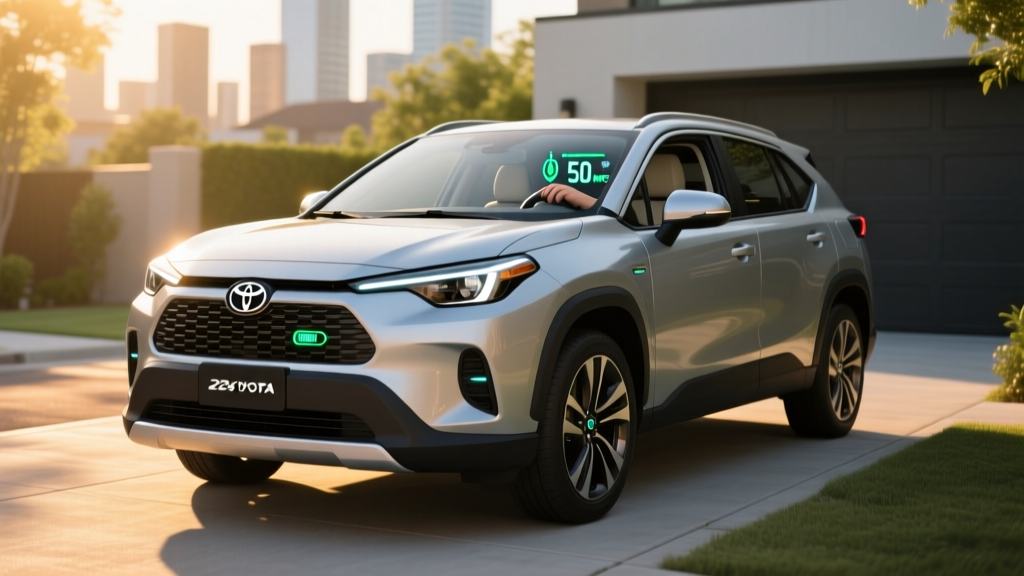
The 2024 Toyota Corolla Cross Hybrid fills a specific gap in Toyota's lineup: a compact crossover that delivers genuine hybrid efficiency without the premium pricing of the RAV4 Hybrid. With an EPA-estimated 42 MPG combined and standard all-wheel drive, it targets buyers who want SUV practicality, year-round traction, and fuel costs that undercut most gas-only compacts — all without ever plugging in.
This is a conventional hybrid (HEV), not a plug-in hybrid (PHEV). That distinction matters: the Corolla Cross Hybrid charges its own battery through regenerative braking and the gasoline engine. There is no plug, no electric-only driving mode, and no federal tax credit. What you get instead is simplicity — fill up with gas and let the hybrid system handle the rest.
| Specification | Value |
|---|---|
| EPA Combined MPG | 42 MPG |
| EPA City MPG | 45 MPG |
| EPA Highway MPG | 38 MPG |
| Combined System Horsepower | 196 hp |
| Engine | 2.0L 4-cylinder + 3 electric motors |
| Drivetrain | AWD (electronic rear motor) |
| 0–60 mph | ~7.5 seconds (est.) |
| Cargo Volume (rear seats up) | 25.5 cu ft |
| Cargo Volume (rear seats folded) | ~50 cu ft |
| Hybrid Battery Warranty | 10 years / 150,000 miles |
| Base MSRP (S Hybrid) | $29,395 (incl. destination) |
| Top Trim MSRP (XSE Hybrid) | ~$33,500 |
How Many MPG Does the 2024 Toyota Corolla Cross Hybrid Get?
According to fueleconomy.gov, the 2024 Corolla Cross Hybrid achieves:
| Driving Cycle | EPA Estimate |
|---|---|
| City | 45 MPG |
| Highway | 38 MPG |
| Combined | 42 MPG |
The city-highway split is typical of Toyota's hybrid synergy drive: the electric motor handles low-speed crawling and stop-and-go traffic where gasoline engines are least efficient, so city MPG actually exceeds highway MPG.
Real-World MPG: What to Expect Beyond the Sticker
EPA numbers are a useful baseline, but real-world results vary with driving style, climate, and terrain. Based on owner reports and third-party testing:
- City / suburban driving: Many drivers report 44–48 MPG in warm weather with moderate stop-and-go traffic. The hybrid system recovers significant energy through regenerative braking.
- Highway cruising (70–80 mph): Expect 35–38 MPG. Aerodynamic drag dominates at higher speeds, and the 2.0L engine carries more of the load.
- Cold weather (below 32°F): Plan on a 10–15% reduction, bringing combined MPG into the 36–38 range. The engine runs more frequently to heat the cabin and maintain battery temperature.
- Mixed real-world average: Most owners land between 39–44 MPG in combined daily driving across seasons.
The Corolla Cross Hybrid does not have the range-extending advantage of a PHEV or EV in stop-and-go traffic, but it also never requires behavior changes. You drive it like a normal car, and the hybrid system optimizes in the background.
Hybrid vs PHEV vs EV: Where Does the Corolla Cross Hybrid Fit?
Toyota offers the Corolla Cross only as a conventional hybrid (HEV) in the US market — there is no plug-in hybrid (PHEV) variant. For comparison, here's how the three electrified powertrain types stack up:
| Factor | HEV (Corolla Cross Hybrid) | PHEV (e.g., RAV4 Prime) | BEV (e.g., bZ4X) |
|---|---|---|---|
| Plug-in required? | No | Yes (for EV mode) | Yes |
| Electric-only range | None | ~42 mi (RAV4 Prime) | 220–250+ mi |
| Home charging needed? | No | Recommended | Essential |
| Federal tax credit (§30D) | Not eligible | Up to $7,500* | Up to $7,500* |
| Combined MPG / MPGe | 42 MPG | 94 MPGe (EV) / 38 MPG (gas) | ~114 MPGe |
| Upfront cost | Lowest | Moderate–High | Highest |
| Best for | No home charging, budget-first | Home charging + short commutes | Home charging + EV-ready |
*Federal §30D tax credit eligibility depends on MSRP caps, buyer income limits, battery component sourcing, and point-of-sale transfer rules. See IRS.gov for current-year requirements.
Decision Framework
- Choose the Corolla Cross Hybrid (HEV) if: You don't have access to home or workplace charging, you want the lowest purchase price, you prioritize reliability and simplicity, or you live in an apartment where installing a charger isn't feasible.
- Choose a PHEV (like the RAV4 Prime) if: You can install a Level 2 charger at home, your daily commute is under 40 miles round-trip, and you want electric-only driving most days with a gas backup for road trips.
- Choose a full EV (BEV) if: You have reliable home charging, your daily driving is under 200 miles, you want the lowest per-mile fuel cost, and you're ready to plan around public charging for longer trips.
Powertrain: 196 HP with Toyota's Fifth-Gen Hybrid System
The 2024 Corolla Cross Hybrid pairs a 2.0-liter four-cylinder Atkinson-cycle engine with three electric motors — two on the front axle integrated into the transaxle and one dedicated motor on the rear axle. Combined system output is 196 horsepower.
The rear motor provides electronic all-wheel drive without a mechanical driveshaft. Under normal cruising, the front wheels do most of the work. When the system detects slip — wet roads, snow, hard acceleration — the rear motor engages within milliseconds. This is not an off-road system, but it provides confident traction in rain and light snow.
The hybrid battery is a compact lithium-ion pack mounted under the rear seats. Toyota does not publish the exact kWh capacity for this application (it is small — roughly 1.0–1.5 kWh usable — because it only needs to buffer energy between regeneration and assist, not drive the car independently). The battery is never fully depleted or fully charged in normal operation; the system keeps it in a narrow state-of-charge window to maximize longevity.
Acceleration is adequate for merging and passing. The 0–60 mph time of approximately 7.5 seconds won't win any drag races, but the instant electric torque at low RPM makes the car feel quicker around town than the number suggests. The CVT-like behavior of the e-CVT transaxle means no shift shocks, though sustained highway acceleration can produce the characteristic engine drone common to Toyota hybrids.
Pricing, Trims, and Tax Credit Eligibility
The 2024 Corolla Cross Hybrid is available in three trims, all with AWD:
- S Hybrid: ~$29,395 — 8-inch touchscreen, wireless Apple CarPlay/Android Auto, Toyota Safety Sense 3.0, LED headlights
- SE Hybrid: ~$31,095 — Sport-tuned suspension, 18-inch alloy wheels, heated front seats, power driver seat
- XSE Hybrid: ~$33,500 — SofTex synthetic leather, JBL premium audio, wireless phone charging, ambient lighting
Does the 2024 Toyota Corolla Cross Hybrid Qualify for a Tax Credit?
No. The Corolla Cross Hybrid is a conventional hybrid (HEV), not a plug-in vehicle. The federal §30D Clean Vehicle Credit applies only to battery electric vehicles (BEVs) and plug-in hybrids (PHEVs) that meet specific battery sourcing, MSRP, and buyer income requirements. Conventional hybrids like this one do not qualify for the federal credit.
Some states offer small rebates or HOV lane access for hybrids, but these programs vary widely and change frequently. Check your state's energy office or AFDC energy law database for current local incentives.
On a total-cost basis, the Corolla Cross Hybrid's advantage comes from fuel savings, not incentives. At 42 MPG combined versus a comparable gas-only compact crossover at roughly 28 MPG, and with gas at $3.50/gallon, the hybrid saves approximately $650–$800 per year in fuel costs over 12,000 miles of driving. Over a 5-year ownership period, that's $3,250–$4,000 in fuel savings — partially offsetting the hybrid's modest price premium over the gas-only Corolla Cross.
Battery Warranty, Reliability, and Replacement Cost
Toyota Hybrid Battery Warranty
Coverage: 10 years or 150,000 miles (whichever comes first) for the hybrid battery pack, effective for 2020 and later model years.
What's covered: Defects in materials or workmanship, and capacity loss below a defined threshold (typically 60–70% of original capacity as measured by Toyota's diagnostic tool).
Transferability: The hybrid battery warranty transfers to subsequent owners at no cost, which supports resale value.
Is the 2024 Corolla Cross Hybrid Reliable?
Toyota's hybrid powertrain is one of the most proven in the industry, with over two decades of real-world deployment since the original Prius. The fifth-generation hybrid system in the Corolla Cross uses fewer moving parts than a conventional automatic transmission (no torque converter, no traditional gear shifts), which reduces mechanical failure points.
Third-party reliability data from Consumer Reports and J.D. Power consistently ranks Toyota hybrids among the most dependable vehicles in their segments. The Corolla Cross Hybrid shares its powertrain architecture with other Toyota hybrids, and there are no widespread reports of systemic failures in the 2023–2024 model years.
Hybrid Battery Replacement Cost
If the hybrid battery does fail outside warranty, replacement costs typically range from $2,000 to $4,000 for a new OEM pack, including labor. Refurbished or aftermarket packs may be available for $1,200–$2,500. However, real-world data suggests Toyota hybrid batteries routinely last 150,000–200,000+ miles with minimal degradation, because the system's conservative charge window (never fully charging or fully depleting the pack) dramatically reduces cell stress.
For context, many first-generation Prius vehicles from the early 2000s are still running on their original hybrid batteries at well over 200,000 miles. The Corolla Cross Hybrid's lithium-ion pack should meet or exceed this track record.
Interior, Tech, and Daily Practicality
The Corolla Cross Hybrid's cabin is functional rather than luxurious. The 8-inch infotainment screen runs Toyota's latest interface with wireless Apple CarPlay and Android Auto on all trims. Physical knobs for volume and climate control remain — a practical choice that avoids the touchscreen-only frustration found in some competitors.
Toyota Safety Sense 3.0 is standard across all trims and includes:
- Pre-Collision System with Pedestrian Detection
- Lane Departure Alert with Steering Assist
- Dynamic Radar Cruise Control (full-speed adaptive cruise)
- Lane Tracing Assist (centering in lane)
- Automatic High Beams
- Road Sign Assist
Important note on driver assistance: Toyota Safety Sense is a Level 2 driver-assist system per SAE automation levels. This means the system can control steering and speed under certain conditions, but the driver must remain fully engaged, hands on or near the wheel, and eyes on the road at all times. It is not self-driving.
Cargo space measures 25.5 cubic feet behind the rear seats — competitive with the Honda HR-V and Subaru Crosstrek. Folding the 60/40 split rear seats opens up roughly 50 cubic feet. The hybrid battery's under-seat placement means no cargo floor compromise versus the gas model.
Who Should Buy the 2024 Toyota Corolla Cross Hybrid?
Pros
- 42 MPG combined EPA — strong for an AWD crossover
- Standard AWD on every trim
- No plug-in required — zero behavior change
- 10-year / 150,000-mile hybrid battery warranty
- Competitive starting price (~$29,400)
- Proven Toyota hybrid reliability track record
- Toyota Safety Sense 3.0 standard
Cons
- No federal tax credit (HEV, not PHEV)
- Modest 196 hp — adequate but not quick
- Highway MPG drops to 38 (engine drone under load)
- Interior materials are basic at the S trim level
- Small rear seat compared to RAV4
- No PHEV option available in this model
The 2024 Corolla Cross Hybrid is the right choice if you want crossover versatility and AWD security without the complexity, cost, or charging requirements of a PHEV or EV. It's ideal for apartment dwellers, street parkers, and anyone who simply wants to fill up with gas and drive. If you have home charging access and a short commute, a PHEV like the RAV4 Prime offers greater fuel savings through electric-only driving — but at a significantly higher purchase price.
Frequently Asked Questions
How many MPG does the 2024 Toyota Corolla Cross Hybrid get?
The EPA rates it at 45 city / 38 highway / 42 combined MPG. Real-world driving typically yields 39–44 MPG combined, with city driving sometimes exceeding the EPA estimate and highway driving falling slightly short.
Does the Corolla Cross Hybrid need to be plugged in?
No. This is a conventional hybrid (HEV). The battery charges itself through regenerative braking and the gasoline engine. You fuel it like any other car at a gas station.
Does the 2024 Corolla Cross Hybrid qualify for any federal tax credit?
No. The federal §30D Clean Vehicle Credit applies only to plug-in vehicles (BEVs and PHEVs) that meet battery sourcing, MSRP, and income requirements. Conventional hybrids are not eligible. Some states may offer small incentives — check your local programs.
Is the hybrid battery reliable, and what does replacement cost?
Toyota's hybrid batteries have a strong long-term reliability record, often lasting 150,000–200,000+ miles. The battery is covered by a 10-year / 150,000-mile warranty. Out-of-warranty replacement typically costs $2,000–$4,000 for a new OEM pack.
How does the Corolla Cross Hybrid compare to the RAV4 Hybrid?
The RAV4 Hybrid offers more interior space, a slightly higher EPA rating (39–41 MPG combined depending on trim), and a more powerful 219 hp powertrain — but starts around $5,000–$7,000 higher. The Corolla Cross Hybrid is the more budget-friendly option if you don't need the RAV4's extra cargo room.
Is AWD always active on the Corolla Cross Hybrid?
The electronic AWD system is automatic and on-demand. Under normal conditions, the front wheels provide most propulsion. The rear electric motor engages when the system detects slip or when extra traction is needed. There is no driver-selectable AWD mode.
Hybrid vs PHEV vs EV — which should I choose?
Choose the HEV (Corolla Cross Hybrid) if you have no home charging and want simplicity. Choose a PHEV if you can charge at home and want electric-only commuting with gas backup. Choose a BEV if you have home charging, want the lowest per-mile cost, and are comfortable planning around charging on road trips.