The Toyota RAV4 Hybrid has long been the default answer for buyers who want crossover practicality without the fuel bill of a traditional SUV. But the Toyota RAV4 Hybrid Woodland Edition occupies a specific niche: it layers rugged, trail-oriented styling and all-weather capability onto Toyota's proven hybrid powertrain. For 2026, the Woodland Edition returns as a distinct trim aimed at outdoor-minded drivers who need a hybrid that can handle light trails, snow, and gravel roads without sacrificing efficiency.
This guide breaks down exactly what the 2026 RAV4 Hybrid Woodland Edition delivers — EPA MPG, powertrain specs, real-world fuel economy, battery longevity, pricing, and how it compares to the RAV4 Prime (PHEV) and a full battery-electric vehicle. If you're researching whether this is the right electrified SUV for your lifestyle, you'll have the numbers to decide by the end.
HEV vs. PHEV: Where the Woodland Edition Fits
Before examining specs, it's essential to understand what the Woodland Edition is — and what it isn't. The RAV4 Hybrid Woodland Edition is a conventional hybrid electric vehicle (HEV). It pairs a gasoline engine with electric motors and a small battery that recharges through regenerative braking and the engine. You never plug it in. You simply fill it with gas and drive.
Toyota also sells the RAV4 Prime, which is a plug-in hybrid electric vehicle (PHEV). The Prime has a much larger battery, an electric-only driving range, and requires plugging in to realize its full efficiency benefit. The Woodland Edition does not offer electric-only driving — the gas engine and electric motors always work together.
| Attribute | RAV4 Hybrid Woodland (HEV) | RAV4 Prime (PHEV) |
|---|---|---|
| Powertrain type | Conventional hybrid (no plug) | Plug-in hybrid |
| Combined horsepower | 219 hp | 302 hp |
| Battery capacity | ~1.6 kWh (NiMH) | 18.1 kWh (Li-ion) |
| Electric-only range | None (motor assists engine) | 42 miles (EPA) |
| EPA combined MPG / MPGe | 39 MPG | 94 MPGe (electric) / 38 MPG (gas) |
| Plug-in charging required | No | Yes (Level 1 or Level 2) |
| DC fast charging | N/A | No DC fast charge |
| Starting MSRP (2026) | ~$37,250 | ~$44,500 |
The Woodland Edition is the right pick if you want hybrid efficiency without the complexity, cost, or charging requirements of a PHEV. The Prime is better if you have home charging access, a short commute, and want to drive mostly on electricity most days.
Fuel Economy: EPA MPG and Real-World Efficiency
The headline number for the 2026 RAV4 Hybrid Woodland Edition is its EPA-rated fuel economy. According to fueleconomy.gov, the RAV4 Hybrid AWD achieves:
| Driving Cycle | EPA Rating |
|---|---|
| City | 41 MPG |
| Highway | 38 MPG |
| Combined | 39 MPG |
Real-World MPG: What Owners Actually See
Toyota's hybrid system excels in stop-and-go city driving, where regenerative braking and low-speed electric motor assist do the heavy lifting. Many owners report exceeding the EPA city rating in urban and suburban driving — 42 to 45 MPG is common in warm weather at moderate speeds.
Highway driving is a different story. At sustained 70–80 mph speeds, the gasoline engine carries most of the load, and aerodynamic drag works against the boxy RAV4 shape. Expect 34–37 MPG on the highway in real-world conditions. In cold weather (below 30°F), the engine runs more often to provide cabin heat and maintain battery temperature, which can drop combined real-world economy to 33–36 MPG until the vehicle warms up.
Powertrain Specs: 219 Horsepower with AWD Standard
The Woodland Edition uses the same powertrain as all RAV4 Hybrid trims: a 2.5-liter four-cylinder Atkinson-cycle engine paired with three electric motors — one integrated into the front transaxle and a dedicated rear motor providing electronic on-demand all-wheel drive (AWD).
| Specification | Value |
|---|---|
| Engine | 2.5L 4-cylinder Atkinson-cycle |
| Engine output | 176 hp / 163 lb-ft torque |
| Front electric motor | 118 hp / 149 lb-ft |
| Rear electric motor (AWD) | 54 hp / 89 lb-ft |
| Net combined system output | 219 hp |
| Transmission | eCVT (electronically controlled) |
| Drivetrain | Electronic AWD (standard) |
| 0–60 mph | ~7.4 seconds |
| Towing capacity | 1,750 lbs |
The Woodland Edition's AWD system is particularly relevant for its off-road positioning. The rear motor engages automatically when front-wheel slip is detected, providing torque to the rear axle without a mechanical driveshaft. This system is responsive in rain, snow, and loose gravel, though it's not a substitute for a dedicated off-road vehicle with low-range gearing and locking differentials.
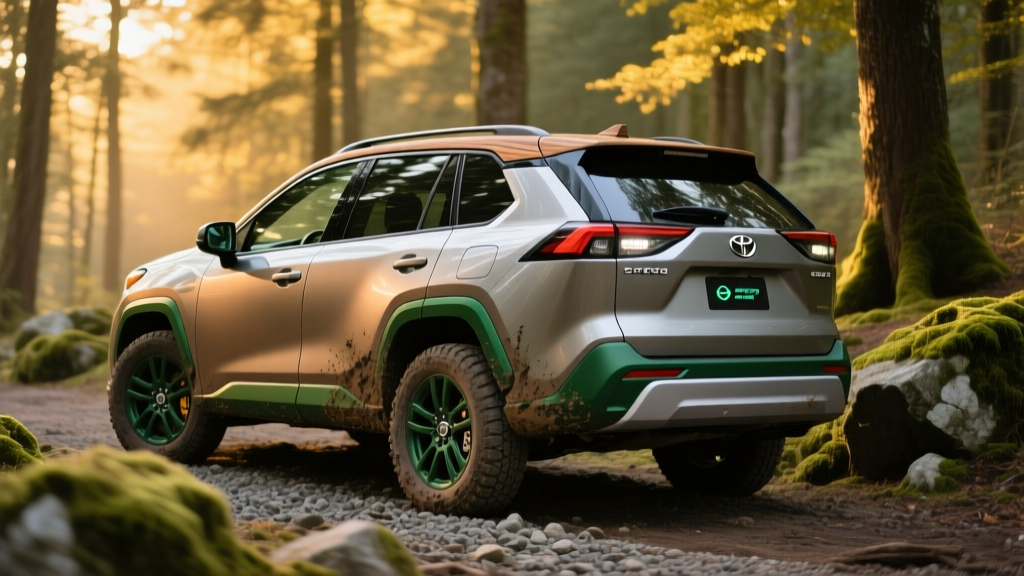
Woodland Edition: What Sets This Trim Apart
The Woodland Edition isn't mechanically different from the RAV4 Hybrid XLE or SE — it's a styling and equipment package that emphasizes outdoor capability. Key differentiators for 2026 include:
- TRD-tuned suspension with slightly increased ground clearance (~8.4 inches)
- All-terrain tires on 18-inch bronze-colored alloy wheels
- Unique front grille and body cladding with a more rugged aesthetic
- Roof rails with integrated cross bars for cargo and gear
- Weather-resistant interior materials and all-weather floor liners
- Multi-terrain select (Mud & Sand, Rock & Dirt modes)
- Standard Toyota Safety Sense 2.5+ (pre-collision, lane departure, adaptive cruise, lane tracing)
These features make the Woodland Edition practical for weekend camping, ski trips, and light trail use. The trade-off is slightly higher road noise from the all-terrain tires and a marginally firmer ride compared to the XLE.
Pricing, Tax Credits, and Ownership Cost
The 2026 Toyota RAV4 Hybrid Woodland Edition starts at an MSRP of approximately $37,250 (including destination charge). With popular options like the premium audio/navigation package and a moonroof, a well-equipped example lands between $39,000 and $41,000.
Federal Tax Credit Eligibility
Here's where the HEV vs. PHEV distinction matters for your wallet. Under IRS §30D Clean Vehicle Credit rules, conventional hybrids like the RAV4 Hybrid Woodland Edition do not qualify for the federal EV tax credit. The §30D credit applies only to plug-in electric vehicles (BEVs and PHEVs) that meet battery capacity, critical-mineral sourcing, MSRP, and buyer income thresholds.
If you want a RAV4 that may qualify for a federal credit, the RAV4 Prime (PHEV) is the candidate — though eligibility depends on battery sourcing requirements that have tightened significantly. Always verify current-year rules on IRS.gov or consult a tax professional before purchasing based on credit assumptions.
Five-Year Cost of Ownership Estimate
Even without a tax credit, the RAV4 Hybrid Woodland Edition keeps running costs low. Here's a rough five-year/75,000-mile ownership comparison:
| Vehicle | MPG Combined | 5-Year Fuel Cost |
|---|---|---|
| RAV4 Hybrid Woodland (HEV) | 39 MPG | ~$6,540 |
| RAV4 Gas AWD (non-hybrid) | 29 MPG | ~$8,795 |
| RAV4 Prime (PHEV, 60% electric) | 94 MPGe equiv. | ~$3,800 |
The hybrid saves roughly $2,250 in fuel over five years compared to the gas-only RAV4 AWD. That partially offsets the hybrid's higher MSRP. Toyota's hybrid components also reduce brake wear (regenerative braking extends pad life) and eliminate the alternator and starter motor — fewer parts to fail.
Battery Warranty, Reliability, and Replacement Cost
Hybrid battery longevity is the top concern for buyers new to the technology. Toyota addresses this with one of the strongest hybrid battery warranties in the industry.
How Long Do Toyota Hybrid Batteries Actually Last?
Toyota's hybrid battery packs — particularly the nickel-metal hydride (NiMH) units used in the RAV4 Hybrid — have a proven track record. Data from fleet and owner reports shows most Toyota hybrid batteries last 150,000 to 200,000+ miles before requiring replacement. The small 1.6 kWh battery in the RAV4 Hybrid operates within a narrow state-of-charge window (roughly 40%–80%), which dramatically reduces cell stress compared to a full EV battery that cycles between 10% and 90%.
If replacement is eventually needed out of warranty, a refurbished RAV4 Hybrid battery typically costs $2,000–$3,500 installed, while a new OEM pack runs $3,500–$5,000. Independent hybrid shops offer refurbished options at the lower end of that range. This is substantially less than a full EV battery replacement.
Overall Reliability
Toyota consistently ranks at or near the top of reliability surveys from Consumer Reports and J.D. Power. The RAV4 Hybrid's powertrain is one of the most thoroughly validated hybrid systems on the road, with millions of units in service across Toyota's lineup. The eCVT transmission has no traditional gears or clutch packs to wear out — it uses a planetary gearset that's remarkably durable.
RAV4 Hybrid Woodland vs. PHEV vs. Full EV: Which Is Right for You?
Choosing between the RAV4 Hybrid, the RAV4 Prime, and a battery-electric SUV comes down to your driving habits, charging access, and budget.
Choose the RAV4 Hybrid (HEV) if:
- You don't have access to home or workplace charging
- You want the lowest purchase price among electrified RAV4s
- You take frequent long road trips and don't want to plan charging stops
- You want simple, proven technology with zero plug-in hassle
- Your daily driving varies widely (some days 10 miles, some days 300)
Choose the RAV4 Prime (PHEV) if:
- You have Level 2 home charging and a commute under 42 miles
- You want to drive mostly on electricity but need gas for longer trips
- You may qualify for the §30D federal tax credit
- You value the 302 hp performance boost
- You're willing to pay ~$7,000 more upfront for electric driving
Choose a Full EV (e.g., Tesla Model Y) if:
- You have reliable home charging (Level 2)
- Your daily driving is under 250 miles and you rarely tow
- You want the lowest per-mile fuel cost and zero tailpipe emissions
- You're eligible for the full $7,500 federal tax credit
- You're comfortable with route planning around DC fast chargers
The Woodland Edition specifically adds value for buyers who regularly encounter unpaved roads, snow, or need to carry gear on roof racks. If your "adventures" stay on paved roads, the RAV4 Hybrid XLE offers the same powertrain for roughly $2,500 less.
Pros and Cons: 2026 RAV4 Hybrid Woodland Edition
✓ Pros
- 39 MPG combined — excellent for an AWD crossover
- No plug-in charging required; zero lifestyle change
- Standard AWD with competent light off-road ability
- 10-year / 150,000-mile hybrid battery warranty
- Strong resale value and proven Toyota reliability
- Over 535 miles of real-world range per tank
- Toyota Safety Sense 2.5+ standard
✗ Cons
- No federal tax credit (HEV, not PHEV or BEV)
- 219 hp is adequate but not quick for highway merging
- All-terrain tires increase road noise vs. standard trims
- 1,750-lb towing capacity limits utility for boat/trailer owners
- Rear seat and cargo space unchanged from standard RAV4 (not class-leading)
- No DC fast charging or meaningful electric-only assist
- Woodland premium over XLE is hard to justify purely on function
Frequently Asked Questions
How many MPG does the Toyota RAV4 Hybrid Woodland Edition get?
The EPA rates the 2026 RAV4 Hybrid AWD at 41 MPG city, 38 MPG highway, and 39 MPG combined. In real-world driving, most owners see 37–42 MPG combined depending on conditions. City driving often exceeds the EPA rating, while sustained highway speeds and cold weather reduce it.
Does the RAV4 Hybrid Woodland Edition need to be plugged in?
No. The RAV4 Hybrid is a conventional hybrid (HEV). Its small battery recharges through regenerative braking and the gasoline engine. You never plug it in — you simply refuel with gasoline as you would any other car.
Does the RAV4 Hybrid qualify for a federal tax credit?
No. The IRS §30D Clean Vehicle Credit applies only to plug-in vehicles (BEVs and PHEVs). Conventional hybrids like the RAV4 Hybrid do not qualify. The RAV4 Prime (PHEV) may qualify, depending on current-year sourcing rules, MSRP caps, and buyer income limits. Check IRS.gov for the latest eligibility details.
How long will the RAV4 Hybrid battery last and what does replacement cost?
Toyota's hybrid batteries routinely last 150,000–200,000+ miles. The battery is warrantied for 10 years or 150,000 miles. If replacement is needed out of warranty, expect to pay $2,000–$5,000 depending on whether you choose a refurbished or new OEM pack.
Is the Woodland Edition worth the premium over the RAV4 Hybrid XLE?
If you regularly drive on unpaved roads, carry roof-mounted gear, or want the rugged aesthetic, the Woodland Edition's TRD-tuned suspension, all-terrain tires, and integrated roof rails justify the ~$2,500 premium. If you drive primarily on pavement, the XLE provides the same powertrain and fuel economy at a lower price.
How does the RAV4 Hybrid compare to a full EV like the Tesla Model Y?
The Model Y offers lower per-mile energy costs, stronger performance, and available tax credits — but requires home charging access, route planning for long trips, and a higher purchase price. The RAV4 Hybrid eliminates range anxiety and charging logistics entirely, at the cost of higher fuel spend and no electric-only driving. For households without reliable charging, the hybrid remains the more practical choice.