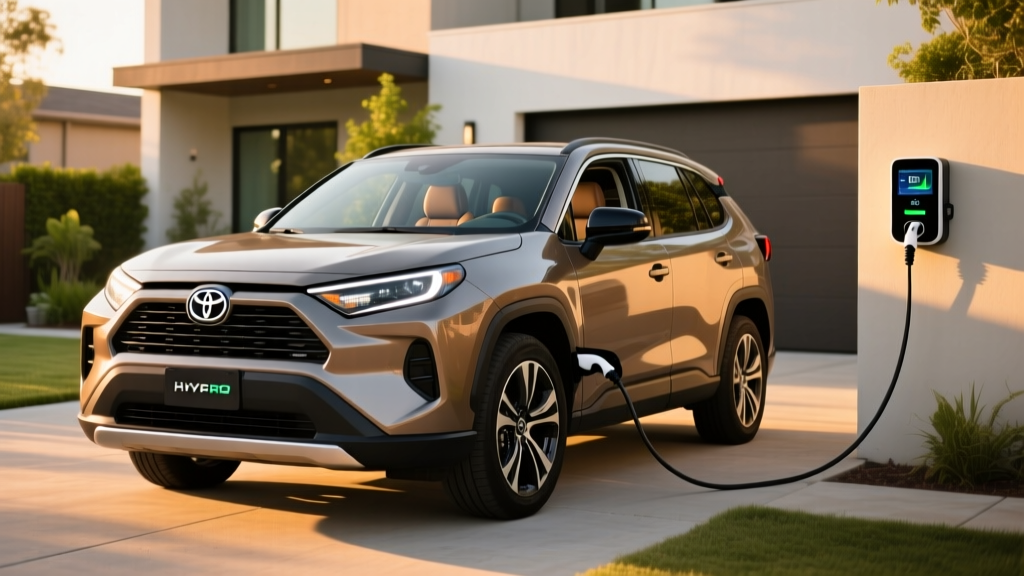
The phrase "tank hybrid" gets thrown around forums and EV communities to describe a hybrid vehicle that delivers enormous total driving range — enough to cross entire states on a single fill-up. In 2026, the Toyota RAV4 Hybrid remains the benchmark for this concept. With its 14.5-gallon fuel tank and class-leading fuel economy, it offers roughly 580–600 miles of total range, making it one of the most practical electrified vehicles for drivers who aren't ready to commit to a plug.
But the RAV4 Hybrid lineup now sits alongside the RAV4 Prime (a plug-in hybrid) and the fully electric bZ4X. Which one actually fits your life? This guide breaks down the RAV4 Hybrid's real-world efficiency, powertrain, battery longevity, tax-credit eligibility, and how it stacks up against its electrified siblings.
HEV vs PHEV: What the RAV4 Lineup Actually Offers
Before diving into MPG figures, it's critical to understand the distinction between the two RAV4 electrified variants, because confusing them leads to bad purchase decisions.
| Attribute | RAV4 Hybrid (HEV) | RAV4 Prime (PHEV) |
|---|---|---|
| Plug-in required? | No — self-charging via regenerative braking and engine | Yes — plug in to access electric-only range |
| Electric-only range | 0 miles (EV mode limited to ~1 mi at low speed) | 42 miles (EPA est.) |
| Battery capacity | ~1.6 kWh (small buffer) | 18.1 kWh usable |
| Combined horsepower | 219 hp | 302 hp |
| EPA combined MPG / MPGe | 39 MPG combined | 94 MPGe (electric) / 38 MPG (gas-only) |
| DC fast charging | N/A | No DC fast charge — Level 2 only |
| Federal tax credit (§30D) | Not eligible | Up to $7,500 (subject to income, sourcing rules) |
| Starting MSRP (2026) | ~$33,500 | ~$44,500 |
The conventional RAV4 Hybrid is a self-charging hybrid (HEV). You never plug it in. The gasoline engine and regenerative braking keep a small battery charged, and the electric motor assists during acceleration and low-speed driving. The RAV4 Prime is a plug-in hybrid (PHEV) with a much larger battery that delivers genuine electric-only commuting range before the engine kicks in.
Fuel Economy: EPA Numbers and Real-World MPG
For the RAV4 Hybrid, the EPA rates the 2026 RAV4 Hybrid (AWD, LE trim) at:
| Driving Cycle | EPA MPG | Real-World Expectation |
|---|---|---|
| City | 41 MPG | 42–46 MPG (hybrids excel in stop-and-go) |
| Highway | 38 MPG | 34–37 MPG (sustained 70+ mph reduces regen benefit) |
| Combined | 39 MPG | 38–42 MPG (depends on driving mix) |
The "Tank Hybrid" Range Math
With a 14.5-gallon fuel tank and a real-world combined average of ~40 MPG, the RAV4 Hybrid delivers approximately 580 miles of total range. Conservative drivers in city-heavy commutes have reported exceeding 620 miles before the low-fuel warning. That's the "tank hybrid" appeal: you visit the gas station roughly once every two to three weeks under normal driving, and road trips require minimal fuel stops.
By comparison, the RAV4 Prime delivers 42 miles of electric range (enough for most commutes) plus roughly 480 miles of gasoline range once the battery depletes, for a total system range of about 520 miles — slightly less than the HEV due to its smaller effective gas tank allocation and heavier curb weight.
How Many MPG Does the RAV4 Hybrid Actually Get?
In mixed suburban and highway driving during moderate temperatures (55–75°F), expect 38–42 MPG combined. In cold weather (below 30°F), the engine runs more frequently for cabin heat, dropping real-world economy to 33–36 MPG. This is a smaller cold-weather penalty than full EVs experience, but it's real.
Powertrain and Performance
| Specification | RAV4 Hybrid (HEV) | RAV4 Prime (PHEV) |
|---|---|---|
| Engine | 2.5L 4-cylinder Atkinson cycle | 2.5L 4-cylinder Atkinson cycle |
| Electric motors | Front + rear (eAWD) | Front + rear (eAWD, higher output) |
| Combined horsepower | 219 hp | 302 hp |
| 0–60 mph | 7.4 seconds | 5.7 seconds |
| Drivetrain | Electronic AWD (eAWD) | Electronic AWD (eAWD) |
| Transmission | eCVT (planetary gearset) | eCVT (planetary gearset) |
| Towing capacity | 1,750 lbs | 2,500 lbs |
Toyota's eCVT is not a traditional belt-driven CVT — it's a planetary gearset that blends engine and motor power with no fixed gear ratios. The result is smooth, linear acceleration with no shift shock. The tradeoff is a droning engine note under hard acceleration, which is the single most common complaint among RAV4 Hybrid owners.
The RAV4 Prime's 302 hp and 5.7-second 0–60 time make it the quickest RAV4 ever sold, and one of the quickest vehicles in its price class. If performance matters alongside efficiency, the Prime earns its premium.
Battery Longevity, Warranty, and Replacement Cost
Hybrid Battery Warranty: Toyota covers the RAV4 Hybrid and Prime hybrid battery for 10 years or 150,000 miles (whichever comes first) in all 50 states. This applies to the original owner and is transferable to subsequent owners.
Battery Chemistry: The RAV4 Hybrid uses a Nickel-Metal Hydride (NiMH) pack — proven, thermally stable, and less energy-dense than lithium-ion. The RAV4 Prime uses a lithium-ion (NMC) pack for its larger capacity.
How Long Do RAV4 Hybrid Batteries Last?
Toyota's hybrid battery packs have an excellent longevity record. Data from fleet operators and long-term owners shows most RAV4 Hybrid NiMH batteries retain functional capacity well past 150,000 miles. Failure before 100,000 miles is uncommon. The most frequent failure mode is individual cell imbalance rather than total pack death — which can sometimes be repaired by replacing individual modules rather than the entire pack.
What Does Hybrid Battery Replacement Cost?
If the battery fails outside warranty:
- RAV4 Hybrid (NiMH): $2,500–$4,000 for a new OEM replacement pack (installed)
- RAV4 Prime (Li-ion): $6,000–$9,000 for a new OEM replacement pack (installed)
- Refurbished/reconditioned options: $1,200–$2,500 for the HEV pack through independent hybrid specialists
For context, at 40 MPG and 15,000 miles/year, a RAV4 Hybrid owner spends roughly $1,500/year on gasoline (at $3.50/gal). A $3,000 battery replacement at year 12 represents about two years of fuel costs — a manageable expense spread over more than a decade of ownership.
Is the RAV4 Hybrid Reliable?
Toyota's hybrid system is among the most proven in the industry, with over 25 years of continuous refinement since the original Prius. The RAV4 Hybrid earns strong reliability marks from Consumer Reports and consistently scores well in J.D. Power dependability studies. The eCVT has no clutch packs, belts, or friction bands to wear — it's one of the most durable transmission designs in production.
Pricing, Trims, and Tax Credit Eligibility
Here's where the HEV vs PHEV decision gets financial:
| Trim | RAV4 Hybrid MSRP | RAV4 Prime MSRP |
|---|---|---|
| LE (base) | $33,500 | $44,500 |
| XLE | $35,200 | $47,800 |
| XSE / SE | $37,000 | $50,200 |
| Woodland Edition | $37,500 | N/A |
| Limited | $40,000 | $53,500 |
Does the RAV4 Hybrid Qualify for a Federal Tax Credit?
No. The conventional RAV4 Hybrid (HEV) does not qualify for the federal §30D Clean Vehicle Credit. Only plug-in vehicles with sufficient battery capacity are eligible.
The RAV4 Prime (PHEV) may qualify for up to $7,500 under current IRS §30D rules, but eligibility depends on several conditions:
- MSRP cap: The vehicle must have an MSRP at or below $80,000 (SUVs/vans) — the RAV4 Prime clears this easily
- Buyer income cap: Modified AGI must not exceed $150,000 (single), $225,000 (head of household), or $300,000 (joint)
- Battery sourcing: Critical minerals and battery components must meet phased-in domestic/free-trade sourcing requirements — Toyota's supply chain has adapted, but verify the specific VIN on the IRS eligible vehicle list at the time of purchase
- Point-of-sale transfer: As of 2024, buyers can transfer the credit to the dealer for an immediate price reduction rather than waiting to claim it on their tax return
State incentives vary widely. California, Colorado, New York, and several other states offer additional rebates for PHEVs (typically $1,000–$3,500). Check your state energy office or AFDC state incentive database for current programs. Conventional hybrids rarely qualify for state incentives.
Real-World Ownership: Who Should Choose Which?
RAV4 Hybrid (HEV) Pros
- 580+ mile total range — true "tank hybrid" road-trip capability
- No plug-in required; zero behavior change from a gas car
- Proven reliability with 10yr/150k-mi battery warranty
- Strong city MPG (41 EPA, often exceeded in real-world)
- Lower entry price ($33,500)
RAV4 Hybrid (HEV) Cons
- No federal tax credit eligibility
- No meaningful electric-only driving
- Engine drone under hard acceleration
- Modest 219 hp — adequate but not exciting
RAV4 Prime (PHEV) Pros
- 42 miles electric-only covers most daily commutes gas-free
- 302 hp — genuinely quick (5.7s 0–60)
- Eligible for up to $7,500 federal tax credit (income/sourcing dependent)
- 94 MPGe when operating on electricity
- 2,500-lb towing capacity
RAV4 Prime (PHEV) Cons
- $11,000+ price premium over HEV base
- No DC fast charging — Level 2 only (~2.5 hours to full)
- Heavier, reducing gas-only MPG slightly vs HEV
- Higher battery replacement cost if out of warranty
- Limited dealer availability; often marked up above MSRP
Hybrid vs PHEV vs EV — Which Fits You?
Choose the RAV4 Hybrid (HEV) if: You lack reliable home or workplace charging, regularly drive 300+ miles in a day, want the lowest purchase price, and don't want to think about plugging in. This is the "tank hybrid" for people who just want to drive.
Choose the RAV4 Prime (PHEV) if: You can charge at home (Level 1 or 2), your daily commute is under 40 miles round-trip, you want to drive mostly on electricity without range anxiety on longer trips, and you qualify for the federal tax credit (which narrows the price gap significantly).
Choose a full EV (like the Toyota bZ4X or Hyundai Ioniq 5) if: You have reliable Level 2 home charging, your daily driving is under 250 miles, you want zero tailpipe emissions and minimal maintenance (no oil changes, no engine), and you're ready to plan around DC fast charging on road trips.
Charging the RAV4 Prime: What PHEV Owners Need to Know
If you opt for the RAV4 Prime, here's what charging looks like in practice:
| Charging Level | Power (kW) | Time to Full (18.1 kWh) | Availability |
|---|---|---|---|
| Level 1 (120V household outlet) | ~1.4 kW | ~12–13 hours | Any standard outlet |
| Level 2 (240V, home or public) | ~3.3 kW (vehicle-limited) | ~5.5 hours | Home wall charger, public Level 2 stations |
| DC Fast Charging | N/A | N/A | Not supported |
A critical limitation: the RAV4 Prime's onboard charger maxes out at 3.3 kW on Level 2, which is slow by modern PHEV standards. The competing Chrysler Pacifica PHEV charges at 6.6 kW. This means overnight charging is fine, but topping off at a public Level 2 station during a shopping trip won't add much range.
The lack of DC fast charging is standard for most PHEVs (the battery is too small to justify the hardware cost), but it means you cannot rapid-charge on road trips. Once the 42 electric miles are depleted, the Prime operates as a conventional hybrid at 38 MPG combined.
Frequently Asked Questions
How many MPG does the RAV4 Hybrid get?
The EPA rates the 2026 RAV4 Hybrid AWD at 41 city / 38 highway / 39 combined MPG. In real-world city driving, many owners report 42–46 MPG thanks to regenerative braking. Highway-only driving at 75+ mph typically yields 34–37 MPG.
How far can the RAV4 Prime go on electric only?
The EPA rates the RAV4 Prime at 42 miles of electric-only range. In warm weather at moderate speeds, 44–48 miles is achievable. In cold weather (below freezing) with cabin heat on, expect 32–36 miles of electric range before the engine engages.
Does the RAV4 Hybrid need to be plugged in?
No. The RAV4 Hybrid (HEV) is a self-charging hybrid. It generates electricity through regenerative braking and the gasoline engine. You never plug it in — you only refuel with gasoline. Only the RAV4 Prime (PHEV) requires plugging in to access its electric-only range.
Is the RAV4 Hybrid reliable, and what does a battery replacement cost?
Yes. Toyota's hybrid system has over 25 years of proven reliability. The hybrid battery is covered for 10 years / 150,000 miles. Out-of-warranty replacement costs $2,500–$4,000 for the HEV pack (NiMH) and $6,000–$9,000 for the Prime pack (lithium-ion). Refurbished packs are available for $1,200–$2,500.
Does the RAV4 Hybrid or Prime qualify for a tax credit?
The conventional RAV4 Hybrid (HEV) does not qualify for any federal tax credit. The RAV4 Prime (PHEV) may qualify for up to $7,500 under IRS §30D rules, subject to buyer income limits ($300,000 joint / $150,000 single), MSRP caps, and battery critical-mineral sourcing requirements. Always verify eligibility for your specific VIN and tax situation at irs.gov or with a tax professional.
How does the RAV4 Hybrid compare to a full EV for total cost of ownership?
Over 5 years and 75,000 miles, a RAV4 Hybrid at 39 MPG costs roughly $7,200 in gasoline (at $3.50/gal). A comparable EV consuming 3.5 miles/kWh at $0.14/kWh (national average home electricity) costs roughly $3,000 in electricity — a savings of about $4,200. However, the EV may cost $5,000–$10,000 more upfront (before credits) and may require home charging installation ($500–$2,000). The hybrid wins on simplicity and lower entry cost; the EV wins on per-mile energy cost and reduced maintenance.
What's the total range of the RAV4 Hybrid — is it really a "tank hybrid"?
With a 14.5-gallon tank and ~40 MPG real-world combined, the RAV4 Hybrid delivers approximately 580 miles between fill-ups. Gentle city driving can push this past 600 miles. This is among the highest total ranges of any non-diesel SUV sold in the U.S., which is why enthusiasts call it a "tank hybrid." By comparison, most full EVs offer 250–350 miles before needing a 20–40 minute DC fast charge stop.