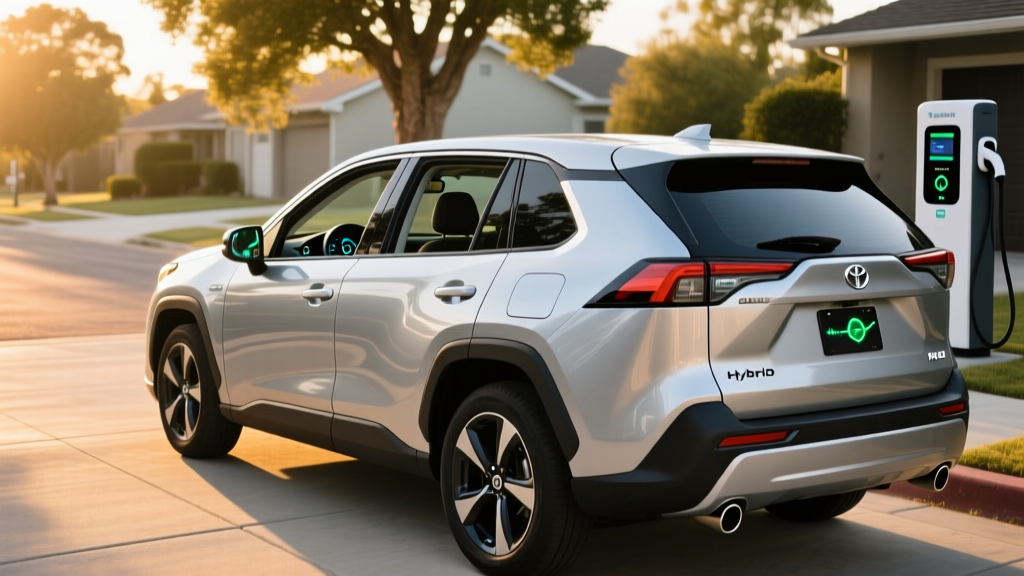
The Toyota RAV4 Hybrid remains the best-selling hybrid SUV in the United States for good reason: it pairs a proven 2.5-liter four-cylinder engine with Toyota's hybrid synergy drive to deliver over 40 MPG combined without ever needing a plug. For 2026, the RAV4 Hybrid continues to anchor the compact crossover segment with all-wheel drive as standard, a competitive starting price, and a powertrain that rewards city driving with exceptional efficiency.
But the RAV4 lineup now includes three distinct powertrains — the conventional hybrid (HEV), the RAV4 Prime plug-in hybrid (PHEV), and the gas-only model. Understanding which version fits your driving pattern, budget, and charging access is the key decision. This guide breaks down the 2026 RAV4 Hybrid's engine, hybrid system specs, real-world MPG, battery longevity, and how it stacks up against its plug-in sibling and full-electric alternatives.
2026 RAV4 Hybrid Engine and Powertrain Specs
The 2026 Toyota RAV4 Hybrid uses a 2.5-liter Dynamic Force inline-four engine paired with two electric motors — one driving the front axle and a second powering the rear axle for standard electronic all-wheel drive (AWD). This is Toyota's fifth-generation hybrid system, which improved efficiency and power delivery over earlier generations.
| Specification | Value |
|---|---|
| Engine | 2.5L inline-4 (A25A-FXS, Atkinson cycle) |
| Engine horsepower | 176 hp @ 5,700 rpm |
| Engine torque | 163 lb-ft @ 5,200 rpm |
| Front electric motor | 88 kW (118 hp) |
| Rear electric motor | 40 kW (54 hp) |
| Net combined system output | 219 hp |
| Transmission | eCVT (planetary gearset, no belt) |
| Drivetrain | Electronic AWD (standard on all trims) |
| Hybrid battery | 1.6 kWh lithium-ion (sealed NiMH on base LE trim) |
| 0–60 mph | 7.4 seconds |
| Towing capacity | 1,750 lbs |
The combined 219 hp is competitive with turbocharged rivals, and the electric motors provide instant torque off the line. The eCVT is a planetary gearset — not a belt-and-pulley CVT — so it avoids the rubber-band feel that plagues some continuously variable transmissions. Expect confident merging and passing, though the engine does drone under hard acceleration as the system holds optimal RPM.
EPA Fuel Economy: City, Highway, and Combined MPG
Fuel economy is where the RAV4 Hybrid's engine-hybrid system earns its reputation. According to EPA data on fueleconomy.gov, the 2026 RAV4 Hybrid achieves the following ratings across most trims (LE through Limited):
| Trim | City MPG | Highway MPG | Combined MPG |
|---|---|---|---|
| LE | 41 | 38 | 40 |
| XLE / XLE Premium | 41 | 38 | 40 |
| SE / Woodland Edition | 40 | 36 | 38 |
| XSE / Limited | 41 | 38 | 40 |
The LE trim's slightly higher efficiency comes from lighter wheels and fewer power accessories. The Woodland Edition's all-terrain tires and roof rails cost you roughly 2 MPG combined — a modest penalty for off-road capability.
Real-World MPG vs. EPA Sticker
Hybrids consistently outperform their EPA estimates in city driving because regenerative braking recaptures energy that gas-only vehicles waste as heat. In real-world testing across mixed suburban and urban routes, owners regularly report 42–45 MPG in stop-and-go traffic. Highway driving at sustained 70–75 mph typically yields 34–37 MPG — below the EPA highway figure — because the electric motor contributes less at constant high speed and aerodynamic drag dominates.
EPA combined: 40 MPG | Real-world city: 42–45 MPG | Real-world highway (75 mph): 34–37 MPG | Cold-weather penalty: 3–5 MPG reduction in winter months due to cabin heating demand and reduced battery efficiency.
For a driver covering 15,000 miles annually at $3.50/gallon, the 40 MPG combined figure translates to roughly 375 gallons per year and $1,313 in fuel costs. A comparable gas-only RAV4 (28 MPG combined) would consume 536 gallons and cost $1,876 — a $563 annual fuel savings with the hybrid.
RAV4 Hybrid (HEV) vs. RAV4 Prime (PHEV): Which Powertrain Fits?
The RAV4 lineup includes a plug-in hybrid variant — the RAV4 Prime — which adds a larger battery, more powerful electric motors, and the ability to drive on electricity alone. Here is how the two hybrid systems compare:
| Attribute | RAV4 Hybrid (HEV) | RAV4 Prime (PHEV) |
|---|---|---|
| Battery capacity | 1.6 kWh (Li-ion) | 18.1 kWh (Li-ion) |
| Electric-only range | N/A (EV assist only) | 42 miles (EPA) |
| Total range | ~580 miles | ~600 miles (EV + gas) |
| Combined horsepower | 219 hp | 302 hp |
| 0–60 mph | 7.4 sec | 5.7 sec |
| MPG (gas mode) | 40 combined | 38 combined (charge-sustaining) |
| MPGe (electric mode) | N/A | 94 MPGe |
| Level 2 charge time (0–100%) | N/A | ~2.5 hours (6.6 kW onboard charger) |
| DC fast charging | N/A | Not available |
| Starting MSRP | $33,425 (LE) | $45,825 (SE) |
| Federal tax credit (§30D) | Not eligible | Up to $7,500 (subject to eligibility) |
The RAV4 Prime's 42-mile electric-only range covers most daily commutes without using a drop of gasoline. Plug in overnight on a standard 120V outlet (Level 1) and you'll recover roughly 15–18 miles in 8 hours; a 240V Level 2 home charger fills the 18.1 kWh battery in about 2.5 hours. The Prime does not support DC fast charging — a notable limitation for road-trippers who want quick top-ups.
If you can charge at home and your daily driving is under 40 miles, the Prime effectively operates as a daily EV with a gas backup for longer trips. If you lack home charging access or drive primarily highway miles, the conventional RAV4 Hybrid's simplicity and lower purchase price make it the smarter pick.
Pricing, Trims, and Tax Credit Eligibility
The 2026 RAV4 Hybrid starts at $33,425 for the LE trim (including destination charge) and climbs to approximately $42,575 for the Limited. Key trims and pricing:
- LE: $33,425 — 8-inch touchscreen, Toyota Safety Sense 3.0, cloth seats
- XLE: $35,925 — Blind-spot monitoring, dual-zone climate, alloy wheels
- XLE Premium: $37,425 — SofTex seats, sunroof, 10-way power driver seat
- SE: $37,925 — Sport-tuned suspension, 19-inch wheels
- XSE: $39,425 — Sport appearance, heated front seats
- Woodland Edition: $37,125 — TRD-tuned suspension, all-terrain tires, roof rack
- Limited: $42,575 — 12.3-inch digital cluster, JBL audio, ventilated seats
Tax Credit Eligibility
The conventional RAV4 Hybrid (HEV) does not qualify for the federal §30D Clean Vehicle Credit. That credit is reserved for plug-in electric vehicles and PHEVs with sufficient battery capacity. The RAV4 Prime (PHEV) may qualify for up to $7,500 under current IRS §30D rules, but eligibility depends on:
- Buyer income caps: Modified AGI ≤ $150,000 (single) / $300,000 (joint)
- MSRP cap: SUVs must not exceed $80,000 (RAV4 Prime qualifies)
- Battery sourcing requirements: Critical minerals and battery components must meet phased-in thresholds for 2026 — verify current-year compliance on the IRS qualified vehicles list
- Point-of-sale transfer: Eligible buyers can transfer the credit to the dealer for an immediate price reduction
Always confirm eligibility with a tax professional before purchase, as sourcing rules tighten annually and specific build dates affect qualification.
Battery Warranty, Reliability, and Replacement Cost
Hybrid battery longevity is consistently the top concern among first-time hybrid buyers. Toyota's track record here is among the strongest in the industry — the Prius fleet has demonstrated hybrid batteries lasting well beyond 200,000 miles with proper operation.
Coverage: 10 years / 150,000 miles (whichever comes first)
Threshold: Battery must retain sufficient capacity to function as designed
Additional: Hybrid system components (inverter, motors, control module) covered under same term
Basic warranty: 3 years / 36,000 miles | Powertrain: 5 years / 60,000 miles
The 1.6 kWh hybrid battery in the RAV4 HEV is small and rarely cycled deeply — it buffers energy from regenerative braking and assists acceleration in short bursts. This shallow cycling is far less stressful than the deep discharge cycles in a full EV, which is why hybrid batteries routinely outlast their warranty periods without significant degradation.
What Does Replacement Cost?
If the hybrid battery does fail outside warranty, a new OEM replacement for the RAV4 Hybrid runs approximately $3,000–$4,500 including parts and labor at a Toyota dealer. Independent hybrid specialists often offer refurbished or reconditioned battery packs for $1,500–$2,500. Given the 10-year/150,000-mile warranty and Toyota's reliability data, unplanned replacement is uncommon — IIHS safety ratings and long-term owner surveys consistently place the RAV4 Hybrid near the top of its segment for dependability.
Who Should Choose the RAV4 Hybrid vs. a Full EV or Gas Car?
The RAV4 Hybrid occupies a specific sweet spot. Here's a decision framework based on driving patterns and infrastructure:
- You cannot charge at home (apartment, street parking, no garage)
- Your daily driving exceeds 40 miles and you want zero behavior change from a gas car
- You want AWD and strong fuel economy for under $35,000
- You take frequent long road trips and don't want to plan around charging stops
- You can install a Level 2 charger at home
- Your daily commute is under 40 miles round-trip
- You want EV-like daily driving with gas-engine backup for road trips
- You qualify for the $7,500 federal credit (effectively bringing the price gap closer to the HEV)
- You have reliable home charging and your trips rarely exceed 250 miles
- You want to eliminate oil changes, spark plugs, and exhaust-system maintenance
- Your state offers additional EV rebates or HOV lane access
Pros and Cons at a Glance
- 40 MPG combined — excellent for a compact AWD SUV
- Standard AWD across all trims
- No plug-in required — zero infrastructure change
- 10-year / 150,000-mile hybrid battery warranty
- Strong resale value and Toyota reliability reputation
- Competitive 0–60 time (7.4 sec) for the segment
- No federal tax credit for the HEV variant
- Engine drone under hard acceleration (eCVT character)
- Towing limited to 1,750 lbs (Prime tows 2,500 lbs)
- Infotainment interface still lags behind rivals in responsiveness
- Woodland Edition's off-road tires reduce MPG to 38 combined
- No DC fast charging option (Prime only, but it lacks DC capability too)
Frequently Asked Questions
How many MPG does the 2026 RAV4 Hybrid get?
The EPA rates the 2026 RAV4 Hybrid at 41 city / 38 highway / 40 combined MPG for most trims. In real-world city driving with frequent stops, owners commonly see 42–45 MPG. Sustained highway driving at 75 mph typically returns 34–37 MPG.
Does the RAV4 Hybrid need to be plugged in?
No. The conventional RAV4 Hybrid (HEV) charges its small 1.6 kWh battery through regenerative braking and the gasoline engine. You never plug it in. Only the RAV4 Prime (PHEV) requires plugging in to access its 42-mile electric-only range.
How far can the RAV4 Prime go on electric only?
The 2026 RAV4 Prime delivers 42 miles of EPA-rated electric-only range from its 18.1 kWh battery. Real-world electric range varies from roughly 35 miles (highway, cold weather) to 48 miles (city, mild temperatures with efficient driving).
Is the RAV4 Hybrid reliable, and what does a battery replacement cost?
Toyota's hybrid system is among the most proven in the industry, with the hybrid battery covered for 10 years / 150,000 miles. Out-of-warranty replacement costs approximately $3,000–$4,500 at a dealer, though refurbished packs are available for less. Deep-cycle degradation is minimal because the HEV battery operates in a shallow charge window.
Does the RAV4 Hybrid qualify for any tax credit?
The conventional RAV4 Hybrid (HEV) does not qualify for the federal §30D Clean Vehicle Credit — that credit applies only to plug-in vehicles. The RAV4 Prime (PHEV) may qualify for up to $7,500 depending on buyer income, battery sourcing compliance, and MSRP caps. Check the current IRS qualified vehicle list before purchasing. Some states offer additional hybrid or PHEV rebates — consult your state energy office for details.
Hybrid vs. PHEV vs. full EV — which should I choose?
Choose the HEV if you lack home charging and want maximum simplicity. Choose the PHEV if you can charge at home and want electric daily driving with gas flexibility. Choose a full EV if you have reliable charging access, want minimal maintenance, and your driving rarely exceeds 250 miles between stops. The RAV4 Hybrid HEV is the lowest-risk entry point into electrified driving — it asks nothing of you except to fill up less often.