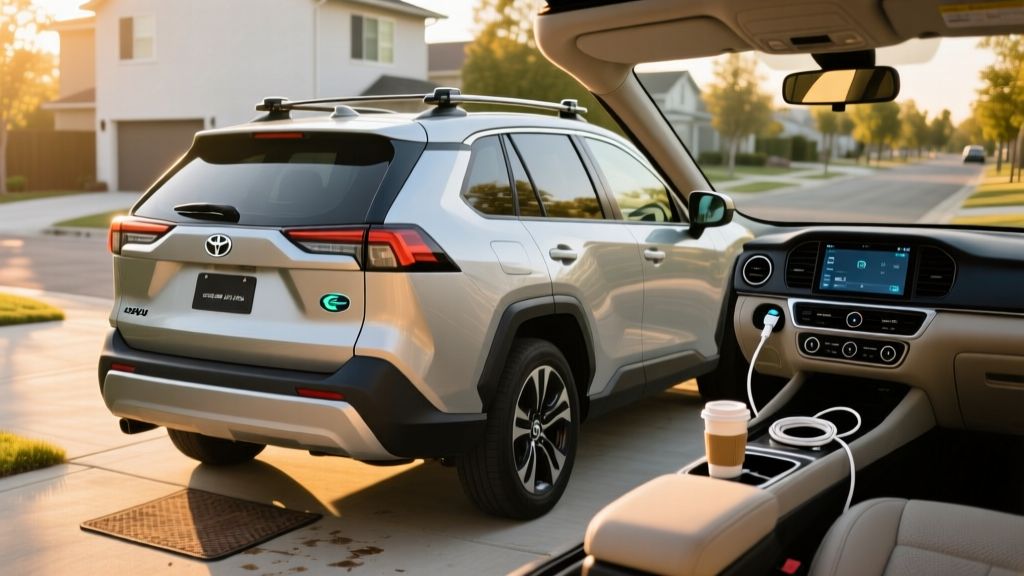
The 2020 Toyota RAV4 Hybrid remains one of the most sought-after compact SUVs on the used market in 2026 — and for good reason. It delivers 40 MPG combined with standard all-wheel drive, a spacious cargo area, and Toyota's reputation for long-term hybrid reliability. If you're cross-shopping this model against newer hybrids, plug-in hybrids, or full EVs, this guide breaks down exactly what you get, what it costs to own, and whether it still holds up six years after its debut.
2020 RAV4 Hybrid Powertrain and Performance Specs
The 2020 RAV4 Hybrid pairs a 2.5-liter four-cylinder Atkinson-cycle engine with two electric motor-generators and a nickel-metal hydride (NiMH) traction battery. Unlike many AWD systems that rely on a mechanical driveshaft, the RAV4 Hybrid uses a dedicated rear-mounted electric motor to power the rear wheels — an electronic on-demand AWD system Toyota calls E-Four.
| Specification | Value |
|---|---|
| Engine | 2.5L 4-cyl Atkinson-cycle |
| Combined System Horsepower | 219 hp |
| Gas Engine Output | 176 hp @ 5,700 rpm |
| Front Electric Motor | 88 kW (118 hp) |
| Rear Electric Motor (AWD) | 40 kW (54 hp) |
| Traction Battery | 1.6 kWh NiMH (sealed) |
| Transmission | eCVT (planetary gearset) |
| Drivetrain | Electronic AWD (E-Four) — standard |
| 0-60 mph | 7.8 seconds |
| Towing Capacity | 1,750 lbs |
| Cargo Volume (rear seats up) | 37.6 cu ft |
| Cargo Volume (rear seats folded) | 69.8 cu ft |
The 219 combined horsepower is generous for a compact hybrid SUV, and the 7.8-second 0-60 time means highway merging is confident. The eCVT is not a belt-driven CVT — it uses a planetary gearset that seamlessly blends engine and motor power with no rubber-band sensation.
Fuel Economy: EPA Ratings vs Real-World MPG
Fuel economy is the headline reason buyers choose the RAV4 Hybrid over its gas-only sibling. Here's how the EPA rates it, alongside what owners typically see in daily driving:
| Driving Condition | EPA Rating | Real-World Expectation |
|---|---|---|
| City | 41 MPG | 42-46 MPG (regenerative braking excels in stop-and-go) |
| Highway | 38 MPG | 34-37 MPG (engine runs more at sustained speeds) |
| Combined | 40 MPG | 38-42 MPG depending on driving mix |
As with most Toyota hybrids, real-world city MPG often exceeds the EPA estimate. Regenerative braking recaptures energy during deceleration, and the electric motor handles low-speed driving where gas engines are least efficient. Highway driving is the opposite: the gasoline engine carries more of the load at steady speeds, so expect a slight dip below the EPA highway figure, particularly above 75 mph or into headwinds.
In cold weather (below 30°F), expect a 5-10% fuel economy reduction. The engine runs more frequently to provide cabin heat and to warm the catalytic converter, reducing the time the hybrid system can operate in electric-only mode at low speeds.
HEV vs PHEV: The 2020 RAV4 Hybrid vs the RAV4 Prime
Toyota offered two electrified RAV4 variants for the 2020 model year: the standard RAV4 Hybrid (HEV) and the RAV4 Prime plug-in hybrid (PHEV), which launched as a 2021 model but was announced during the same era. Understanding the difference is essential before you buy.
| Attribute | 2020 RAV4 Hybrid (HEV) | 2021 RAV4 Prime (PHEV) |
|---|---|---|
| Powertrain Type | Conventional Hybrid — no plug | Plug-in Hybrid — charges via outlet |
| Combined HP | 219 hp | 302 hp |
| Battery Capacity | 1.6 kWh NiMH | 18.1 kWh lithium-ion |
| Electric-Only Range | ~0.5 miles at very low speed | 42 miles (EPA) |
| MPGe (electric + gas) | N/A | 94 MPGe |
| Gas-Only MPG (after battery depletes) | 40 MPG combined | 38 MPG combined |
| Charging Required? | No — self-charging via regen & engine | Yes — Level 1 (120V) or Level 2 (240V) |
| DC Fast Charging? | No | No |
| Level 2 Charge Time (0-100%) | N/A | ~2.5 hours (6.6 kW onboard charger) |
| Federal Tax Credit | None | Up to $7,500 (see eligibility below) |
| Original MSRP (base) | $28,350 (LE) | $38,220 (SE) |
The bottom line: The conventional RAV4 Hybrid never needs to be plugged in. It charges its small battery through regenerative braking and the gasoline engine. The RAV4 Prime, by contrast, offers 42 miles of electric-only driving but requires regular plug-in charging to realize its efficiency advantage. If you can charge at home and your commute is under 42 miles round-trip, the Prime effectively operates as a daily EV with a gas backup. If you lack charging access, the standard HEV is simpler and still highly efficient.
Used Pricing in 2026 and Tax Credit Eligibility
The 2020 RAV4 Hybrid has held its value exceptionally well. In early 2026, used examples typically trade between $22,000 and $30,000 depending on mileage, trim, and condition. The XSE and Limited trims command premiums, while high-mileage LE models sit at the lower end.
Regarding federal tax incentives: the original buyer of a new 2020 RAV4 Hybrid did not qualify for the §30D federal EV tax credit. Conventional hybrids (HEVs) do not meet the plug-in and battery-capacity requirements under IRS rules for the clean vehicle credit. The RAV4 Prime PHEV did qualify for up to $7,500 when purchased new, subject to the buyer's tax liability at the time.
For used purchases in 2026, the Used Clean Vehicle Credit (IRC §25E) offers up to $4,000 or 30% of the sale price (whichever is less) — but only for plug-in hybrids and full EVs, not conventional HEVs. This means the standard RAV4 Hybrid is ineligible, while a used RAV4 Prime may qualify if all conditions are met:
- Sale price must be $25,000 or below
- Buyer income caps: $75,000 single / $112,500 head of household / $150,000 joint
- Vehicle must be at least two model years old (2020 qualifies)
- Must be purchased from a licensed dealer
- Vehicle must have a battery capacity of at least 7 kWh (Prime qualifies at 18.1 kWh; standard Hybrid does not)
- Credit is non-refundable — you must have federal tax liability to claim it
Always verify eligibility with a tax professional and consult IRS Publication on the Used Clean Vehicle Credit before finalizing a purchase.
Battery Longevity, Warranty, and Replacement Costs
Hybrid battery longevity is the single most common concern among used hybrid buyers — and it's the area where Toyota has the strongest track record. The 2020 RAV4 Hybrid's 1.6 kWh NiMH battery is far less stressed than a full EV battery because it operates in a narrow state-of-charge window (roughly 40-80%), which dramatically reduces degradation.
10 years / 150,000 miles (whichever comes first) — applicable in all 50 states for 2020 and newer models. This covers the hybrid traction battery and all hybrid-system components including the inverter, motor-generators, and eCVT.
What this means in 2026: A 2020 RAV4 Hybrid is still within the 10-year factory hybrid warranty window through 2030. If you purchase one with under 150,000 miles, remaining warranty coverage transfers to subsequent owners automatically.
Real-world data is reassuring. Toyota's hybrid systems, dating back to the 2001 Prius, have demonstrated battery lifespans routinely exceeding 200,000 miles. The NiMH chemistry used in the 2020 RAV4 Hybrid is less energy-dense than modern lithium-ion but is exceptionally durable and tolerant of temperature extremes.
If the hybrid battery does eventually need replacement outside of warranty, expect a cost of approximately $3,000-$5,000 for a new OEM battery pack installed at a Toyota dealer. Refurbished or reconditioned packs are available for $1,500-$3,000 through independent hybrid specialists. Individual module replacement — addressing just the failed cells — can cost as little as $500-$1,200 at a qualified shop.
The hybrid system's other components (inverter, motor-generators, eCVT) are similarly robust. The eCVT has no belts, clutches, or traditional friction elements to wear out; it's a gearset that typically outlasts the vehicle.
Reliability and Safety Ratings
The 2020 RAV4 Hybrid earns strong marks from the agencies that matter most. The NHTSA awarded it a 5-Star Overall Safety Rating, and the IIHS named it a Top Safety Pick when equipped with LED reflector headlights (available on XLE and above).
Toyota Safety Sense 2.0 (TSS 2.0) is standard on every trim, which includes:
- Pre-Collision System with Pedestrian Detection
- Full-Speed Range Dynamic Radar Cruise Control
- Lane Departure Alert with Steering Assist
- Lane Tracing Assist
- Automatic High Beams
- Road Sign Assist
On reliability, J.D. Power and Consumer Reports consistently rate the RAV4 Hybrid above average for the compact SUV segment. Common complaints are minor: some owners report wind noise at highway speeds (a body design characteristic, not a defect) and an occasionally jerky transition between regenerative and friction braking — typical of Toyota's hybrid brake-blending calibration. There are no widespread powertrain or battery failure patterns for this model year.
Who Should Buy the 2020 RAV4 Hybrid — And Who Should Look Elsewhere
- You want 40 MPG without ever plugging in
- You lack home or workplace charging access
- You want AWD standard for snow or rain without the fuel penalty of a gas AWD SUV
- You value proven long-term reliability and low maintenance costs
- Your budget is $22,000-$30,000 for a used compact SUV
- You have home Level 2 charging and a commute under 40 miles
- You want to drive primarily on electricity for lower per-mile fuel costs
- You want to qualify for federal or state EV/PHEV tax incentives
- You prioritize acceleration — the RAV4 Prime's 302 hp delivers a 5.7-second 0-60
- Your annual mileage is very low (under 5,000 miles) and fuel savings won't offset any price premium
- You need maximum towing capacity (the gas RAV4 Adventure tows up to 3,500 lbs vs. the Hybrid's 1,750 lbs)
Pros and Cons at a Glance
- 40 MPG combined with standard AWD — best-in-class efficiency
- Hybrid battery still under 10-year/150,000-mile warranty in 2026
- 219 hp provides confident acceleration for the segment
- Excellent cargo space (37.6 cu ft) with no battery-pack intrusion
- Toyota Safety Sense 2.0 standard on every trim
- Strong resale value and low depreciation curve
- NiMH battery is proven durable with low replacement cost
- No federal tax credit eligibility (conventional HEV)
- Brake feel can be inconsistent due to regen blending
- Towing limited to 1,750 lbs (gas RAV4 Adventure tows 3,500 lbs)
- Infotainment system feels dated compared to 2024+ models
- No DC fast charging capability (not applicable to HEVs, but limits any electric-only operation)
- Cabin noise noticeable at highway speeds
Frequently Asked Questions
How many MPG does the 2020 Toyota RAV4 Hybrid get?
The EPA rates the 2020 RAV4 Hybrid at 41 MPG city, 38 MPG highway, and 40 MPG combined. In real-world driving, owners frequently report 42-46 MPG in city conditions thanks to regenerative braking, while highway driving may return 34-37 MPG at speeds above 70 mph.
Does the 2020 RAV4 Hybrid need to be plugged in?
No. The RAV4 Hybrid is a conventional hybrid (HEV). It charges its battery through regenerative braking and the gasoline engine. You never plug it in. If you want plug-in capability with electric-only range, look at the RAV4 Prime PHEV.
Is the 2020 RAV4 Hybrid reliable, and what does a battery replacement cost?
Yes. Toyota's hybrid powertrains have an exceptional reliability record, with many exceeding 200,000 miles on the original hybrid battery. The 2020 model carries a 10-year/150,000-mile hybrid battery warranty that still applies in 2026. Out-of-warranty replacement costs $3,000-$5,000 for an OEM pack, or $1,500-$3,000 for a refurbished unit.
Does the 2020 RAV4 Hybrid qualify for any tax credit?
No. As a conventional hybrid (HEV), the RAV4 Hybrid does not qualify for the federal §30D Clean Vehicle Credit or the §25E Used Clean Vehicle Credit. These credits require plug-in capability and minimum battery capacity. The RAV4 Prime PHEV may qualify for the used credit if purchased under $25,000 from a dealer and the buyer meets income requirements.
How does the RAV4 Hybrid compare to a full EV like the Tesla Model Y or Hyundai Ioniq 5?
A full EV eliminates gasoline entirely and has lower per-mile fuel costs (electricity at $0.13/kWh averages roughly 4 cents per mile vs. the RAV4 Hybrid's ~9 cents per mile at $3.50/gallon). However, EVs require home or public charging access, have higher upfront costs, and can lose 20-30% range in cold weather. The RAV4 Hybrid is the better choice if you lack reliable charging, frequently drive long distances in rural areas, or want a lower purchase price with no charging logistics.
What's the difference between the 2020 RAV4 Hybrid trims?
The LE ($28,350 original MSRP) is well-equipped with TSS 2.0 and an 8-inch touchscreen. The XLE ($29,645) adds a power-adjustable driver seat, dual-zone climate, and blind-spot monitoring. The XSE ($31,250) brings sport-tuned suspension and SofTex seats. The Limited ($34,595) adds a panoramic moonroof, heated/ventilated front seats, and a premium JBL audio system. All trims share the identical 219 hp hybrid powertrain and 40 MPG rating.