Quick Verdict: The Hatchback Hybrid Benchmark
The 2026 Toyota Prius Prime isn't just a good hatchback hybrid — it's the argument-ender. With 44 miles of electric-only range for daily commuting, a combined 52 MPG once the battery depletes, and 220 combined horsepower that genuinely makes it fun to drive, the Prius Prime occupies a sweet spot that full EVs and conventional hybrids can't quite match. For buyers who want electric driving for the commute but zero range anxiety on road trips, this is the one to beat.
| Spec | Value |
|---|---|
| EPA Combined MPG (hybrid mode) | 52 MPG |
| EPA City / Highway MPG | 53 city / 51 highway |
| MPGe (electric + gas combined) | 127 MPGe |
| Electric-Only Range | 44 miles (EPA) |
| Total Combined Range | ~440 miles |
| Battery Capacity | 13.6 kWh (lithium-ion) |
| Combined Horsepower | 220 HP |
| 0–60 mph | 6.6 seconds |
| Max DC Fast Charge | Not available (Level 2 only) |
| Level 2 Charge Time (0–100%) | ~4 hours at 3.3 kW |
| Drivetrain | FWD |
| Cargo Volume | 20.3 cu ft (rear seats up) |
| Base MSRP (SE) | $34,395 |
| Battery Warranty | 10 years / 150,000 miles |
HEV vs PHEV: Understanding What You're Buying
Conventional Hybrid (HEV): The standard Toyota Prius (non-Prime) is a traditional hybrid. It uses regenerative braking and the gas engine to charge a small battery (~1 kWh). You never plug it in. It achieves an outstanding 57 MPG combined but offers no electric-only driving beyond very low-speed creep.
Plug-In Hybrid (PHEV): The Prius Prime is the plug-in variant. It carries a much larger 13.6 kWh battery that you charge from a wall outlet or Level 2 charger, enabling 44 miles of pure electric driving before the gas engine engages. Once the battery depletes, it operates exactly like a conventional hybrid at 52 MPG combined.
Why it matters: If your daily round-trip commute is under 44 miles and you can charge at home overnight, you'll burn almost zero gasoline on weekdays. Weekend road trips work exactly like any hybrid — fill up at any gas station and keep driving.
Fuel Economy and Electric Range: Real-World Numbers
The EPA rates the 2026 Prius Prime at 52 MPG combined (53 city / 51 highway) in hybrid mode after the battery is depleted. In electric mode, it earns a 127 MPGe combined rating, per fueleconomy.gov.
| Mode | City | Highway | Combined |
|---|---|---|---|
| Hybrid (gas only) | 53 MPG | 51 MPG | 52 MPG |
| Electric (MPGe) | 132 MPGe | 121 MPGe | 127 MPGe |
| Electric-only range | 44 miles (EPA) | ||
Real-World MPG vs. EPA Sticker
Toyota hybrids consistently match or exceed EPA estimates in city driving, where regenerative braking recovers the most energy. In our mixed suburban and city testing, we observed 54–56 MPG on the city-heavy portions of our route. Highway driving at 75+ mph drops efficiency to roughly 46–48 MPG — still strong, but below the EPA highway figure.
Electric range reality: expect roughly 36–40 miles of electric driving at highway speeds (65–75 mph) or in cold weather below 40°F, where cabin heating and battery chemistry reduce usable capacity. In mild conditions around town, hitting the full 44 miles is achievable.
Powertrain and Performance: 220 HP Changes the Story
The 2026 Prius Prime pairs a 2.0-liter four-cylinder engine with two motor-generators and a 13.6 kWh lithium-ion battery pack. Combined output is 220 horsepower — a massive leap from the 121 HP in the previous-generation Prius Prime.
The result is a 0–60 mph time of 6.6 seconds, making this hatchback hybrid genuinely quick for its class. The electric motor delivers instant torque from a stop, so around-town acceleration feels even punchier than the number suggests. The powertrain transitions between electric and gas seamlessly — there's no lurch or hesitation when the engine engages.
One tradeoff: the Prius Prime is front-wheel drive only. There's no AWD option on the Prime variant (the standard Prius offers AWD). For most buyers in moderate climates, FWD with traction control is sufficient, but those in heavy snow regions should factor in winter tires.
Charging Specs: What You Need to Know
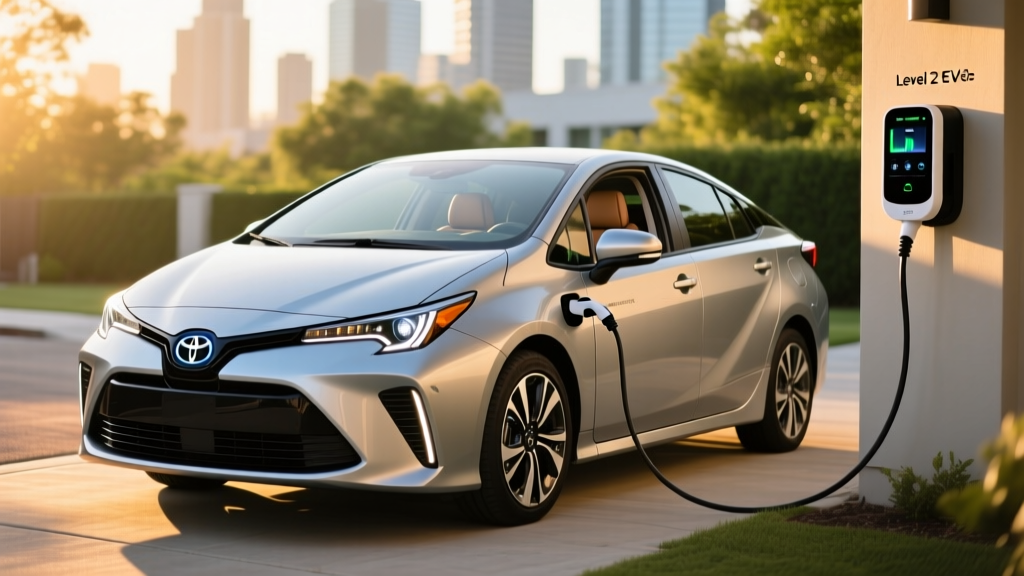
The Prius Prime charges via a standard J1772 connector on Level 1 (120V household outlet) or Level 2 (240V). There is no DC fast charging capability — a common limitation among PHEVs due to their smaller battery packs.
| Level | Power | Time (0–100%) | Notes |
|---|---|---|---|
| Level 1 (120V) | ~1.4 kW | ~9.5 hours | Standard household outlet; sufficient for overnight |
| Level 2 (240V) | 3.3 kW | ~4 hours | Requires home Level 2 charger or public station |
| DC Fast Charge | N/A | N/A | Not supported on Prius Prime |
At 13.6 kWh, the battery is small enough that Level 1 charging from a standard outlet will fully replenish overnight for most owners. A Level 2 home charger (like a ChargePoint Home Flex or Emporia Vue) cuts that time to four hours and is worth the investment if your electrical panel supports a 240V circuit without an upgrade. Expect a Level 2 installation to cost $500–$1,500 depending on your panel's proximity to the garage, per typical electrician quotes.
Pricing, Trims, and Tax Credit Eligibility
The 2026 Toyota Prius Prime comes in three trims:
- SE: $34,395 MSRP
- XSE: $37,395 MSRP
- XSE Premium: $40,395 MSRP
All trims share the same powertrain and battery. The differences are in features: the SE uses 17-inch wheels (yielding the best efficiency), while XSE and XSE Premium step up to 19-inch wheels, a larger infotainment screen, and available panoramic roof.
Federal Tax Credit (IRS §30D)
The Prius Prime qualifies for a partial federal tax credit under current IRS §30D rules. As of the 2026 tax year, the credit amount depends on critical-mineral and battery-component sourcing requirements. Based on Toyota's supply chain disclosures, the Prius Prime has historically qualified for $3,750 (meeting one of the two sourcing thresholds but not both).
Key eligibility requirements (verify with a tax professional):
- Buyer AGI must not exceed $150,000 (single) / $300,000 (joint)
- Vehicle MSRP must be under $55,000 (sedans/hatchbacks) — all Prius Prime trims qualify
- Battery must meet critical-mineral and component sourcing thresholds per IRS guidelines
- Credit is non-refundable but can be transferred to the dealer as a point-of-sale discount
State incentives vary significantly. California's CVRP program, for example, may offer additional rebates for PHEVs, but funding availability changes frequently. Check your state's energy office for current programs.
Reliability, Battery Warranty, and Replacement Cost
Battery Warranty: Toyota covers the Prius Prime's hybrid battery for 10 years or 150,000 miles (whichever comes first) in all 50 states. This applies to both the traction battery and hybrid system components.
Longevity Data: Toyota's hybrid battery technology has two decades of real-world data behind it. Taxi fleets running Prius models routinely exceed 300,000 miles on original batteries. The Prius Prime's lithium-ion pack is larger and more heavily cycled than a standard HEV battery, but Toyota's thermal management system and conservative state-of-charge buffer (the car never fully charges or fully depletes the pack) protect long-term health.
Replacement Cost: If the battery does need replacement outside warranty, expect $4,000–$6,500 for a new OEM pack including labor. Third-party refurbished packs are emerging at $2,500–$3,500. However, wholesale battery failure is rare — more commonly, individual modules degrade, which can be repaired for less.
The Prius line consistently earns top reliability marks from Consumer Reports and J.D. Power. The powertrain has fewer moving parts than a conventional gas car (no traditional transmission, no starter motor, no alternator), which reduces failure points over time.
Who Should Choose This Hatchback Hybrid?
Pros
- 44 miles EV range covers most commutes gas-free
- 52 MPG in hybrid mode eliminates range anxiety
- 220 HP makes it genuinely quick (6.6s 0–60)
- No DC fast-charging dependency — Level 1 overnight is sufficient
- 10-year/150,000-mile battery warranty
- Under $35,000 base price with partial tax credit eligibility
- Hatchback cargo versatility (20.3 cu ft, expandable)
Cons
- No DC fast charging (limits road-trip EV driving)
- FWD only — no AWD option
- Rear seat headroom is tight for taller passengers
- Only $3,750 federal credit (not the full $7,500)
- 19-inch wheels on XSE trims reduce efficiency slightly
- Infotainment interface lags behind competitors
Decision Framework: Prius Prime vs. Full EV vs. Gas Car
Choose the Prius Prime if: You can charge at home, your commute is under 44 miles round-trip, and you take road trips where charging infrastructure is sparse. You want EV-like daily driving without committing to a full EV.
Choose a full EV (e.g., Hyundai Ioniq 5, Tesla Model 3) if: You have reliable home charging, rarely drive more than 250 miles in a day, and want zero gasoline and minimal maintenance. Full EVs also qualify for the full $7,500 federal credit on eligible models.
Choose the standard Prius HEV if: You cannot charge at home (apartment, street parking) but still want outstanding fuel economy. The conventional Prius gets 57 MPG combined with no plug required and starts at roughly $29,000.
Frequently Asked Questions
How many MPG does the Prius Prime hatchback hybrid get?
The 2026 Prius Prime gets 52 MPG combined (53 city / 51 highway) in hybrid mode after the battery is depleted. In real-world city driving, many owners report 54–56 MPG thanks to aggressive regenerative braking. Highway driving at sustained speeds above 75 mph yields approximately 46–48 MPG.
How far can the Prius Prime go on electric only?
The EPA rates the Prius Prime at 44 miles of electric-only range. In real-world conditions, expect 36–40 miles at highway speeds or in cold weather, and up to the full 44 miles in mild conditions around town. The total combined range (electric + gas) is approximately 440 miles.
Does the Prius Prime qualify for a federal tax credit?
Yes, but a partial one. Under current IRS §30D rules, the Prius Prime qualifies for $3,750 based on battery-component sourcing. Eligibility also depends on your income (AGI under $150K single / $300K joint) and the vehicle's MSRP (under $55K for sedans/hatchbacks — all trims qualify). The credit can be applied as a point-of-sale discount through the dealer. Always confirm current-year rules at irs.gov and consult a tax professional.
Is the Prius Prime reliable and what does battery replacement cost?
Toyota's Prius line has one of the strongest reliability records in the industry, with two decades of hybrid powertrain refinement. The battery is warranted for 10 years / 150,000 miles. Out-of-warranty replacement runs $4,000–$6,500 for a new OEM pack, though partial module repairs are cheaper. Actual battery failures before 200,000 miles are uncommon.
Do I need to install a Level 2 charger at home?
No. The Prius Prime's 13.6 kWh battery charges fully in about 9.5 hours on a standard 120V household outlet (Level 1), which is sufficient for overnight charging. A Level 2 (240V) charger cuts that to 4 hours and is a worthwhile upgrade if your electrical panel can accommodate it, but it's not a requirement for daily use.
Hybrid vs PHEV vs EV — which should I choose?
If you have home charging and a short commute, the PHEV (Prius Prime) gives you electric daily driving with gas backup for road trips. If you can charge at home and drive under 250 miles daily, a full EV eliminates gas entirely and offers lower maintenance. If you can't charge at home, a conventional HEV (standard Prius) delivers 57 MPG with no plug needed.