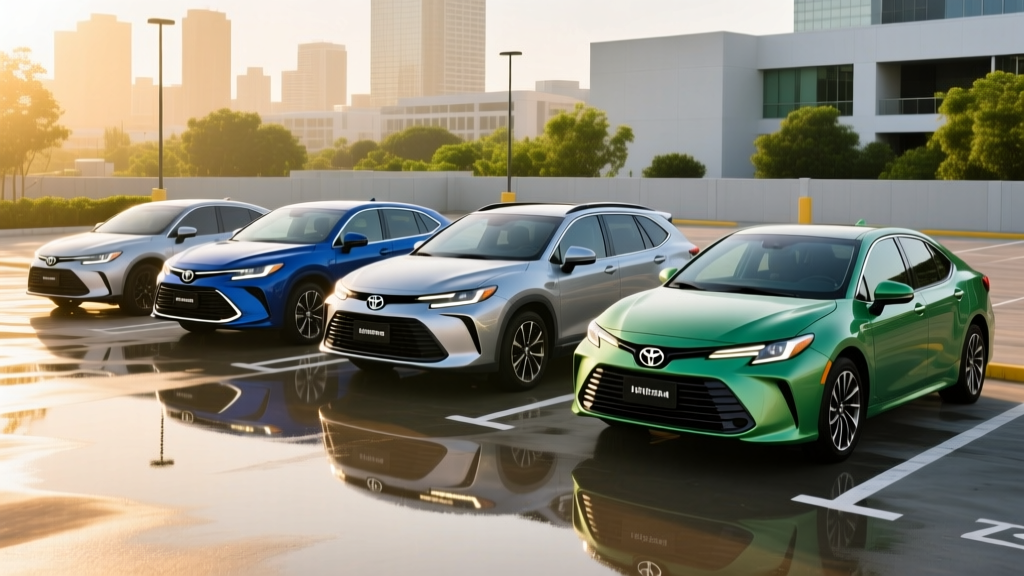
Toyota pioneered the hybrid segment with the original Prius in 1997, and by 2026, the automaker offers the broadest lineup of hybrid and plug-in hybrid vehicles of any mainstream manufacturer in the U.S. market. Whether you're looking for a compact hatchback that sips fuel or a three-row SUV with hybrid efficiency, Toyota has an electrified option. This guide covers every Toyota hybrid and PHEV currently on sale, with exact EPA figures, pricing, powertrain details, and real-world ownership insights.
HEV vs PHEV: Understanding Toyota's Two Hybrid Types
Before diving into the lineup, it's essential to understand the fundamental difference between Toyota's two hybrid categories:
Conventional Hybrid (HEV)
How it works: A small battery (typically 1.0–1.6 kWh) is charged by the gasoline engine and regenerative braking. You never plug it in.
Best for: Drivers without home charging access who want better fuel economy with zero behavior change.
Tax credit: None — HEVs do not qualify for federal §30D credits.
Plug-in Hybrid (PHEV)
How it works: A larger battery (13.6–18.1 kWh) provides 30–44 miles of electric-only driving. You plug it in to recharge, and a gas engine extends range for longer trips.
Best for: Drivers with home Level 2 charging who commute short distances but want road-trip flexibility.
Tax credit: PHEVs with ≥7 kWh batteries may qualify for up to $7,500 under IRS §30D, subject to income, MSRP, and battery-sourcing requirements.
The Full List of Toyota Hybrid Vehicles (2026 Model Year)
Below is every Toyota hybrid and PHEV available in the U.S. for 2026, organized by body style. Figures are sourced from fueleconomy.gov and Toyota's official specifications.
| Model | Type | EPA Combined MPG | City / Hwy MPG | Combined HP | Starting MSRP |
|---|---|---|---|---|---|
| Prius | HEV | 57 MPG | 57 / 56 | 196 hp | $29,745 |
| Prius Prime | PHEV | 52 MPG (hybrid) / 127 MPGe | — | 220 hp | $34,395 |
| Corolla Hybrid | HEV | 50 MPG | 53 / 46 | 138 hp | $24,595 |
| Camry | HEV | 51 MPG | 53 / 50 | 225 hp | $29,495 |
| Crown | HEV | 41 MPG | 42 / 41 | 236 hp | $42,390 |
| Crown Signia | HEV | 38 MPG | 39 / 37 | 243 hp | $44,990 |
| RAV4 Hybrid | HEV | 39 MPG | 41 / 38 | 219 hp | $33,145 |
| RAV4 Prime | PHEV | 38 MPG (hybrid) / 94 MPGe | — | 302 hp | $44,990 |
| Highlander Hybrid | HEV | 35 MPG | 36 / 35 | 243 hp | $42,290 |
| Grand Highlander Hybrid | HEV | 35 MPG (MAX 34) | 36 / 34 | 245 / 362 hp | $46,190 |
| Venza | HEV | 39 MPG | 40 / 37 | 219 hp | $36,490 |
| Sienna | HEV | 36 MPG | 36 / 36 | 245 hp | $39,485 |
| Corolla Cross Hybrid | HEV | 42 MPG | 45 / 38 | 196 hp | $30,290 |
| Tacoma i-FORCE MAX | HEV | 23–27 MPG | varies by config | 326 hp | $42,590 |
| Tundra i-FORCE MAX | HEV | 20–22 MPG | varies by config | 437 hp | $59,095 |
| Land Cruiser | HEV | 23 MPG | 23 / 24 | 326 hp | $58,150 |
PHEV Deep Dive: Prius Prime and RAV4 Prime Electric Range & Charging
Toyota's two plug-in hybrids — the Prius Prime and RAV4 Prime — are where the most compelling electrification story lives. Both offer meaningful electric-only commuting with gas-engine backup for road trips.
| Spec | Prius Prime (2026) | RAV4 Prime (2026) |
|---|---|---|
| Battery Capacity | 13.6 kWh (lithium-ion) | 18.1 kWh (lithium-ion) |
| EPA Electric-Only Range | 44 miles | 42 miles |
| Total Combined Range (EV + Gas) | ~440 miles | ~460 miles |
| Combined Horsepower | 220 hp | 302 hp |
| 0–60 mph | 6.6 sec | 5.7 sec |
| Level 2 Charge Time (0–100%) | ~4 hours (3.3 kW onboard) | ~2.5 hours (6.6 kW onboard) |
| DC Fast Charging | No | No |
| Starting MSRP | $34,395 | $44,990 |
Real-world electric range note: The EPA-rated 44 miles (Prius Prime) and 42 miles (RAV4 Prime) assume moderate temperatures and mixed driving. In cold weather (below 30°F), expect a 15–25% reduction in electric range due to cabin heating demands and reduced battery efficiency. Highway-speed driving at 70+ mph will also reduce electric range by roughly 20% compared to city use.
Charging reality: Neither Toyota PHEV supports DC fast charging. This is a deliberate engineering choice — PHEV batteries are small enough that Level 2 charging (240V) fully replenishes them overnight or during a workday. The RAV4 Prime's 6.6 kW onboard charger is notably faster than the Prius Prime's 3.3 kW unit, meaning a full charge in roughly 2.5 hours versus 4 hours.
Toyota Hybrid Battery Warranty
All 2026 Toyota hybrids and PHEVs come with a 10-year / 150,000-mile hybrid battery warranty (whichever comes first). This covers defects and capacity loss below a functional threshold. Toyota also provides a 10-year / 150,000-mile warranty on all hybrid system components including the inverter, control module, and electric motors.
Replacement cost context: If a hybrid battery fails out of warranty, replacement costs typically range from $2,000 to $4,500 depending on the model (HEV batteries are smaller and cheaper; PHEV batteries are larger and more expensive). Third-party remanufactured batteries are available for $1,500–$2,500. In practice, Toyota's hybrid batteries have demonstrated exceptional longevity — many first-generation Prius batteries lasted well beyond 200,000 miles.
Real-World MPG: What Owners Actually Report
One of Toyota's hybrid strengths is that real-world fuel economy often matches or exceeds EPA estimates, especially in city driving. This is the opposite of many gas-only vehicles, which tend to fall short of their stickers. Here's why and what to expect:
City driving advantage: Toyota's hybrid system relies heavily on regenerative braking and electric-motor assist at low speeds. Stop-and-go traffic actually improves hybrid efficiency because every braking event recovers energy. Owners of the Prius (57 MPG combined) and Corolla Hybrid (50 MPG combined) frequently report 52–60 MPG in urban commuting, exceeding the EPA city figures.
Highway reality: At sustained 70–80 mph speeds, the gas engine does most of the work and the hybrid advantage narrows. Expect highway MPG to track closely with — or slightly below — the EPA highway estimate. The Camry Hybrid, rated at 50 MPG highway, typically delivers 46–50 MPG on flat interstate driving at 70 mph.
Cold weather impact: In sub-freezing temperatures, hybrid fuel economy drops 10–20% because the engine runs more frequently to provide cabin heat and because cold batteries are less efficient. The Prius might dip to 45–50 MPG combined in deep winter versus its 57 MPG EPA rating. This is still dramatically better than a comparable gas-only car's winter performance.
The AWD factor: Several Toyota hybrids (RAV4 Hybrid, Camry AWD, Corolla Cross Hybrid) offer electronic all-wheel drive via a rear-mounted electric motor. Expect a 1–3 MPG penalty versus FWD trims. The RAV4 Hybrid AWD, for example, is rated at 39 MPG combined versus 41 MPG for the FWD variant.
Federal Tax Credit Eligibility for Toyota PHEVs
Only Toyota's plug-in hybrids — the Prius Prime and RAV4 Prime — have batteries large enough (≥7 kWh) to potentially qualify for the federal §30D clean vehicle credit. However, eligibility is complex and model-dependent:
- Battery capacity: Both Prius Prime (13.6 kWh) and RAV4 Prime (18.1 kWh) meet the ≥7 kWh threshold. ✓
- MSRP cap: Vans/SUVs must be under $80,000; sedans/hatchbacks under $55,000. The RAV4 Prime ($44,990) and Prius Prime ($34,395) both clear their respective caps. ✓
- Buyer income limits: Modified AGI must not exceed $150,000 (single), $225,000 (head of household), or $300,000 (joint). Varies by buyer.
- Battery sourcing & critical minerals: This is the most restrictive requirement. The vehicle must meet increasing percentages of North American battery component manufacturing and critical mineral sourcing. As of 2026, the Prius Prime and RAV4 Prime's eligibility for the full $7,500 depends on current-year sourcing compliance, which has shifted frequently. Check the latest IRS guidance or consult a tax professional before relying on the credit.
- Point-of-sale transfer: If eligible, the credit can be transferred to the dealer at purchase, reducing your out-of-pocket cost immediately rather than waiting for tax filing.
HEV tax credit note: Conventional Toyota hybrids (standard Prius, Camry Hybrid, RAV4 Hybrid, etc.) do not qualify for any federal tax credit. Some states and utilities offer rebates for hybrids — check your local programs — but there is no federal incentive for HEVs.
Who Should Choose a Toyota Hybrid vs. a PHEV vs. a Full EV?
Choose a Toyota HEV (conventional hybrid) if:
- You cannot install a home charger (apartment, street parking, no garage)
- You want zero behavior change — just fill up at the gas station less often
- Your budget is under $35,000 and you want maximum MPG per dollar
- You drive 15,000+ miles per year and want proven reliability with minimal maintenance
- You want AWD capability (available on RAV4 Hybrid, Camry, Corolla Cross Hybrid)
Choose a Toyota PHEV (Prius Prime or RAV4 Prime) if:
- You have access to Level 2 home charging (garage or driveway with 240V outlet)
- Your daily commute is under 40 miles round-trip — you'll drive mostly on electricity
- You want EV-like operating costs on weekdays but road-trip range on weekends
- You want to reduce (but not eliminate) gasoline consumption and emissions
- You may qualify for the §30D federal tax credit, lowering effective cost
Choose a full BEV (like the Toyota bZ4X or competitor) if:
- You have reliable home and/or workplace charging
- You want zero tailpipe emissions and the lowest per-mile fuel cost
- You're comfortable with 220–300 miles of range and DC fast charging for road trips
- You want to eliminate oil changes, spark plugs, and exhaust maintenance entirely
Toyota Hybrid Lineup by Category: Best Picks
Best Fuel Economy: Prius (57 MPG)
Pros: Highest MPG in the lineup, attractive redesign, 196 hp is genuinely quick, low starting price ($29,745), strong cargo space for a hatchback.
Cons: Rear seat is tighter than Camry, no AWD option on base LE, road noise on coarse pavement.
Best Value: Corolla Hybrid (50 MPG)
Pros: Lowest starting price ($24,595), excellent city MPG (53), proven powertrain, available AWD, Toyota Safety Sense 3.0 standard.
Cons: Modest 138 hp feels slow on highway merges, smaller cargo area, infotainment is functional but dated.
Best Family SUV: RAV4 Prime (42 mi EV / 302 hp)
Pros: Quick 5.7-second 0–60, 42 miles electric range covers most commutes, standard AWD, 38 MPG in hybrid mode, potential tax credit eligibility.
Cons: $44,990 starting price is steep, long dealer waitlists, no DC fast charging, cargo space reduced vs. RAV4 Hybrid by battery placement.
Best Three-Row: Grand Highlander Hybrid (35 MPG)
Pros: Genuine third-row space for adults, Hybrid MAX powertrain option (362 hp), 35 MPG combined for a large SUV, strong towing capacity (5,000 lbs).
Cons: $46,190 starting price, Hybrid MAX trims drop to 27 MPG, no PHEV variant available.
Reliability and Long-Term Ownership
Toyota's hybrid systems are among the most proven electrified powertrains on the road. The company has sold over 25 million hybrids globally since 1997, and the fifth-generation Toyota Hybrid System (THS) used in current models benefits from decades of refinement.
Key reliability indicators:
- Hybrid battery longevity: Toyota's nickel-metal-hydride (NiMH) and lithium-ion hybrid batteries routinely last 150,000–200,000+ miles. Failures before 100,000 miles are rare.
- No conventional starter or alternator: Toyota hybrids use the hybrid motor to start the engine, eliminating two common failure points found in gas-only vehicles.
- Brake pad life: Regenerative braking significantly reduces wear on friction brakes. Owners commonly report 80,000–100,000+ miles on original brake pads.
- Transmission: Toyota's e-CVT (planetary gearset, not a belt-driven CVT) is mechanically simple and highly reliable. Catastrophic failures are exceptionally uncommon.
Maintenance cost advantage: Toyota hybrids require the same routine maintenance as their gas counterparts (oil changes, tire rotations, cabin filters) but tend to have lower brake and starter/alternator costs over a 10-year ownership period. Total maintenance costs over 5 years are typically $500–$1,200 lower than equivalent gas-only models.
Frequently Asked Questions
How many MPG does the best Toyota hybrid get?
The 2026 Toyota Prius leads the lineup at 57 MPG combined (57 city / 56 highway) in the LE trim. The Corolla Hybrid follows at 50 MPG combined (53 city / 46 highway). In real-world city driving, both models frequently exceed their EPA ratings thanks to regenerative braking.
How far can the Toyota PHEVs go on electric only?
The 2026 Prius Prime delivers 44 miles of EPA-rated electric-only range, while the RAV4 Prime provides 42 miles. Both are sufficient for most daily commutes. In cold weather or at highway speeds, expect 30–37 miles of real-world electric range.
Do Toyota hybrids need to be plugged in?
No. Conventional Toyota hybrids (HEV) — like the standard Prius, Camry Hybrid, RAV4 Hybrid, and Sienna — never need to be plugged in. The battery charges automatically through the gasoline engine and regenerative braking. Only the Prius Prime and RAV4 Prime (PHEVs) benefit from plugging in, though they can also operate without charging if needed.
Is a Toyota hybrid reliable, and what does battery replacement cost?
Toyota hybrids are among the most reliable vehicles on the road, backed by a 10-year / 150,000-mile hybrid battery warranty. Out-of-warranty battery replacements typically cost $2,000–$4,500 depending on the model, with remanufactured options available for $1,500–$2,500. Many original batteries exceed 200,000 miles without issue.
Does any Toyota hybrid qualify for a federal tax credit?
Only Toyota's plug-in hybrids — the Prius Prime and RAV4 Prime — have batteries large enough to potentially qualify for the federal §30D credit of up to $7,500. Eligibility depends on your income, the vehicle's MSRP, and current battery-sourcing requirements, which change frequently. Check IRS guidelines before purchasing. Conventional Toyota hybrids do not qualify for federal tax credits.
Which Toyota hybrid has the most horsepower?
The Tundra i-FORCE MAX leads at 437 hp and 583 lb-ft of torque, followed by the Grand Highlander Hybrid MAX at 362 hp. Among non-truck hybrids, the RAV4 Prime (302 hp) and Tacoma i-FORCE MAX (326 hp) are the most powerful.
Can I get AWD on a Toyota hybrid?
Yes. Toyota offers electronic AWD (using a rear electric motor) on the RAV4 Hybrid, RAV4 Prime, Camry Hybrid, Corolla Hybrid, Corolla Cross Hybrid, Highlander Hybrid, Grand Highlander Hybrid, Venza, and Crown. The Sienna is AWD-available as well. The Prius (non-Prime) offers AWD on select trims.