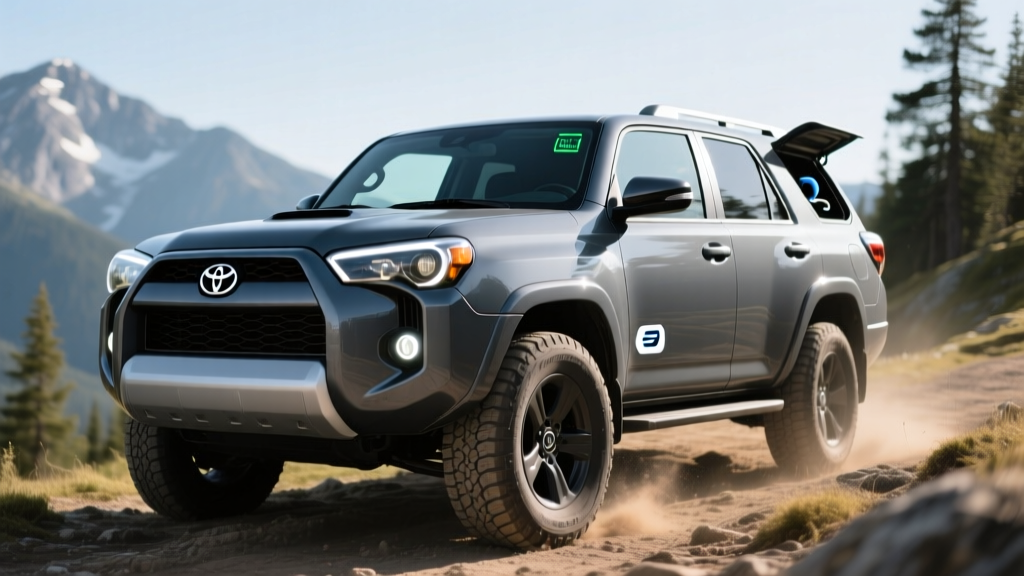
For two decades, the Toyota 4Runner soldiered on with a thirsty 4.0-liter V6 that hadn't been meaningfully updated since 2010. The current-generation 4Runner, built on the TNGA-F platform shared with the Tacoma and Land Cruiser, finally changed that story. At the center of the efficiency conversation is the Toyota hybrid 4Runner — officially badged as the i-FORCE MAX — which pairs a turbocharged 2.4-liter four-cylinder with an electric motor integrated into the transmission. It's not a plug-in. It's a conventional hybrid (HEV), and it transforms the 4Runner from one of the least efficient SUVs on the market into something far more livable at the pump.
Here's everything you need to know about the hybrid 4Runner's powertrain, real-world fuel economy, battery longevity, and whether it makes sense versus a full EV or the standard gas model.
i-FORCE MAX Powertrain: What Toyota's Hybrid System Actually Is
The hybrid 4Runner uses Toyota's i-FORCE MAX powertrain, which is a conventional hybrid (HEV), not a plug-in hybrid (PHEV). This is a critical distinction that trips up many buyers:
HEV vs PHEV — What's the Difference?
HEV (Conventional Hybrid): A small battery (typically 1-2 kWh) is charged by the engine and regenerative braking. You never plug it in. The electric motor assists the gas engine during acceleration and can drive the vehicle at low speeds for short distances. The 4Runner i-FORCE MAX falls into this category.
PHEV (Plug-in Hybrid): A larger battery (typically 10-25 kWh) can be charged from a wall outlet or charger, providing 20-40+ miles of electric-only driving before the gas engine kicks in. Toyota does not currently offer a PHEV version of the 4Runner. If plug-in capability matters to you, you'd need to look at vehicles like the Toyota RAV4 Prime or Jeep Wrangler 4xe.
The i-FORCE MAX system combines:
- Engine: 2.4-liter turbocharged inline-4 producing 278 hp and 317 lb-ft of torque
- Electric motor: 48 hp integrated between the engine and 8-speed automatic transmission
- Combined system output: 326 hp and 465 lb-ft of torque
- Hybrid battery: Approximately 1.87 kWh nickel-metal hydride (NiMH), located under the rear cargo area
- Transmission: 8-speed automatic (Direct Shift-8AT)
That 465 lb-ft of torque figure is significant — it's available low in the rev range thanks to the electric motor's instant torque delivery, making the hybrid 4Runner feel considerably more responsive than the old V6, particularly when merging onto highways or climbing grades.
| Specification | Value |
|---|---|
| Powertrain | 2.4L Turbo I-4 + Electric Motor (i-FORCE MAX) |
| Combined Horsepower | 326 hp |
| Combined Torque | 465 lb-ft |
| Transmission | 8-Speed Automatic |
| Hybrid Battery | ~1.87 kWh NiMH |
| Drivetrain | RWD or 4WD (part-time or full-time depending on trim) |
| Towing Capacity | Up to 6,000 lbs |
| 0-60 mph (est.) | ~7.0 seconds |
| Body Style | Body-on-frame SUV |
Fuel Economy: EPA Ratings and Real-World MPG
The headline number for the Toyota hybrid 4Runner is a substantial improvement over the outgoing V6, which managed just 16 mpg city and 19 mpg highway in 4WD form. According to fueleconomy.gov, the i-FORCE MAX delivers:
| Drivetrain | City MPG | Highway MPG | Combined MPG |
|---|---|---|---|
| Rear-Wheel Drive | 24 | 27 | 25 |
| 4WD (Part-Time) | 23 | 26 | 24 |
| 4WD (Full-Time) | 22 | 25 | 23 |
For context, that's a roughly 30-40% improvement in city driving over the previous V6 4Runner and puts the hybrid in the same ballpark as many midsize crossovers that are far lighter and less capable off-road.
Real-World MPG: What to Actually Expect
Hybrids typically exceed their EPA city estimates in stop-and-go traffic because regenerative braking recovers energy that would otherwise be lost as heat. On the highway, where the electric motor contributes less and aerodynamic drag dominates, real-world numbers often fall slightly below the EPA sticker.
Based on owner-reported data and early testing:
- City driving: Expect 24-27 mpg in mixed urban use — the hybrid system shines here, and many drivers report beating the EPA city number
- Highway driving (70-80 mph): Expect 22-25 mpg — the 4Runner's brick-like aerodynamics and 4,800+ lb curb weight work against it at sustained speed
- Towing: Drop to 14-17 mpg when pulling a 4,000+ lb trailer — the hybrid system still helps, but physics wins
- Cold weather (below 30°F): Expect a 5-10% reduction as the engine runs more frequently to generate cabin heat and the battery's efficiency drops
The real-world combined figure for most 4WD owners hovers around 22-24 mpg, which is genuinely impressive for a body-on-frame SUV with legitimate off-road capability and a 6,000-lb tow rating.
Hybrid 4Runner Trims and Pricing
Toyota offers the i-FORCE MAX hybrid powertrain across several 4Runner trims, though not all of them. The hybrid is standard on higher trims and optional on others. Pricing for the 2026 model year:
| Trim | MSRP (approx.) | Notes |
|---|---|---|
| TRD Off-Road Hybrid | $53,000 | Part-time 4WD, Crawl Control, locking rear diff |
| Limited Hybrid | $56,500 | Full-time 4WD, leather, premium audio |
| TRD Pro Hybrid | $63,000 | FOX shocks, skid plates, 33" tires |
| Platinum Hybrid | $58,000 | Top luxury trim, panoramic roof |
Prices include destination but exclude dealer markups, which remain common on high-demand 4Runner trims. The standard (non-hybrid) turbocharged 2.4L 4Runner starts around $42,000, making the i-FORCE MAX a $5,000-$7,000 premium depending on trim.
Tax Credit Eligibility
Because the 4Runner i-FORCE MAX is a conventional hybrid (HEV) and not a plug-in vehicle, it does not qualify for the federal §30D clean vehicle tax credit. That credit — up to $7,500 — applies only to battery electric vehicles (BEVs) and plug-in hybrids (PHEVs) that meet battery sourcing, MSRP, and buyer income requirements under current IRS rules.
Some states offer their own incentives for conventional hybrids, but these are increasingly rare as state programs shift focus to plug-in vehicles. Check your state's energy office or DMV website for any local rebates. A few states offer reduced registration fees or HOV lane access for hybrid vehicles, though these programs vary widely by jurisdiction and may have changed for 2026.
Hybrid Battery Warranty, Lifespan, and Replacement Cost
Toyota Hybrid Battery Warranty
Warranty coverage: 10 years / 150,000 miles (whichever comes first) on the hybrid battery and all hybrid system components. This applies in all 50 states for current model-year vehicles.
What's covered: The hybrid battery pack, inverter, electric motor, and associated control modules. If any hybrid component fails within the warranty period, Toyota covers diagnosis, parts, and labor.
How Long Do Toyota Hybrid Batteries Actually Last?
Toyota has built millions of hybrid vehicles since the original Prius in 1997, and the long-term data is reassuring. The NiMH battery chemistry used in the 4Runner i-FORCE MAX is less energy-dense than the lithium-ion packs in full EVs, but it's extremely well-proven for longevity. Toyota's hybrid system uses a relatively small battery that is never fully charged or fully discharged — the system keeps the state of charge in a narrow middle band, which dramatically reduces degradation.
Based on historical data from the Prius, Camry Hybrid, and RAV4 Hybrid:
- Most Toyota hybrid batteries last 150,000-200,000+ miles before significant capacity loss
- Failure before 100,000 miles is uncommon and would be covered under warranty
- The 4Runner's NiMH pack is less susceptible to thermal degradation than lithium-ion, making it well-suited to hot climates
Replacement Cost
If the hybrid battery does eventually need replacement out of warranty:
- OEM replacement (new): $2,500-$4,000 including labor at a Toyota dealer
- Refurbished/remanufactured pack: $1,500-$2,500 from third-party suppliers
- Individual cell replacement: Some specialty hybrid shops can replace failed cells within the pack for $500-$1,200
For comparison, a full EV battery replacement runs $8,000-$20,000+. The 4Runner's small hybrid battery is relatively inexpensive to replace, and the likelihood of needing one within typical ownership periods is low.
Who Should Choose the Hybrid 4Runner vs an EV or Gas Model
Reasons to Choose the Hybrid 4Runner
- You want a body-on-frame SUV with real off-road capability and don't want to sacrifice fuel economy
- You tow regularly and need the 6,000-lb capacity that no current EV SUV matches at this price point
- You don't have reliable access to home or workplace charging, making a full EV impractical
- You drive in remote areas with limited charging infrastructure
- You want Toyota's proven hybrid reliability with a 10-year battery warranty
- You want instant low-end torque for trail crawling and towing without turbo lag
Reasons to Consider an Alternative
- You primarily commute in the city and could benefit from a PHEV's electric-only range (consider the RAV4 Prime)
- You want the lowest possible operating cost — a full EV like the Rivian R1S or Hyundai Ioniq 5 will cost far less per mile to "fuel"
- You want the federal $7,500 tax credit, which requires a plug-in vehicle
- You rarely go off-road and a unibody crossover (Highlander Hybrid, 36 mpg combined) would serve you better
- You want the latest EV tech — large frunk, V2L/V2H capability, OTA updates on the scale of Tesla or Hyundai E-GMP
Decision Framework
Choose the Toyota hybrid 4Runner if: You need a rugged, truck-based SUV for off-roading or towing, you want better fuel economy without plugging in, and you value Toyota's long-term reliability track record.
Choose a full EV (Rivian R1S, upcoming electric SUVs) if: You have home charging, your daily driving is under 250 miles, you want the lowest cost per mile, and you don't need to tow more than 5,000 lbs regularly.
Choose a PHEV (RAV4 Prime, Wrangler 4xe) if: You want electric-only commuting (30-40 miles) with a gas backup for longer trips, and you qualify for the federal tax credit.
Choose the standard gas 4Runner if: You drive fewer than 10,000 miles per year, the hybrid premium doesn't pay back in fuel savings within your ownership timeline, and you want the lowest entry price.
Frequently Asked Questions
How many MPG does the Toyota hybrid 4Runner get?
The 2026 4Runner i-FORCE MAX is EPA-rated at 23-24 mpg city, 25-27 mpg highway, and 23-25 mpg combined depending on drivetrain configuration. Real-world combined driving for most 4WD owners falls in the 22-24 mpg range. City driving often exceeds the EPA estimate thanks to regenerative braking.
Is the hybrid 4Runner a plug-in vehicle?
No. The 4Runner i-FORCE MAX is a conventional hybrid (HEV). You never plug it in. The small hybrid battery charges through regenerative braking and the gas engine. Toyota does not currently offer a plug-in hybrid (PHEV) version of the 4Runner.
Does the hybrid 4Runner qualify for any tax credit?
No. The federal §30D clean vehicle credit applies only to plug-in electric vehicles (BEVs and PHEVs). The 4Runner i-FORCE MAX, as a conventional hybrid, is not eligible for the $7,500 federal credit. Some states may offer minor hybrid incentives, but these vary by jurisdiction. Consult a tax professional for your specific situation.
How reliable is the Toyota hybrid system, and what does battery replacement cost?
Toyota's hybrid system has over 25 years of real-world data behind it, with millions of units on the road. The 4Runner's hybrid battery is covered by a 10-year/150,000-mile warranty. Historical data suggests most Toyota hybrid batteries last 150,000-200,000+ miles. If replacement is needed out of warranty, expect $2,500-$4,000 for a new OEM pack — far less than a full EV battery replacement.
Is the hybrid 4Runner slower than the gas model?
No — it's faster. The i-FORCE MAX produces 326 hp and 465 lb-ft of combined torque, compared to 278 hp and 317 lb-ft from the standard turbocharged 2.4L. The electric motor fills in torque while the turbo spools up, eliminating the lag that the base engine can exhibit. Estimated 0-60 mph time is around 7.0 seconds for the hybrid versus approximately 7.5 seconds for the standard turbo model.
Can the hybrid 4Runner still go off-road?
Yes. The i-FORCE MAX powertrain is available on the TRD Off-Road and TRD Pro trims, which include all the off-road hardware you'd expect: locking rear differential, Crawl Control, Multi-Terrain Select, and on the TRD Pro, FOX internal bypass shocks and 33-inch all-terrain tires. The hybrid system actually enhances low-speed trail driving with its instant electric torque.
How does the hybrid 4Runner compare to the Toyota Land Cruiser?
The current Toyota Land Cruiser (also on the TNGA-F platform) uses the same i-FORCE MAX hybrid powertrain with 326 hp and 465 lb-ft. The Land Cruiser is EPA-rated at 22-23 mpg combined. The 4Runner is slightly lighter and less expensive, while the Land Cruiser offers a more refined interior and standard full-time 4WD. Both are excellent hybrid body-on-frame options — the 4Runner is the value play, the Land Cruiser is the premium choice.
The Toyota hybrid 4Runner represents a pragmatic evolution rather than an electric revolution. It doesn't require any change in your fueling habits, doesn't depend on charging infrastructure, and delivers meaningful fuel savings over the gas model — especially in the city driving where most SUVs spend their time. For buyers who need genuine off-road and towing capability but are tired of $80 fill-ups, the i-FORCE MAX is the most sensible 4Runner Toyota has ever built. For those ready to go fully electric, the EV SUV market continues to grow — but for now, the hybrid 4Runner occupies a compelling middle ground that very few vehicles can match.