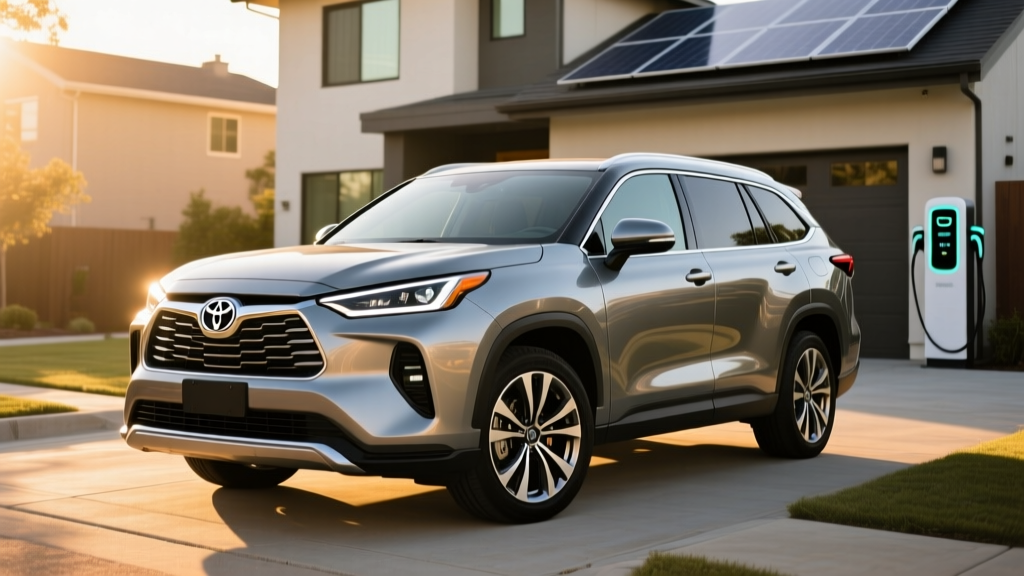
If you're researching the Toyota Highlander Hybrid cost, you're likely weighing a three-row family hauler that sips fuel against both its gas-only sibling and the growing crop of full-electric SUVs. The Highlander Hybrid occupies a specific niche: a conventional hybrid electric vehicle (HEV) that requires no plug, delivers consistent fuel savings, and carries Toyota's long-standing hybrid reliability reputation. But with a starting MSRP now pushing past $41,000 and trim levels climbing toward $54,000, understanding the total financial picture — purchase price, fuel savings, battery longevity, and tax credit eligibility — is essential before you sign.
This guide breaks down the 2026 Toyota Highlander Hybrid's real costs, fuel economy, powertrain specs, and how it compares to the plug-in hybrid (PHEV) alternative and full-electric competitors. We'll also address the battery replacement question that sits at the top of every hybrid buyer's mind.
HEV vs. PHEV: Which Highlander Is Which?
Toyota sells the Highlander exclusively as a conventional hybrid (HEV) in the U.S. market. There is no plug-in hybrid (PHEV) Highlander variant — you cannot charge it from a wall outlet, and it has no electric-only driving range to speak of. The hybrid system recharges its small battery through regenerative braking and the gasoline engine.
| Feature | Highlander Hybrid (HEV) | Typical PHEV SUV (e.g., RAV4 Prime) |
|---|---|---|
| Plug-in charging required? | No | Yes (for EV range benefit) |
| Battery capacity | ~1.87 kWh (NiMH) | ~18.1 kWh (lithium-ion) |
| Electric-only range | Not applicable | ~42 miles (RAV4 Prime) |
| DC fast charging | No | No (Level 2 AC only) |
| Level 2 charge time | N/A | ~2.5 hours at 240V |
| Federal tax credit (§30D) | Not eligible | Eligible (if sourcing rules met) |
| Complexity | Lower — no charging infrastructure | Higher — benefits need home charging |
If you want a three-row Toyota with plug-in capability, you'd need to look outside the Highlander lineup entirely — the Grand Highlander Hybrid (also an HEV) or a competitor like the Kia Sorento PHEV. The Highlander Hybrid's value proposition is simplicity: drive it like any gas car, and the hybrid system handles the rest.
Fuel Economy: EPA Ratings vs. Real-World MPG
The 2026 Toyota Highlander Hybrid pairs a 2.5-liter four-cylinder engine with front and rear electric motors (electronic on-demand AWD is standard on most trims). Combined system output is 243 horsepower. Here's what the EPA says you'll get:
| Configuration | City MPG | Highway MPG | Combined MPG |
|---|---|---|---|
| FWD (LE trim) | 36 | 35 | 36 |
| AWD (most trims) | 35 | 34 | 35 |
Source: fueleconomy.gov
For context, the gas-only Highlander with its turbocharged 2.4-liter four-cylinder returns an EPA-estimated 24 MPG combined (22 city / 29 highway). The hybrid's 35 MPG combined represents roughly a 46% fuel economy improvement — meaningful over the 150,000+ miles many families keep a three-row SUV.
Pricing by Trim: What the Highlander Hybrid Actually Costs
The 2026 Highlander Hybrid lineup spans five trims. Prices below include the $1,395 destination charge but exclude dealer markups, which remain a concern in some markets for Toyota hybrids.
| Trim | MSRP (AWD) | Key Features |
|---|---|---|
| LE | $41,890 | 8-inch touchscreen, Toyota Safety Sense 3.0, 18-inch wheels |
| XLE | $45,390 | SofTex seats, power liftgate, wireless CarPlay/Android Auto |
| XLE Bronze | $46,640 | Bronze exterior accents, unique interior trim |
| Limited | $49,890 | Leather, 12.3-inch screen, panoramic roof, JBL audio |
| Platinum | $53,890 | Head-up display, 360° camera, heated/ventilated 2nd row |
The hybrid powertrain adds approximately $1,600-$2,400 to the equivalent gas-only Highlander trim. That premium recoups itself through fuel savings in roughly 3-4 years for a driver covering 15,000 miles annually (at $3.50/gallon average).
Does the Highlander Hybrid Qualify for a Tax Credit?
No. The federal §30D Clean Vehicle Credit applies only to plug-in electric vehicles — battery-electric vehicles (BEVs) and plug-in hybrids (PHEVs) with battery capacities of at least 7 kWh that meet critical mineral and battery component sourcing requirements. Because the Highlander Hybrid is a conventional HEV with a small (~1.87 kWh) nickel-metal hydride battery that cannot be plugged in, it does not qualify for the federal EV tax credit.
- Vehicle must be a BEV or PHEV (plug-in capable)
- Battery capacity ≥ 7 kWh
- Final assembly in North America
- Critical minerals and battery component sourcing thresholds (phasing up annually)
- MSRP cap: $80,000 for SUVs/vans/pickups; $55,000 for sedans
- Buyer income cap: $300K joint / $225K head of household / $150K individual (AGI)
- Point-of-sale transfer available at participating dealers
Source: IRS.gov §30D
Some states offer their own hybrid incentives or HOV lane access for hybrids, but these vary significantly by jurisdiction. Check your state's energy office or DMV for current programs — don't rely on dealer claims about eligibility.
Powertrain and Performance Specs
| Specification | 2026 Highlander Hybrid |
|---|---|
| Engine | 2.5L 4-cylinder Atkinson-cycle |
| Electric motors | Front + rear (AWD e-motor) |
| Combined horsepower | 243 HP |
| 0-60 mph | ~7.8 seconds |
| Battery type | NiMH (nickel-metal hydride) |
| Battery capacity | ~1.87 kWh |
| Drivetrain | Electronic on-demand AWD (standard most trims) |
| Towing capacity | 3,500 lbs |
| Cargo (behind 3rd row) | 16.1 cu ft |
| Cargo (max, seats folded) | 84.3 cu ft |
The 243 HP figure won't excite enthusiasts, but the electric motors provide immediate low-end torque that makes the Highlander Hybrid feel responsive around town. The CVT (continuously variable transmission) keeps things smooth but can drone under hard acceleration. This is a comfort-and-efficiency powertrain, not a performance one.
Battery Warranty, Lifespan, and Replacement Cost
This is the question every hybrid buyer asks: what happens when the battery dies?
- Coverage: 10 years / 150,000 miles (whichever comes first)
- What's covered: Defects and capacity loss below a defined threshold
- Transferable: Yes, to subsequent owners
Toyota's hybrid battery warranty is among the strongest in the industry. For reference, the broader hybrid system (inverter, control module, etc.) is also covered under the 8-year/100,000-mile hybrid component warranty.
In practice, Toyota's NiMH hybrid batteries have demonstrated exceptional longevity. Data from fleet operators and long-term owners shows many Highlander Hybrid batteries lasting 180,000-250,000+ miles before significant degradation. The NiMH chemistry is less energy-dense than modern lithium-ion but extremely durable and heat-tolerant.
If replacement is needed out of warranty, a new OEM hybrid battery for the Highlander Hybrid typically costs between $3,000-$4,500 installed. Refurbished or reconditioned battery packs are available for $1,500-$2,500. Individual module replacement (only failed cells) can run $500-$1,200 at a hybrid specialist shop.
Total Cost of Ownership: 5-Year Breakdown
Let's compare the Highlander Hybrid AWD (XLE trim) against the gas-only Highlander XLE and a representative three-row EV over five years and 75,000 miles.
| Cost Factor | Highlander Hybrid AWD XLE | Highlander Gas AWD XLE | Kia EV9 (Wind AWD) |
|---|---|---|---|
| MSRP (approx.) | $45,390 | $43,190 | $59,900 |
| Federal tax credit | $0 | $0 | Up to $7,500* |
| Fuel/energy (75K mi) | ~$7,500 | ~$11,250 | ~$3,750 (home charging) |
| Maintenance (5 yr) | ~$2,800 | ~$3,500 | ~$1,500 |
| Insurance (5 yr avg) | ~$8,500 | ~$8,200 | ~$9,500 |
| Estimated depreciation | ~$18,000 | ~$19,500 | ~$25,000 |
| 5-yr total cost | ~$46,190 | ~$56,640 | ~$57,150 |
*EV9 credit eligibility depends on §30D sourcing rules, buyer income, and point-of-sale availability. Verify with your tax professional and IRS guidelines.
The Highlander Hybrid's fuel savings of roughly $3,750 over five years versus the gas model more than offset its higher MSRP. It also holds resale value well — Toyota hybrids command strong used-market demand. Against the EV9, the Highlander Hybrid wins on upfront cost and avoids charging infrastructure dependency, though the EV9 delivers lower running costs if you charge at home.
Pros
- 35 MPG combined in a three-row SUV — no plug required
- 10-year/150,000-mile hybrid battery warranty
- Strong resale value and proven reliability track record
- AWD standard on most trims with no fuel economy penalty
- 3,500-lb towing (adequate for small trailers and boats)
- Toyota Safety Sense 3.0 standard across all trims
Cons
- No federal tax credit eligibility
- Third row is tight for adults (best for children)
- 243 HP feels modest for a 4,500-lb vehicle when loaded
- CVT drone under hard acceleration
- Only 16.1 cu ft cargo behind third row
- Dealer markups still common on hybrid trims
Highlander Hybrid vs. PHEV vs. Full EV: Which Fits You?
Choose the Highlander Hybrid (HEV) if:
- You lack home charging access (apartment, street parking, no garage outlet)
- You want a three-row SUV without range anxiety on long road trips
- You plan to keep the vehicle 8-12 years and want proven long-term reliability
- Your daily commute is mixed city/highway (where the hybrid system shines)
- You tow occasionally and want simple, proven drivetrain tech
Choose a PHEV (like the Kia Sorento PHEV) if:
- You have home Level 2 charging and a commute under 30 miles round-trip
- You want electric-only daily driving with gas backup for road trips
- You want to qualify for the federal tax credit (if the model meets sourcing rules)
- You can commit to actually plugging in — an unplugged PHEV is just a heavy hybrid
Choose a full EV (like the Kia EV9 or Rivian R1S) if:
- You have reliable home charging and mostly drive under 250 miles/day
- You want maximum fuel savings and the lowest running costs
- You're willing to plan DC fast-charging stops on road trips
- Upfront cost is less of a barrier (EVs are pricier, even after credits)
Frequently Asked Questions
How many MPG does the Toyota Highlander Hybrid actually get?
The EPA rates the AWD Highlander Hybrid at 35 city / 34 highway / 35 combined MPG. In real-world mixed driving, most owners report 34-38 MPG. Highway-only driving at high speeds returns closer to 31-33 MPG. Cold weather and heavy cargo loads reduce efficiency by 2-4 MPG.
Does the Highlander Hybrid need to be plugged in?
No. The Highlander Hybrid is a conventional hybrid (HEV). Its small battery charges through regenerative braking and the gasoline engine. You fuel it like any other car — just with fewer fill-ups.
Is the Highlander Hybrid reliable, and what does battery replacement cost?
Toyota's hybrid system is one of the most proven in the industry, with over 25 years of continuous refinement. The hybrid battery is warrantied for 10 years/150,000 miles, and real-world data shows many lasting 200,000+ miles. If replacement is needed out of warranty, expect $3,000-$4,500 for a new OEM pack or $1,500-$2,500 for a refurbished unit.
Does the Highlander Hybrid qualify for any federal tax credit?
No. The federal §30D Clean Vehicle Credit only applies to plug-in vehicles (BEVs and PHEVs). The Highlander Hybrid is a conventional HEV and does not qualify. Check your state for possible local hybrid incentives.
How does the Highlander Hybrid compare to the Grand Highlander Hybrid?
The Grand Highlander Hybrid offers a larger third row and more cargo space but uses a similar hybrid powertrain. It's rated at 34-36 MPG combined depending on configuration, starts around $44,000, and also does not qualify for the federal tax credit. Choose the Grand if third-row passenger space is a priority; choose the standard Highlander for a slightly lower price and marginally better efficiency.
What's the maintenance cost difference between the hybrid and gas Highlander?
The hybrid typically costs less to maintain over time. Regenerative braking reduces brake pad wear (many hybrid owners report 80,000+ miles on original pads). The hybrid system has no additional fluid changes or belts beyond the gas engine. Toyota's hybrid components are sealed and require no routine service.
Bottom Line: Is the Highlander Hybrid Worth the Premium?
The Toyota Highlander Hybrid cost equation is straightforward: you pay $1,600-$2,400 more upfront versus the gas model, gain roughly 11 MPG combined, and recoup that premium in 3-4 years of typical driving. After that, every mile is cheaper. The 10-year battery warranty eliminates the biggest long-term risk, and Toyota's hybrid reliability data supports the confidence.
It won't qualify for federal tax credits, it won't drive on electricity alone, and it won't win any stoplight races. But for a family that needs three rows, wants AWD, and plans to keep their SUV for 100,000+ miles without the complexity of plug-in charging, the Highlander Hybrid remains one of the most financially rational choices in the segment. The math works — and that's what matters most in a family hauler.