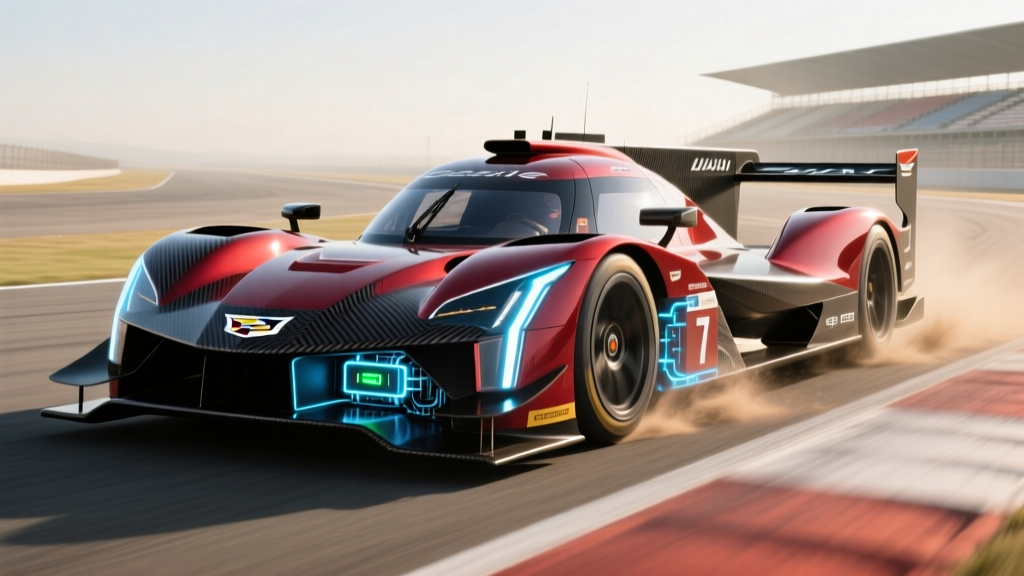
If you have searched for "Cadillac hybrid race car" recently, you have likely seen the black-and-gold Cadillac V-Series.R tearing through the 24 Hours of Daytona and Le Mans. That prototype pairs a twin-turbo V8 with a Bosch motor-generator unit—a genuine hybrid race car built to the LMDh (Le Mans Daytona hybrid) formula. But what does that motorsport technology mean for the Cadillac hybrids and plug-in hybrids you can actually park in your garage in 2026?
This guide connects the dots between Cadillac's hybrid racing program and its consumer lineup. We will cover the V-Series.R's hybrid powertrain architecture, then pivot to the road-going models—the 2026 Cadillac CT5 PHEV, the Escalade IQ (fully electric, included as a baseline), and the plug-in hybrid variants available in global markets. You will get exact MPG figures, electric-only range, battery specs, pricing, and tax-credit eligibility so you can decide whether a Cadillac electrified vehicle fits your driving life.
The Cadillac V-Series.R: A True Hybrid Race Car
The Cadillac V-Series.R competes in the IMSA GTP class and the FIA World Endurance Championship's Hypercar class under the LMDh regulations. Unlike pure internal-combustion race cars, every LMDh entry uses a spec hybrid system:
- Motor-Generator Unit (MGU): Bosch-supplied, producing up to 50 kW (approximately 67 hp) of electric boost
- Energy Storage System (ESS): Williams Advanced Engineering lithium-ion battery pack, mounted in the floor
- Internal Combustion Engine: Cadillac's bespoke 5.5-liter twin-turbocharged V8
- Combined Output: Capped at 500 kW (670 hp) by the Balance of Performance system
The hybrid system recovers energy under braking and deploys it for acceleration boosts out of corners. The MGU sits between the engine and the gearbox (a spec 7-speed unit from Xtrac). This architecture is a conventional hybrid in the HEV sense—it never plugs in and recovers all its energy on-track—but the power density and thermal management lessons feed directly into Cadillac's road-car engineering.
Cadillac's V-Series.R won the 2024 IMSA GTP Manufacturers' Championship and has been a consistent podium finisher at Le Mans. The program validates hybrid powertrain durability under extreme thermal and mechanical stress—conditions far beyond anything a street car faces.
Cadillac's Road-Going Electrified Lineup for 2026
Cadillac's consumer electrified strategy in 2026 spans three categories. Understanding which is which matters because fuel economy, range, and charging behavior differ dramatically.
HEV vs. PHEV vs. BEV: What Cadillac Offers
| Type | Plug In? | Electric-Only Range | How It Refuels | Example |
|---|---|---|---|---|
| HEV (Conventional Hybrid) | No | ~1 mile at low speed | Gasoline only; regenerative braking recharges small battery | Not currently offered in US Cadillac lineup |
| PHEV (Plug-In Hybrid) | Yes | 25–40 miles (model dependent) | Gasoline + plug-in charging (Level 1/Level 2) | Cadillac CT5 PHEV (select markets), XT6 PHEV (China) |
| BEV (Battery Electric) | Yes | Full range (250–460 mi EPA) | Electricity only (Level 1/2/DC fast charge) | Lyriq, Optiq, Escalade IQ, Vistiq |
In the US market for 2026, Cadillac has largely skipped conventional hybrids and moved directly to PHEV variants (in limited models) and full BEVs. If you want hybrid technology wearing a Cadillac crest stateside, the PHEV route or the track-bred V-Series.R are your options. In China and select global markets, Cadillac offers PHEV versions of the CT5, XT6, and CT6.
2026 Cadillac CT5 PHEV: Specs, Range, and MPG
The CT5 PHEV represents Cadillac's most accessible plug-in hybrid sedan, though US availability has been limited to fleet and special-order channels. Here is what the powertrain delivers based on Cadillac's global specification sheets:
| Specification | 2026 Cadillac CT5 PHEV |
|---|---|
| Engine | 2.0L turbocharged inline-4 |
| Electric Motor | Integrated transmission motor, ~120 kW peak |
| Combined Horsepower | ~337 hp |
| Combined Torque | ~389 lb-ft |
| Battery (Usable) | ~15.0 kWh lithium-ion (NMC) |
| Electric-Only Range | ~35 miles (WLTP); ~28–30 miles EPA-equivalent |
| Total Combined Range | ~430 miles |
| MPG (Combined, hybrid mode) | ~42 MPG combined (EPA-estimated equivalent) |
| MPGe (electric mode) | ~75 MPGe |
| Level 2 Charge Time (0–100%) | ~2.5 hours at 7.2 kW |
| DC Fast Charging | Not supported |
| 0–60 mph | ~5.8 seconds |
| Drivetrain | Rear-wheel drive |
| Base MSRP (US, if available) | ~$52,000 (estimated) |
Real-World Range and MPG Expectations
The CT5 PHEV's electric-only range is rated around 28–30 miles on an EPA-equivalent cycle. In practice, expect 22–26 miles on the highway in warm weather and as little as 18–20 miles in cold weather (below 35°F), where battery chemistry is less efficient and cabin heating draws significant energy. In hybrid mode after the battery depletes, real-world combined MPG typically lands between 36–40 MPG in mixed driving—slightly below the EPA estimate due to the vehicle's weight and luxury-oriented tuning. City driving with frequent regenerative braking opportunities can push observed figures above 42 MPG.
How the Race Car Hybrid Differs From the Road Car
The V-Series.R's 50 kW Bosch MGU and the CT5 PHEV's ~120 kW electric motor share a philosophical lineage—both use electric torque to fill gaps in the combustion engine's power delivery—but the engineering priorities diverge sharply:
| Feature | V-Series.R (LMDh Race Car) | CT5 PHEV (Road Car) |
|---|---|---|
| Hybrid Type | HEV (no plug-in) | PHEV (plug-in capable) |
| Battery Size | ~2.0 kWh (spec WAE pack) | ~15.0 kWh |
| Electric Motor Output | 50 kW (67 hp) | ~120 kW (161 hp) |
| Electric-Only Driving | Limited to pit lane speed | Up to ~28 miles at highway speed |
| Energy Recovery | Regenerative braking under extreme deceleration | Regenerative braking in daily driving |
| Thermal Management | Active liquid cooling sized for 24-hour race stints | Passive/active cooling for daily commutes |
| Weight Penalty (hybrid system) | ~120 lbs | ~350 lbs |
The race car's hybrid system is optimized for burst power and energy recovery under braking forces exceeding 3G. The road car's system prioritizes daily electric-only commuting and seamless transitions between electric and gasoline operation. Both benefit from Cadillac's growing expertise in power electronics and thermal management—knowledge that flows from track to street.
Pricing, Tax Credits, and Ownership Economics
Federal tax credit eligibility for PHEVs falls under IRS §30D Clean Vehicle Credit, the same rule governing full EVs. However, the credit amount for PHEVs depends on battery capacity and critical-mineral sourcing requirements.
§30D Tax Credit Checklist for Cadillac PHEVs
- Battery Capacity: Must be at least 7 kWh (CT5 PHEV qualifies at ~15 kWh)
- MSRP Cap: Sedans must be under $55,000; SUVs/vans/trucks under $80,000
- Buyer Income Cap: AGI ≤ $150,000 (single), $225,000 (head of household), $300,000 (joint)
- Critical Minerals: Battery minerals must meet escalating US/free-trade-agreement sourcing thresholds (phased percentages by year)
- Battery Component Manufacturing: Components must be manufactured or assembled in North America (phased percentages by year)
- Point-of-Sale Transfer: Eligible buyers can transfer the credit to the dealer for an immediate price reduction at purchase
- Maximum Credit: Up to $7,500 if both critical-mineral and battery-component requirements are met; $3,750 if only one is satisfied
Eligibility varies by model year, trim, and battery supplier. Always verify current sourcing compliance on the manufacturer's disclosure form and consult a tax professional. Rules are subject to legislative change.
If the CT5 PHEV becomes broadly available in the US and meets sourcing requirements, a $3,750–$7,500 credit could bring the effective price into the mid-$40,000s—competitive with a well-equipped gas-only CT5 when you factor in fuel savings.
Estimated 5-Year Total Cost of Ownership: CT5 PHEV vs. CT5 Gas
| Cost Category | CT5 PHEV (est.) | CT5 2.0T Gas |
|---|---|---|
| Purchase Price (after credit) | ~$47,000 | ~$42,000 |
| Fuel/Energy (5 years, 15k mi/yr) | ~$4,200 | ~$8,500 |
| Maintenance (5 years) | ~$2,800 | ~$3,500 |
| Insurance (5 years) | ~$9,500 | ~$8,200 |
| Depreciation (est.) | ~$18,000 | ~$17,000 |
| 5-Year Total | ~$81,500 | ~$79,200 |
Assumes $3.50/gal gasoline, $0.14/kWh home electricity, 60% electric-mode driving for PHEV. Actual costs vary by region, driving pattern, and incentives. Source: fueleconomy.gov comparison methodology.
Battery Warranty, Reliability, and Replacement Costs
Cadillac PHEV Battery Warranty
GM covers the high-voltage battery in its PHEV and BEV models with an 8-year / 100,000-mile warranty (whichever comes first). The warranty guarantees the battery will retain a minimum capacity threshold—typically 60–70% of original capacity—over the warranty period. If degradation exceeds this threshold, GM will repair or replace the battery at no cost.
This warranty is mandated in part by CARB (California Air Resources Board) requirements adopted by multiple states, and it applies nationwide for GM vehicles.
Is the hybrid system reliable? GM's PHEV powertrains have been in production since the second-generation Volt (2016) and the architecture is well-understood by dealer service networks. The CT5 PHEV's 2.0L turbo engine is a proven GM Ecotec unit with a strong track record. The primary reliability risk is the high-voltage battery, but NMC lithium-ion packs in PHEVs tend to degrade slowly because the battery is relatively small and rarely cycled to full depth.
Battery replacement cost: If the battery fails out of warranty, a Cadillac PHEV battery pack replacement typically ranges from $6,000 to $9,000 including parts and labor. This is significantly less than a full BEV battery replacement because the PHEV pack is much smaller (~15 kWh vs. 85–120 kWh in a BEV). Individual module replacement may be possible at lower cost if only one cell group degrades.
Who Should Choose a Cadillac Hybrid, PHEV, or EV?
Choose the Right Cadillac Electrified Vehicle
Choose a Cadillac PHEV (like the CT5 PHEV) if:
- You want electric-only commuting (25–30 miles covers most daily drives) but need gasoline range for road trips
- You have Level 1 or Level 2 home charging access but no reliable DC fast charging nearby
- You are not ready to commit to full electric but want to reduce fuel consumption by 40–60%
- You live in a region with extreme cold where BEV range loss is a concern
Choose a Cadillac BEV (Lyriq, Optiq, Vistiq, Escalade IQ) if:
- You have reliable home Level 2 charging and your daily driving is under 250 miles
- You want the lowest per-mile energy cost and minimal maintenance
- You qualify for the full $7,500 federal tax credit and state incentives
- You want access to DC fast charging (150–200+ kW) for road trips
Stick with a gas Cadillac (CT4, CT5, Escalade ICE) if:
- You have no home charging access and public charging infrastructure is sparse in your area
- You tow frequently (PHEVs and BEVs lose significant range under heavy towing loads)
- Your annual mileage is low enough that fuel savings will not offset the electrified premium
Pros: Cadillac PHEV Ownership
- 25–30 miles of electric-only commuting eliminates most gasoline use
- No range anxiety—gasoline engine provides 400+ total miles
- Regenerative braking reduces brake wear
- Lower fuel cost when charged regularly ($0.04–$0.06/mile on electricity vs. $0.15–$0.20/mile on gas)
- 8-year/100,000-mile battery warranty provides long-term peace of mind
- Potential $3,750–$7,500 federal tax credit
Cons: Cadillac PHEV Ownership
- Limited US model availability—Cadillac's focus has shifted to BEVs
- No DC fast charging—Level 2 only (2.5-hour charge time)
- Heavier than gas-only equivalent, slightly reducing handling agility
- Higher upfront cost vs. gas-only CT5
- Insurance premiums may be 10–15% higher than gas models
- Electric-only range drops significantly in cold weather (30–40% loss below freezing)
The Future: Cadillac's Electrified Motorsport-to-Street Pipeline
Cadillac's commitment to hybrid racing extends beyond marketing. The V-Series.R program, combined with Cadillac's entry into Formula 1 in 2026 as the 11th team, signals a deep institutional investment in electrified powertrain development. Formula 1's 2026 regulations mandate that nearly 50% of powertrain output comes from electric energy—a ratio that closely mirrors the PHEV road cars Cadillac is engineering.
The technology transfer pipeline works in both directions: race-proven thermal management strategies, power-electronics packaging, and energy-deployment algorithms inform road-car development, while road-car battery cell research (particularly GM's Ultium platform) feeds back into motorsport applications. For buyers, this means the PHEV and BEV Cadillacs of 2027–2030 will benefit from billions of dollars in motorsport R&D validated under the most punishing conditions in racing.
Frequently Asked Questions
How many MPG does the Cadillac CT5 PHEV get?
In hybrid mode (after the battery is depleted), the CT5 PHEV achieves an estimated 42 MPG combined (EPA-equivalent), with approximately 45 MPG city and 38 MPG highway. In electric-only mode, it rates around 75 MPGe. Real-world results vary: city drivers who charge daily may use almost no gasoline, while highway-heavy drivers who rarely charge may see 34–38 MPG.
How far can the Cadillac CT5 PHEV go on electric only?
The CT5 PHEV delivers approximately 28–30 miles of electric-only range under EPA-equivalent testing. In real-world conditions, expect 22–26 miles in warm weather mixed driving and 18–20 miles in cold weather. The gasoline engine extends total range to approximately 430 miles.
Is the Cadillac V-Series.R race car a hybrid?
Yes. The Cadillac V-Series.R is a genuine hybrid race car competing under LMDh regulations. It pairs a 5.5L twin-turbo V8 with a 50 kW Bosch motor-generator unit and a Williams Advanced Engineering battery pack. The hybrid system recovers energy under braking and deploys it for acceleration, with total system output capped at 670 hp by Balance of Performance.
Does the Cadillac CT5 PHEV qualify for a tax credit?
The CT5 PHEV may qualify for a partial or full federal Clean Vehicle Credit under IRS §30D, depending on battery-component sourcing and critical-mineral origin requirements. The credit ranges from $3,750 to $7,500 and is subject to buyer income caps ($150K single / $300K joint) and MSRP caps ($55,000 for sedans). Always verify current eligibility on the IRS website and consult a tax professional before purchase.
Is the Cadillac hybrid reliable and what does battery replacement cost?
GM's PHEV powertrains have been in production since 2016 (second-generation Volt) and are generally reliable. The high-voltage battery is covered by an 8-year / 100,000-mile warranty guaranteeing at least 60–70% capacity retention. Out-of-warranty battery replacement costs an estimated $6,000–$9,000 for the ~15 kWh PHEV pack, significantly less than a full BEV replacement.
Can I buy a Cadillac hybrid in the United States?
As of 2026, Cadillac's US lineup focuses primarily on battery-electric vehicles (Lyriq, Optiq, Vistiq, Escalade IQ). The CT5 PHEV has been available in select global markets (primarily China) and through limited fleet channels in the US. If you specifically want a Cadillac plug-in hybrid, check with your local dealer for availability or consider Cadillac's BEV lineup as an alternative.
What is the difference between the race car hybrid and a road car hybrid?
The V-Series.R is a conventional hybrid (HEV) that never plugs in—it recovers braking energy and deploys it as short bursts of electric boost. The CT5 PHEV is a plug-in hybrid with a larger battery that can be charged from a wall outlet and provides 25–30 miles of pure electric driving before the gasoline engine takes over. The race car prioritizes peak performance; the road car prioritizes daily efficiency.