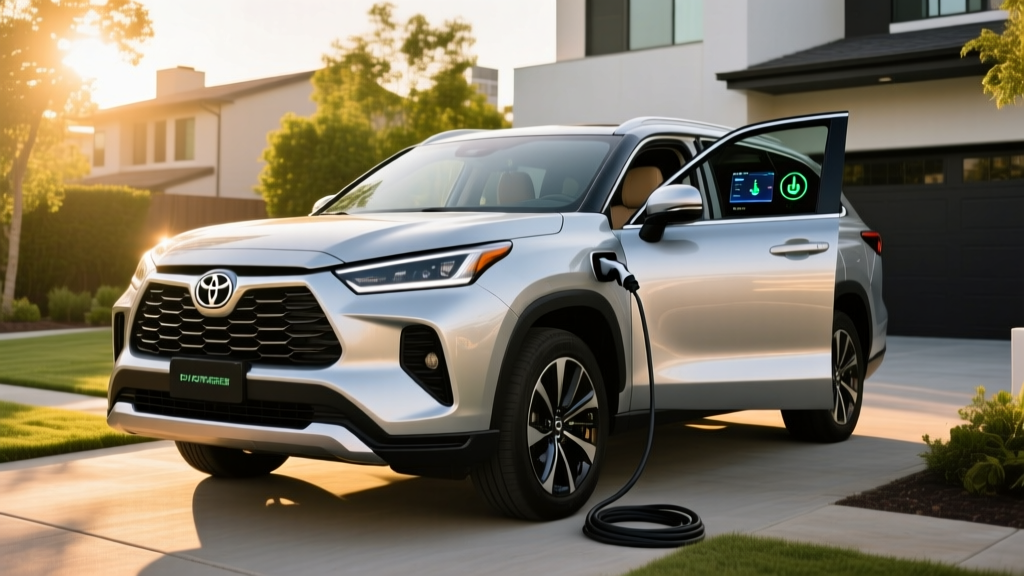
If you need three rows of seating but refuse to accept the fuel bills that usually come with them, the 2026 Toyota Highlander Hybrid SUV occupies a narrow and increasingly crowded sweet spot. It pairs a 2.5-liter four-cylinder engine with a pair of electric motors for a combined 243 horsepower, delivers an EPA-estimated 35 MPG combined, and does it all without ever needing a plug. For families weighing a full battery-electric vehicle (BEV) against the practicality of a gas-electric hybrid, the Highlander Hybrid remains one of the most data-backed choices in the midsize SUV segment.
Below, we break down the powertrain, real-world efficiency expectations, trim pricing, battery longevity, and how this hybrid stacks up against both plug-in alternatives and full EVs.
2026 Toyota Highlander Hybrid: Powertrain & Key Specs
The Highlander Hybrid uses Toyota's fourth-generation hybrid system (THS II). A 2.5-liter Atkinson-cycle inline-four produces 186 hp on its own, supplemented by two electric motor-generators that bring the net system output to 243 hp. Power is routed through an electronically controlled continuously variable transmission (eCVT). Front-wheel drive is standard; Electronic On-Demand All-Wheel Drive (AWD-i), which uses a separate rear-mounted electric motor, is available on most trims.
| Attribute | Value |
|---|---|
| Powertrain | 2.5L I4 + 2 electric motor-generators (AWD-i adds rear motor) |
| Combined Horsepower | 243 hp |
| Transmission | eCVT |
| Drivetrain | FWD standard; AWD-i available |
| Hybrid Battery | ~1.73 kWh nickel-metal hydride (NiMH), sealed |
| 0–60 mph | ~7.5 seconds (est.) |
| Towing Capacity | 3,500 lbs (AWD) |
| Seating | 7 or 8 passengers (trim-dependent) |
| Cargo Volume (behind 3rd row) | ~16.1 cu ft |
Note: The Highlander Hybrid is a conventional hybrid (HEV). It charges its small battery through regenerative braking and the gasoline engine. It does not plug in. Toyota discontinued the Highlander's plug-in variant (sold as the Highlander Hybrid Prime in limited markets through earlier model years) and instead steers buyers wanting plug-in capability toward the RAV4 Prime or the Sienna, which is hybrid-only.
EPA Fuel Economy & Real-World MPG
The EPA rates the 2026 Highlander Hybrid at 36 MPG city / 35 highway / 35 combined for FWD trims. AWD-i trims carry a negligible penalty, typically dropping highway figures by 1 MPG. According to fueleconomy.gov, this makes the Highlander Hybrid one of the most efficient three-row SUVs on the market.
| Drivetrain | City | Highway | Combined |
|---|---|---|---|
| FWD | 36 MPG | 35 MPG | 35 MPG |
| AWD-i | 35 MPG | 34 MPG | 35 MPG |
Trim Levels & Pricing (2026 Model Year)
Toyota has structured the 2026 Highlander Hybrid across five trims. Pricing below reflects manufacturer MSRP before destination charges (~$1,395).
| Trim | MSRP (FWD) | MSRP (AWD-i) | Key Features |
|---|---|---|---|
| LE | $42,220 | $43,820 | Toyota Safety Sense 3.0, 8" touchscreen, tri-zone climate |
| XLE | $45,670 | $47,270 | SofTex seats, sunroof, 20" alloy wheels, power liftgate |
| XSE | $48,310 | $49,910 | Sport-tuned suspension, black exterior accents, paddle shifters |
| Limited | $51,840 | $53,440 | Leather, 12.3" touchscreen, panoramic roof, JBL audio |
| Platinum | $55,520 | $57,120 | Head-up display, 360° camera, ventilated front seats, capless fuel |
Tax Credits & Incentives: What Qualifies?
Because the 2026 Toyota Highlander Hybrid is a conventional HEV (not a plug-in hybrid or battery-electric vehicle), it does not qualify for the federal §30D Clean Vehicle Credit, which requires a plug-in vehicle with at least 7 kWh of battery capacity and compliance with critical-mineral and battery-component sourcing rules.
Some states offer modest rebates or HOV-lane access for conventional hybrids, but these programs have largely shifted focus to PHEVs and BEVs. Check your state's energy office or the Alternative Fuels Data Center for current local incentives. Toyota's own dealer network may offer manufacturer loyalty cash or low-APR financing that partially offsets the lack of federal credits.
Battery Longevity, Warranty & Replacement Cost
Toyota equips the Highlander Hybrid with a nickel-metal hydride (NiMH) traction battery — a chemistry Toyota has used in its hybrids since the original Prius. NiMH is less energy-dense than lithium-ion but extremely durable, with decades of real-world reliability data behind it.
In practice, Toyota hybrid batteries routinely exceed 200,000 miles before significant capacity loss. Degradation manifests as slightly reduced electric-only assist at low speeds, not as a sudden failure. When replacement is necessary, a remanufactured NiMH battery for the Highlander Hybrid typically costs between $2,000 and $3,500 installed at a dealership, with third-party remanufactured units available for less. This is dramatically cheaper than BEV battery replacements, which can exceed $10,000–$15,000.
Highlander Hybrid vs. PHEV vs. Full EV: Which Fits You?
| Factor | HEV (Highlander Hybrid) | PHEV (e.g., Kia Sorento PHEV) | BEV (e.g., Kia EV9, Rivian R1S) |
|---|---|---|---|
| Plug-in required? | No | Yes (for EV range) | Yes (always) |
| Electric-only range | None (EV assist only) | ~30–32 mi | 250–320 mi |
| Fuel cost per mile | ~$0.11 | ~$0.04 (EV) / ~$0.11 (gas) | ~$0.04–$0.06 |
| Home charging needed? | No | Recommended (Level 2) | Essential (Level 2) |
| Federal tax credit | None | Up to $7,500 (if eligible) | Up to $7,500 (if eligible) |
| 3-row seating | Yes | Yes | Yes (select models) |
| Road-trip convenience | Excellent | Excellent (gas backup) | Requires DC fast-charging planning |
| Upfront cost | $$ | $$$ | $$$$ |
- Choose the Highlander Hybrid (HEV) if you lack home charging access, frequently take long road trips, want the lowest upfront cost, and prefer the simplicity of a vehicle that operates identically to a gas car.
- Choose a PHEV if you can install a Level 2 home charger, most of your daily driving is under 30 miles, and you want electric commuting with gas-engine flexibility for longer trips.
- Choose a BEV if you have reliable home charging, want the lowest per-mile operating cost, qualify for the §30D tax credit, and are comfortable with DC fast-charging on road trips.
Pros, Cons & Ownership Verdict
Pros
- 35 MPG combined in a 3-row SUV — exceptional for the class
- No plug-in charging required; zero lifestyle change vs. gas car
- 10-year/150,000-mile hybrid battery warranty
- Toyota's long-standing hybrid reliability track record
- AWD-i available without major MPG penalty
- 3,500-lb towing capacity (AWD)
Cons
- No federal tax credit eligibility
- eCVT drone under hard acceleration
- Third row is tight for adults on long trips
- Cargo space behind 3rd row (16.1 cu ft) trails some rivals
- Base price ($42,220) is higher than gas-only Highlander
- NiMH battery (not lithium-ion) — proven but older chemistry
Frequently Asked Questions
How many MPG does the 2026 Toyota Highlander Hybrid get?
The EPA rates the FWD Highlander Hybrid at 36 city / 35 highway / 35 combined MPG. AWD-i trims achieve 35/34/35 MPG. Real-world city driving often yields 37–40 MPG due to heavy regenerative braking; sustained highway driving at 75+ mph typically returns 31–33 MPG.
Does the Highlander Hybrid need to be plugged in?
No. The 2026 Highlander Hybrid is a conventional hybrid (HEV). Its small NiMH battery charges exclusively through regenerative braking and the gasoline engine. You fuel it like any other vehicle.
Is there a plug-in (PHEV) version of the Highlander?
Toyota does not currently offer a plug-in hybrid Highlander in the U.S. market for the 2026 model year. Buyers seeking a Toyota PHEV with three rows should look at the Sienna (hybrid-only, not plug-in) or consider competitors like the Kia Sorento PHEV or Mitsubishi Outlander PHEV.
Is the Highlander Hybrid reliable, and what does a battery replacement cost?
Toyota's hybrid system is among the most reliable in the industry, with NiMH batteries routinely lasting 200,000+ miles. The battery is covered by a 10-year/150,000-mile warranty. Out-of-warranty replacement costs range from approximately $2,000 to $3,500 for a remanufactured unit installed at a dealership.
Does the 2026 Highlander Hybrid qualify for any tax credit?
No. The federal §30D Clean Vehicle Credit applies only to plug-in electric vehicles (PHEVs and BEVs) with qualifying battery capacity and sourcing. The Highlander Hybrid is a conventional HEV and is ineligible. Some states may offer minor incentives — check the Alternative Fuels Data Center for local programs.
How does the Highlander Hybrid compare to a full EV like the Kia EV9?
The EV9 offers 230–300 miles of electric range, qualifies for up to $7,500 in federal tax credits (subject to income and sourcing rules), and has lower per-mile operating costs. However, it requires home Level 2 charging, has a higher starting MSRP (~$54,900), and demands route planning for road trips. The Highlander Hybrid costs less upfront, needs no charging infrastructure, and eliminates range anxiety entirely — at the trade-off of higher fuel costs and no tax credit.