Quick Verdict: The CR-V Touring Hybrid at a Glance
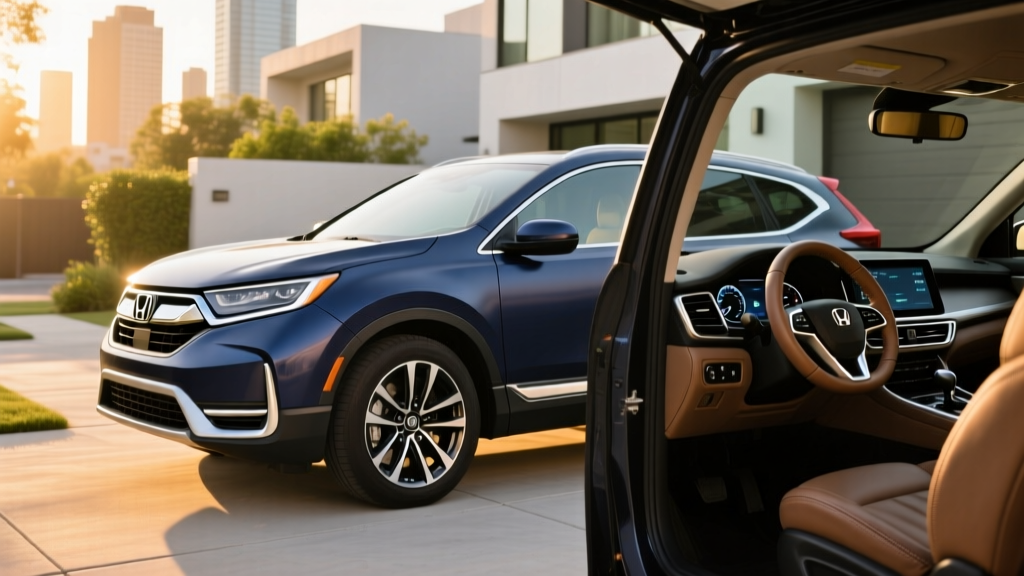
The Honda CR-V has long been the compact SUV benchmark, and the Touring Hybrid sits at the top of the lineup as the most equipped, most efficient variant you can buy. For 2026, the CR-V Touring Hybrid pairs a 2.0-liter Atkinson-cycle four-cylinder with Honda's fourth-generation two-motor hybrid system, delivering 204 combined horsepower and an EPA-estimated 40 MPG combined. At an MSRP of approximately $42,350 (including destination), it's the priciest CR-V — but also the most compelling if you want maximum fuel savings without plugging in.
This is a conventional hybrid (HEV), not a plug-in hybrid (PHEV). That means no charging cable, no electric-only range, and no federal tax credit under IRS §30D. But it also means zero lifestyle change: you fuel up at any gas station and let the hybrid system handle efficiency behind the scenes. For buyers who want EV-like city MPG without EV infrastructure concerns, the CR-V Touring Hybrid makes a strong case.
A conventional hybrid (HEV) like the CR-V Touring Hybrid uses a small battery (roughly 1.1 kWh) charged entirely by the engine and regenerative braking. You never plug it in. A plug-in hybrid (PHEV) has a larger battery (typically 12–20 kWh), offers 25–40 miles of electric-only driving, and requires plugging in to realize its full efficiency benefit. The CR-V is offered only as an HEV in the U.S. market — Honda does not currently sell a CR-V PHEV stateside.
Fuel Economy: EPA Ratings and Real-World MPG
Fuel economy is the headline reason buyers choose the CR-V Hybrid over the gas-only trims. Here's the official breakdown from fueleconomy.gov:
| Metric | AWD (Standard on Touring) |
|---|---|
| City MPG | 40 |
| Highway MPG | 34 |
| Combined MPG | 37 |
| Fuel Tank Capacity | 14.0 gal |
| Total Range (est.) | ~518 miles |
Real-world note: Honda's hybrid system, like Toyota's, tends to overperform its EPA city rating in stop-and-go driving because the electric motor handles low-speed propulsion while the engine stays off. In real-world city commuting, owners regularly report 41–43 MPG. Highway driving is a different story — at sustained 75+ mph speeds, expect 31–33 MPG as the engine takes on more direct load. Cold weather (below 30°F) can reduce combined efficiency by 5–10% due to increased engine runtime for cabin heat and battery conditioning.
Compared to the gas-only CR-V AWD (EPA 27 city / 32 highway / 29 combined), the Touring Hybrid delivers roughly a 28% improvement in combined fuel economy — a meaningful gap that compounds over years of ownership.
Powertrain and Performance Specs
The CR-V Touring Hybrid uses Honda's two-motor hybrid architecture, which operates primarily in series-hybrid mode at low speeds (engine generates electricity, motor drives wheels) and switches to parallel mode at highway speeds (engine directly drives wheels via a lock-up clutch). This is fundamentally different from a traditional transmission — there is no conventional gearbox.
| Specification | Value |
|---|---|
| Engine | 2.0L Atkinson-cycle I-4 |
| Engine Power | 145 hp @ 6,100 rpm |
| Electric Motor Power | 181 hp / 247 lb-ft torque |
| Combined System Output | 204 hp / 247 lb-ft |
| Drivetrain | AWD (standard on Touring) |
| 0–60 mph (est.) | ~7.6 seconds |
| Hybrid Battery | ~1.1 kWh lithium-ion |
| Transmission | e-CVT (single-speed w/ lock-up clutch) |
| Towing Capacity | 1,000 lbs |
The 204-hp combined output is competitive with rivals like the Toyota RAV4 Hybrid (219 hp) and the Hyundai Tucson Hybrid (226 hp). The electric motor's 247 lb-ft of torque is available from near-zero rpm, which gives the CR-V Hybrid a responsive, punchy feel around town that belies its modest horsepower figure. Highway passing power is adequate but not thrilling — the engine ramps audibly under hard acceleration as the e-CVT holds revs.
Pricing, Trim Details, and Tax Credit Eligibility
The 2026 CR-V Touring Hybrid is the range-topping trim, and it's loaded accordingly:
| Trim | MSRP (incl. destination) | Drivetrain |
|---|---|---|
| Sport Hybrid | ~$36,350 | FWD / AWD |
| Sport-L Hybrid | ~$38,850 | FWD / AWD |
| Sport Touring Hybrid | ~$42,350 | AWD only |
Touring Hybrid standard equipment includes: 9-inch touchscreen with wireless Apple CarPlay/Android Auto, 12-speaker Bose audio, wireless phone charging, heated front and rear seats, heated steering wheel, power tailgate with hands-free access, panoramic moonroof, Honda Sensing suite (adaptive cruise, lane-keeping, collision mitigation), blind-spot monitoring with rear cross-traffic alert, and 19-inch alloy wheels.
The Honda CR-V Hybrid is a conventional HEV, not a plug-in vehicle. Under IRS §30D rules, only battery electric vehicles (BEVs) and plug-in hybrids (PHEVs) with sufficient battery capacity qualify for the federal clean vehicle credit. The CR-V Hybrid does not qualify for the §30D credit. Some states may offer modest rebates for high-efficiency hybrids — check your state energy office or AFDC state incentive database for current local programs.
Battery Warranty, Reliability, and Replacement Costs
Hybrid battery longevity is consistently the top concern among first-time hybrid buyers. Here's what Honda provides:
Honda covers the CR-V Hybrid's lithium-ion battery pack for 8 years / 100,000 miles (whichever comes first) in most states. In California Air Resources Board (CARB) states — which include CA, CT, ME, MD, MA, NJ, NY, OR, RI, VT, WA, and others adopting CARB standards — the hybrid battery warranty extends to 10 years / 150,000 miles. This warranty covers battery capacity loss below a defined threshold and any manufacturing defects.
Real-world degradation: Honda's hybrid batteries are small (~1.1 kWh) and operate within a narrow state-of-charge window — the system never fully charges or fully depletes the pack. This shallow-cycling strategy dramatically extends battery life. Based on data from earlier-generation Honda hybrids (Accord Hybrid, Insight), significant battery degradation before 150,000 miles is uncommon. Most hybrid battery failures occur due to manufacturing defects (covered under warranty) rather than age-related wear.
Out-of-warranty replacement cost: If the hybrid battery does need replacement after the warranty period, expect a dealer-installed replacement to cost between $2,000 and $4,000 depending on labor rates and whether a new or refurbished unit is used. Independent hybrid specialists often offer refurbished batteries for $1,500–$2,500 installed. This is far less than a full EV battery replacement ($8,000–$20,000+) because the CR-V Hybrid's battery pack is small.
Overall reliability: Honda's hybrid powertrain has a strong track record. The e-CVT design has fewer moving parts than a conventional automatic transmission — no planetary gear sets, no torque converter, no clutch packs to wear. The engine runs less often and under lighter loads than in a gas-only vehicle, which can actually reduce long-term engine wear. IIHS typically rates the CR-V highly for crashworthiness; check for the latest 2026 test results when published.
CR-V Touring Hybrid vs. PHEV vs. Full EV: Which Fits You?
The CR-V Touring Hybrid competes not just with rival HEVs but with PHEVs and full BEVs in the compact SUV segment. Here's a practical decision framework:
| Factor | CR-V Touring Hybrid (HEV) | Toyota RAV4 Prime (PHEV) | Tesla Model Y (BEV) |
|---|---|---|---|
| Combined Efficiency | 37 MPG | 94 MPGe / 38 MPG | 122 MPGe |
| Electric-Only Range | N/A | 42 miles | ~310 miles |
| Plugging In Required? | No | Yes (for max benefit) | Yes (always) |
| Federal Tax Credit (§30D) | Not eligible | Eligible (verify rules) | Eligible (verify rules) |
| Fuel Cost (15K mi/yr) | ~$1,350/yr | ~$800–$1,100/yr | ~$500–$700/yr |
| Home Charging Needed? | No | Recommended | Essential |
| Approx. Starting Price | $42,350 | $44,000+ | $44,000+ |
Choose the CR-V Touring Hybrid if: You don't have access to home charging (apartment, street parking, no garage), you want zero lifestyle change from your current gas car, you value Honda's reliability reputation, and you want a fully loaded compact SUV under $43K.
Choose a PHEV (like the RAV4 Prime) if: You have home charging and a commute under 40 miles, you want electric-only daily driving with gas flexibility for road trips, and you want to pursue the §30D federal tax credit (check current eligibility at irs.gov).
Choose a full BEV (like the Model Y) if: You have reliable home Level 2 charging, you want the lowest per-mile fuel cost, you want instant torque and one-pedal driving, and you're ready to plan around DC fast charging on long road trips.
Ownership Costs: 5-Year Estimate
Here's a practical 5-year/75,000-mile ownership cost estimate for the CR-V Touring Hybrid compared to the gas-only CR-V EX-L AWD (MSRP ~$37,500), assuming $3.50/gallon regular unleaded and 15,000 miles per year:
| Category | CR-V Touring Hybrid | CR-V EX-L Gas AWD |
|---|---|---|
| Purchase Price | $42,350 | $37,500 |
| Fuel (5 yrs / 75K mi) | ~$6,750 | ~$8,700 |
| Maintenance (est.) | ~$2,200 | ~$2,800 |
| Federal Tax Credit | $0 | $0 |
| Total (purchase + fuel + maint.) | ~$51,300 | ~$49,000 |
The hybrid's fuel savings (~$1,950 over 5 years) and slightly lower maintenance costs (regenerative braking reduces brake pad wear; no traditional transmission fluid changes) narrow the $4,850 purchase price gap, but don't fully close it at current gas prices. The hybrid pays for itself on fuel alone around the 12–13 year mark at 15K miles/year. However, the Touring trim's premium equipment — Bose audio, panoramic roof, heated rear seats — accounts for much of the price gap versus the EX-L, independent of the hybrid powertrain.
The value proposition is stronger when comparing the Touring Hybrid to the Sport Hybrid base trim. If you don't need the Touring's luxury features, the Sport Hybrid at ~$36,350 delivers the same powertrain and fuel economy for $6,000 less.
Pros and Cons
- Excellent real-world city MPG (41–43 observed)
- AWD standard on Touring — no FWD compromise
- Responsive electric-motor torque in daily driving
- No charging infrastructure needed
- Strong 8yr/100K mi battery warranty (10yr/150K in CARB states)
- Fully loaded with premium features at under $43K
- Honda Sensing safety suite standard
- Proven hybrid system with low maintenance needs
- No federal tax credit eligibility (HEV, not PHEV/BEV)
- Highway MPG drops noticeably (31–33 real-world at 75+ mph)
- Engine noise under hard acceleration (e-CVT drone)
- 1,000-lb towing capacity — less than some rivals
- Touring trim premium hard to justify on fuel savings alone
- No spare tire (tire-inflation kit only)
- Cold-weather efficiency loss (5–10% below 30°F)
Frequently Asked Questions
How many MPG does the CR-V Touring Hybrid get?
The 2026 CR-V Touring Hybrid AWD is EPA-rated at 40 city / 34 highway / 37 combined MPG. In real-world city driving, owners commonly see 41–43 MPG. Highway driving at sustained high speeds yields 31–33 MPG. Over 50,000 miles of mixed driving, expect an average of 36–38 MPG.
Does the CR-V Hybrid need to be plugged in?
No. The CR-V Hybrid is a conventional HEV. Its small lithium-ion battery is charged entirely by the gasoline engine and by regenerative braking during deceleration. You never plug it in — just fill up at any gas station as you would with a conventional vehicle.
Is the CR-V Touring Hybrid reliable, and what does a battery replacement cost?
Honda's hybrid system has demonstrated strong reliability across multiple model generations. The hybrid battery is warranted for 8 years/100,000 miles (10 years/150,000 miles in CARB states). Out-of-warranty battery replacement typically costs $2,000–$4,000 at a dealer, or $1,500–$2,500 through an independent hybrid specialist. Given the battery's small size and shallow-cycling operation, most owners will never need a replacement.
Does the CR-V Hybrid qualify for any tax credit?
No. Under current IRS §30D rules, only plug-in electric vehicles (BEVs and PHEVs) with battery packs of at least 7 kWh are eligible for the federal clean vehicle credit. The CR-V Hybrid's ~1.1 kWh battery does not qualify. Some states may offer small incentives for high-efficiency hybrids — consult the Alternative Fuels Data Center for your state's current programs.
How does the CR-V Hybrid compare to the Toyota RAV4 Hybrid?
The RAV4 Hybrid offers slightly more power (219 hp vs. 204 hp), slightly higher EPA ratings (41/38/39 for the XSE AWD), and a PHEV variant (RAV4 Prime with 42 miles of electric range). The CR-V Hybrid counters with a more refined interior, a smoother ride, and Honda's reputation for long-term durability. Both are segment leaders — the choice often comes down to styling preference, dealer experience, and which features matter most to you.
Can the CR-V Hybrid run on electric power alone?
Only at very low speeds for short distances (typically under 1 mile at parking-lot speeds). The hybrid battery is too small (~1.1 kWh) to sustain electric-only driving at any meaningful speed or distance. The system is designed to seamlessly blend electric and gas power for maximum efficiency, not to provide EV-mode range.