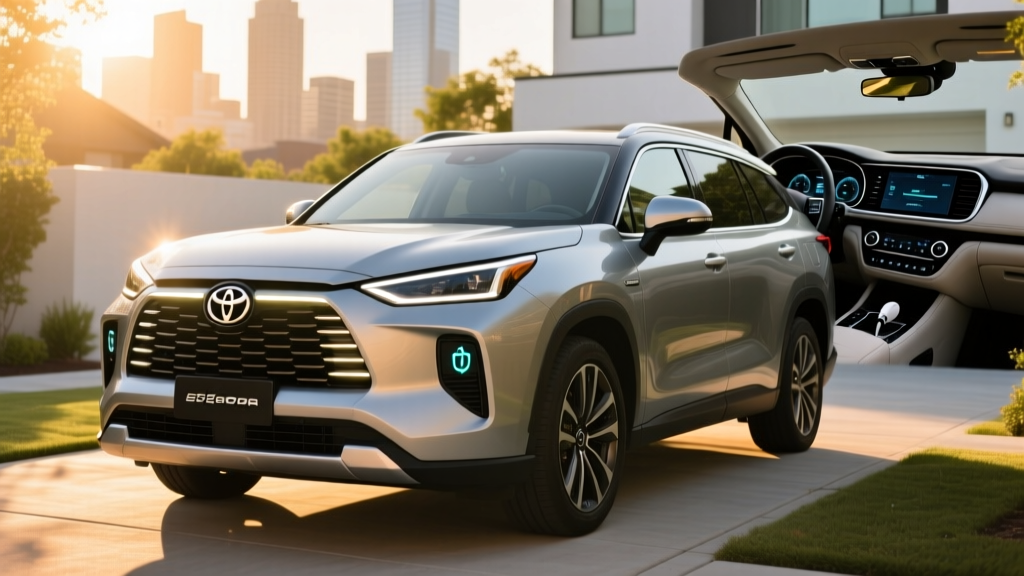
The three-row hybrid SUV segment doesn't have many players, but the Toyota Grand Highlander Hybrid SUV occupies a specific niche: full-size family hauler with minivan-rivaling cargo space and hybrid fuel economy that undercuts nearly every gasoline competitor by 10–15 MPG. For 2026, Toyota continues offering two distinct hybrid powertrains across the Grand Highlander lineup — a standard hybrid tuned for maximum efficiency and a Hybrid MAX variant tuned for performance. Neither is a plug-in hybrid. Neither requires a charger. And for families who aren't ready to commit to a battery-electric vehicle but want to cut fuel costs meaningfully, the Grand Highlander Hybrid remains one of the most practical choices available.
This guide breaks down exactly what you're getting: real-world MPG data, the two powertrain options, pricing by trim, battery warranty specifics, and a clear framework for deciding whether this hybrid SUV fits your garage better than a PHEV or full EV.
HEV vs. PHEV: What the Grand Highlander Hybrid Actually Is
Before diving into specs, it's critical to establish what this vehicle is and isn't. The Toyota Grand Highlander Hybrid is a conventional hybrid electric vehicle (HEV). It pairs a gasoline engine with one or more electric motors and a small battery pack that recharges through regenerative braking and engine power. You never plug it in. There is no electric-only driving range to manage. You simply fill it with gas and drive.
HEV vs. PHEV vs. BEV — Quick Distinction
| Feature | HEV (Grand Highlander Hybrid) | PHEV (e.g., RAV4 Prime) | BEV (e.g., Kia EV9) |
|---|---|---|---|
| Plugs in? | No | Yes | Yes |
| Electric-only range | ~1 mile at low speed | 25–42 miles typical | 250–350+ miles |
| Battery size | ~1.6 kWh (self-charging) | 15–20 kWh | 75–100+ kWh |
| Federal tax credit | Not eligible (§30D) | Up to $7,500 if eligible | Up to $7,500 if eligible |
| Home charger needed? | No | Recommended (Level 2) | Essential |
The Grand Highlander Hybrid is strictly an HEV. Toyota does not offer a PHEV (Prime) variant of the Grand Highlander as of the 2026 model year.
If you're cross-shopping and wondering why there's no Grand Highlander Prime: Toyota has kept the plug-in hybrid technology in the smaller RAV4 Prime and Prius Prime. The Grand Highlander's larger size and weight would require a substantially bigger battery for meaningful electric range, which would add cost and complexity Toyota hasn't pursued in this nameplate.
Fuel Economy: EPA MPG and Real-World Expectations
The headline number for the standard Grand Highlander Hybrid powertrain is 36 MPG combined — a figure that stands out for a three-row SUV with over 97 cubic feet of maximum cargo volume. But the two available hybrid powertrains deliver meaningfully different efficiency, so trim selection matters.
| Powertrain | City MPG | Highway MPG | Combined MPG | Drivetrain |
|---|---|---|---|---|
| 2.5L 4-cyl Hybrid | 36 | 35 | 36 | AWD (eAWD) |
| 2.4L Turbo Hybrid MAX | 27 | 28 | 27 | AWD |
Source: EPA Fuel Economy (fueleconomy.gov). Your actual mileage will vary.
Real-World MPG: What Owners Actually See
Toyota hybrids have a well-documented tendency to exceed their EPA city estimates in stop-and-go driving, where regenerative braking and electric motor assist do the most work. In real-world owner reports and independent testing, the standard 2.5L hybrid Grand Highlander regularly achieves 34–38 MPG in mixed city/suburban driving. Highway cruising at 75+ MPH tends to pull the number down to 30–33 MPG, since the aerodynamic profile of a large SUV creates significant drag at speed.
For the Hybrid MAX, expect real-world combined figures in the 25–28 MPG range. The turbocharged engine and performance-tuned hybrid system prioritize acceleration over efficiency. If you're choosing between the two powertrains, you're trading roughly 9 MPG combined for an extra 117 horsepower.
Cold-weather note: Hybrid fuel economy drops 10–15% in sustained freezing temperatures. The engine runs more frequently to maintain cabin heat and battery temperature, reducing the electric motor's contribution. Expect 30–32 MPG combined from the standard hybrid in winter conditions if you live in northern climates.
Powertrain Specs: Two Hybrid Systems Compared
| Specification | 2.5L Hybrid (LE/XLE/Limited) | 2.4L Turbo Hybrid MAX (Limited/Platinum) |
|---|---|---|
| Engine | 2.5L inline-4 | 2.4L turbocharged inline-4 |
| Combined horsepower | 245 hp | 362 hp |
| Combined torque | 173 lb-ft (engine) + electric motor torque | 400 lb-ft (combined) |
| Transmission | eCVT | 6-speed automatic |
| 0–60 mph (est.) | ~7.5 sec | ~5.6 sec |
| Drivetrain | Electronic AWD (rear e-motor) | Full-time AWD |
| Towing capacity | 3,500 lbs | 5,000 lbs |
| Hybrid battery | ~1.6 kWh NiMH / Li-ion | ~1.6 kWh Li-ion |
The standard 2.5L hybrid uses Toyota's proven eCVT planetary gearset — the same architecture that has powered millions of Prius, Camry Hybrid, and Highlander Hybrid vehicles over two decades. The rear axle is driven by an independent electric motor, providing electronic all-wheel drive without a mechanical driveshaft.
The Hybrid MAX swaps the eCVT for a traditional 6-speed automatic transmission and pairs a turbocharged 2.4L engine with a more powerful electric motor sandwiched between the engine and transmission. The result is substantially more torque, faster acceleration, and a 1,500-pound increase in towing capacity — but at a significant fuel-economy penalty.
Pricing by Trim: What You'll Actually Pay
For the 2026 model year, the Grand Highlander Hybrid lineup starts at approximately $42,490 (including destination) for the LE trim with the standard hybrid powertrain. Here's the approximate trim breakdown:
| Trim | Powertrain | Approx. MSRP | Key Features |
|---|---|---|---|
| LE | 2.5L Hybrid | $42,490 | Toyota Safety Sense 3.0, 8-seat config, 12.3" screen |
| XLE | 2.5L Hybrid | $46,150 | SofTex seats, heated front seats, power liftgate |
| Limited | 2.5L Hybrid or MAX | $50,500–$54,000 | Leather, panoramic roof, JBL audio available |
| Platinum | Hybrid MAX only | $58,000+ | Head-up display, 360° camera, ventilated 2nd row |
Federal Tax Credit Eligibility
The Grand Highlander Hybrid does not qualify for the federal §30D new clean vehicle tax credit. Under current IRS rules, the §30D credit applies only to plug-in electric vehicles (PHEVs and BEVs) with sufficient battery capacity. Conventional hybrids like the Grand Highlander Hybrid are excluded regardless of price or buyer income.
Some states and municipalities offer their own incentives for hybrid vehicles, though these are far less common than EV incentives. Check your state's department of revenue or energy office for any local programs. Toyota's own Grand Highlander Hybrid page may list current manufacturer offers or lease incentives.
Hybrid Battery Warranty and Longevity
Toyota Hybrid Battery Warranty
Coverage: 10 years / 150,000 miles (whichever comes first)
What's covered: Hybrid battery pack and all internally mounted hybrid system components, including the hybrid control module and inverter.
Applies to: All 2026 Toyota hybrids, including both Grand Highlander Hybrid powertrains.
Transferable: Yes — the hybrid battery warranty transfers to subsequent owners at no cost, which supports resale value.
Toyota's hybrid battery track record is among the strongest in the industry. The Prius, now in its fifth generation, has demonstrated that Toyota's hybrid battery management — which keeps the battery in a narrow state-of-charge window (roughly 40–80%) to minimize degradation — yields exceptional longevity. It's common for Toyota hybrid batteries to last 150,000–200,000+ miles before capacity loss becomes noticeable.
Replacement Cost If Out of Warranty
If the hybrid battery does eventually need replacement after the 10-year/150,000-mile warranty window, expect to pay between $3,000 and $5,000 for a new OEM battery pack installed at a Toyota dealer. Third-party refurbishment shops offer reconditioned packs for $1,500–$3,000. Because the Grand Highlander Hybrid's battery is relatively small (~1.6 kWh), replacement costs are a fraction of what a full EV battery replacement would cost.
This is a key ownership advantage of conventional hybrids: the hybrid battery is a supplemental component, not the sole energy source. Even with a degraded hybrid battery, the vehicle remains drivable — you'd simply see reduced fuel economy and less electric motor assist until replacement.
Real-World Ownership: Fuel Cost Savings
To put the Grand Highlander Hybrid's efficiency in financial context, here's a comparison against a comparable gasoline-only three-row SUV averaging 23 MPG combined:
| Metric | Grand Highlander Hybrid (36 MPG) | Gas-only 3-row SUV (23 MPG) |
|---|---|---|
| Annual fuel cost (15,000 mi/yr at $3.40/gal) | $1,417 | $2,217 |
| 5-year fuel cost | $7,083 | $11,087 |
| Gallons per year | 417 gal | 652 gal |
Over a typical 5-year ownership period, the standard hybrid saves approximately $4,000 in fuel compared to a gas-only competitor. That saving narrows to roughly $1,800 if you opt for the Hybrid MAX powertrain (27 MPG combined). These calculations assume $3.40/gallon regular unleaded; the Hybrid MAX requires premium fuel, which adds to the cost gap.
Grand Highlander Hybrid vs. EV vs. PHEV: Which Fits Your Life?
Decision Framework: Which Powertrain Is Right for You?
Choose the Grand Highlander Hybrid (HEV) if:
- You can't charge at home (apartment, street parking, no garage)
- You regularly take long road trips and don't want to plan around charging stations
- You want lower fuel costs without changing your refueling habits at all
- You need three rows and maximum cargo space (97.5 cu ft behind front seats)
- You want a proven, low-risk powertrain with a 10-year battery warranty
Consider a PHEV (e.g., Toyota Sienna — though minivan, not SUV) if:
- You can install a Level 2 home charger and most daily trips are under 30 miles
- You want some electric-only driving without full EV commitment
- You want to qualify for the federal tax credit (up to $7,500, income and sourcing rules apply)
Consider a full EV (e.g., Kia EV9, Tesla Model X) if:
- You have reliable home charging and your daily commute is within the vehicle's range
- You want the lowest per-mile fuel cost (electricity at ~$0.04–0.06/mile vs. gas at ~$0.09–0.12/mile)
- You want zero tailpipe emissions and qualify for the full federal tax credit
- You're willing to plan charging on longer road trips
The honest reality: for most three-row SUV buyers who lack home charging access or who drive 400+ miles on road trips regularly, the Grand Highlander Hybrid offers the most practical bridge between fuel savings and convenience. You get hybrid efficiency without any behavioral change. The trade-off is that you'll never drive on electricity alone, and you won't access the federal tax credit that makes some PHEVs and EVs more financially compelling on paper.
Pros and Cons at a Glance
✓ Pros
- 36 MPG combined is exceptional for a 3-row SUV
- 97.5 cu ft max cargo volume rivals minivans
- 10-year/150,000-mile hybrid battery warranty
- No charging infrastructure required
- Standard Toyota Safety Sense 3.0 (L2 ADAS)
- Available Hybrid MAX with 5,000-lb towing
- Strong resale value typical of Toyota hybrids
✗ Cons
- No federal tax credit eligibility (HEV, not PHEV/BEV)
- No plug-in hybrid (Prime) variant available
- Starting MSRP above $42K — premium over non-hybrid rivals
- Hybrid MAX drops to 27 MPG combined
- eCVT can drone under hard acceleration (standard hybrid)
- Third row best suited for children on longer trips
- No DC fast charging capability (not applicable for HEV)
Frequently Asked Questions
How many MPG does the Toyota Grand Highlander Hybrid get?
The standard 2.5L hybrid powertrain achieves an EPA-estimated 36 city / 35 highway / 36 combined MPG with electronic AWD. The Hybrid MAX powertrain achieves 27 city / 28 highway / 27 combined MPG. Real-world driving in mixed city conditions often yields 34–38 MPG with the standard hybrid.
Does the Grand Highlander Hybrid need to be plugged in?
No. The Grand Highlander Hybrid is a conventional hybrid (HEV), not a plug-in hybrid. The small hybrid battery recharges automatically through regenerative braking and the gasoline engine. You never need to plug it in — just fill up with gasoline as you would with any other vehicle.
Is there a plug-in hybrid (PHEV) version of the Grand Highlander?
As of the 2026 model year, Toyota does not offer a PHEV or "Prime" version of the Grand Highlander. The only electrified options are the two conventional hybrid powertrains described above. If you need a Toyota PHEV with three rows, no current model fills that role — the RAV4 Prime seats five, and the Sienna (a minivan) is a hybrid but not a plug-in.
Is the Grand Highlander Hybrid reliable, and what does battery replacement cost?
Toyota's hybrid systems have demonstrated exceptional long-term reliability across millions of vehicles over 25+ years. The hybrid battery is covered by a 10-year/150,000-mile warranty. Out-of-warranty replacement runs approximately $3,000–$5,000 for an OEM pack. Given that the hybrid battery is small (~1.6 kWh) and Toyota's battery management system is conservative with charge cycles, most owners will never need a replacement during typical ownership.
Does the Grand Highlander Hybrid qualify for any tax credit?
No. The federal §30D clean vehicle credit applies only to plug-in electric vehicles (PHEVs and BEVs). Conventional hybrids like the Grand Highlander Hybrid are not eligible. Some states may offer minor hybrid incentives, but these vary by jurisdiction and are typically much smaller than the federal EV credit. Consult your tax professional for guidance on any applicable state or local programs.
How does the Grand Highlander Hybrid compare to a full EV like the Kia EV9?
The Kia EV9 (a 3-row electric SUV) offers 279–304 miles of EPA range, qualifies for the federal tax credit (if eligibility requirements are met), and costs roughly $0.04–0.06 per mile to "fuel" on home electricity vs. ~$0.09–0.10 per mile for the Grand Highlander Hybrid on gas. However, the EV9 requires home charging access, adds charging time to road trips, and starts at a higher MSRP. The Grand Highlander Hybrid is the better choice if you can't charge at home or frequently drive in areas with sparse charging infrastructure.
What is the total range on a full tank?
With a fuel tank capacity of approximately 17.1 gallons and a combined rating of 36 MPG, the standard Grand Highlander Hybrid can travel roughly 615 miles on a full tank under ideal conditions. Real-world range of 500–560 miles is typical in mixed driving. The Hybrid MAX, with its lower efficiency, delivers roughly 460 miles per tank.