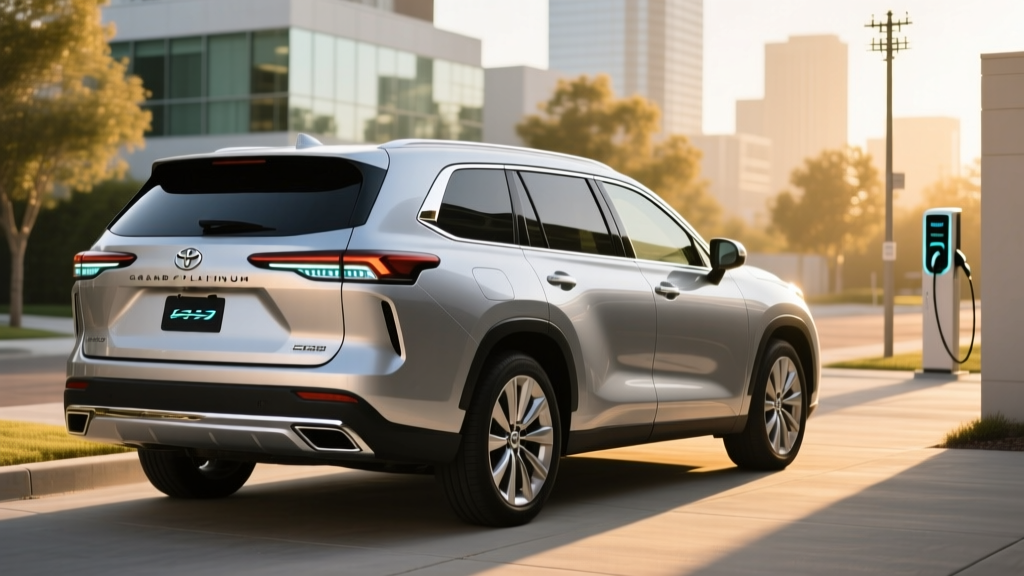
The three-row SUV segment has no shortage of options, but the Toyota Grand Highlander Hybrid Platinum occupies a rare sweet spot: genuine family hauling space, standard all-wheel drive, and fuel economy that embarrasses vehicles half its size. For 2026, Toyota's flagship hybrid SUV continues to refine a formula that prioritizes efficiency without sacrificing the power and cargo capacity that three-row buyers demand.
As a conventional hybrid (HEV)—not a plug-in—the Grand Highlander Hybrid requires no behavioral changes from its owner. You fuel it like any other car, and the hybrid system handles the rest. That simplicity is a major selling point for buyers who want EV-like efficiency without charging infrastructure concerns. Let's examine what the Platinum trim specifically delivers and whether its ~$54,000 price tag makes sense for your household.
HEV vs. PHEV vs. EV: Where Does the Grand Highlander Hybrid Fit?
Before diving into specs, it's critical to understand what the Grand Highlander Hybrid is not: it is not a plug-in hybrid (PHEV), and it is not a battery-electric vehicle (BEV). Here's how the three electrification paths compare for a three-row SUV buyer:
| Category | Conventional Hybrid (HEV) | Plug-In Hybrid (PHEV) | Battery Electric (BEV) |
|---|---|---|---|
| Plug-in required? | No | Yes (for EV range) | Yes (always) |
| Electric-only range | None (motor assists engine) | 20–45 mi typical | 250–400+ mi |
| Fuel/energy source | Gasoline only | Gasoline + electricity | Electricity only |
| Example (3-row SUV) | Grand Highlander Hybrid | Toyota Sienna (not PHEV currently) | Kia EV9, Tesla Model X |
| Best for | No home charging access; road-trip flexibility | Short daily commutes + road trips | Home charging + mostly urban/suburban driving |
The Grand Highlander Hybrid Platinum is squarely an HEV. Its hybrid battery is small (approximately 1.6 kWh usable), recharges exclusively through regenerative braking and the gasoline engine, and never provides meaningful electric-only driving. The electric motors assist the engine during acceleration and low-speed crawling, but the 2.4-liter turbocharged four-cylinder is always the primary power source.
If you have home Level 2 charging and a commute under 30 miles, a PHEV or BEV might save you more at the pump. But if you live in an apartment, lack charging access, or regularly drive 400+ miles between fuel stops, the Grand Highlander Hybrid's HEV setup removes range anxiety entirely.
Fuel Economy: EPA Ratings vs. Real-World MPG
The headline number for the 2026 Grand Highlander Hybrid is its EPA-estimated 36 MPG combined—a remarkable figure for a 4,800-pound, three-row SUV with standard AWD. Here's the full breakdown:
| Driving Cycle | EPA Estimated MPG | Real-World Expectation |
|---|---|---|
| City | 36 MPG | 35–38 MPG (hybrids often exceed EPA in stop-and-go) |
| Highway | 34 MPG | 30–33 MPG (aerodynamic drag and turbo use reduce efficiency) |
| Combined | 36 MPG | 33–36 MPG (mixed driving) |
Toyota's Hybrid MAX powertrain is optimized for city efficiency. The electric motor handles low-speed launches, and regenerative braking recaptures energy at every stoplight. In real-world urban and suburban driving, owners frequently report matching or slightly exceeding the EPA city estimate. On long highway trips at 75–80 mph, expect the figure to dip toward the low 30s—aerodynamic drag is the enemy of any tall SUV, hybrid or not.
For comparison, the non-hybrid Grand Highlander (turbo 2.4L, AWD) achieves approximately 24 MPG combined. That's a 50% improvement in fuel economy from choosing the hybrid powertrain, translating to roughly $600–$800 in annual fuel savings for a driver covering 15,000 miles per year at $3.50/gallon.
Hybrid MAX Powertrain: 362 HP and Standard AWD
The Grand Highlander Hybrid Platinum uses Toyota's Hybrid MAX system, which is fundamentally different from the efficiency-first hybrid setups found in the standard Highlander Hybrid or Prius. Here's the powertrain breakdown:
| Specification | Detail |
|---|---|
| Engine | 2.4L turbocharged 4-cylinder |
| Electric Motors | Front + rear motor (eAWD) |
| Combined Horsepower | 362 hp |
| Combined Torque | 400 lb-ft |
| Transmission | 6-speed automatic (not CVT) |
| Drivetrain | Electronic AWD (standard) |
| 0–60 mph | ~6.3 seconds |
| Towing Capacity | 3,500 lbs |
| Hybrid Battery | ~1.6 kWh (NiMH), sealed, no plug |
The Hybrid MAX system pairs the turbo engine with a front electric motor integrated into the transmission housing and a separate rear-mounted electric motor for all-wheel drive. Unlike Toyota's eCVT-based hybrids, this setup uses a conventional 6-speed automatic, which delivers more direct, linear acceleration feel. The 362 hp output makes the Grand Highlander Hybrid Platinum one of the quickest vehicles in its class—quicker than the V6-powered Honda Pilot and comparable to the turbocharged Kia Telluride.
The rear electric motor provides instantaneous torque to the rear axle when traction demands it, functioning as an electronic AWD system rather than a mechanical one. There's no driveshaft connecting front and rear; the rear motor engages independently. This saves weight and packaging space while delivering confident traction in rain and light snow.
Platinum Trim: What You Get for the Money
The Platinum is the top-tier trim in the Grand Highlander Hybrid lineup for 2026. It sits above the Limited and commands a premium for its exclusive comfort and technology features. Here's the pricing structure:
| Trim | MSRP (2026 est.) | Key Additions Over Previous Trim |
|---|---|---|
| Hybrid Limited | ~$49,500 | Leather, 12.3" infotainment, heated/ventilated front seats, panoramic roof |
| Hybrid Platinum | ~$54,000 | Panoramic camera, head-up display, premium audio, second-row captain's chairs, digital rearview mirror |
The Platinum adds several features that matter for daily family use: a panoramic-view monitor (360° camera system) makes parking this large SUV manageable, the 10-inch head-up display keeps your eyes on the road, and the standard second-row captain's chairs provide a more premium passenger experience with a center console between them. The 11-speaker JBL premium audio system is a meaningful upgrade over the Limited's standard unit.
All Grand Highlander Hybrid trims include Toyota Safety Sense 3.0 as standard—adaptive cruise control, lane-keeping assist, automatic emergency braking with pedestrian detection, and blind-spot monitoring. This is a Level 2 driver-assistance system per SAE classification, meaning the driver must remain fully engaged at all times.
Tax Credits and Incentives: What to Expect
Here's where the Grand Highlander Hybrid's HEV classification matters for your wallet: conventional hybrids do not qualify for the federal §30D Clean Vehicle Credit. That credit—up to $7,500—is reserved for plug-in electric vehicles (BEVs and PHEVs) meeting battery sourcing, MSRP, and buyer income requirements under current IRS rules.
- §30D New Clean Vehicle Credit: Not eligible (HEV, not a plug-in vehicle)
- State hybrid incentives: Some states offer modest rebates ($250–$1,000) for HEVs — check your state's energy office
- Local utility rebates: Rare for HEVs; more common for PHEVs/BEVs
- Employer or fleet incentives: Check with your employer — some offer hybrid purchase bonuses
Consult a tax professional for your specific situation. Incentive programs change frequently.
While the lack of a federal credit stings compared to a similarly priced BEV like the Kia EV9 (which may qualify for partial credit depending on battery sourcing), the Grand Highlander Hybrid's fuel savings and lower purchase price relative to three-row EVs help offset this gap. Over five years and 75,000 miles, the fuel savings versus a non-hybrid three-row SUV typically total $3,000–$4,000.
Battery Warranty, Reliability, and Longevity
Hybrid battery longevity is the number-one concern for prospective buyers, and it's an area where Toyota has decades of data working in its favor. The Prius, now in its third decade, has demonstrated that Toyota's hybrid battery systems routinely exceed 150,000–200,000 miles with minimal degradation.
- Hybrid battery: 10 years / 150,000 miles (whichever comes first)
- Hybrid system components: 8 years / 100,000 miles
- Basic new-vehicle warranty: 3 years / 36,000 miles
- Powertrain warranty: 5 years / 60,000 miles
Toyota's hybrid battery warranty is among the most generous in the industry. For reference, fueleconomy.gov lists the full efficiency and emissions data for the Grand Highlander Hybrid.
If the hybrid battery does eventually need replacement out of warranty (typically at 200,000+ miles), expect a cost between $3,000 and $5,000 for a Toyota OEM replacement, including labor. Third-party refurbished batteries are available for $1,500–$2,500. Given the Grand Highlander Hybrid's small 1.6 kWh battery pack—far smaller and less expensive than a BEV's 80–100 kWh pack—replacement costs are manageable.
Toyota's reliability reputation is well-earned. The brand consistently tops long-term dependability surveys, and the Hybrid MAX powertrain uses proven components: the 2.4L turbo engine is shared across the Toyota/Lexus lineup, and the electric motor/generator assemblies have been refined over millions of hybrid vehicles sold globally.
Who Should Buy the Grand Highlander Hybrid Platinum?
✓ Pros
- 36 MPG combined in a 3-row, 7-passenger SUV
- 362 hp with confident passing power and 6.3-sec 0–60
- Standard AWD with no fuel-economy penalty vs. FWD
- 10-year/150,000-mile hybrid battery warranty
- No charging infrastructure needed
- 640+ miles of total range per tank
- Strong Toyota resale value and reliability track record
✗ Cons
- No federal tax credit (HEV, not PHEV/BEV)
- Platinum trim pushes past $54,000 MSRP
- Highway MPG drops to low 30s at sustained 75+ mph
- Towing limited to 3,500 lbs (less than body-on-frame rivals)
- Third row suits children, not adults on long trips
- Hybrid MAX powertrain prioritizes power over max efficiency (vs. standard Highlander Hybrid)
Decision Framework: Is This the Right SUV for You?
Choose the Grand Highlander Hybrid Platinum if: You need three rows and cargo space, want 35+ MPG without plugging in, take regular road trips where charging infrastructure is uncertain, and value Toyota's reliability and resale value.
Consider a full EV (Kia EV9, Tesla Model X) if: You have reliable home Level 2 charging, your daily driving is under 250 miles, you want zero tailpipe emissions, and you're eligible for the $7,500 federal tax credit.
Consider a PHEV if: You have home charging and a short commute (under 30 miles) but also take frequent long road trips. Note: no three-row PHEV SUVs are widely available in the US market as of 2026.
Stick with the non-hybrid Grand Highlander if: Your annual mileage is under 8,000 miles and the ~$4,500 hybrid premium won't pay for itself in fuel savings within your ownership period.
Frequently Asked Questions
How many MPG does the Toyota Grand Highlander Hybrid get?
The EPA rates the 2026 Grand Highlander Hybrid at 36 MPG city, 34 MPG highway, and 36 MPG combined. In real-world city driving, many owners report 35–38 MPG. Highway driving at sustained speeds above 70 mph typically yields 30–33 MPG. Cold weather and full cargo/passenger loads will reduce these figures by 2–4 MPG.
Does the Grand Highlander Hybrid need to be plugged in?
No. The Grand Highlander Hybrid is a conventional hybrid (HEV). Its small battery recharges through regenerative braking and the gasoline engine. You never plug it in—you simply fuel it with gasoline as you would any other car. This is fundamentally different from a plug-in hybrid (PHEV) or battery electric vehicle (BEV).
How far can it drive on electric power alone?
Effectively zero miles. As an HEV, the Grand Highlander Hybrid uses its electric motors to assist the gasoline engine and enable brief low-speed electric-only creeping (under ~1 mph in parking situations). It does not offer meaningful electric-only driving range. If electric-only commuting is a priority, you need a PHEV or BEV.
Is the hybrid battery reliable, and what does replacement cost?
Toyota's hybrid batteries have an exceptional reliability track record, routinely lasting 150,000–200,000+ miles. The Grand Highlander Hybrid's battery is covered by a 10-year/150,000-mile warranty. Out-of-warranty replacement costs approximately $3,000–$5,000 for an OEM battery, or $1,500–$2,500 for a refurbished unit. Given the small 1.6 kWh pack size, this is far less expensive than a BEV battery replacement.
Does the Grand Highlander Hybrid qualify for any tax credit?
The Grand Highlander Hybrid does not qualify for the federal §30D Clean Vehicle Credit, which is limited to plug-in vehicles (BEVs and PHEVs). Some states may offer modest incentives for hybrid purchases—check your state energy office. Always consult a tax professional for your specific eligibility, as rules change frequently. See IRS guidance on clean vehicle credits.
How does it compare to the standard Highlander Hybrid?
The Grand Highlander is approximately 6.5 inches longer than the standard Highlander, providing significantly more third-row legroom and cargo space behind the third row. The Hybrid MAX powertrain (362 hp) is more powerful than the standard Highlander Hybrid's 243 hp system but trades a few MPG (36 vs. ~35 combined, though the Grand Highlander is a larger, heavier vehicle). If third-row usability and cargo volume are priorities, the Grand Highlander is the clear choice.
Is the Platinum trim worth the premium over Limited?
At roughly $4,500 more than the Hybrid Limited, the Platinum adds a panoramic camera, head-up display, digital rearview mirror, JBL premium audio, and standard captain's chairs. For buyers who regularly park in tight spaces (the 360° camera is invaluable on a vehicle this size) and value premium audio, the upgrade is justified. Budget-conscious buyers will find the Limited nearly as well-equipped for daily driving.