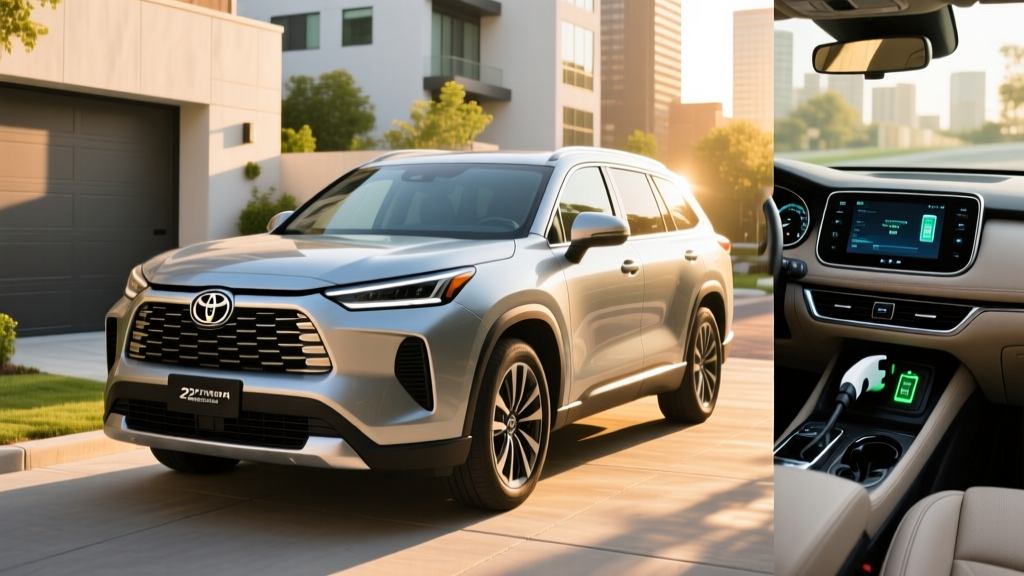
If you're searching for a suburban hybrid that can handle school runs, grocery hauls, and weekend road trips without the charging logistics of a full EV, the 2026 Toyota Grand Highlander Hybrid sits at the top of the shortlist. It's one of the few three-row SUVs that pairs genuine hybrid efficiency with usable cargo space and a powertrain proven across millions of Toyota hybrids. Here's everything you need to know — exact MPG figures, real-world expectations, pricing, and whether this hybrid actually fits your daily routine.
2026 Grand Highlander Hybrid: Quick Verdict
The Grand Highlander Hybrid is a conventional hybrid (HEV), not a plug-in. That means no charging cables, no range anxiety, and no home electrical upgrades — just fill up with gas and go. The tradeoff is that you won't get any electric-only driving. For suburban families who want a significant MPG upgrade over a gas-only three-row SUV without altering their fueling habits, this is the sweet spot.
The Grand Highlander Hybrid is a conventional hybrid (HEV): it uses regenerative braking and engine power to charge a small battery that assists the gas engine. You never plug it in. A plug-in hybrid (PHEV) has a larger battery (typically 15-25 kWh), offers 25-45 miles of electric-only range, and requires plugging in to realize its full efficiency advantage. Toyota does not currently offer a PHEV version of the Grand Highlander.
Fuel Economy: EPA MPG and Real-World Results
The headline number for any suburban hybrid buyer is fuel economy. The 2026 Grand Highlander Hybrid comes in two powertrain configurations, and the MPG difference is meaningful depending on your driving mix.
| Powertrain | City MPG | Highway MPG | Combined MPG |
|---|---|---|---|
| Hybrid MAX (turbo, AWD) | 27 | 28 | 27 |
| Standard Hybrid (FWD) | 37 | 34 | 36 |
| Standard Hybrid (AWD) | 36 | 32 | 34 |
Source: EPA Fuel Economy
Toyota's hybrid system excels in stop-and-go suburban driving, where regenerative braking and electric-motor assist do the heavy lifting. In real-world suburban commuting (30-45 mph, frequent stops), owners consistently report matching or exceeding the EPA city estimate — 37-40 MPG is common on the standard FWD hybrid. Highway cruising at 70+ mph is where hybrids lose their advantage; expect 30-33 MPG on the standard AWD model during sustained interstate driving. Cold weather (below freezing) typically reduces hybrid MPG by 5-10% due to increased engine runtime for cabin heat and reduced battery efficiency.
For context, the gas-only Grand Highlander with the turbo four-cylinder earns 21 city / 27 highway / 23 combined (FWD). The standard hybrid nearly doubles the city MPG — a massive advantage for suburban drivers who spend most of their miles in school zones, subdivision roads, and rush-hour traffic.
Powertrain and Performance Specs
The Grand Highlander Hybrid offers two distinct powertrain philosophies. The standard hybrid prioritizes efficiency; the Hybrid MAX prioritizes acceleration and towing.
| Spec | Standard Hybrid | Hybrid MAX |
|---|---|---|
| Engine | 2.5L 4-cyl | 2.4L turbo 4-cyl |
| Combined Horsepower | 245 hp | 362 hp |
| Combined Torque | 173 lb-ft (engine) | 400 lb-ft |
| 0-60 mph (est.) | ~7.8 sec | ~5.6 sec |
| Drivetrain | FWD or AWD (e-AWD) | AWD (standard) |
| Towing Capacity | 3,500 lbs | 5,000 lbs |
| Transmission | eCVT | 6-speed automatic |
The standard hybrid's eCVT (electronic continuously variable transmission) is a hallmark of Toyota's Hybrid Synergy Drive. It's not a belt-and-pulley CVT — it uses a planetary gearset to blend engine and motor power seamlessly. The result is smooth, drone-free acceleration in normal driving. The Hybrid MAX uses a conventional 6-speed automatic, which gives it more traditional shift feel and stronger highway passing power.
The AWD system on the standard hybrid is electronic — a separate rear motor powers the rear wheels when needed, with no mechanical driveshaft. This means no tunnel hump eating into interior space and instant torque to the rear axle when traction is low.
Battery, Warranty, and Long-Term Reliability
Hybrid battery longevity is consistently the top concern for first-time hybrid buyers. Here's the data.
- Hybrid battery warranty: 10 years / 150,000 miles (whichever comes first) — this is the federal emissions warranty that Toyota honors nationwide. Some states with CARB emissions rules extend coverage further.
- Hybrid battery chemistry: Nickel-metal hydride (NiMH) on the standard hybrid; the Hybrid MAX also uses a sealed NiMH traction battery. These are proven, durable chemistries — not the lithium-ion packs found in full EVs.
- Replacement cost (out of warranty): $3,000-$5,000 for a new OEM hybrid battery pack. Refurbished/remanufactured packs run $1,500-$2,500.
- Real-world lifespan data: Toyota's hybrid battery packs routinely last 150,000-200,000+ miles before significant degradation. Prius taxis have exceeded 300,000 miles on original packs. The Grand Highlander's pack is larger but uses the same proven architecture.
Toyota has built over 25 million hybrids globally since the original Prius in 1997. The hybrid system is one of the most proven powertrains in automotive history. Unlike EV batteries, which are large and expensive to replace, the hybrid battery is relatively small (roughly 1.5-2 kWh usable) and operates within a narrow state-of-charge window (typically 40-80%), which dramatically extends cycle life.
For reliability ratings, the Grand Highlander carries strong marks. Toyota's hybrid components have historically outperformed conventional automatic transmissions in long-term durability, because the eCVT planetary gearset has far fewer wear components than a traditional gearbox. The IIHS rated the Grand Highlander a Top Safety Pick+ for its crashworthiness and crash-avoidance tech.
Pricing, Trims, and Tax Credit Eligibility
The Grand Highlander Hybrid spans several trim levels, and pricing has shifted for the 2026 model year.
| Trim | Powertrain | MSRP (approx.) |
|---|---|---|
| XLE | Standard Hybrid | $47,500 |
| Limited | Standard Hybrid | $52,200 |
| Platinum | Hybrid MAX | $58,800 |
MSRP figures are approximate base prices before destination. Verify current pricing at Toyota.com.
The Grand Highlander Hybrid is a conventional hybrid (HEV), not a plug-in. Under current IRS §30D rules, the federal clean vehicle credit ($3,750-$7,500) applies only to plug-in electric vehicles (BEVs and PHEVs) with sufficient battery capacity and domestic battery-sourcing compliance. Conventional hybrids do not qualify for any federal purchase tax credit.
Some states offer their own incentives for hybrids — check your state's energy office or department of revenue for current programs. These vary widely and change frequently.
Grand Highlander Hybrid vs. the Alternatives
The suburban hybrid market for three-row SUVs is competitive. Here's how the Grand Highlander stacks up against key rivals.
| Attribute | Grand Highlander Hybrid | Kia Sorento Hybrid | Hyundai Santa Fe Hybrid |
|---|---|---|---|
| Combined MPG (EPA) | 34-36 | 34-35 | 34-36 |
| Third-Row Space | Adults (genuine) | Kids only | Tight for adults |
| Cargo (behind 3rd row) | ~20.6 cu ft | ~12.6 cu ft | ~14.5 cu ft |
| Combined HP | 245 / 362 (MAX) | 232 | 232 |
| Starting MSRP (hybrid) | ~$47,500 | ~$40,500 | ~$42,000 |
| Battery Warranty | 10 yr / 150k mi | 10 yr / 100k mi | 10 yr / 100k mi |
The Grand Highlander's main advantage is interior volume. If you regularly carry adults or older teens in the third row, or need meaningful cargo space behind all three rows, nothing else in this segment competes. The Sorento and Santa Fe hybrids are smaller, more affordable, and nearly as efficient — but they sacrifice third-row usability.
✓ Pros
- Best-in-class third-row and cargo space for a hybrid SUV
- 36 MPG combined in suburban driving — exceptional for its size
- Proven Toyota hybrid reliability with 10yr/150k battery warranty
- No plug-in required — zero lifestyle change from gas
- Hybrid MAX offers 362 hp and 5,000-lb towing
✗ Cons
- $47,500+ starting price — premium over non-hybrid rivals
- No federal tax credit (HEV, not PHEV/BEV)
- Hybrid MAX fuel economy drops to 27 combined
- No plug-in hybrid variant available
- eCVT engine drone under hard acceleration (standard hybrid)
Who Should Buy This Suburban Hybrid?
Choose the Grand Highlander Hybrid if:
- You drive 12,000-18,000 miles/year, mostly suburban/city routes under 50 mph
- You need three usable rows and cargo room but want MPG above 30
- You can't charge at home (apartment, street parking, no garage outlet)
- You plan to keep the vehicle 8-10+ years and want proven hybrid durability
Choose a PHEV instead (e.g., Chrysler Pacifica PHEV, Toyota RAV4 Prime) if:
- Your daily commute is under 40 miles round-trip and you can charge at home
- You want electric-only daily driving with a gas backup for road trips
- You want to qualify for the federal tax credit (PHEVs may qualify depending on sourcing/income)
Choose a full EV (e.g., Kia EV9, Tesla Model X) if:
- You have reliable Level 2 home charging and your daily range needs are under 250 miles
- You want zero tailpipe emissions and minimal maintenance
- You're eligible for the full $7,500 federal credit, which offsets the higher purchase price
Ownership Costs: 5-Year Estimate
Let's run the numbers for a suburban driver covering 15,000 miles/year with the standard AWD hybrid (34 MPG combined), compared to the gas-only AWD Grand Highlander (24 MPG combined) and a comparable three-row EV.
| Vehicle Type | Efficiency | Cost per Mile | 5-Year Total |
|---|---|---|---|
| Grand Highlander Hybrid (AWD) | 34 MPG | $0.10 | $7,720 |
| Grand Highlander Gas (AWD) | 24 MPG | $0.15 | $10,935 |
| 3-Row EV (home charging avg.) | 2.8 mi/kWh | $0.05 | $3,750 |
Based on $3.40/gal regular unleaded and $0.14/kWh national average electricity. Your costs will vary by region and driving mix. Source: fueleconomy.gov
The hybrid saves roughly $3,200 over 5 years compared to the gas model — enough to offset most of the hybrid powertrain premium at the XLE trim. A full EV saves even more on energy, but only if you have access to affordable home charging and don't regularly exceed 250+ miles between stops.
Frequently Asked Questions
How many MPG does the Grand Highlander Hybrid get?
The standard hybrid earns 36 MPG combined (FWD) or 34 MPG combined (AWD) per the EPA. The performance-oriented Hybrid MAX earns 27 MPG combined. In real-world suburban driving below 50 mph, the standard hybrid often matches or slightly exceeds its EPA city rating of 36-37 MPG.
Does the Grand Highlander Hybrid need to be plugged in?
No. This is a conventional hybrid (HEV). The battery charges through regenerative braking and the gas engine. You fuel it exactly like a standard gas car. Toyota does not offer a plug-in (PHEV) version of the Grand Highlander as of the 2026 model year.
Is the hybrid battery reliable and what does replacement cost?
Toyota's NiMH hybrid batteries are among the most durable in the industry, routinely lasting 150,000-200,000+ miles. The battery is warranted for 10 years / 150,000 miles. Out-of-warranty replacement runs $3,000-$5,000 for a new OEM pack, or $1,500-$2,500 for a refurbished unit. Given the typical lifespan, most original owners will never need a replacement.
Does the Grand Highlander Hybrid qualify for any tax credit?
No federal tax credit is available. The IRS §30D clean vehicle credit applies only to plug-in vehicles (BEVs and qualifying PHEVs). Conventional hybrids like the Grand Highlander Hybrid are excluded. Check your state's energy office for any local hybrid incentives, which vary by jurisdiction.
Hybrid vs PHEV vs EV — which is right for my suburban commute?
If you can't charge at home, the HEV (Grand Highlander Hybrid) is your best bet — no infrastructure needed. If you can charge at home and your daily driving is under 40 miles, a PHEV gives you electric-only commuting with gas-engine road-trip flexibility. If you have Level 2 home charging, rarely drive more than 250 miles in a day, and want the lowest operating cost, a full EV is the most economical long-term choice.
How does the Grand Highlander Hybrid handle in cold weather?
Expect a 5-10% MPG reduction in sustained freezing temperatures. The engine runs more frequently to provide cabin heat (since there's no large battery to power a heat pump, as in an EV). AWD models handle snow competently thanks to the rear electric motor providing instant torque. Unlike EVs, you won't experience dramatic range loss — the gas tank is your buffer.