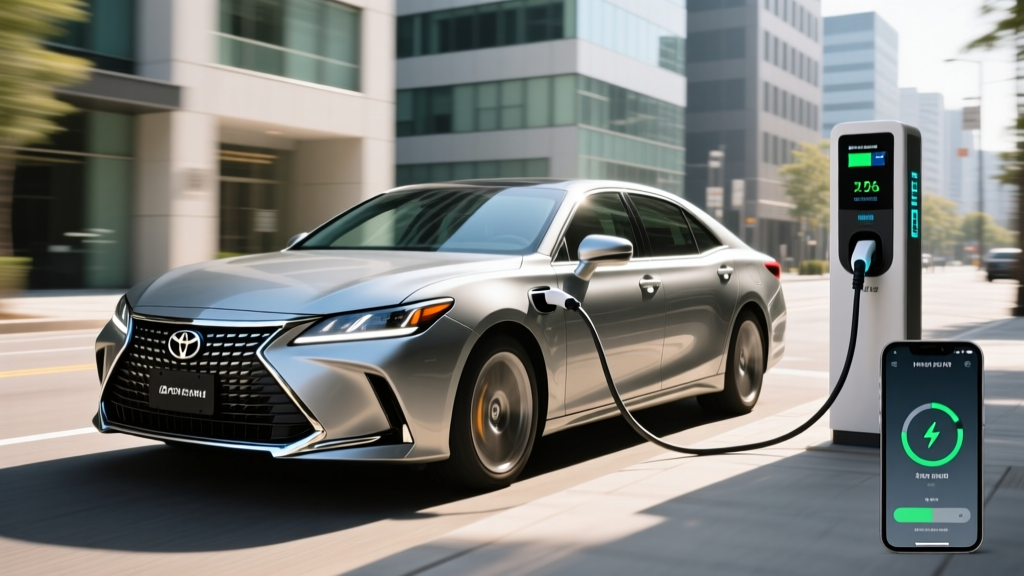
The Toyota Crown occupies a strange space in the American sedan market: part premium liftback, part crossover alternative, and entirely hybrid. For 2026, Toyota continues to offer the Crown exclusively with electrified powertrains, giving buyers a choice between a fuel-sipping standard hybrid and a surprisingly quick Hybrid MAX setup. Neither requires plugging in — these are conventional hybrids (HEVs), not plug-in hybrids — but the efficiency and performance spread between the two systems is wide enough to warrant a close look.
If you're cross-shopping the Crown Hybrid against midsize sedans, crossovers, or even entry-level luxury vehicles, this guide breaks down exactly what you're getting: real MPG, powertrain specs, battery longevity, ownership costs, and where it fits in the broader hybrid-vs-PHEV-vs-EV decision.
What Is the Toyota Crown Hybrid? HEV vs PHEV Clarity
Before getting into specs, it's critical to understand what the Crown Hybrid is — and what it isn't. The 2026 Crown uses Toyota's self-charging hybrid system. A gasoline engine and one or more electric motors work together, with a small battery pack that recharges through regenerative braking and the engine itself. You never plug it in. There is no electric-only driving mode beyond very low-speed, short-distance creep (typically under 1 mile at parking-lot speeds).
This makes the Crown a conventional hybrid electric vehicle (HEV), distinct from a plug-in hybrid (PHEV) like the Toyota RAV4 Prime or the now-discontinued Prius Prime, which carry larger batteries (typically 13–18 kWh usable), offer 25–44 miles of electric-only range, and require regular plug-in charging to realize their efficiency advantage.
| Attribute | HEV (Crown Hybrid) | PHEV (e.g., RAV4 Prime) | BEV (e.g., Tesla Model 3) |
|---|---|---|---|
| Plug-in required? | No | Yes (for max benefit) | Yes (always) |
| Electric-only range | ~0.5 mi at low speed | 25–44 mi | 250–360+ mi |
| Battery size (usable) | ~1.0–1.6 kWh | 13–18 kWh | 50–82+ kWh |
| Fuel/energy source | Gasoline + regen | Gasoline + grid electricity | Grid electricity only |
| Home charger needed? | No | Recommended (Level 2) | Essential |
| Federal tax credit (§30D) | Not eligible | Up to $7,500 (if eligible) | Up to $7,500 (if eligible) |
Fuel Economy: How Many MPG Does the Crown Hybrid Get?
The 2026 Toyota Crown Hybrid's fuel economy depends on which powertrain you choose. Toyota offers two distinct hybrid setups across the trim lineup, and the efficiency gap between them is substantial.
| Powertrain | City MPG | Highway MPG | Combined MPG | Trims Available |
|---|---|---|---|---|
| Standard Hybrid (2.5L 4-cyl + 2 motors) | 42 | 41 | 41 | XLE |
| Hybrid MAX (2.4L turbo + direct-drive motor) | 29 | 32 | 30 | Limited, Platinum |
The standard hybrid system — a 2.5-liter inline-four paired with two motor-generators through Toyota's e-CVT — delivers an EPA-estimated 41 MPG combined. That figure is competitive with the Toyota Camry Hybrid and significantly better than any non-hybrid midsize sedan on the market.
The Hybrid MAX system, which pairs a turbocharged 2.4-liter four-cylinder with a more powerful electric motor through a 6-speed automatic (no e-CVT here), prioritizes performance over efficiency at 30 MPG combined. That's still respectable for a 340-horsepower vehicle, but it's a meaningful drop from the base setup.
Real-World MPG: What to Actually Expect
Toyota hybrids tend to perform close to — and sometimes above — their EPA city estimates in stop-and-go driving, where regenerative braking and electric-motor assist do the most work. In our experience with Toyota's fourth-generation hybrid system, you can expect:
- City driving (standard hybrid): 40–44 MPG. Short trips with frequent stops let regen recapture energy effectively. In warm weather on flat terrain, some drivers report touching 45 MPG on mixed city routes.
- Highway driving (standard hybrid): 37–41 MPG. At sustained 70–80 mph speeds, the gasoline engine carries most of the load. The hybrid advantage narrows at highway speeds compared to city driving — this is normal for all hybrids.
- Cold-weather penalty: Expect a 5–10% reduction in fuel economy during winter months (roughly 37–39 MPG combined for the standard hybrid). The engine runs more frequently to maintain cabin heat and warm up the catalytic converter.
- Hybrid MAX real-world: 27–31 MPG combined depending on driving style. Aggressive acceleration — easy to do with 340 HP on tap — will push you toward the lower end.
For context, a comparable gasoline-only midsize sedan (like a non-hybrid Honda Accord 1.5T) returns around 33 MPG combined. The Crown's standard hybrid saves roughly 100–120 gallons of fuel per year at 15,000 miles driven — approximately $350–$450 annually at $3.50/gallon.
Powertrain Deep Dive: Horsepower, Engines, and Motors
| Spec | Standard Hybrid | Hybrid MAX |
|---|---|---|
| Engine | 2.5L DOHC 4-cylinder | 2.4L turbocharged 4-cylinder |
| Engine output | 184 HP / 163 lb-ft | 264 HP / 304 lb-ft |
| Electric motor output | 134 HP (front) + rear motor | 83 HP (direct-drive) |
| Combined system output | 236 HP | 340 HP / 400 lb-ft |
| Transmission | e-CVT | 6-speed automatic |
| Drivetrain | AWD (electronic rear motor) | AWD (direct torque) |
| 0-60 mph | 7.6 sec (est.) | 5.1 sec (est.) |
| Battery type | Lithium-ion (bipolar) | Lithium-ion |
| Battery capacity (usable) | ~1.0 kWh | ~1.6 kWh |
The standard hybrid uses Toyota's well-proven series-parallel architecture. The front axle is driven by both the gasoline engine and a 134-HP motor-generator, while a smaller rear-axle motor provides electronic all-wheel drive when slip is detected or during hard acceleration. The system seamlessly blends electric and gas power — most drivers won't notice the transitions.
The Hybrid MAX is a fundamentally different beast. The turbocharged 2.4-liter engine produces 264 HP on its own, and the electric motor fills in torque at low RPM before the turbo spools, eliminating the lag that typically plagues turbo fours. The result is 340 combined horsepower with immediate throttle response. The 6-speed automatic replaces the e-CVT, giving the Hybrid MAX a more traditional — and sportier — driving feel with perceptible gear shifts.
Both systems are paired with electronic on-demand AWD, though the implementation differs. The standard hybrid energizes its rear motor only when needed, while the Hybrid MAX uses a more robust torque-distribution system.
Battery Warranty, Lifespan, and Replacement Cost
Hybrid battery longevity remains one of the most common concerns for buyers transitioning from conventional vehicles. Here's the reality: modern Toyota hybrid batteries are far more durable than early-generation packs from the 2000s.
2026 Toyota Crown Hybrid — Battery & Powertrain Warranty
- Hybrid battery warranty: 10 years / 150,000 miles (whichever comes first)
- Hybrid system components warranty: 8 years / 100,000 miles (inverters, converters, control modules)
- Powertrain warranty: 5 years / 60,000 miles (engine, transmission)
- Basic warranty: 3 years / 36,000 miles
The 10-year/150,000-mile hybrid battery warranty is among the best in the industry and applies in all 50 states. Toyota's lithium-ion bipolar hybrid packs are designed for shallow cycling — they never fully charge or fully discharge, which dramatically reduces degradation stress. Based on long-term data from Toyota's hybrid fleet (over 25 million hybrids sold globally since 1997), most hybrid batteries last well beyond 150,000 miles with minimal capacity loss.
Battery Replacement Cost
If your Crown's hybrid battery does fail outside of warranty, here's what to budget:
- OEM replacement (dealer): $3,000–$4,500 including labor
- Refurbished/remanufactured pack: $1,500–$2,500 including labor
- Individual cell/module repair: $500–$1,200 at a hybrid specialist (not all failures require full pack replacement)
For context, Toyota's hybrid batteries in the Camry and RAV4 Hybrid have shown failure rates under 5% even at 200,000+ miles in fleet data. The Crown's newer bipolar lithium-ion design is expected to perform at least as well. This is not a component you should lose sleep over.
Pricing, Trims, and Tax Credit Eligibility
The 2026 Toyota Crown Hybrid starts at approximately $41,440 for the XLE trim with the standard hybrid powertrain and climbs to around $54,990 for the Platinum trim with Hybrid MAX. Here's the approximate trim breakdown:
- XLE (standard hybrid, 236 HP): ~$41,440 MSRP
- Limited (Hybrid MAX, 340 HP): ~$47,000 MSRP
- Platinum (Hybrid MAX, 340 HP): ~$54,990 MSRP
Does the Crown Hybrid Qualify for a Federal Tax Credit?
No. The Toyota Crown Hybrid is a conventional HEV, not a plug-in hybrid or battery electric vehicle. Under current IRS §30D rules, the federal clean vehicle credit (up to $7,500) is available only for qualifying PHEVs and BEVs that meet battery-component and critical-mineral sourcing requirements, MSRP caps, and buyer income limits. Conventional hybrids like the Crown do not qualify for §30D.
However, some states and local utilities offer separate incentives for hybrid vehicles — typically smaller rebates ($250–$1,000) or HOV-lane access. Check your state's energy office or utility provider for current programs. These vary significantly by jurisdiction and change frequently.
Who Should Choose the Crown Hybrid vs a PHEV or Full EV?
The Crown Hybrid Is Right for You If:
- You don't have access to home or workplace charging (no garage, no outlet, apartment living)
- You want maximum fuel efficiency without changing any habits — no plugging in, no route planning
- You regularly take long road trips where charging infrastructure is sparse
- You want a premium-feeling sedan with AWD and strong resale value
- You plan to keep the car 8–12 years and want proven hybrid reliability
Consider a PHEV Instead If:
- You have reliable home Level 2 charging and a commute under 30 miles
- You want electric-only daily driving with gas-engine backup for road trips
- You want to qualify for the federal tax credit (up to $7,500 point-of-sale)
- You're willing to pay a $5,000–$10,000 premium for the larger battery and dual powertrain
Consider a Full EV Instead If:
- You have dependable home charging and your daily driving is under 250 miles
- You want the lowest per-mile fuel cost (electricity vs gasoline)
- You want zero tailpipe emissions and minimal drivetrain maintenance
- You're ready to use public DC fast charging for longer trips
The Crown Hybrid's strongest value proposition is effortless efficiency. You get 41 MPG in the XLE without ever thinking about charging, plugging in, or range. For buyers in apartments, condos, or homes without dedicated parking near an outlet, this is often the deciding factor over a PHEV or EV.
Pros
- 41 MPG combined (standard hybrid) with no plug-in required
- Standard AWD across all trims
- 10-year / 150,000-mile hybrid battery warranty
- Hybrid MAX offers 340 HP and 5.1-sec 0-60 for enthusiasts
- Elevated ride height provides crossover-like visibility and entry
- Toyota Safety Sense 3.0 standard (adaptive cruise, lane-keep, auto emergency braking)
- Strong Toyota resale value and reliability track record
Cons
- No federal tax credit eligibility (HEV, not PHEV)
- Starting price above $41K — premium over a Camry Hybrid (~$30K)
- Hybrid MAX drops to 30 MPG — not much better than a turbo gas sedan
- Liftback styling reduces rear headroom vs traditional sedans
- No plug-in hybrid variant available — can't drive on electric alone
- Cargo volume (15.2 cu ft) trails midsize crossovers it competes with on price
Reliability and Safety Ratings
Toyota's hybrid systems have been in continuous production since 1997 and are among the most proven electrified powertrains on the road. The Crown shares its hybrid architecture with the Camry Hybrid, Highlander Hybrid, and RAV4 Hybrid — all of which have demonstrated long-term reliability across hundreds of thousands of units in the field.
The 2026 Crown comes standard with Toyota Safety Sense 3.0, which includes:
- Pre-Collision System with Pedestrian Detection
- Full-Speed Range Dynamic Radar Cruise Control
- Lane Departure Alert with Steering Assist
- Lane Tracing Assist
- Automatic High Beams
- Road Sign Assist
This is an SAE Level 2 driver-assistance suite — meaning the driver must remain fully engaged and keep hands on the wheel at all times. It is not autonomous driving. For safety crash ratings, check the latest results from IIHS and NHTSA, as the Crown has historically performed well in crash testing due to its TNGA-K platform structure.
Ownership Costs: 5-Year Fuel Savings vs Competitors
Here's how the Crown Hybrid XLE (41 MPG) stacks up on fuel costs over 5 years at 15,000 miles/year and $3.50/gallon:
| Vehicle | Combined MPG | Gallons Used | Total Fuel Cost | Savings vs Avg Gas Sedan |
|---|---|---|---|---|
| Toyota Crown Hybrid XLE | 41 | 1,829 | $6,402 | $2,598 |
| Honda Accord 1.5T (gas) | 33 | 2,273 | $7,955 | $1,045 |
| Toyota Camry Hybrid | 52 | 1,442 | $5,048 | $3,952 |
| Average gas midsize sedan | 28 | 2,679 | $9,376 | Baseline |
The Crown Hybrid XLE saves roughly $2,600 over five years compared to a typical gasoline midsize sedan. However, the Camry Hybrid — at 52 MPG combined — saves nearly $4,000 in the same period, and costs about $11,000 less upfront. The Crown's premium buys you a more upscale interior, elevated seating position, standard AWD, and a more distinctive design — not superior fuel economy.
Frequently Asked Questions
How many MPG does the 2026 Toyota Crown Hybrid get?
The standard hybrid (XLE trim) achieves an EPA-estimated 42 city / 41 highway / 41 combined MPG. The Hybrid MAX (Limited and Platinum trims) achieves 29 city / 32 highway / 30 combined MPG. Real-world results for the standard hybrid typically fall between 37–44 MPG depending on driving conditions, temperature, and terrain.
Do I need to plug in the Toyota Crown Hybrid?
No. The Crown Hybrid is a conventional hybrid (HEV). Its battery recharges through regenerative braking and the gasoline engine. There is no plug, no charging cable, and no need for a home charger. You simply fill it with gasoline like any other car.
Does the Toyota Crown Hybrid qualify for any federal tax credit?
No. Under current IRS §30D rules, only qualifying plug-in hybrid electric vehicles (PHEVs) and battery electric vehicles (BEVs) are eligible for the federal clean vehicle credit. The Crown is a conventional hybrid and does not qualify. Some state or utility programs may offer smaller incentives for hybrids — check locally.
Is the Toyota Crown Hybrid reliable? What about battery replacement?
Toyota's hybrid systems are among the most reliable electrified powertrains available, backed by over 25 years of continuous production. The Crown's hybrid battery is warranted for 10 years / 150,000 miles. Based on historical data from Toyota's hybrid fleet, battery failure rates remain very low even beyond 200,000 miles. If replacement is needed out of warranty, expect $3,000–$4,500 at a dealer, or $1,500–$2,500 for a refurbished pack.
Is there a plug-in hybrid version of the Toyota Crown?
As of the 2026 model year, Toyota does not offer a plug-in hybrid (PHEV) variant of the Crown. All Crown models use conventional hybrid powertrains. If you want a Toyota PHEV sedan, the closest option is the Prius Prime (44 miles electric-only range, EPA-estimated). For a PHEV SUV in Toyota's lineup, the RAV4 Prime offers 42 miles of electric range.
How does the Crown Hybrid compare to the Camry Hybrid?
The Camry Hybrid is more fuel-efficient (52 MPG combined vs 41 MPG) and significantly less expensive (~$30,000 starting vs ~$41,440). The Crown trades some efficiency and value for a more premium interior, elevated ride height, standard AWD, available Hybrid MAX performance (340 HP), and a more distinctive liftback design. If pure fuel savings is your priority, the Camry Hybrid wins. If you want a near-premium experience with strong efficiency, the Crown fills that niche.
What's the difference between the standard hybrid and Hybrid MAX?
The standard hybrid uses a 2.5L naturally aspirated engine with an e-CVT for 236 combined HP and 41 MPG. The Hybrid MAX uses a 2.4L turbocharged engine with a 6-speed automatic for 340 combined HP and 30 MPG. The standard hybrid prioritizes efficiency; the Hybrid MAX prioritizes acceleration and driving engagement. Both include AWD.