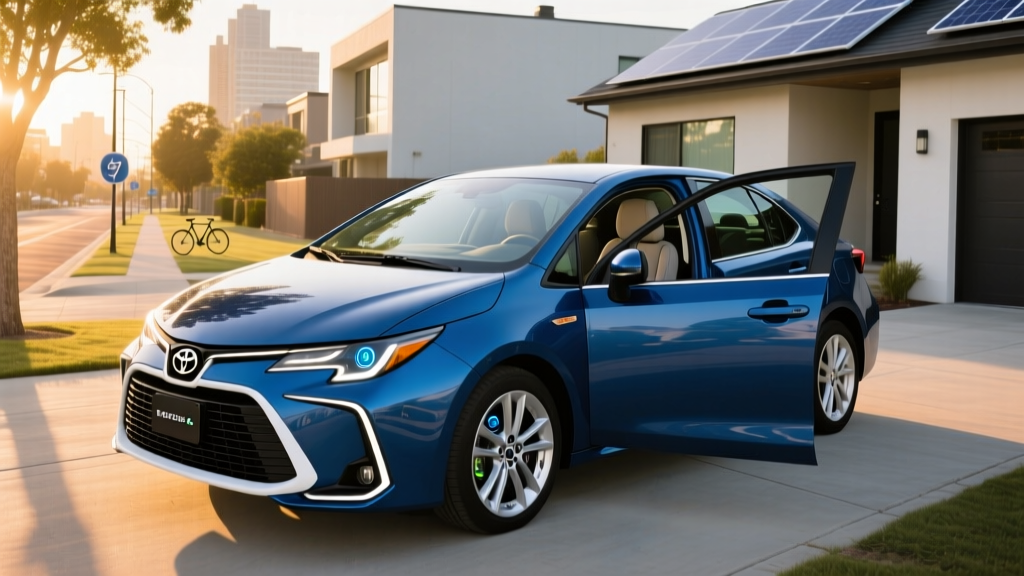
The Toyota Corolla Hybrid has quietly become one of the most fuel-efficient mainstream sedans you can buy without plugging in. For 2026, the Corolla Hybrid XLE sits at the top of the hybrid lineup, bundling Toyota's fifth-generation hybrid system with premium trim features that push it well beyond basic-commuter territory. If you've been searching for a Toyota Corolla Hybrid XLE and want hard numbers — not brochure language — this guide breaks down everything from EPA fuel economy to real-world MPG, battery longevity, and whether this HEV makes more financial sense than a PHEV or full EV for your driving pattern.
2026 Toyota Corolla Hybrid XLE: Core Specifications
| Specification | Value |
|---|---|
| Powertrain Type | Conventional Hybrid (HEV) — no plug-in required |
| Engine | 1.8L 4-cylinder Atkinson-cycle + 2 electric motor-generators |
| Combined System Horsepower | 138 hp |
| Transmission | Electronically controlled CVT (eCVT) |
| Drivetrain | Front-wheel drive (AWD-e available on LE trim only) |
| Hybrid Battery | ~1.3 kWh lithium-ion (sealed, self-charging) |
| EPA Fuel Economy (City / Hwy / Combined) | 53 / 46 / 50 MPG |
| Fuel Tank Capacity | 11.4 gallons |
| Total Driving Range | ~570 miles (EPA estimate) |
| 0–60 mph | ~9.2 seconds (est.) |
| Starting MSRP (XLE trim) | ~$29,500 (est., incl. destination) |
| Hybrid Battery Warranty | 10 years / 150,000 miles |
Understanding the Corolla Hybrid: HEV, Not PHEV
Before we get into fuel economy, it's critical to establish what the Corolla Hybrid is — and what it isn't. The Corolla Hybrid is a conventional hybrid electric vehicle (HEV). It generates all its electricity internally through regenerative braking and the gasoline engine. You never plug it in. There is no electric-only driving range to manage, no home charger to install, and no charging station to seek out.
HEV vs. PHEV vs. BEV: Where the Corolla Hybrid Fits
| Feature | HEV (Corolla Hybrid) | PHEV (e.g., Prius Prime) | BEV (e.g., Tesla Model 3) |
|---|---|---|---|
| Plug-in Required? | No | Yes (Level 1/2) | Yes (Level 2/DC fast) |
| Electric-Only Range | None (EV assist only at low speed) | ~40–44 miles | 250–360+ miles |
| Total Range | ~570 miles | ~400+ miles combined | 250–360+ miles |
| Fuel/Energy Cost per Mile | ~$0.07/mi (gas) | ~$0.04/mi (electric) + gas | ~$0.04/mi (electric) |
| Home Charging Needed? | No | Recommended | Essential |
| Federal Tax Credit (§30D) | Not eligible | Up to $7,500 (if eligible) | Up to $7,500 (if eligible) |
| Upfront Price Premium | Low (~$1,500 over gas model) | Moderate ($4,000–$7,000) | Higher ($8,000–$15,000+) |
This distinction matters because many shoppers confuse the Corolla Hybrid with the Prius Prime (a PHEV). The Corolla Hybrid has no plug, no electric-only mode, and no §30D federal tax credit eligibility. What it does offer is exceptional fuel economy with zero lifestyle change — you fuel up at any gas station and drive normally.
Fuel Economy: EPA Ratings and Real-World MPG
EPA Fuel Economy Breakdown
| Driving Condition | EPA Rating |
|---|---|
| City | 53 MPG |
| Highway | 46 MPG |
| Combined | 50 MPG |
Source: EPA Fuel Economy Guide
The Corolla Hybrid's 53 MPG city rating is the headline number, and it's one of the highest city ratings of any non-plug-in vehicle sold in the U.S. This is where Toyota's hybrid system shines: in stop-and-go traffic, the electric motor-generators handle low-speed propulsion while regenerative braking recovers energy that a conventional car would waste as heat.
Real-World MPG: What Owners Actually See
EPA estimates are conducted under controlled conditions. In real-world driving, the Corolla Hybrid often exceeds its EPA city rating — a rarity among vehicles. On suburban routes with frequent stops and speeds under 45 mph, owners regularly report 54–58 MPG. This is because the hybrid system is most efficient at exactly the kind of low-load, variable-speed driving that defines city commutes.
Highway driving tells a different story. At sustained 70–80 mph speeds, the gasoline engine carries most of the load, and real-world highway fuel economy typically falls to 42–45 MPG. Cold weather further reduces efficiency — expect a 5–10% drop in combined MPG during winter months as the engine runs more frequently to maintain cabin heat and battery temperature. On a mixed-driving road trip averaging 65 mph, plan for roughly 44–47 MPG, which still translates to approximately 500+ miles per tank.
Compared to the gas-only Corolla LE (rated at 32 city / 41 hwy / 35 combined per fueleconomy.gov), the hybrid delivers a 43% improvement in combined fuel economy — a meaningful gap that pays dividends at the pump.
Powertrain Deep Dive: How 138 HP Gets 50 MPG
The 2026 Corolla Hybrid XLE uses Toyota's fifth-generation Hybrid Synergy Drive, pairing a 1.8-liter Atkinson-cycle four-cylinder engine with two motor-generators through a planetary gearset eCVT. The gasoline engine produces approximately 96 hp and 105 lb-ft of torque on its own, while the electric motor-generators supplement output to reach a combined system rating of 138 hp.
The Atkinson-cycle engine achieves its high thermal efficiency (~40%) by keeping the intake valve open slightly during the compression stroke, effectively reducing pumping losses. The trade-off is lower low-end torque, which is precisely where the electric motors compensate. The result is seamless acceleration from stops — the electric motors deliver instant torque while the engine spools up — without the rubber-band feel that plagued earlier CVT-equipped hybrids.
The ~1.3 kWh lithium-ion hybrid battery pack is small by PHEV or BEV standards, but it doesn't need to be large. It serves as an energy buffer, storing recaptured braking energy and releasing it for electric assist during acceleration. It never fully depletes and never fully charges — the system manages state of charge (SoC) within a narrow operating window to maximize battery longevity.
Pricing, Trims, and Tax Credit Reality
The 2026 Corolla Hybrid is offered in LE and XLE trims (AWD-e is available on the LE only). The XLE trim commands a premium over the LE, adding features such as:
- SofaTex-trimmed heated front seats
- 7-inch digital instrument cluster
- Wireless Apple CarPlay and Android Auto
- Blind Spot Monitor with Rear Cross-Traffic Alert
- 16-inch alloy wheels (design-specific)
- Auto-dimming rearview mirror with HomeLink
The estimated MSRP for the 2026 Corolla Hybrid XLE is approximately $29,500 including destination charges. This positions it roughly $1,500–$2,000 above the Hybrid LE and approximately $4,000–$5,000 above the base gas-only Corolla LE.
Federal Tax Credit: Not Eligible
Because the Corolla Hybrid is a conventional HEV — not a plug-in vehicle — it does not qualify for the IRS §30D Clean Vehicle Credit. That credit, which offers up to $7,500 for qualifying new EVs and PHEVs, requires a minimum battery capacity of 7 kWh and plug-in charging capability (per IRS §30D guidelines). The Corolla Hybrid's ~1.3 kWh battery falls well below that threshold.
Some states offer their own incentives for hybrid purchases, but these vary widely by jurisdiction and change frequently. Check your state's energy office or department of environmental quality for current programs. A few utilities also offer rebates for hybrid vehicle purchases — worth investigating if you're comparing total cost of ownership.
Battery Longevity, Warranty, and Replacement Costs
Toyota Hybrid Battery Warranty
Coverage: 10 years or 150,000 miles (whichever comes first)
What's covered: Defects in materials/workmanship, and capacity loss below a defined threshold (typically ~60–70% of original capacity)
Transferable: Yes — warranty transfers to subsequent owners
Battery longevity is consistently the top concern for hybrid shoppers, and Toyota has the longest track record in the industry to draw on. Since launching the Prius in 1997, Toyota has built millions of hybrids worldwide, and the data is clear: modern Toyota hybrid battery packs routinely last 150,000–200,000+ miles before significant degradation occurs.
The fifth-generation system in the 2026 Corolla Hybrid uses a lithium-ion pack (earlier generations used nickel-metal hydride). Lithium-ion chemistry offers better energy density and a wider operating temperature range, and Toyota's battery management system keeps the pack in a conservative state-of-charge window — typically between 40% and 80% — to minimize calendar and cycle degradation.
What If the Battery Does Need Replacement?
Out-of-warranty hybrid battery replacement for a Corolla Hybrid currently runs approximately $2,500–$4,000 including parts and labor at a Toyota dealership. Independent hybrid specialists often offer refurbished or reconditioned packs for $1,500–$2,500. Individual module replacement (if only one or two cells have degraded) can cost as little as $500–$1,000.
For context, this is a fraction of the cost of a BEV battery replacement ($10,000–$20,000+), and the smaller pack size is the primary reason. The 10-year/150,000-mile warranty provides substantial coverage, and Toyota's hybrid battery failure rates in the first decade of ownership remain extremely low based on long-term fleet data.
Reliability and Ownership Costs
Toyota's hybrid powertrains are among the most reliable in the automotive industry. The eCVT transmission has no conventional belts, clutches, or torque converters — it's a planetary gearset with far fewer wear components than a traditional automatic. The regenerative braking system reduces wear on the friction brakes, meaning brake pads and rotors often last 80,000–100,000+ miles.
Maintenance costs are comparable to or slightly lower than the gas-only Corolla:
- Oil changes: Still required (1.8L engine), but the engine runs less frequently, so oil stays cleaner longer. Toyota recommends 10,000-mile intervals with synthetic oil.
- Brake service: Significantly reduced due to regenerative braking.
- No spark plugs until ~120,000 miles (iridium plugs).
- No starter motor or alternator — the motor-generators handle both functions.
- Hybrid system coolant: Periodic replacement per maintenance schedule (~100,000 miles).
Insurance costs for the Corolla Hybrid are typically in line with the gas-only model — insurers generally don't surcharge hybrids the way some do for EVs. Depreciation is favorable; Toyota Corollas (hybrid and gas) consistently rank among the best-retaining vehicles in their segment.
Who Should Buy the Corolla Hybrid XLE — and Who Shouldn't
Choose the Corolla Hybrid XLE If:
- You want 50+ MPG without changing your fueling habits
- You don't have access to home or workplace charging
- You drive 15,000+ miles per year and want to minimize fuel spend
- You want a proven, low-risk powertrain with a 10-year battery warranty
- You prefer a conventional sedan with premium trim features (heated seats, wireless CarPlay)
- You want low maintenance costs and strong resale value
Look Elsewhere If:
- You want electric-only driving or zero tailpipe emissions — consider a BEV
- You want to qualify for the $7,500 federal tax credit — you need a PHEV or BEV
- You prioritize acceleration — 138 hp and a 9.2-second 0–60 time are adequate, not quick
- You need AWD — it's only available on the Hybrid LE trim, not the XLE
- You want a larger vehicle — the Corolla is a compact sedan with limited rear-seat and cargo space
The Decision Framework: HEV vs. PHEV vs. BEV
Corolla Hybrid (HEV) is the right call if you can't charge at home, drive high annual miles, and want maximum fuel savings with minimum disruption. It's the lowest-risk path to better efficiency.
A PHEV like the Prius Prime makes sense if you have home charging, a short commute (under 40 miles), and want to drive mostly on electricity while keeping a gas backup for road trips. The §30D credit can offset the higher purchase price — but only if you meet income and sourcing requirements.
A full BEV is ideal if you have reliable home charging, mostly drive under 250 miles per day, and want the lowest per-mile energy cost plus zero tailpipe emissions. The trade-off is higher upfront cost and dependence on charging infrastructure for longer trips.
Frequently Asked Questions
How many MPG does the 2026 Toyota Corolla Hybrid XLE get?
The EPA rates the Corolla Hybrid at 53 MPG city, 46 MPG highway, and 50 MPG combined. In real-world city and suburban driving, many owners report 54–58 MPG. Highway driving at 70+ mph typically yields 42–45 MPG. Cold weather can reduce combined efficiency by 5–10%.
Does the Corolla Hybrid need to be plugged in?
No. The Corolla Hybrid is a conventional HEV. It charges its own small battery through regenerative braking and the gasoline engine. You never plug it in — you simply fill up at a gas station as you would with any other car.
How far can the Corolla Hybrid drive on electric power alone?
The Corolla Hybrid cannot drive on electric power alone for any meaningful distance. The electric motor-generators assist the gasoline engine during acceleration and can propel the car at very low speeds (under ~15 mph) for brief distances, but the engine is always the primary power source. If you want electric-only driving, you need a PHEV like the Prius Prime (~44 miles EV range) or a full BEV.
Does the Toyota Corolla Hybrid qualify for any tax credit?
The Corolla Hybrid does not qualify for the federal §30D Clean Vehicle Credit, which requires plug-in capability and a minimum 7 kWh battery. Some states and utilities offer their own hybrid incentives — check your state's energy office for current programs. The used-vehicle credit (§25E) may apply if you purchase a qualifying pre-owned Corolla Hybrid through a dealer, subject to income and price caps.
How long will the Corolla Hybrid battery last, and what does replacement cost?
Toyota covers the hybrid battery with a 10-year / 150,000-mile warranty. Based on long-term data from millions of Toyota hybrids on the road, these packs typically last 150,000–200,000+ miles before significant degradation. If replacement is needed out of warranty, expect to pay $2,500–$4,000 at a dealership, or $1,500–$2,500 for a refurbished pack from an independent hybrid specialist.
Is the Corolla Hybrid XLE worth the premium over the LE?
The XLE adds SofTex heated seats, blind spot monitoring, a digital instrument cluster, wireless phone integration, and upgraded interior materials. If you value these comfort and safety features, the ~$2,500 premium is reasonable. If your priority is pure fuel-economy value, the Hybrid LE delivers identical MPG at a lower price — and it's the only trim offering AWD-e.
How does the Corolla Hybrid compare to the Prius?
The current-generation Prius (redesigned for 2023) offers more power (194 hp combined for the FWD model), a sportier driving experience, and slightly better highway efficiency. However, the Corolla Hybrid XLE offers a more traditional sedan profile, a lower starting price, and comparable city MPG. The Prius also offers a PHEV variant (Prius Prime) with ~44 miles of electric-only range — something the Corolla lineup doesn't provide.
Note: Pricing and specifications are based on manufacturer data and EPA estimates available at time of publication. Final MSRP, trim availability, and fuel economy figures may vary. Always verify current tax credit eligibility through the IRS and confirm vehicle specs with your local Toyota dealer.