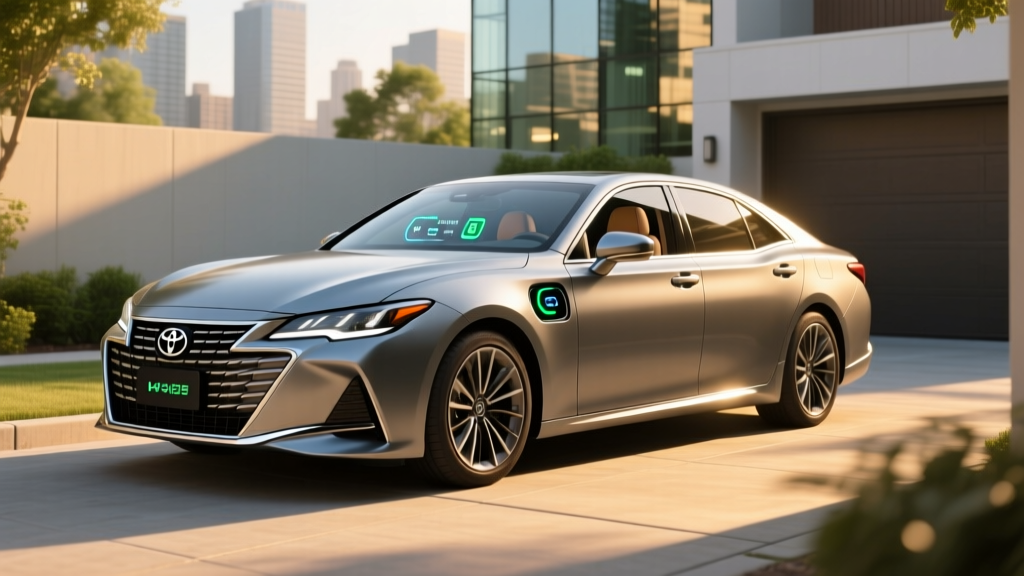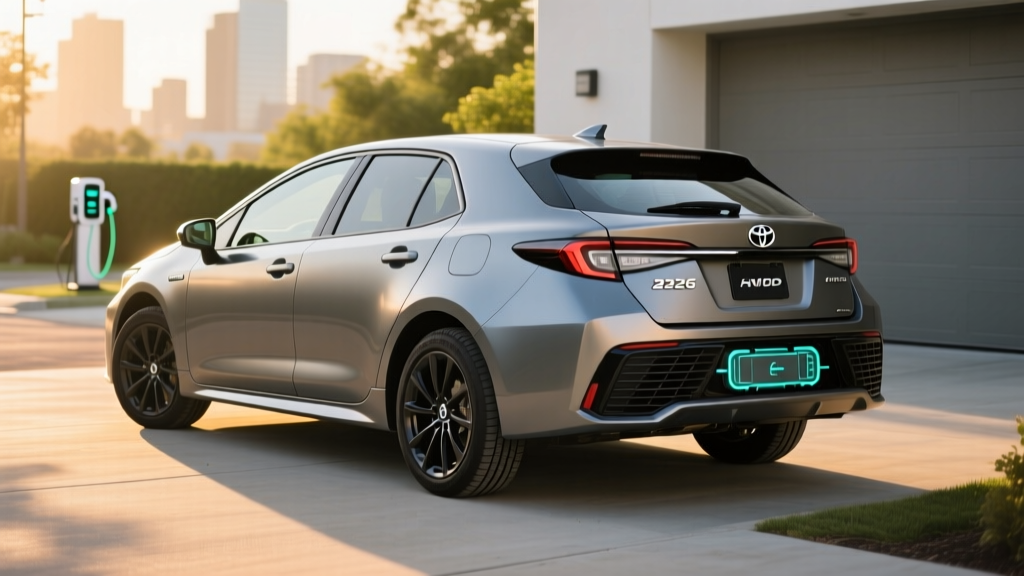
If you want all-weather traction without the fuel penalty of a conventional AWD sedan, the Toyota Corolla Hybrid AWD occupies a narrow but compelling lane. Unlike most hybrid compacts that send power only to the front wheels, Toyota pairs its fifth-generation hybrid system with an independent rear electric motor, giving the Corolla Hybrid genuine all-wheel-drive capability while returning EPA-estimated fuel economy that embarrasses many front-drive-only competitors.
This is a conventional hybrid (HEV), not a plug-in. You never plug it in — the 1.8-liter gasoline engine and regenerative braking keep the small battery charged. That distinction matters enormously for buyers weighing a Corolla Hybrid against a PHEV like the Toyota Prius Prime or a full battery-electric vehicle. Below, we break down every number that matters: EPA and real-world MPG, powertrain output, pricing by trim, battery warranty, and who should actually buy this car versus stepping up to a plug-in or EV.
Corolla Hybrid AWD Fuel Economy: EPA Numbers and Real-World MPG
The headline figure is what draws most buyers to this car. For the 2026 model year, the Corolla Hybrid AWD carries EPA estimates that place it among the most efficient all-wheel-drive sedans on the market.
| Trim | City MPG | Highway MPG | Combined MPG |
|---|---|---|---|
| LE AWD | 51 | 44 | 48 |
| SE AWD | 50 | 43 | 47 |
| XLE AWD (if equipped) | 50 | 43 | 47 |
Source: EPA Fuel Economy Guide — fueleconomy.gov
How the AWD Hybrid Powertrain Works
The Corolla Hybrid AWD uses Toyota's fifth-generation hybrid architecture. Here's what's under the hood and floor:
| Component | Specification |
|---|---|
| Gasoline Engine | 1.8L 4-cylinder Atkinson cycle |
| Front Electric Motor | Permanent-magnet synchronous, integrated in transaxle |
| Rear Electric Motor (AWD) | Independent rear-mounted motor, up to ~30 kW |
| Combined Net Horsepower | 138 hp |
| Hybrid Battery | Lithium-ion, ~1.0 kWh (not plug-in) |
| Transmission | Electronically controlled CVT (eCVT) |
| 0–60 mph | ~9.0 seconds (estimated) |
| Drivetrain | Electronic On-Demand AWD |
The rear motor is the key differentiator. It doesn't drive the rear wheels constantly — it engages during acceleration from a stop, in low-traction conditions (rain, snow, gravel), and during certain cornering scenarios where additional rear-axle torque improves stability. Under steady-state highway cruising on dry pavement, the car operates primarily as a front-wheel-drive hybrid, which is how it maintains such strong highway fuel economy despite the AWD hardware.
Because this is a self-charging hybrid, the battery stays small (~1.0 kWh). It exists to buffer energy between the engine, regenerative braking, and the electric motors — not to provide meaningful electric-only range. You'll see brief electric-only driving at very low speeds (parking lots, residential streets under ~25 mph), but the engine kicks in seamlessly and frequently. There is no plug, no charging port, and no range to manage.
Hybrid vs. PHEV vs. EV: Which Powertrain Fits You?
The Corolla Hybrid AWD is an HEV — a conventional hybrid. Toyota does not currently offer a plug-in hybrid (PHEV) version of the Corolla in the U.S. market. If you want Toyota plug-in capability in a similar footprint, you're looking at the Prius Prime. Here's how the three powertrain types compare for a typical buyer:
| Factor | Corolla Hybrid AWD (HEV) | Prius Prime (PHEV) | bZ4X / Tesla Model 3 (BEV) |
|---|---|---|---|
| Plug-in Required? | No | Yes, for EV range benefit | Yes, always |
| Electric-Only Range | ~1 mi at low speed | ~44 mi (EPA) | 250–340 mi (EPA) |
| Home Charging Needed? | No | Recommended (Level 2) | Essential (Level 2) |
| Combined Efficiency | 47–48 MPG | 52 MPG + 127 MPGe | 110–132 MPGe |
| Fuel Cost (annual, 15k mi) | ~$1,200 | ~$500–$900 | ~$450–$750 |
| Federal Tax Credit (§30D) | Not eligible | Up to $7,500* | Up to $7,500* |
| AWD Availability | Yes (standard on this trim) | No (FWD only) | Yes (select models) |
| Base MSRP (approx.) | ~$24,000 | ~$33,500 | ~$38,000–$42,000 |
*Federal tax credit eligibility under IRS §30D depends on buyer income limits, vehicle MSRP caps, battery critical-mineral sourcing, and point-of-sale transfer rules. Always verify current-year eligibility at irs.gov and consult a tax professional.
Choose a PHEV (Prius Prime) if: You have home charging, a short commute (<40 mi), and want to drive mostly on electricity while keeping a gas engine for road trips — and you want to capture the federal tax credit.
Choose a BEV if: You have reliable home charging, want zero tailpipe emissions, and are ready to plan around DC fast charging on road trips.
Pricing, Trims, and Tax Credit Eligibility
The 2026 Corolla Hybrid AWD is positioned as one of the most affordable all-wheel-drive vehicles in the U.S. market, period. Here's the approximate pricing breakdown by trim:
| Trim | MSRP (incl. destination) | Federal §30D Credit | Effective Price |
|---|---|---|---|
| LE AWD | ~$24,050 | $0 | ~$24,050 |
| SE AWD | ~$26,500 | $0 | ~$26,500 |
| XLE AWD | ~$28,800 | $0 | ~$28,800 |
The Corolla Hybrid does not qualify for the federal §30D clean vehicle credit. That credit applies only to plug-in electric vehicles (PHEVs and BEVs) that meet battery capacity, sourcing, MSRP, and buyer income requirements. Conventional hybrids like this one are excluded. Some states may offer small rebates or reduced registration fees for high-efficiency hybrids — check your state's energy office or Alternative Fuels Data Center for local programs.
Even without a tax credit, the Corolla Hybrid AWD's total cost of ownership remains compelling. At 48 MPG combined and $3.30/gallon regular unleaded, annual fuel cost for 15,000 miles is approximately $1,030. A comparable non-hybrid AWD compact sedan averaging 30 MPG combined would cost roughly $1,650 per year — a $620 annual fuel savings that compounds over ownership.
Hybrid Battery Warranty, Lifespan, and Replacement Cost
This is one of the strongest hybrid battery warranties in the industry and reflects Toyota's two-plus decades of hybrid production data. The Corolla Hybrid's lithium-ion traction battery is small (~1.0 kWh) and operates within a narrow state-of-charge window — the hybrid control system never fully charges or fully depletes it, which dramatically reduces degradation stress.
Expected lifespan: Based on long-term data from Toyota's hybrid fleet (Prius, Camry Hybrid, RAV4 Hybrid), modern lithium-ion hybrid batteries routinely last 150,000–200,000+ miles before requiring replacement. Many first-generation Prius batteries lasted well beyond 200,000 miles.
Replacement cost if out of warranty: A replacement hybrid battery pack for the Corolla Hybrid runs approximately $2,000–$3,500 (parts and labor) at a Toyota dealer. Third-party refurbishment shops offer reconditioned packs for $1,200–$2,000. This is far less than a BEV battery replacement because the pack is small and simple.
Reliability, Safety, and Ownership Costs
Toyota's hybrid powertrain is among the most thoroughly proven in the automotive industry. The eCVT transaxle has no traditional gears or clutch packs to wear — it's a planetary gearset with fewer moving parts than a conventional automatic. Brake pad life is extended significantly by regenerative braking; owners commonly report 60,000–80,000+ miles on original brake pads.
The Corolla has consistently earned top safety ratings. Check the latest scores at IIHS and NHTSA. Toyota Safety Sense 3.0 (TSS 3.0) comes standard on all trims and includes pre-collision braking with pedestrian detection, full-speed adaptive cruise control, lane-departure alert with steering assist, lane-tracing assist, automatic high beams, and road-sign assist. This is a SAE Level 1–2 driver-assistance suite — it supports the driver but does not replace active attention and steering input.
Insurance: Hybrid Corolla insurance premiums are typically in line with or slightly below the compact-segment average. The car isn't fast (0–60 in ~9 seconds), repair costs are moderate, and theft rates are low. Expect annual premiums of $1,200–$1,600 depending on your profile and state.
Who Should Buy the Corolla Hybrid AWD — and Who Shouldn't
- You live in a snow-belt state and need AWD but hate the fuel penalty
- You can't install a Level 2 home charger (apartment, street parking)
- Your budget is under $28,000 and you want maximum efficiency
- You want a proven, low-risk powertrain with a 10-year battery warranty
- You drive 15,000+ miles/year and want to minimize fuel spend without plugging in
- You have home charging and a short commute — a PHEV saves more fuel and gets a tax credit
- You want electric-only silent driving or zero tailpipe emissions
- You need more than 138 hp for highway merging confidence
- You want a hatchback or wagon body style (Corolla Hybrid is sedan-only)
- You're chasing the federal §30D tax credit — this car doesn't qualify
2026 Corolla Hybrid AWD FAQ
How many MPG does the Corolla Hybrid AWD get?
The EPA rates the Corolla Hybrid LE AWD at 51 city / 44 highway / 48 combined MPG. The SE AWD drops slightly to 50/43/47. In real-world city driving, many owners exceed the EPA city number; highway driving at 75+ mph typically returns 40–42 MPG.
Does the Corolla Hybrid AWD need to be plugged in?
No. This is a conventional hybrid (HEV), not a plug-in hybrid (PHEV). The gasoline engine and regenerative braking keep the small battery charged automatically. There is no charging port.
Is the Corolla Hybrid AWD good in snow?
The electronic on-demand AWD system engages the rear motor automatically when it detects front-wheel slip, providing additional traction on snow and ice. It's not a substitute for dedicated winter tires in severe conditions, but it meaningfully improves launch traction and cornering stability compared to FWD-only compacts.
How long will the hybrid battery last?
Toyota's hybrid batteries routinely last 150,000–200,000+ miles based on two decades of fleet data. The battery is covered by a 10-year/150,000-mile warranty. Out-of-pocket replacement costs approximately $2,000–$3,500 at a dealer.
Does the Corolla Hybrid qualify for a tax credit?
No. The federal §30D clean vehicle credit applies only to plug-in vehicles (PHEVs and BEVs). The Corolla Hybrid is a conventional HEV and is not eligible. Some states may offer minor efficiency rebates — check your local programs.
How does the Corolla Hybrid AWD compare to the Prius AWD?
The current-generation Prius AWD offers slightly more power (196 hp combined) and similar fuel economy (up to 53 MPG combined for FWD, ~49 for AWD), but starts at a higher price. The Corolla Hybrid AWD remains the more affordable entry point into Toyota's AWD hybrid lineup, with a more conventional sedan design and a lower base MSRP by roughly $3,000–$4,000.
What's the 0–60 time on the Corolla Hybrid AWD?
Approximately 9.0 seconds. The car prioritizes fuel efficiency over acceleration. Highway merging is adequate but not brisk — drivers accustomed to turbocharged or electric powertrains will notice the difference.