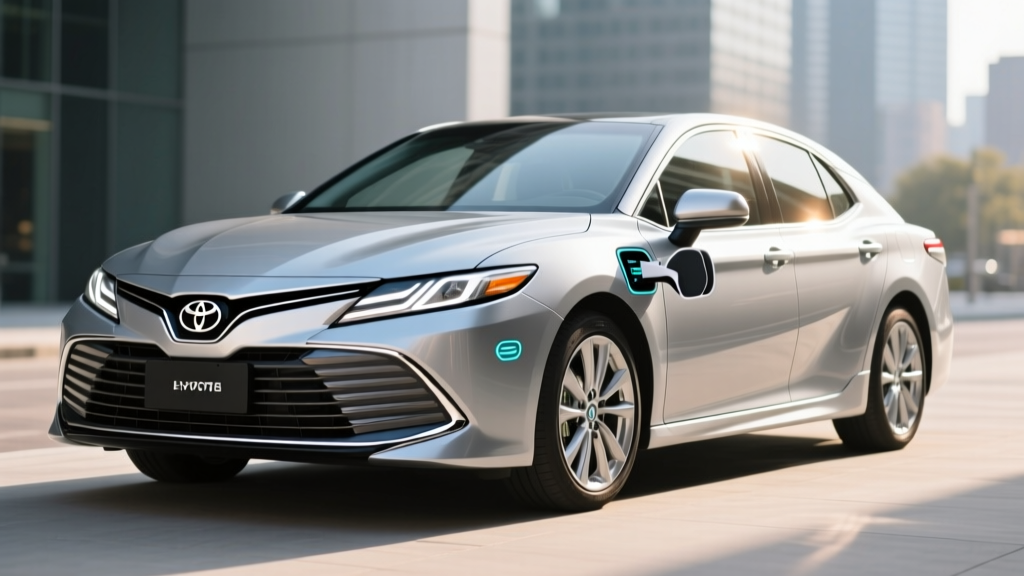
If you have been searching for the Toyota XLE hybrid, you are most likely looking at the Toyota Camry XLE Hybrid — the range-topping comfort trim in Toyota's best-selling midsize sedan lineup. For 2026, the Camry is offered exclusively as a hybrid, meaning every trim, including the XLE, uses Toyota's fifth-generation hybrid powertrain. There is no gas-only Camry anymore, and honestly, the hybrid is the better car for it.
This guide covers everything a data-driven buyer needs: EPA and real-world MPG, the exact powertrain specs, how the XLE compares to the SE, battery longevity and warranty details, and whether any tax credits apply. We will also clarify the difference between this conventional hybrid (HEV) and a plug-in hybrid (PHEV), because that distinction matters enormously for your garage setup and your wallet.
HEV vs PHEV: What the Camry XLE Hybrid Actually Is
The 2026 Toyota Camry XLE Hybrid is a conventional hybrid electric vehicle (HEV). It does not plug in. It charges its small battery through regenerative braking and the gasoline engine. You fuel it at a gas station like any other car, and the hybrid system silently manages energy flow behind the scenes.
| Attribute | HEV (Camry Hybrid) | PHEV (e.g., RAV4 Prime) | BEV (e.g., bZ4X) |
|---|---|---|---|
| Plugs in to charge? | No | Yes | Yes |
| Electric-only range | ~1 mi at low speed | 25–42 mi typical | 200–320+ mi |
| Battery size | ~1.1 kWh (NiMH/Li-ion) | 13–18 kWh | 65–85 kWh |
| Home charging needed? | No | Recommended (Level 2) | Essential (Level 2) |
| Federal tax credit (§30D) | Not eligible | Up to $7,500* | Up to $7,500* |
| Gasoline required? | Yes | Yes (backup) | No |
*§30D credit eligibility depends on MSRP caps, buyer income limits, and battery sourcing requirements. See IRS clean vehicle credit rules for current-year details.
The Camry XLE Hybrid is for drivers who want exceptional fuel economy without changing their refueling habits. If you cannot install a home charger or live in an apartment without charging access, an HEV like this is often the smartest electrified choice.
Fuel Economy: EPA Ratings and Real-World MPG
The 2026 Camry XLE Hybrid pairs a 2.5-liter four-cylinder engine with front-mounted electric motors (FWD) or front and rear motors (AWD). The FWD model is the efficiency champion of the lineup.
| Drivetrain | City MPG | Highway MPG | Combined MPG | Annual Fuel Cost* |
|---|---|---|---|---|
| FWD | 51 | 49 | 51 | ~$1,050 |
| AWD (Electronic) | 51 | 49 | 50 | ~$1,075 |
*Based on 15,000 miles/year at $3.20/gallon. Source: fueleconomy.gov
Real-World MPG: Expect to Match or Beat the EPA in Town
Hybrids like the Camry XLE tend to exceed their EPA city rating in stop-and-go traffic because regenerative braking recovers energy that a gas car wastes as heat. In mixed suburban driving with moderate temperatures, owners routinely report 52–55 MPG on the FWD model. Highway-only driving at 75+ mph will drop efficiency closer to 44–47 MPG, as aerodynamic drag dominates and the electric motor contributes less at sustained speed.
Cold weather (below 30°F) typically costs a hybrid 5–10% fuel economy due to engine warm-up cycles and reduced battery efficiency. Expect roughly 46–48 MPG combined in winter if you are in a northern climate.
Powertrain Specs: 225 Horsepower from a Hybrid
Toyota's fifth-generation hybrid system in the 2026 Camry XLE is not the sluggish hybrid of a decade ago. Here are the exact numbers:
| Engine | 2.5L Dynamic Force 4-cylinder |
| Engine horsepower | 184 hp @ 5,700 rpm |
| Front electric motor | 100 kW (134 hp) |
| Rear motor (AWD only) | 40 kW (54 hp) |
| Net combined system output | 225 hp (FWD) / 232 hp (AWD) |
| Transmission | ECVT (planetary gearset) |
| 0–60 mph (est.) | ~7.1 seconds (FWD) |
| Hybrid battery | ~1.1 kWh lithium-ion (sealed) |
| Fuel tank capacity | 13.2 gallons |
| Total driving range | ~670 miles (FWD) |
The ECVT is not a belt-and-pulley CVT — it is a planetary gearset that blends engine and motor power seamlessly. There are no shift shocks, no rubber-band sensation, and the acceleration is linear. The 225 hp output is competitive with turbocharged rivals, and the instant electric torque makes the Camry feel quicker in city driving than the 0–60 number suggests.
Pricing, Trims, and Tax Credit Eligibility
The 2026 Camry XLE Hybrid sits near the top of the Camry range, above the LE and SE trims. Here is the current MSRP breakdown:
| Trim | Drivetrain | MSRP (incl. destination) |
|---|---|---|
| LE | FWD | $30,290 |
| LE | AWD | $31,690 |
| SE | FWD | $32,090 |
| XLE | FWD | $34,790 |
| XLE | AWD | $36,190 |
Does the Camry XLE Hybrid Qualify for a Federal Tax Credit?
No. The Camry Hybrid is a conventional HEV, not a plug-in vehicle. The federal §30D Clean Vehicle Credit applies only to battery electric vehicles (BEVs) and plug-in hybrids (PHEVs) that meet specific battery sourcing, MSRP, and buyer income requirements. The Camry Hybrid does not qualify.
Some states and local utilities offer rebates for conventional hybrids, but these are less common than EV incentives and vary widely by jurisdiction. Check your state energy office or utility provider for current programs. A tax professional can advise on any state-level deductions.
Battery Warranty, Lifespan, and Replacement Cost
Toyota Hybrid Battery Warranty: 10 years or 150,000 miles (whichever comes first), covering defects and capacity loss below a defined threshold. In California-emissions states (CA, CO, CT, ME, MA, NJ, NY, OR, RI, VT, WA), the warranty extends to 10 years / 150,000 miles under the same terms.
Toyota's hybrid battery packs are among the most proven in the industry. The Prius has been on US roads since 2000, and data from fleet operators and long-term owners consistently shows hybrid battery packs lasting 150,000–200,000+ miles before significant degradation. The lithium-ion pack in the 2026 Camry is smaller and less stressed than an EV battery — it never deep-cycles from 0 to 100%, which dramatically extends cycle life.
What Does a Hybrid Battery Replacement Cost?
If the battery does eventually need replacement out of warranty, expect to pay between $2,500 and $4,000 for a new OEM pack at a Toyota dealer, including labor. Refurbished and aftermarket packs are available for $1,500–$2,500. This is substantially less than an EV battery replacement, which can exceed $10,000–$15,000, because the Camry's pack is roughly 1.1 kWh versus 65–85 kWh in a full EV.
Individual hybrid battery modules can sometimes be replaced rather than the entire pack, further reducing cost. Toyota dealerships and independent hybrid specialists offer this service.
Camry XLE Hybrid vs. the Alternatives
Pros
- 51 MPG combined — among the best of any midsize sedan
- No plug-in charging required; works for apartment dwellers
- 225 hp provides confident highway merging
- 10-year / 150,000-mile hybrid battery warranty
- ~670 miles of total range on a single tank
- XLE trim includes premium interior, heated seats, 12.3" display
- Toyota Safety Sense 3.0 standard
Cons
- No federal tax credit (HEV, not PHEV/BEV)
- Engine noise under hard acceleration (ECVT drone)
- No DC fast charging (not applicable to HEV)
- AWD adds weight and costs ~1 MPG combined
- XLE price creeps into RAV4 Hybrid territory
- No electric-only driving beyond parking-lot speeds
Camry XLE Hybrid vs. RAV4 Prime (PHEV) vs. Tesla Model 3 (BEV)
| Factor | Camry XLE Hybrid (HEV) | RAV4 Prime (PHEV) | Tesla Model 3 (BEV) |
|---|---|---|---|
| MSRP (base comparable) | $34,790 | $44,590 | $40,240 |
| Federal tax credit | $0 | Up to $7,500* | Up to $7,500* |
| Effective price after credit | $34,790 | ~$37,090 | ~$32,740 |
| Combined MPG / MPGe | 51 MPG | 94 MPGe (elec) / 38 MPG (gas) | 132 MPGe |
| Electric-only range | None (low-speed only) | 42 mi | 341 mi |
| Home charger needed? | No | Recommended | Essential |
| Annual fuel/energy cost | ~$1,050 | ~$600–$900 | ~$500–$700 |
*Tax credit eligibility varies by buyer income, MSRP caps, and battery sourcing rules. Verify at irs.gov.
The math is clear: if you have home charging access and a short commute, the RAV4 Prime or Model 3 may save more on fuel and qualify for tax credits that close the price gap. But if you lack reliable charging — apartment living, street parking, frequent long road trips through charging deserts — the Camry XLE Hybrid delivers outstanding efficiency with zero infrastructure dependency.
Who Should Buy the Toyota Camry XLE Hybrid?
Choose the Camry XLE Hybrid if:
- You cannot install a Level 2 home charger (apartment, condo, street parking)
- You drive 12,000–20,000 miles per year and want to minimize fuel costs
- You want a proven, low-risk powertrain with a 10-year battery warranty
- You take frequent long road trips where charging infrastructure is sparse
- You prefer a traditional sedan with a premium interior and quiet ride
Consider a PHEV or full EV instead if:
- You have a garage or driveway where you can install a Level 2 charger
- Your daily commute is under 40 miles round-trip (a PHEV covers it on electricity alone)
- You want to qualify for the $7,500 federal tax credit to offset a higher purchase price
- You want to eliminate gasoline use entirely (BEV)
The Camry XLE Hybrid occupies a specific and valuable niche: it is the maximum-efficiency choice for drivers who are not ready — or not able — to plug in. At 51 MPG combined with a $34,790 starting price and no charging infrastructure required, it is one of the most cost-effective ways to cut fuel spending in 2026 without changing a single habit.
Frequently Asked Questions
How many MPG does the 2026 Toyota Camry XLE Hybrid get?
The FWD Camry XLE Hybrid achieves an EPA-rated 51 city / 49 highway / 51 combined MPG. The AWD model drops to 50 combined. Real-world city driving often exceeds the EPA rating, while sustained highway driving above 75 mph may return 44–47 MPG.
Does the Camry XLE Hybrid need to be plugged in?
No. The Camry Hybrid is a conventional HEV. It charges its battery through regenerative braking and the gasoline engine. You never plug it in — you simply refuel at a gas station.
How far can the Camry Hybrid drive on electric only?
Essentially zero meaningful distance. The hybrid battery can propel the car at very low speeds (under 25 mph) for roughly one mile or less, such as creeping through a parking lot. It is not designed for electric-only commuting like a PHEV.
Is the Camry Hybrid battery reliable, and what does replacement cost?
Toyota hybrid batteries have an excellent track record spanning 25+ years of production. The battery is warranted for 10 years or 150,000 miles. Real-world data suggests most packs last 150,000–200,000+ miles. Out-of-warranty replacement runs $2,500–$4,000 for a new OEM pack, or $1,500–$2,500 for a refurbished unit.
Does the 2026 Camry XLE Hybrid qualify for a federal tax credit?
No. The federal §30D Clean Vehicle Credit applies only to plug-in vehicles (PHEVs and BEVs). As a conventional hybrid, the Camry does not qualify. Some state or utility rebates may apply depending on your jurisdiction.
What is the difference between the Camry XLE and SE trims?
The XLE emphasizes comfort: softer suspension tuning, leather-trimmed seats, heated front seats, a 12.3-inch infotainment display, and ambient interior lighting. The SE is sport-tuned with a firmer suspension, paddle shifters, and sport-bolstered seats. Both use the identical 225 hp hybrid powertrain and achieve similar MPG.
Is the Camry Hybrid AWD system worth it?
The electronic AWD adds a rear-mounted 40 kW electric motor that engages automatically when front-wheel slip is detected. It costs about 1 MPG combined, adds roughly 100 lbs, and increases MSRP by ~$1,400. If you regularly drive in snow or rain, it provides meaningful traction confidence. In dry, mild climates, FWD is the better value.