Quick Verdict: The Camry SE Hybrid in 2026
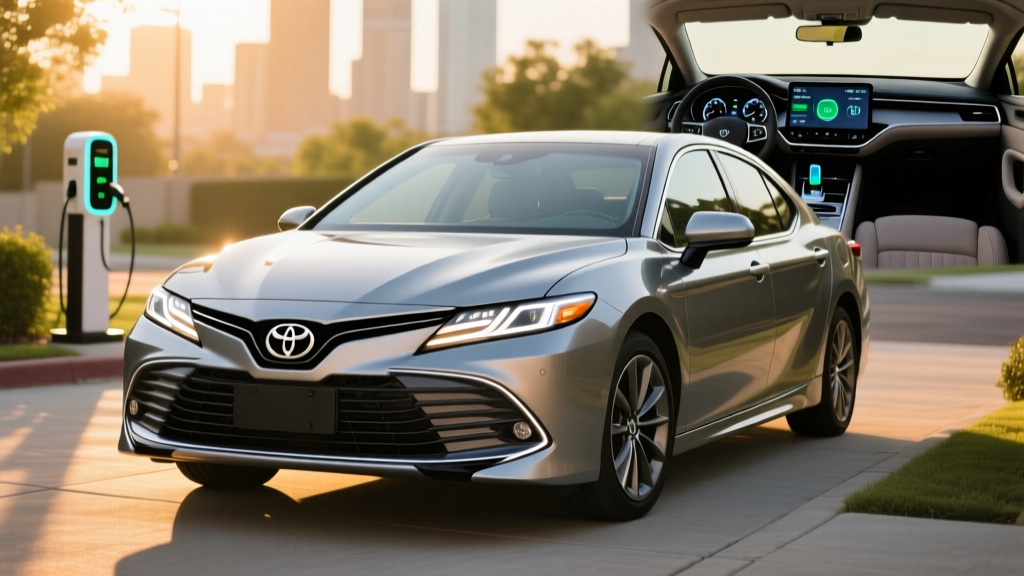
The 2026 Toyota Camry SE Hybrid occupies a specific niche: sport-tuned suspension and styling on a proven hybrid-electric powertrain that never requires plugging in. With an EPA-estimated 46 MPG combined and a starting MSRP of $30,495 (including destination), the SE Hybrid trim undercuts many compact SUVs while delivering midsize sedan space and Toyota's hybrid reliability reputation. For 2026, the Camry lineup is hybrid-only across all trims, meaning every Camry you buy uses the fifth-generation Toyota Hybrid System (THS 5) — no gas-only option exists.
The SE trim specifically adds sport-oriented tuning: a retuned suspension, paddle shifters, 19-inch alloy wheels, and a blacked-out exterior treatment. You sacrifice roughly 2 MPG compared to the LE Hybrid (48 MPG combined) for the larger wheels and stickier tires, but the trade-off is noticeably sharper handling on back roads.
Camry SE Hybrid Powertrain: Engine, Motors, and Horsepower
The 2026 Camry SE Hybrid pairs a 2.5-liter four-cylinder Dynamic Force engine (running the Atkinson cycle for efficiency) with two electric motor-generators and a 1.1 kWh nickel-metal hydride (NiMH) hybrid battery pack. The front-mounted electric motor handles propulsion assist and regenerative braking; the second motor serves as a generator and starter.
| Component | Specification |
|---|---|
| Engine | 2.5L 4-cyl Atkinson-cycle |
| Engine output | 184 hp / 163 lb-ft torque |
| Electric motor | 100 kW front motor-generator |
| Combined net horsepower | 225 hp |
| Transmission | eCVT (planetary gearset, no belts) |
| Hybrid battery | 1.1 kWh NiMH (sealed) |
| Drivetrain | FWD (AWD available, adds rear motor, 232 hp) |
| 0-60 mph | ~7.2 seconds (FWD) |
The eCVT is not a traditional belt-and-pulley CVT. It uses a planetary gearset to seamlessly blend engine and motor power, which eliminates the rubber-band feeling common in older CVTs. Acceleration is linear, and the engine only drones under hard acceleration — during normal city and highway driving, the electric motor masks most engine noise.
Fuel Economy: EPA Ratings vs. Real-World MPG
This is where the Camry SE Hybrid earns its keep. The EPA rates the front-wheel-drive SE Hybrid at 46 MPG combined, with a city/highway split that favors urban driving — exactly the opposite of a gas-only car.
| Trim | City MPG | Highway MPG | Combined MPG |
|---|---|---|---|
| LE Hybrid (FWD) | 51 | 44 | 48 |
| SE Hybrid (FWD) | 48 | 43 | 46 |
| SE Hybrid (AWD) | 46 | 41 | 44 |
| XSE Hybrid (FWD) | 48 | 43 | 46 |
The 13.2-gallon fuel tank gives the SE Hybrid (FWD) a theoretical range of 607 miles on a single tank. Real-world mixed driving yields 540-580 miles before the low-fuel warning, which is among the best in the midsize sedan segment.
HEV vs. PHEV vs. EV: Is the Camry SE Hybrid Right for You?
The Camry SE Hybrid is a conventional hybrid electric vehicle (HEV). It charges its small battery exclusively through regenerative braking and engine power — there is no plug, no electric-only driving mode of meaningful distance, and no external charging required. This is fundamentally different from a plug-in hybrid (PHEV) like the Toyota RAV4 Prime or a full battery-electric vehicle (BEV) like the Tesla Model 3.
| Factor | HEV (Camry Hybrid) | PHEV (e.g., RAV4 Prime) | BEV (e.g., Model 3) |
|---|---|---|---|
| Plug in required? | No | Yes (for EV range) | Yes (always) |
| Electric-only range | ~1 mile at low speed | 30-42 miles | 250-360 miles |
| Fuel/energy | Gasoline only | Gasoline + electricity | Electricity only |
| Home charging needed | No | Recommended (Level 2) | Essential (Level 2) |
| Tailpipe emissions | Yes | Yes (when engine runs) | None |
| Federal tax credit | None | Up to $7,500* | Up to $7,500* |
| Upfront cost premium | Low (~$1,500 over gas) | High (~$8,000+) | Varies |
*Federal §30D tax credit eligibility depends on MSRP caps, buyer income limits, battery critical-mineral sourcing, and point-of-sale transfer rules. See IRS.gov for current-year requirements. Conventional HEVs like the Camry Hybrid do not qualify for the federal EV tax credit.
Choose a PHEV if: You have home Level 2 charging and a commute under 40 miles — you'd drive mostly electric daily with gas backup for road trips.
Choose a BEV if: You have reliable home charging, want zero tailpipe emissions, and are ready to plan DC fast-charging stops on road trips.
Pricing, Trims, and Tax Credit Eligibility
The 2026 Camry SE Hybrid starts at $30,495 (MSRP including $1,150 destination charge). Adding AWD (which includes a rear-mounted electric motor for 232 combined hp) costs approximately $1,500. Popular option packages — such as the Convenience Package with heated seats and a power moonroof — add $1,500-$2,500.
| Trim | MSRP (FWD) | MSRP (AWD) |
|---|---|---|
| LE Hybrid | $28,995 | $30,495 |
| SE Hybrid | $30,495 | $31,995 |
| XSE Hybrid | $33,495 | $34,995 |
| XLE Hybrid | $34,495 | $35,995 |
Federal tax credit: The Camry Hybrid is a conventional HEV and does not qualify for the IRS §30D New Clean Vehicle Credit. That credit applies only to plug-in vehicles (PHEVs and BEVs) meeting battery-sourcing, MSRP, and buyer-income requirements. However, some states and utilities offer rebates for hybrid purchases — check your state energy office or local utility for programs.
Battery Warranty, Reliability, and Replacement Cost
Toyota's hybrid battery warranty is one of the strongest in the industry and a key reason buyers trust the Camry Hybrid for long-term ownership.
The 1.1 kWh NiMH battery in the Camry Hybrid is far smaller than a BEV or PHEV pack, and it operates within a narrow state-of-charge window (roughly 40%-80% SoC) managed by the hybrid controller. This shallow cycling dramatically reduces degradation. Real-world data from IIHS and long-term owner surveys show Camry Hybrid batteries routinely lasting 150,000-200,000+ miles before any capacity-related issues arise.
Replacement cost: If the hybrid battery fails outside warranty, a new OEM replacement costs approximately $2,500-$3,500 installed at a Toyota dealer. Refurbished or reconditioned NiMH modules are available from third-party shops for $1,200-$2,000. For context, this is a fraction of the $7,000-$15,000+ cost of replacing a BEV or PHEV traction battery.
The Camry as a nameplate consistently earns top reliability scores. The current generation holds an IIHS Top Safety Pick designation and benefits from Toyota Safety Sense 3.0 (pre-collision, lane tracing, adaptive cruise, and road sign assist) as standard equipment on every trim.
Ownership Costs: Fuel Savings vs. Gas-Only Midsize Sedans
At 46 MPG combined, the Camry SE Hybrid uses roughly 326 gallons of fuel per year at 15,000 miles. At a national average of $3.40/gallon (regular unleaded), that's approximately $1,109/year in fuel cost. A comparable gas-only midsize sedan averaging 30 MPG combined would burn 500 gallons — about $1,700/year. The hybrid saves roughly $590/year at the pump, or about $2,950 over five years.
Maintenance costs are low. The hybrid system has no belts to replace, the eCVT has no transmission fluid service interval under normal use, and regenerative braking extends brake pad life significantly (many owners report 60,000-80,000 miles on original pads). Oil changes are required every 10,000 miles using 0W-16 synthetic.
Pros and Cons
- 48 city MPG — excellent in stop-and-go traffic
- No plug-in charging required; zero behavior change
- 225 hp provides confident merging and passing
- 10-year/150k-mile hybrid battery warranty
- Low annual fuel cost (~$1,100/year)
- Standard Toyota Safety Sense 3.0 ADAS suite
- Strong resale value and reliability reputation
- No federal tax credit (HEV, not PHEV/BEV)
- SE trim's 19-inch wheels reduce MPG by 2 vs. LE
- Engine drone under hard acceleration
- AWD adds weight and reduces MPG to 44 combined
- 1.1 kWh battery offers negligible electric-only driving
- No DC fast charging or plug-in capability
Frequently Asked Questions
How many MPG does the Camry SE Hybrid get?
The EPA rates the 2026 Camry SE Hybrid (FWD) at 48 city / 43 highway / 46 combined MPG. Real-world owner data on fueleconomy.gov averages 47.1 MPG combined, with city driving often exceeding the EPA estimate thanks to aggressive regenerative braking. Highway-only trips at 75 mph typically return 40-42 MPG.
Does the Camry SE Hybrid need to be plugged in?
No. The Camry SE Hybrid is a conventional hybrid (HEV). It charges its small 1.1 kWh battery through regenerative braking and the gasoline engine. There is no plug, no charging port, and no electric-only driving mode of any meaningful distance.
Does the Camry Hybrid qualify for a federal tax credit?
No. The IRS §30D New Clean Vehicle Credit applies only to plug-in electric vehicles (PHEVs and BEVs) that meet battery-sourcing, MSRP, and income requirements. The Camry Hybrid is an HEV and does not qualify. Some state or utility rebates may apply — check local programs.
How long will the Camry Hybrid battery last?
Toyota warrants the hybrid battery for 10 years or 150,000 miles. In practice, Camry Hybrid batteries commonly last 150,000-200,000+ miles due to shallow charge cycling. Replacement cost outside warranty is approximately $2,500-$3,500 for a new OEM battery, or $1,200-$2,000 for a refurbished unit.
Is the Camry SE Hybrid better than the LE Hybrid?
It depends on your priorities. The LE Hybrid gets 48 MPG combined (2 MPG more than the SE) and costs $1,500 less. The SE Hybrid adds sport-tuned suspension, paddle shifters, 19-inch wheels, and a more aggressive exterior. If driving engagement matters, the SE is worth the trade-off. If maximum efficiency is the goal, the LE is the better pick.
Should I buy the Camry Hybrid or a full EV?
If you have reliable Level 2 home charging, a BEV like the Tesla Model 3 or Hyundai Ioniq 6 offers lower per-mile energy costs, zero tailpipe emissions, and eligibility for the $7,500 federal tax credit (if you qualify). If you lack home charging, drive long distances frequently, or live in an area with sparse DC fast-charging infrastructure, the Camry Hybrid delivers strong efficiency with zero charging hassle.