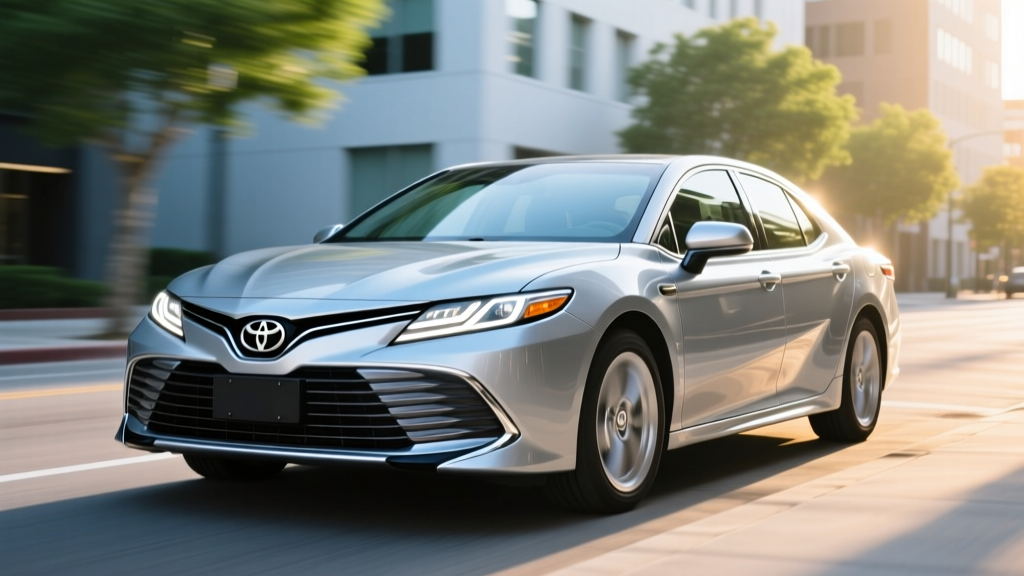
The Toyota Camry has been America's best-selling sedan for years, and its transition to a hybrid-only lineup for the current generation was a calculated bet that paid off. For buyers in snow-belt states or anyone wanting extra traction without the fuel penalty of a traditional AWD crossover, the Toyota Camry Hybrid All Wheel Drive occupies a compelling middle ground: sedan efficiency with all-weather confidence. This guide covers everything you need to know about the AWD variant — from real-world MPG and powertrain specs to whether it qualifies for any tax incentives.
Quick Verdict: Who Should Consider the Camry Hybrid AWD?
The Camry Hybrid AWD is the right call if you want a midsize sedan with year-round traction, don't have reliable access to plug-in charging, and prioritize low running costs over EV-style zero-tailpipe-emission driving. It's not a plug-in hybrid — you'll never plug it in — and it doesn't qualify for the federal §30D EV tax credit. But with EPA ratings up to 51 MPG combined and a starting price under $31,000, the total cost of ownership is difficult to beat in the midsize sedan segment.
The Camry Hybrid AWD is a conventional hybrid (HEV). It uses a small battery recharged by the gasoline engine and regenerative braking. You never plug it in. A plug-in hybrid (PHEV) like the Toyota RAV4 Prime has a larger battery (18.1 kWh) that you charge from a wall outlet or public charger, giving 30-40+ miles of electric-only range before the gas engine kicks in. The Camry does not currently offer a PHEV variant in the U.S. market. If you want plug-in capability from Toyota in a sedan, you'd need to look at the Prius Prime.
Fuel Economy: EPA Ratings and Real-World MPG
For 2026, the Camry Hybrid AWD is rated by the EPA at 51 MPG city / 49 MPG highway / 50 MPG combined in LE trim. Higher trims (SE, XLE, XSE) with larger 18- or 19-inch wheels drop slightly to 44 MPG city / 43 MPG highway / 44 MPG combined. These figures represent a modest penalty versus the front-wheel-drive (FWD) Camry Hybrid, which achieves up to 53 MPG combined in LE trim — a trade-off of roughly 2-3 MPG for the security of a rear electric motor providing all-wheel traction.
| Trim | City MPG | Highway MPG | Combined MPG | AWD Surcharge vs. FWD |
|---|---|---|---|---|
| LE | 51 | 49 | 50 | -2 MPG |
| SE | 44 | 43 | 44 | -3 MPG |
| XLE | 44 | 43 | 44 | -3 MPG |
| XSE | 44 | 43 | 44 | -3 MPG |
Source: fueleconomy.gov (EPA). Actual mileage will vary.
Real-World MPG: What Owners Actually See
Toyota's hybrid system excels in stop-and-go city driving, where regenerative braking and electric-motor assist do the heavy lifting. In real-world driving, many Camry Hybrid owners report matching or slightly exceeding EPA city estimates — a rarity in the automotive world. Expect 48-52 MPG in mixed suburban and city driving in the LE trim. Highway-only driving at 75+ MPH will pull numbers down toward 42-46 MPG in the LE and 38-41 MPG in the sport trims, as aerodynamic drag overwhelms the hybrid system's advantages.
In cold weather (below 30°F), expect a 10-15% reduction in fuel economy during short trips. The engine runs longer to heat the cabin and bring the catalytic converter to operating temperature, reducing the time the car spends in EV mode. On longer highway trips in cold weather, the penalty shrinks to roughly 5-8%.
Powertrain: How the AWD System Works
The 2026 Camry Hybrid AWD pairs Toyota's fifth-generation hybrid system with an electronic on-demand all-wheel-drive setup. Here's the breakdown:
| Specification | Detail |
|---|---|
| Engine | 2.5L 4-cylinder Dynamic Force (184 hp) |
| Front Electric Motor | 100 kW (134 hp) |
| Rear Electric Motor (AWD) | 30 kW (40 hp) |
| Net Combined Horsepower | 232 hp |
| Transmission | eCVT (planetary gearset, not a belt CVT) |
| Hybrid Battery | ~1.6 kWh lithium-ion (sealed NiMH on some earlier builds) |
| 0-60 MPH | ~7.1 seconds (est.) |
| Drivetrain | Electronic AWD (rear motor engages on demand) |
The AWD system is not a traditional mechanical setup with a driveshaft and center differential. Instead, a dedicated rear electric motor provides torque to the rear wheels when the system detects slip, during hard acceleration, or in low-traction conditions. Under normal dry-road cruising, the Camry Hybrid AWD operates primarily in front-wheel drive, which is how it preserves most of the FWD model's fuel economy. The rear motor can send up to roughly 50% of available torque rearward when needed, but it's designed for traction enhancement — not performance driving.
Combined output of 232 hp is competitive with turbocharged rivals like the Honda Accord Hybrid (204 hp) and significantly more than the previous-generation Camry Hybrid's 208 hp. Acceleration feels brisk around town thanks to the electric motor's instant torque, though highway passing at speed reveals the naturally aspirated four-cylinder's limits compared to turbocharged competitors.
Pricing, Trims, and Tax Credit Eligibility
The 2026 Camry Hybrid AWD starts at approximately $30,995 MSRP for the LE trim (including destination). Here's the approximate pricing ladder:
- LE AWD: ~$30,995
- SE AWD: ~$33,195
- XLE AWD: ~$35,495
- XSE AWD: ~$36,695
No. The federal §30D Clean Vehicle Credit (up to $7,500) applies only to plug-in electric vehicles — battery-electric vehicles (BEVs) and plug-in hybrids (PHEVs) with a minimum battery capacity of 7 kWh. Because the Camry Hybrid AWD is a conventional HEV with a ~1.6 kWh battery that cannot be plugged in, it does not qualify for the §30D credit. There is currently no federal tax credit for conventional hybrids. Some states or local utilities may offer small rebates for hybrid purchases — check your state energy office or utility provider for current programs. For full §30D rules, see IRS.gov.
The lack of a federal tax credit stings compared to PHEV competitors like the Prius Prime (which can qualify for up to $3,750 depending on battery sourcing), but the Camry Hybrid's lower sticker price and absence of plug-in infrastructure needs often balance the equation over a 5-year ownership period.
Hybrid vs. PHEV vs. Full EV: Which Fits Your Situation?
The Camry Hybrid AWD sits in a spectrum of electrified options. Here's how to decide which category fits your life:
| Factor | HEV (Camry Hybrid) | PHEV (Prius Prime) | BEV (Tesla Model 3 / Ioniq 6) |
|---|---|---|---|
| Plug-in required? | No | Yes (optional) | Yes (mandatory) |
| Electric-only range | ~1 mi (low speed) | 39-44 mi | 270-360 mi |
| Home charging needed? | No | Strongly recommended | Yes (Level 2 ideal) |
| Federal tax credit | None | Up to $3,750* | Up to $7,500* |
| AWD available? | Yes | No (Prius Prime) | Yes (most models) |
| Best for... | No home charging, want simplicity | Short commutes + home charger | Home charging + low fuel cost |
*Tax credit amounts vary by battery sourcing, buyer income, and MSRP caps. See IRS §30D guidelines.
- You live in an apartment or lack access to home/plug-in charging
- You need AWD for snow, ice, or rain but don't want an SUV's fuel penalty
- You want minimal behavioral change — just gas up like normal and enjoy 50 MPG
- Your daily commute exceeds 40 miles, making PHEV electric-only range impractical
- You have a garage or driveway where you can install a Level 2 charger
- Your daily driving is under 40 miles round-trip (PHEV covers it on electricity alone)
- You want to qualify for federal tax credits and reduce tailpipe emissions further
Battery Warranty, Reliability, and Replacement Cost
Toyota covers the Camry Hybrid's battery pack with a 10-year / 150,000-mile warranty (whichever comes first) in all 50 states. This applies to the hybrid traction battery, not the 12V auxiliary battery. Additionally, all hybrid-system components (inverter, motor, control module) carry an 8-year / 100,000-mile warranty. Toyota's hybrid battery warranty is among the best in the industry and reflects the company's decades of hybrid-system refinement since the original 1997 Prius.
How Long Do Toyota Hybrid Batteries Actually Last?
Real-world data from Toyota's hybrid fleet — spanning millions of vehicles over two decades — shows that modern lithium-ion hybrid batteries routinely last 150,000 to 200,000+ miles before significant degradation. Unlike full EV batteries, which cycle through large portions of their capacity daily, hybrid batteries operate in a narrow state-of-charge window (roughly 40-80%). This shallow-cycling strategy dramatically extends cell life.
Should the battery eventually need replacement outside of warranty, expect to pay between $2,000 and $4,000 for a new OEM battery pack at a Toyota dealer, including labor. Refurbished or aftermarket packs are available for $1,000-$2,000. This is significantly cheaper than a full EV battery replacement ($8,000-$20,000+), owing to the Camry's small ~1.6 kWh pack.
Overall Reliability
Toyota's hybrid powertrain is one of the most thoroughly proven in the automotive industry. The eCVT transmission — which uses a planetary gearset rather than a belt or chain — has no clutches, bands, or torque converter to wear out, making it one of the most durable transmission designs in production. IIHS has consistently given the Camry top safety ratings, and the model's long-term reliability record with Consumer Reports and J.D. Power places it near the top of the midsize sedan segment year after year.
Ownership Costs: Fuel Savings vs. a Gas-Only Sedan
At 50 MPG combined (LE AWD), the Camry Hybrid uses approximately 240 gallons per year assuming 12,000 miles of mixed driving. At $3.50/gallon, that's roughly $840/year in fuel. Compare that to a typical non-hybrid midsize AWD sedan averaging 28 MPG combined: 429 gallons, or about $1,500/year. The hybrid saves approximately $660 per year in fuel costs, or $3,300 over five years — enough to offset its slightly higher purchase price even without a tax credit.
Maintenance costs also trend lower than gas-only competitors. The regenerative braking system significantly reduces brake pad wear (many owners report 80,000+ miles on original pads), and the engine operates less frequently, potentially extending oil life and reducing engine wear over time. Toyota recommends synthetic 0W-16 oil changes every 10,000 miles.
Pros, Cons, and the Bottom Line
Pros
- Up to 50 MPG combined with AWD — best-in-class efficiency
- No plug-in charging required — zero lifestyle change
- 232 hp provides confident acceleration for a hybrid
- 10-year/150,000-mile hybrid battery warranty
- Strong resale value and proven long-term reliability
- Spacious cabin with 15.1 cu ft trunk (AWD models)
- Standard Toyota Safety Sense 3.0 (ADAS suite)
Cons
- No federal tax credit eligibility (HEV, not PHEV/BEV)
- Sport trims drop to 44 MPG — still good, but less impressive
- Rear AWD motor provides traction, not performance — not a sports sedan
- No plug-in/PHEV variant available (check Prius Prime for that)
- Base LE trim's interior materials feel budget-oriented
- Cabin noise under hard acceleration (4-cylinder drone)
- AWD system is electronic on-demand, not full-time — limited off-pavement use
Frequently Asked Questions
How many MPG does the Toyota Camry Hybrid All Wheel Drive get?
The EPA rates the 2026 Camry Hybrid AWD at 51 city / 49 highway / 50 combined MPG in LE trim. SE, XLE, and XSE trims with larger wheels are rated at 44 city / 43 highway / 44 combined. In real-world mixed driving, many owners report matching or slightly exceeding these figures, particularly in city traffic where the hybrid system excels.
Does the Camry Hybrid AWD need to be plugged in?
No. The Camry Hybrid is a conventional hybrid (HEV), not a plug-in hybrid. Its small battery recharges through regenerative braking and the gasoline engine. You simply fill up at a gas station as you would with any other car.
Is the Camry Hybrid AWD a good car for snow and ice?
Yes, within reason. The electronic AWD system sends torque to the rear wheels when it detects front-wheel slip, providing meaningful traction advantages over FWD in snow and rain. However, it's not a substitute for proper winter tires — we strongly recommend dedicated winter tires (like Bridgestone Blizzaks or Nokian Hakkapeliittas) for serious snow-belt driving. The Camry Hybrid AWD's low center of gravity and stability control also contribute to confident winter handling.
How long will the hybrid battery last, and what does replacement cost?
Toyota's hybrid batteries routinely last 150,000-200,000+ miles thanks to shallow-cycling battery management. The battery is warrantied for 10 years/150,000 miles. If replacement is needed out of warranty, expect $2,000-$4,000 for a new OEM pack — far less than a full EV battery replacement.
Does the Camry Hybrid AWD qualify for any tax credit?
No. The federal §30D Clean Vehicle Credit applies only to plug-in vehicles (BEVs and PHEVs with at least 7 kWh of battery capacity). The Camry Hybrid AWD is a conventional HEV and does not qualify. Some state or utility rebates may apply — check local programs. For federal rules, consult IRS.gov.
How does the Camry Hybrid AWD compare to the Honda Accord Hybrid?
The Accord Hybrid offers 48 MPG combined (FWD only — no AWD option), 204 hp, and a more refined interior at a similar price point. If you don't need AWD, the Accord is a strong rival. If you need all-wheel traction, the Camry Hybrid AWD is essentially the only midsize hybrid sedan offering it in the U.S. market.
Can the rear AWD motor drive the car by itself?
No. The rear motor (30 kW / 40 hp) supplements the front powertrain. It cannot propel the car independently. It engages automatically during acceleration, cornering, and low-traction situations, then disengages during steady-state cruising to preserve fuel economy.