Quick Verdict: The Corolla Cross Hybrid XSE at a Glance
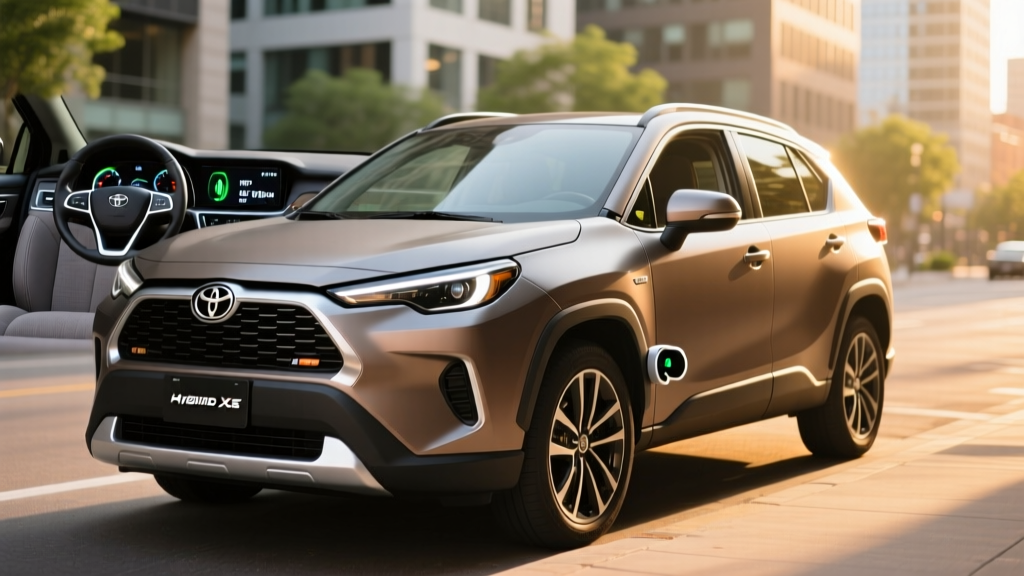
The 2025 Toyota Corolla Cross Hybrid XSE sits at the sporty top of Toyota's compact hybrid crossover lineup, pairing a 196-horsepower all-wheel-drive powertrain with an EPA-estimated 42 MPG combined. It is a conventional hybrid (HEV), not a plug-in — meaning you never plug it in, and it generates its own electricity through regenerative braking and the gasoline engine. For buyers who want crossover utility, standard AWD, and Prius-rivaling efficiency without changing their fueling habits, the XSE trim delivers sport-tuned suspension, distinctive styling, and Toyota's proven hybrid reliability.
| Spec | Value |
|---|---|
| Powertrain | 2.0L 4-cyl + 3 electric motors (AWD) |
| Combined Horsepower | 196 hp |
| EPA MPG (City / Hwy / Combined) | 46 / 43 / 42 (S trim); XSE: 45 / 38 / 42 |
| Fuel Tank Capacity | 10.6 gallons |
| Total Driving Range | ~445 miles (EPA est.) |
| Drivetrain | Electronic AWD (e-AWD) |
| 0–60 mph | ~7.5 seconds (est.) |
| Cargo Volume (behind rear seats) | 25.5 cu ft |
| Starting MSRP (XSE trim) | ~$33,400 (incl. destination) |
| Hybrid Battery Warranty | 10 years / 150,000 miles |
| Federal Tax Credit Eligibility | Not eligible (§30D is for BEVs/PHEVs only) |
Hybrid (HEV) vs. Plug-In Hybrid (PHEV): What the Corolla Cross Hybrid Actually Is
A common point of confusion in the compact crossover segment is whether a "hybrid" needs to be plugged in. The 2025 Toyota Corolla Cross Hybrid is a conventional hybrid electric vehicle (HEV). It has a small lithium-ion traction battery (approximately 1.0 kWh usable) that charges exclusively through the gasoline engine and regenerative braking. There is no charge port, no electric-only driving mode of meaningful distance, and no plug.
| Feature | HEV (Corolla Cross Hybrid) | PHEV (e.g., RAV4 Prime) | BEV (e.g., bZ4X) |
|---|---|---|---|
| Plug-in Required? | No | Yes (Level 1 or 2) | Yes (Level 2 or DCFC) |
| Electric-Only Range | ~1 mile at low speed | 25–42 miles typical | 220–350+ miles |
| Total Range | ~445 miles | ~550–600 miles | 220–350 miles |
| Federal Tax Credit (§30D) | Not eligible | Up to $7,500 (if eligible) | Up to $7,500 (if eligible) |
| Home Charging Needed? | No | Recommended for EV range | Essential |
| Best For | No home charging access; simple ownership | Short commute + road trips | Home charging + daily driving |
If you're cross-shopping the Corolla Cross Hybrid against a plug-in like the Toyota RAV4 Prime (42 miles electric-only, 94 MPGe), know that the RAV4 Prime starts around $44,000 — over $10,000 more than the Corolla Cross Hybrid XSE. The Corolla Cross Hybrid trades electric-only range for a dramatically lower entry price and zero charging infrastructure requirements.
Fuel Economy: EPA Ratings vs. Real-World MPG
The EPA rates the 2025 Corolla Cross Hybrid at 46 city / 43 highway / 42 combined MPG for the base S trim. The XSE trim, with its larger 18-inch alloy wheels and sport-tuned suspension, sees a slight highway penalty, landing at approximately 45 city / 38 highway / 42 combined according to fueleconomy.gov.
| Trim | City MPG | Highway MPG | Combined MPG |
|---|---|---|---|
| S / SE | 46 | 43 | 42 |
| XSE | 45 | 38 | 42 |
Real-world expectations: Toyota's fifth-generation hybrid system excels in city driving, where regenerative braking and low-speed electric assist do the heavy lifting. Owners consistently report matching or exceeding the EPA city estimate in stop-and-go traffic — 47–50 MPG is achievable in warm weather urban driving. Highway driving at 75+ mph, however, will pull the number closer to 35–38 MPG, particularly with the XSE's larger wheels and increased rolling resistance. In cold weather (below 30°F), expect a 5–10% reduction across the board as the engine runs more frequently for cabin heat and battery conditioning.
At the current national average of ~$3.15/gallon (regular unleaded), filling the 10.6-gallon tank costs roughly $33 and delivers approximately 445 miles of range. That translates to about $0.075 per mile in fuel cost — roughly half what a comparable non-hybrid compact crossover (28 MPG combined) would cost.
Powertrain Deep Dive: 196 HP and Electronic AWD
The Corolla Cross Hybrid uses Toyota's fifth-generation hybrid synergy drive, pairing a 2.0-liter Dynamic Force 4-cylinder engine (150 hp, 139 lb-ft torque) with three electric motor-generators:
- MG1: Functions as a starter and generator, managing battery state of charge
- MG2: Primary drive motor on the front axle, contributing to the 196 hp combined output
- Rear axle motor: A dedicated 40-hp electric motor powers the rear wheels on demand, providing electronic AWD (e-AWD) without a mechanical driveshaft
The result is smooth, linear acceleration and genuinely useful traction in rain and light snow. The 0–60 mph time of approximately 7.5 seconds places it mid-pack in the segment — quicker than the non-hybrid Corolla Cross (2.0L gas, 169 hp, ~9.0 seconds to 60) and comparable to turbocharged rivals. The XSE trim adds a sport-tuned suspension with firmer damping, which improves cornering composure at the cost of slightly more road harshness over broken pavement.
Pricing, Trims, and Tax Credit Eligibility
The 2025 Toyota Corolla Cross Hybrid is available in three trims: S, SE, and XSE. The XSE tops the range with 18-inch machined-finish alloy wheels, SofTex-trimmed heated front seats, a power-adjustable driver's seat, dual-zone automatic climate control, and an 8-inch Toyota Audio Multimedia touchscreen with wireless Apple CarPlay and Android Auto.
| Trim | Starting MSRP | Key Additions |
|---|---|---|
| S | ~$29,590 | Base hybrid, 17" wheels, TSS 3.0 |
| SE | ~$31,140 | Sport styling, 18" wheels, paddle shifters |
| XSE | ~$33,400 | SofTex seats, power driver seat, dual-zone climate, ambient lighting |
Federal tax credit status: The Corolla Cross Hybrid does not qualify for the IRS §30D Clean Vehicle Credit. That credit — up to $7,500 — is reserved exclusively for battery electric vehicles (BEVs) and plug-in hybrids (PHEVs) that meet battery sourcing, critical mineral, MSRP cap, and buyer income requirements. Conventional hybrids like this one are ineligible.
Some states offer their own incentives for hybrids, though these are increasingly rare and typically modest ($250–$500 rebates). Check your state's energy or environmental agency for current programs. The real financial story here is operational savings: at 42 MPG combined versus 28 MPG for a gas-only rival, a driver covering 15,000 miles/year saves roughly $575 annually in fuel, recouping the hybrid premium in 3–5 years depending on trim selection.
Battery Warranty, Reliability, and Replacement Cost
Hybrid battery longevity is the single most common concern among first-time hybrid buyers — and it's where Toyota's track record stands apart. The 2025 Corolla Cross Hybrid's lithium-ion traction battery is covered by Toyota's hybrid battery warranty: 10 years or 150,000 miles, whichever comes first. This applies in all 50 states (California-emissions states receive identical coverage for the hybrid battery specifically).
Toyota Hybrid Battery Warranty: 10 years / 150,000 miles. Covers defects and capacity loss below a defined performance threshold. Transferable to subsequent owners.
In practice, Toyota's hybrid batteries have demonstrated exceptional longevity. Data from fleet operators and long-term owners of Prius and RAV4 Hybrid models show that most hybrid batteries retain sufficient capacity well beyond 200,000 miles. The Corolla Cross Hybrid's battery is relatively small (~1.0 kWh usable) and is managed conservatively — the system never fully charges or fully depletes it, keeping the state of charge (SoC) in a narrow 40–80% window that minimizes degradation.
Out-of-warranty replacement cost: Should the hybrid battery require replacement after the warranty period, current pricing for a Toyota hybrid battery pack ranges from $2,500 to $4,000 (parts and labor), depending on the service center. Refurbished units are increasingly available for $1,500–$2,500. Given that the battery is small and the system is well-proven, this is a low-probability expense — but it's a figure worth knowing for long-term ownership planning.
Toyota also covers the broader hybrid system (inverter, motor-generators, control modules) for 8 years / 100,000 miles, and the conventional powertrain warranty is 3 years / 36,000 miles bumper-to-bumper and 5 years / 60,000 miles powertrain. Toyota Safety Sense 3.0 — including pre-collision braking, lane tracing assist, adaptive cruise control, and road sign assist — is standard across all trims.
Who Should Buy the Corolla Cross Hybrid XSE — and Who Shouldn't
Pros
- 42 MPG combined with standard AWD — rare in the segment
- No charging infrastructure required — gas and go
- 196 hp provides confident highway merging
- 10-year / 150,000-mile hybrid battery warranty
- Strong real-world city MPG (often exceeds EPA)
- Compact footprint with 25.5 cu ft cargo space
- Toyota Safety Sense 3.0 standard
Cons
- No federal tax credit eligibility (HEV, not PHEV/BEV)
- XSE highway MPG drops to ~38 due to larger wheels
- Rear seat and cargo space tighter than RAV4 Hybrid
- CVT drone under hard acceleration
- No DC fast charging or meaningful electric-only range
- Infotainment screen is 8-inch (smaller than some rivals)
Choose the Corolla Cross Hybrid XSE if: You want AWD, excellent fuel economy, and crossover versatility without installing a home charger or changing your fueling habits. It's ideal for apartment dwellers, street parkers, and anyone who takes road trips where charging infrastructure may be sparse.
Choose a PHEV (like the RAV4 Prime) if: You have home charging access, a commute under 40 miles, and want to drive on electricity most days while keeping a gas engine for longer trips — and you're willing to pay a $10,000+ premium for that capability.
Choose a full BEV (like the Hyundai Ioniq 5 or Tesla Model Y) if: You have reliable home Level 2 charging, your daily driving is under 250 miles, you want zero tailpipe emissions, and you want to take advantage of the up-to-$7,500 federal tax credit.
Frequently Asked Questions
How many MPG does the 2025 Toyota Corolla Cross Hybrid XSE get?
The EPA rates the XSE trim at approximately 45 city / 38 highway / 42 combined MPG. In real-world city driving, many owners report 47–50 MPG in warm weather. Highway driving at sustained speeds above 70 mph typically yields 35–38 MPG.
Does the Corolla Cross Hybrid need to be plugged in?
No. The Corolla Cross Hybrid is a conventional hybrid (HEV), not a plug-in hybrid. Its small battery charges through regenerative braking and the gasoline engine. There is no charge port and no plug-in capability.
Does the 2025 Corolla Cross Hybrid qualify for any federal tax credit?
No. The IRS §30D Clean Vehicle Credit applies only to battery electric vehicles (BEVs) and plug-in hybrids (PHEVs) that meet specific battery sourcing, MSRP, and buyer income requirements. Conventional hybrids are not eligible. Check your state's energy office for any local hybrid incentives.
How long will the hybrid battery last, and what does replacement cost?
Toyota covers the hybrid battery for 10 years or 150,000 miles. Historical data from Toyota's hybrid lineup shows most batteries last well beyond 200,000 miles under normal use. Out-of-warranty replacement costs range from $2,500 to $4,000 for a new unit, with refurbished options available for less.
Is the Corolla Cross Hybrid XSE better than the RAV4 Hybrid?
They serve different needs. The RAV4 Hybrid offers more interior space (37.5 cu ft cargo), higher towing capacity (1,750 lbs), and slightly better highway MPG (41 combined). The Corolla Cross Hybrid XSE is more affordable (~$33,400 vs. ~$38,000+ for the RAV4 Hybrid LE), easier to park, and more car-like to drive. If cargo space and towing are priorities, the RAV4 wins. For urban driving and budget, the Corolla Cross Hybrid is the smarter pick.
What is the total driving range on a full tank?
With a 10.6-gallon fuel tank and 42 MPG combined, the Corolla Cross Hybrid delivers approximately 445 miles of total range. Highway-heavy driving will reduce this to around 380–400 miles; city-heavy driving can extend it to 475+ miles.