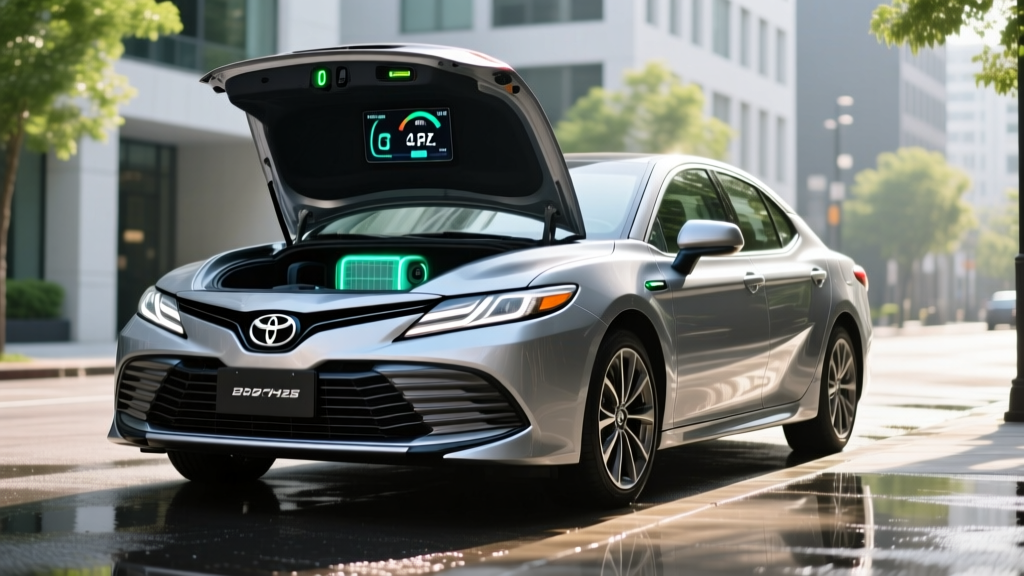
The 2025 Toyota Camry Hybrid sedan arrives with a significant powertrain overhaul: Toyota has dropped the four-cylinder gas-only model entirely, making every Camry a hybrid for the first time. The result is a midsize sedan that delivers up to 51 MPG combined while producing 232 horsepower — figures that would have seemed contradictory a generation ago. For buyers weighing the Camry Hybrid against full electric vehicles, plug-in hybrids, or remaining gas sedans, this review breaks down the exact specs, real-world efficiency, ownership costs, and battery longevity data you need to decide.
Quick Verdict: The 2025 Camry Hybrid in One Paragraph
The 2025 Toyota Camry Hybrid is the default midsize sedan for drivers who want maximum fuel economy without plugging in, worrying about range, or paying an EV premium. With an EPA-estimated 51 MPG combined on front-wheel-drive trims, a starting MSRP of $28,700, and Toyota's proven hybrid reliability record, it occupies a sweet spot: near-EV efficiency at gas-car convenience. It is not a plug-in hybrid and does not qualify for the federal §30D EV tax credit — but its low purchase price and minimal operating costs make the math work without incentives.
HEV vs PHEV vs EV: Where the Camry Hybrid Fits
Before examining specs, it is critical to understand what the 2025 Camry Hybrid is — and what it is not.
| Feature | HEV (Camry Hybrid) | PHEV (e.g., Prius Prime) | BEV (e.g., Tesla Model 3) |
|---|---|---|---|
| Plug-in required? | No — self-charging via regen + engine | Yes — plug in for electric-only miles | Yes — plug in for all driving |
| Electric-only range | ~1 mile at low speed | 35–45 miles typical | 250–360+ miles (full battery) |
| Fuel source | Gasoline + regenerative braking | Gasoline + grid electricity | Grid electricity only |
| Federal tax credit (§30D) | Not eligible | Up to $7,500 (if eligible) | Up to $7,500 (if eligible) |
| Home charging needed? | No | Recommended (Level 2 for best use) | Essential (Level 2 strongly recommended) |
The 2025 Camry is a conventional hybrid (HEV). Its small traction battery recharges through regenerative braking and the gasoline engine — you never plug it in. If you want plug-in electric-only commuting, look at the Toyota Prius Prime (a PHEV with 44 miles of electric range) or a full BEV.
Fuel Economy: EPA Ratings and Real-World MPG
The 2025 Camry Hybrid's efficiency varies by drivetrain. Front-wheel-drive (FWD) models achieve the highest EPA numbers, while all-wheel-drive (AWD) trims sacrifice a few MPG for added traction.
| Trim / Drivetrain | City MPG | Highway MPG | Combined MPG |
|---|---|---|---|
| LE (FWD) | 53 | 50 | 51 |
| SE / XLE / XSE (FWD) | 48 | 47 | 47 |
| LE (AWD) | 51 | 49 | 50 |
| SE / XLE / XSE (AWD) | 46 | 46 | 46 |
Source: EPA / fueleconomy.gov
Real-World MPG: What to Actually Expect
Toyota's fifth-generation hybrid system excels in stop-and-go driving, where the electric motor handles low-speed propulsion and the engine operates in its most efficient range. In real-world city driving, many owners report matching or slightly exceeding the EPA city estimate — 52–55 MPG is common in suburban traffic with frequent regen-braking opportunities.
Highway driving tells a different story. At sustained 70–80 MPH speeds, the gasoline engine carries most of the load, and real-world highway MPG typically drops to 42–46 MPG for FWD trims. Cold weather (below 35°F) further reduces efficiency by 8–12% as the engine runs more frequently to provide cabin heat and maintain battery temperature. On a 400-mile winter road trip, expect closer to 40–43 MPG combined in an FWD LE.
For a driver covering 15,000 miles annually in mixed conditions, the FWD Camry Hybrid LE consumes approximately 294 gallons per year — roughly $880 in fuel at $3.00/gallon. A comparable gas-only midsize sedan at 30 MPG combined would burn 500 gallons ($1,500), yielding about $620 in annual fuel savings.
Powertrain Specs: 232 HP from a Hybrid
The 2025 Camry uses Toyota's fifth-generation hybrid powertrain, pairing a 2.5-liter Dynamic Force four-cylinder engine with one or two electric motors (one for FWD, an additional rear motor for AWD).
| Specification | Detail |
|---|---|
| Engine | 2.5L 4-cylinder Dynamic Force (184 hp) |
| Front electric motor | Permanent magnet synchronous (contributes to 232 hp combined) |
| Rear electric motor (AWD only) | 40 hp rear-axle motor |
| Combined system output | 232 hp (FWD) / 232 hp (AWD) |
| Transmission | Electronic continuously variable (eCVT) |
| 0–60 MPH | ~7.1 seconds (FWD) |
| Hybrid battery | Lithium-ion, ~1.0 kWh (usable) |
| Drivetrain | FWD or electronic AWD |
The 232 hp combined output represents a substantial jump from the outgoing generation's 208 hp. The eCVT provides smooth, seamless acceleration without the rubber-band effect of older CVTs. The AWD system uses a dedicated rear electric motor rather than a mechanical driveshaft, engaging only when traction is needed — this is why AWD trims lose only 1–2 MPG versus FWD.
Pricing, Trims, and Tax Credit Eligibility
The 2025 Camry Hybrid lineup starts under $29,000 and tops out near $38,000 fully loaded:
| Trim | Drivetrain | MSRP |
|---|---|---|
| LE | FWD | $28,700 |
| LE | AWD | $30,100 |
| SE | FWD | $30,400 |
| SE | AWD | $31,800 |
| XLE | FWD | $33,400 |
| XLE | AWD | $34,800 |
| XSE | FWD | $34,100 |
| XSE | AWD | $35,500 |
Federal Tax Credit: Not Eligible
The 2025 Camry Hybrid is a conventional HEV and does not qualify for the federal §30D clean vehicle tax credit (up to $7,500). That credit is reserved for plug-in electric vehicles — BEVs and PHEVs with at least 7 kWh of battery capacity that can be recharged from an external source. The Camry Hybrid's ~1 kWh battery falls well below that threshold.
However, some states offer separate incentives for hybrid vehicles. Check your state's energy office or AFDC state incentive database for local programs. A few states offer modest rebates ($500–$1,000) for high-efficiency hybrids, though these are less common than EV incentives.
§30D Federal Tax Credit — Why the Camry Hybrid Does Not Qualify:
- Vehicle must be a plug-in EV or PHEV with ≥7 kWh battery — Camry has ~1 kWh
- Vehicle must be capable of external charging — Camry is self-charging only
- MSRP, income, and sourcing rules apply to qualifying plug-in vehicles only
- For the credit, consider the Toyota Prius Prime (PHEV) or bZ4X (BEV)
Battery Warranty, Reliability, and Replacement Cost
Hybrid battery longevity is the top concern for first-time hybrid buyers. Toyota addresses this with one of the strongest hybrid battery warranties in the industry.
2025 Camry Hybrid Battery Warranty:
- Hybrid battery: 10 years / 150,000 miles (whichever comes first)
- Hybrid system components: 8 years / 100,000 miles
- Basic vehicle warranty: 3 years / 36,000 miles
- Powertrain warranty: 5 years / 60,000 miles
The hybrid battery warranty covers capacity loss below a defined threshold and any manufacturing defects. In California-emissions states (CARB states), hybrid component coverage extends to 10 years / 150,000 miles for additional emissions-related parts.
Real-World Battery Longevity
Toyota's hybrid batteries have an exceptional track record. The Camry Hybrid's lithium-ion pack is small (~1 kWh usable) and operates within a narrow state-of-charge window — typically between 40% and 80% — which dramatically reduces degradation stress. Toyota's hybrid system never fully charges or fully depletes the battery during normal operation.
Based on data from previous-generation Camry Hybrids and the Prius fleet, hybrid battery failure before 150,000 miles is rare. Many Toyota hybrid batteries exceed 200,000 miles without significant capacity loss. The most common failure mode is individual cell imbalance in high-mileage units (150,000+ miles), which can sometimes be repaired by replacing individual modules rather than the entire pack.
Battery Replacement Cost
If replacement is needed outside warranty coverage:
- New OEM battery (Toyota dealer): $2,500–$3,500 installed
- Refurbished/remanufactured battery: $1,200–$2,000 installed
- Individual module replacement: $300–$800 (if only specific cells fail)
For context, a conventional car's alternator, starter, and transmission repairs over 150,000 miles often approach or exceed these costs — and the hybrid system eliminates the alternator and starter entirely.
Who Should Choose the Camry Hybrid vs an EV or Gas Car
Choose the 2025 Camry Hybrid if:
- You lack access to home or workplace Level 2 charging
- You regularly drive 300+ miles in a single day (no charging stops needed)
- You want near-EV efficiency with zero lifestyle adjustment
- Your budget is under $35,000 and you want a proven, reliable sedan
- You live in an area with sparse DC fast-charging infrastructure
Consider a PHEV (e.g., Prius Prime) instead if:
- You have home Level 2 charging and a commute under 40 miles
- You want electric-only daily driving with gas backup for road trips
- You qualify for the $7,500 federal tax credit (income and sourcing rules apply — see IRS §30D guidelines)
Consider a full BEV (e.g., Tesla Model 3, Hyundai Ioniq 6) instead if:
- You have reliable home Level 2 charging
- You want zero tailpipe emissions and the lowest per-mile energy cost
- You qualify for federal/state EV incentives that offset the higher purchase price
- Your daily driving is under 250 miles and you rarely road-trip beyond charger coverage
Pros and Cons
Pros
- 51 MPG combined EPA (FWD LE) — among the best of any non-plug-in vehicle
- 232 hp provides confident merging and passing power
- No plug-in required — zero charging infrastructure dependency
- 10-year / 150,000-mile hybrid battery warranty
- Starting MSRP of $28,700 undercuts most EVs and PHEVs by $10,000+
- AWD available across all trims for $1,400 premium
- Proven Toyota reliability with extensive dealer network
Cons
- Not eligible for federal §30D tax credit (HEV, not plug-in)
- Highway MPG drops to ~42–46 real-world at 75+ MPH
- eCVT lacks the engagement of a traditional geared transmission
- Small ~1 kWh battery means minimal electric-only driving (~1 mile at low speed)
- No DC fast charging capability (not applicable — no plug)
- Cold-weather efficiency loss of 8–12% without a heat pump (engine provides cabin heat)
Frequently Asked Questions
How many MPG does the 2025 Toyota Camry Hybrid get?
The EPA rates the 2025 Camry Hybrid LE (FWD) at 53 city / 50 highway / 51 combined MPG. Sportier SE, XLE, and XSE trims with larger wheels are rated at 48/47/47 MPG (FWD). Real-world city driving often matches or exceeds EPA estimates, while sustained highway driving at 75+ MPH typically yields 42–46 MPG.
Does the 2025 Camry Hybrid need to be plugged in?
No. The 2025 Camry Hybrid is a conventional hybrid (HEV), not a plug-in hybrid (PHEV). Its battery recharges automatically through regenerative braking and the gasoline engine. There is no charging port on the vehicle.
How far can the Camry Hybrid drive on electric power alone?
Approximately 1 mile at very low speeds (under 25 MPH) in EV mode. The hybrid battery is too small (~1 kWh) for meaningful electric-only driving. For 35–44 miles of electric-only range, consider a PHEV like the Toyota Prius Prime.
Is the 2025 Camry Hybrid reliable, and what does battery replacement cost?
Toyota's hybrid system is among the most reliable powertrains in the industry, with millions of units in service worldwide. The hybrid battery is warranted for 10 years / 150,000 miles. Out-of-warranty replacement costs $2,500–$3,500 for a new OEM battery, or $1,200–$2,000 for a refurbished unit. Most Toyota hybrid batteries last well beyond 150,000 miles.
Does the 2025 Camry Hybrid qualify for any tax credit?
The Camry Hybrid does not qualify for the federal §30D clean vehicle tax credit because it is not a plug-in vehicle. The credit requires a battery capacity of at least 7 kWh and the ability to recharge from an external power source. Some states may offer small incentives for high-efficiency hybrids — check your state's energy office or the AFDC incentive database.
How does the Camry Hybrid compare to the Toyota Prius?
The Camry Hybrid offers more interior space, a quieter ride, and a more powerful 232 hp powertrain at the cost of 4–6 MPG versus the Prius (which achieves up to 57 MPG combined). The Prius Prime PHEV adds 44 miles of electric-only range and federal tax credit eligibility. Choose the Camry for comfort and power; choose the Prius for maximum efficiency or plug-in capability.
What is the total driving range of the 2025 Camry Hybrid?
With a 13.2-gallon fuel tank and 51 MPG combined (FWD LE), the Camry Hybrid delivers approximately 673 miles of total range per tank — enough to drive from Los Angeles to San Francisco and back without refueling.
Final Assessment
The 2025 Toyota Camry Hybrid sedan eliminates the compromise that once defined hybrid vehicles. With 232 hp, 51 MPG combined, a sub-$29,000 starting price, and a 10-year hybrid battery warranty, it delivers on every metric that matters to a practical sedan buyer. It will not satisfy those seeking electric-only commuting or federal tax incentives — that requires a PHEV or BEV. But for the majority of drivers who want exceptional fuel economy without changing their refueling habits, the Camry Hybrid is the benchmark. The LE FWD at $28,700 is the value pick; the XLE AWD at $34,800 adds premium features and all-weather capability while still achieving 50 MPG combined.