The Case for Toyota's All-Wheel-Drive Hybrids
Toyota sells more all-wheel-drive hybrids than any other automaker, and the 2026 lineup spans crossovers, SUVs, and minivans with electronic AWD systems that engage the rear axle only when needed. Unlike mechanical AWD that saps fuel economy through a driveshaft, Toyota's AWD-e and E-Four systems use a dedicated rear electric motor, preserving the efficiency advantage that drew buyers to hybrids in the first place.
If you're researching a Toyota AWD hybrid, you're likely weighing three priorities: traction in rain or snow, fuel cost savings versus a conventional gas AWD SUV, and long-term reliability without the range anxiety of a full battery-electric vehicle. This guide covers every current Toyota model offering AWD in hybrid form, with exact EPA figures, real-world expectations, pricing, and battery longevity data.
HEV vs PHEV: Understanding Toyota's Two Hybrid Types
Conventional Hybrid (HEV): Charges its own small battery (~1-2 kWh) through regenerative braking and the gas engine. You never plug it in. Toyota's RAV4 Hybrid, Highlander Hybrid, Sienna, and Corolla Cross Hybrid all fall here.
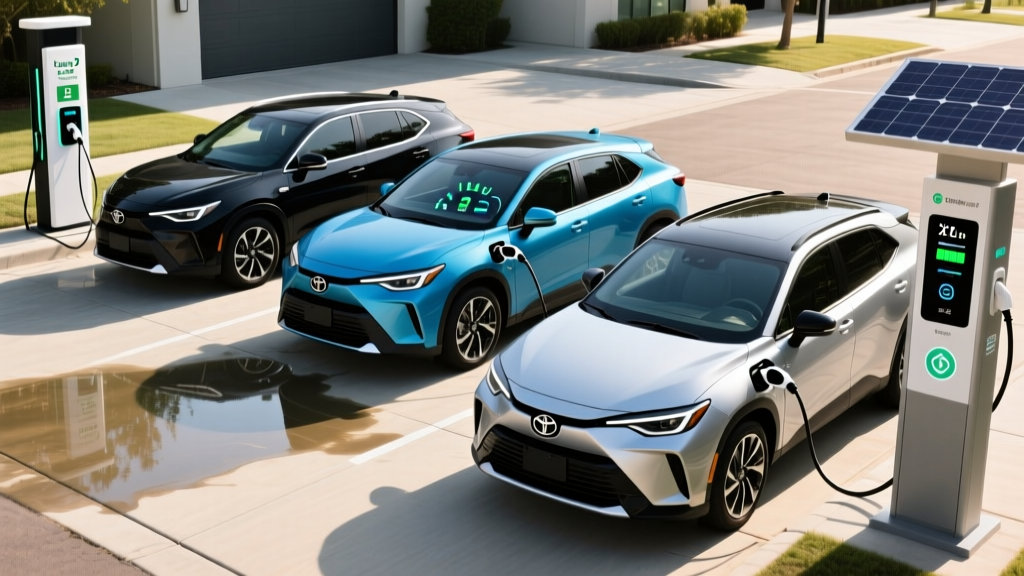
Plug-In Hybrid (PHEV): Carries a larger battery (~13-18 kWh) that you charge from a wall outlet or public charger, giving 30-40+ miles of electric-only driving before the gas engine kicks in. The RAV4 Prime is Toyota's AWD PHEV offering.
The distinction matters for your wallet and your routine. HEVs cost less upfront and require zero behavior change — you just drive and fuel up normally. PHEVs demand access to charging (ideally at home overnight) to capture their efficiency advantage but can slash fuel use dramatically if most trips fall within electric range.
2026 Toyota AWD Hybrid Lineup: Specs at a Glance
| Model | Type | AWD System | Combined HP | 0-60 mph | Starting MSRP |
|---|---|---|---|---|---|
| RAV4 Hybrid | HEV | AWD-e (rear motor) | 219 hp | 7.4 sec | $34,070 |
| RAV4 Prime (PHEV) | PHEV | AWD-e (rear motor) | 302 hp | 5.7 sec | $44,515 |
| Highlander Hybrid | HEV | E-Four (rear motor) | 243 hp | 7.8 sec | $42,820 |
| Grand Highlander Hybrid | HEV | E-Four (rear motor) | 243 hp | 7.9 sec | $47,260 |
| Sienna | HEV | AWD-e (rear motor) | 245 hp | 7.1 sec | $39,485 |
| Venza | HEV | AWD-e (rear motor) | 219 hp | 7.6 sec | $36,420 |
| Corolla Cross Hybrid | HEV | E-Four (rear motor) | 196 hp | 8.0 sec | $30,290 |
Fuel Economy: EPA Ratings and Real-World MPG
Hybrids often exceed their EPA city ratings because stop-and-go traffic maximizes regenerative braking and electric-motor use. Highway driving is where real-world numbers tend to dip slightly below sticker, especially at sustained 75-80 mph speeds or in cold weather when the engine runs more frequently for cabin heat.
| Model | EPA City | EPA Highway | EPA Combined | Real-World Expectation |
|---|---|---|---|---|
| RAV4 Hybrid AWD | 41 mpg | 38 mpg | 40 mpg | 38-44 mpg (city-favorable); 35-38 mpg (highway-heavy) |
| RAV4 Prime AWD (gas-only after EV) | 40 mpg | 36 mpg | 38 mpg | 36-42 mpg once battery depleted |
| Highlander Hybrid AWD | 35 mpg | 35 mpg | 35 mpg | 33-37 mpg combined |
| Grand Highlander Hybrid AWD | 35 mpg | 34 mpg | 35 mpg | 32-36 mpg combined |
| Sienna AWD | 35 mpg | 36 mpg | 35 mpg | 34-38 mpg (minivans often beat EPA in mixed use) |
| Venza AWD | 40 mpg | 37 mpg | 39 mpg | 37-42 mpg combined |
| Corolla Cross Hybrid AWD | 45 mpg | 38 mpg | 42 mpg | 40-47 mpg (city); 35-38 mpg (highway) |
The Corolla Cross Hybrid leads the pack at 42 mpg combined, making it the most fuel-efficient AWD vehicle Toyota currently sells. The RAV4 Hybrid's 41 mpg city figure is particularly strong for a compact SUV — owners with short commutes and lots of stoplights routinely report 43-45 mpg on the EPA's fuel economy site user submissions.
RAV4 Prime: Toyota's AWD Plug-In Hybrid Deep Dive
The RAV4 Prime deserves its own spotlight because it's the only Toyota AWD hybrid you can plug in. For 2026, it carries an 18.1 kWh lithium-ion battery (usable capacity approximately 14.5 kWh) and delivers 42 miles of EPA-rated electric-only range. Total combined range — electric plus the 14.5-gallon gas tank — exceeds 600 miles.
Battery and charging specs:
- Battery capacity: 18.1 kWh gross / ~14.5 kWh usable
- Level 1 (120V household outlet): ~12 hours for a full charge
- Level 2 (240V, 3.3 kW onboard charger): ~4.5 hours
- DC fast charging: Not supported — the RAV4 Prime uses a J1772 connector for AC charging only
The 3.3 kW onboard charger is the Prime's main limitation. If you install a 48-amp Level 2 home charger, the vehicle will still only accept 3.3 kW, so there's no benefit to overspecifying your home charging equipment. A standard 16-amp, 240V circuit is sufficient.
Hybrid Battery Warranty (all Toyota HEV/PHEV): 10 years / 150,000 miles (whichever comes first) for the traction battery. This applies to 2020 and newer model years across all 50 states, an improvement from the prior 8-year/100,000-mile federal standard. Toyota covers battery replacement or repair if capacity drops below a functional threshold that triggers a system warning.
Pricing and Tax Credit Eligibility
Toyota AWD hybrids span from roughly $30,000 to $47,000 before destination charges. The critical question for buyers is whether any federal or state incentives apply.
Federal tax credit (§30D): Conventional hybrids (HEVs) — the RAV4 Hybrid, Highlander, Sienna, Venza, and Corolla Cross Hybrid — do not qualify for the federal EV tax credit. The IRS §30D credit applies only to plug-in vehicles with at least 7 kWh of battery capacity. The RAV4 Prime, with its 18.1 kWh battery, is the only Toyota AWD hybrid in this lineup that potentially qualifies.
However, §30D eligibility for the RAV4 Prime depends on several factors that change annually:
- MSRP cap: SUVs must be under $80,000 MSRP — the RAV4 Prime clears this easily
- Buyer income cap: Modified AGI must not exceed $150,000 (single) / $300,000 (joint filing)
- Battery sourcing: Critical minerals and battery components must meet phased-in domestic-sourcing percentages that tighten each year through 2029
- Point-of-sale transfer: As of 2024, eligible buyers can transfer the credit to the dealer for an immediate price reduction rather than waiting for tax filing
Check the latest eligibility details on IRS.gov's clean vehicle credits page before purchasing, as battery-sourcing requirements have disqualified several previously eligible models in recent years.
State incentives: Several states offer additional rebates for PHEVs. California's CVRP program, Colorado's innovative motor vehicle credit, and various utility-company rebates may apply. These vary by jurisdiction and income level — consult your state energy office or utility provider for current programs.
Reliability and Long-Term Battery Costs
Toyota's hybrid system is the most proven in the industry, with over 25 years of production history dating to the 1997 Prius. The e-CVT transaxle has no traditional gears or bands to wear, and the AWD-e rear motor is a simple, sealed unit with no mechanical linkage to the front axle.
Battery replacement cost: If a hybrid traction battery fails outside warranty, replacement runs approximately $3,000 to $5,000 for HEV models (smaller battery) and $6,000 to $9,000 for the RAV4 Prime (larger PHEV battery), including labor. However, wholesale failures are rare — most degradation manifests as gradual capacity loss over 150,000+ miles, and individual cell modules can sometimes be replaced rather than the entire pack.
According to NHTSA recall data and long-term owner surveys, Toyota hybrid batteries routinely last 150,000-200,000 miles before significant degradation. The 10-year/150,000-mile warranty provides substantial coverage, and many first-generation Prius batteries are still in service past 250,000 miles with 20-30% capacity loss — still functional, just with reduced electric-assist contribution.
Who Should Choose a Toyota AWD Hybrid?
Choose a Toyota HEV AWD if:
- You want AWD traction without plugging in or changing habits
- Your priority is low cost-per-mile with zero charging infrastructure
- You drive 15,000+ miles annually and want predictable fuel costs
- You live in an area with limited public charging or lack home charging access
- You plan to own the vehicle 10+ years and value proven reliability
Choose the RAV4 Prime (PHEV) AWD if:
- You can charge at home overnight (Level 2 preferred)
- Most daily driving is under 40 miles round-trip
- You want electric-commute capability plus gas-engine road-trip freedom
- You qualify for the §30D tax credit, effectively reducing the price by up to $7,500
- You value the 302-hp performance advantage over the standard RAV4 Hybrid
Toyota AWD Hybrid vs. Full EV (e.g., Tesla Model Y, Hyundai Ioniq 5): If you have reliable home charging, drive under 250 miles daily, and want zero tailpipe emissions, a full BEV will have lower per-mile energy costs (~$0.04/mile vs. ~$0.10/mile for a 40 mpg hybrid at $3.50/gal). But if you regularly drive 400+ mile trips, live in an apartment without charging, or face extreme cold that reduces EV range by 25-40%, the Toyota AWD hybrid eliminates range anxiety entirely while still cutting fuel use roughly in half versus a gas-only AWD SUV.
Frequently Asked Questions
How many MPG does a Toyota AWD hybrid get?
EPA combined ratings range from 35 mpg (Highlander Hybrid, Grand Highlander Hybrid, Sienna) to 42 mpg (Corolla Cross Hybrid). The RAV4 Hybrid AWD achieves 40 mpg combined, and the Venza hits 39 mpg. Real-world results typically match or exceed EPA city ratings due to regenerative braking, while sustained highway driving at 75+ mph may drop 2-4 mpg below the sticker.
How far can the RAV4 Prime go on electric only?
The EPA rates the 2026 RAV4 Prime at 42 miles of all-electric range. In practice, gentle driving in mild temperatures can stretch this to 45-48 miles, while aggressive acceleration, cold weather, or highway speeds may reduce it to 35-38 miles. Once depleted, the Prime operates as a conventional hybrid at 38 mpg combined.
Do Toyota AWD hybrids need to be plugged in?
No — only the RAV4 Prime (PHEV) benefits from plug-in charging. All other Toyota AWD hybrids (RAV4 Hybrid, Highlander Hybrid, Sienna, Venza, Corolla Cross Hybrid, Grand Highlander Hybrid) are conventional HEVs that charge their own battery through regenerative braking and the gas engine. You fuel them at any gas station and never need a charger.
Is the Toyota hybrid AWD system reliable?
Toyota's electronic AWD-e and E-Four systems have fewer mechanical failure points than traditional AWD because there's no driveshaft, transfer case, or rear differential with fluid to service. The rear electric motor is a sealed unit. Combined with Toyota's 10-year/150,000-mile hybrid battery warranty, these are among the lowest-risk AWD systems on the market.
What does it cost to replace a Toyota hybrid battery?
Out-of-warranty replacement runs $3,000-$5,000 for conventional hybrid models and $6,000-$9,000 for the RAV4 Prime PHEV. However, most Toyota hybrid batteries last 150,000-200,000+ miles, and the 10-year/150,000-mile warranty covers premature failure. Many owners sell or trade the vehicle before battery replacement becomes necessary.
Does any Toyota AWD hybrid qualify for a federal tax credit?
Only the RAV4 Prime (PHEV) is potentially eligible for the §30D federal clean vehicle credit, which can provide up to $7,500 depending on battery-sourcing compliance, buyer income, and MSRP limits. Conventional Toyota hybrids do not qualify for the federal EV credit. Verify current eligibility at IRS.gov before purchasing.