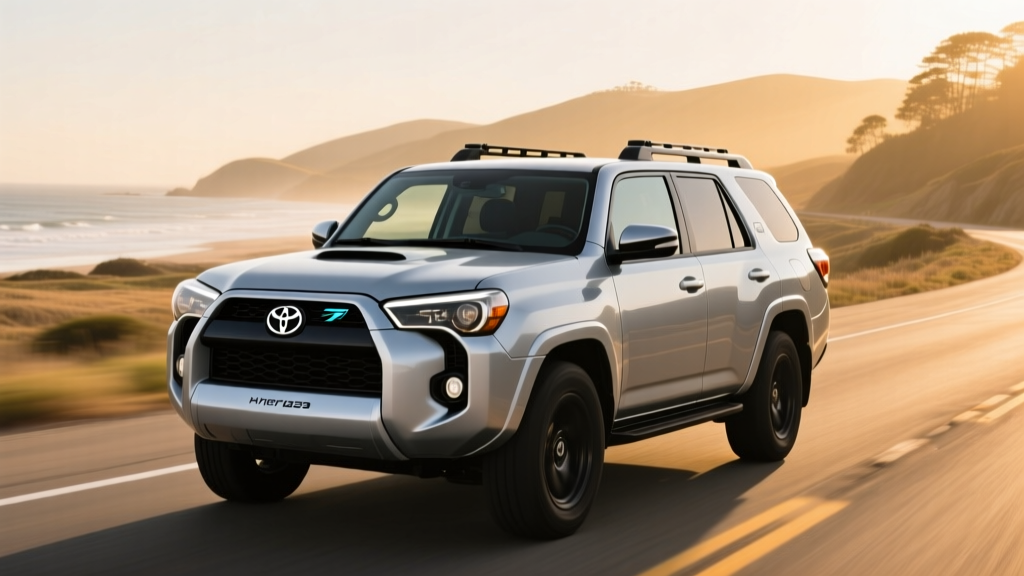
The 2025 Toyota 4Runner Hybrid marks a significant shift for Toyota's rugged SUV lineup. After years of relying on a thirsty 4.0L V6, the 4Runner now offers a turbocharged four-cylinder hybrid powertrain that delivers 326 horsepower while improving fuel economy by over 40% compared to the previous generation. Here's what buyers need to know about MPG, reliability, and whether this hybrid qualifies for federal tax credits.
4Runner Hybrid MPG: EPA vs Real-World
The 2025 4Runner Hybrid uses Toyota's i-FORCE MAX hybrid powertrain, pairing a 2.4L turbocharged four-cylinder engine with an electric motor integrated into the transmission. The EPA rates it at:
| Drive Type | City MPG | Highway MPG | Combined MPG |
|---|---|---|---|
| 4x2 (Rear-Wheel Drive) | 28 | 27 | 27 |
| 4x4 (Four-Wheel Drive) | 27 | 26 | 26 |
Real-World Expectations: Toyota hybrids typically exceed EPA city estimates in stop-and-go traffic where regenerative braking shines. Expect 28-30 MPG city in 4x4 models during urban driving. Highway cruising at 75+ MPH will drop to 23-24 MPG due to the 4Runner's boxy aerodynamics and 4,800+ lb curb weight. Cold weather and aggressive throttle use will further reduce efficiency.
This represents a substantial improvement over the previous 4Runner's 16-17 MPG combined. For comparison, the 2024 V6 4Runner achieved just 17 MPG combined according to EPA data.
Hybrid vs Plug-In Hybrid: What the 4Runner Offers
The 2025 4Runner is available only as a conventional hybrid (HEV), not a plug-in hybrid (PHEV). This distinction matters for buyers:
Conventional Hybrid (HEV) — 4Runner Hybrid
- No plug-in charging required — the battery charges through regenerative braking and the engine
- Small battery (~1.87 kWh) provides electric assist, not electric-only driving
- Lower upfront cost, simpler ownership
- No electric-only range — the gas engine is always available
Plug-In Hybrid (PHEV) — Not Available for 4Runner
- Requires plug-in charging (Level 1 or Level 2)
- Larger battery (typically 15-20 kWh) enables 25-40 miles electric-only
- Higher upfront cost, potential federal tax credit eligibility
- Can drive on electricity alone for short trips
Toyota has not announced a 4Runner PHEV variant. If you need electric-only range for daily commuting, consider the Toyota RAV4 Prime (42 miles electric) or wait to see if Toyota expands PHEV options to the 4Runner platform.
Powertrain Specs: Performance Meets Efficiency
| Specification | 2025 4Runner Hybrid |
|---|---|
| Engine | 2.4L turbocharged 4-cylinder + electric motor |
| Combined Horsepower | 326 HP |
| Combined Torque | 465 lb-ft |
| Transmission | 8-speed automatic |
| Battery Capacity | ~1.87 kWh (NiMH) |
| 0-60 MPH (estimated) | ~6.5 seconds |
| Towing Capacity | 6,000 lbs |
| Drive Types | RWD or 4WD with locking rear differential |
The i-FORCE MAX powertrain delivers V8-like torque (465 lb-ft) from a four-cylinder engine, thanks to the electric motor's instant torque delivery. This makes the 4Runner Hybrid surprisingly quick off the line and confident when merging or passing, while still achieving mid-20s MPG.
Pricing and Trim Levels
The 2025 4Runner Hybrid carries a price premium over non-hybrid trims, but the fuel savings and performance gains justify the cost for many buyers:
| Trim Level | Starting MSRP | Hybrid Availability |
|---|---|---|
| TRD Off-Road Hybrid | $52,220 | Standard |
| Limited Hybrid | $57,320 | Standard |
| Platinum Hybrid | $60,970 | Standard |
| TRD Pro Hybrid | $66,970 | Standard |
Note: The base SR5 and SR5 Premium trims use the non-hybrid i-FORCE 2.4L turbo (278 HP) starting at $42,420. The hybrid powertrain is standard on TRD Off-Road and above.
Federal Tax Credit Eligibility
The 2025 4Runner Hybrid does not qualify for the federal §30D tax credit. Here's why:
§30D Tax Credit Rules (2025): The federal Clean Vehicle Credit applies only to plug-in electric vehicles (BEVs and PHEVs) with battery capacity of at least 7 kWh. Conventional hybrids like the 4Runner Hybrid have batteries under 2 kWh and cannot be plugged in, making them ineligible.
However, some states offer incentives for hybrid vehicles. Check your state's energy office or department of environmental quality for potential rebates. These vary widely and change frequently, so consult official state sources rather than dealer claims.
Battery Warranty and Reliability
Toyota has decades of hybrid experience, and the 4Runner Hybrid benefits from proven technology:
Hybrid Battery Warranty: Toyota covers the hybrid battery for 10 years or 150,000 miles, whichever comes first. This applies to all 2025 Toyota hybrids and is transferable to subsequent owners.
Toyota's hybrid batteries have demonstrated excellent longevity. The Prius and Camry Hybrid have shown minimal degradation even at 200,000+ miles. The 4Runner's NiMH battery is less energy-dense than lithium-ion but extremely durable and tolerant of temperature extremes — important for an off-road SUV.
Battery Replacement Cost: If replacement is needed after warranty expiration, expect $3,000-$4,500 for a new OEM hybrid battery pack (parts and labor). Third-party refurbishment options may reduce this to $1,500-$2,500. However, given Toyota's track record, most 4Runner Hybrids will never need battery replacement during typical ownership.
For reliability data, consult Consumer Reports and J.D. Power ratings once available for the 2025 model year.
Who Should Choose the 4Runner Hybrid?
Choose the 4Runner Hybrid If:
- You need serious off-road capability and 6,000-lb towing
- You want V8-like torque without V8 fuel consumption
- You drive in stop-and-go traffic where hybrid efficiency shines
- You prefer proven hybrid tech over plug-in complexity
- You plan to keep the vehicle 10+ years (hybrid battery warranty coverage)
Consider Alternatives If:
- You need electric-only range for zero-emission zones or short commutes (no 4Runner PHEV exists)
- You prioritize maximum fuel economy over off-road capability (consider RAV4 Hybrid at 40 MPG)
- You want federal tax credits (only BEVs and PHEVs qualify under current §30D rules)
- You rarely drive off-road and prefer car-based crossovers (Highlander Hybrid gets 35 MPG)
4Runner Hybrid vs Full EV vs Gas: Decision Framework
Choose the 4Runner Hybrid if: You need body-on-frame durability, serious off-road capability, and 6,000-lb towing, but want better fuel economy than the old V6. The hybrid delivers 26-27 MPG combined vs 16-17 MPG from the previous generation — a 40%+ improvement without sacrificing capability.
Choose a full EV (Tesla Model Y, Ford Mustang Mach-E) if: You have home charging access, drive under 300 miles daily, and don't need serious off-road or towing capability. EVs offer lower operating costs (electricity vs gas), minimal maintenance, and federal tax credits up to $7,500 — but can't match the 4Runner's ruggedness.
Choose the gas-only 4Runner if: You're on a tighter budget and don't mind 19-21 MPG combined. The non-hybrid i-FORCE turbo (278 HP) is still capable and $10,000 cheaper than hybrid trims. However, you'll pay more in fuel over time and miss out on the hybrid's torque advantage.
Frequently Asked Questions
How many MPG does the 4Runner Hybrid get?
The EPA rates the 2025 4Runner Hybrid at 27 MPG combined (28 city/27 highway) for 4x2 models and 26 MPG combined (27 city/26 highway) for 4x4 models. Real-world city driving often exceeds these estimates, while highway cruising at high speeds will reduce efficiency.
Does the 4Runner Hybrid need to be plugged in?
No. The 4Runner Hybrid is a conventional hybrid (HEV), not a plug-in hybrid. The battery charges automatically through regenerative braking and the gas engine. You never need to plug it in.
Is there a 4Runner plug-in hybrid (PHEV)?
No. Toyota has not announced a 4Runner PHEV variant. If you need electric-only range, consider the RAV4 Prime (42 miles electric) or a full EV like the Tesla Model Y.
Does the 4Runner Hybrid qualify for federal tax credits?
No. The federal §30D Clean Vehicle Credit applies only to plug-in vehicles (BEVs and PHEVs). The 4Runner Hybrid is a conventional hybrid and does not qualify. Check your state for potential hybrid incentives.
How long will the 4Runner Hybrid battery last?
Toyota covers the hybrid battery for 10 years or 150,000 miles. Based on Toyota's hybrid track record (Prius, Camry Hybrid), most batteries last 200,000+ miles with minimal degradation. Replacement cost after warranty is $3,000-$4,500 if needed.
Is the 4Runner Hybrid reliable?
Toyota's hybrid systems have demonstrated excellent reliability over 25+ years. The i-FORCE MAX powertrain is new to the 4Runner but uses proven hybrid technology. Consult Consumer Reports and J.D. Power for 2025-specific reliability data once available.
How much does the 4Runner Hybrid cost?
The 2025 4Runner Hybrid starts at $52,220 for the TRD Off-Road Hybrid trim and ranges up to $66,970 for the TRD Pro Hybrid. The hybrid powertrain is standard on TRD Off-Road and above; lower trims use the non-hybrid turbo four-cylinder.
Sources: EPA fueleconomy.gov, Toyota USA specifications, IRS §30D tax credit guidelines