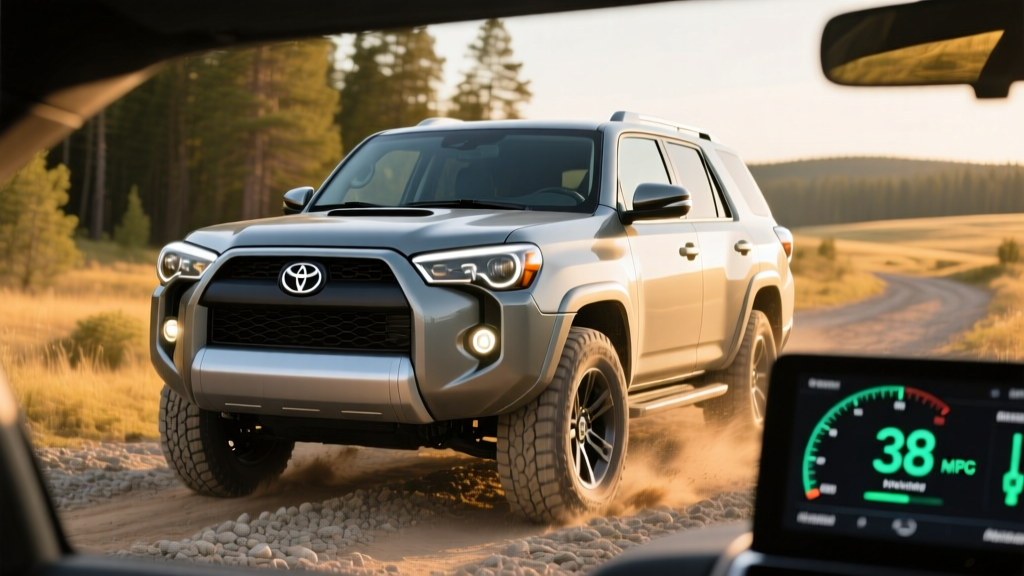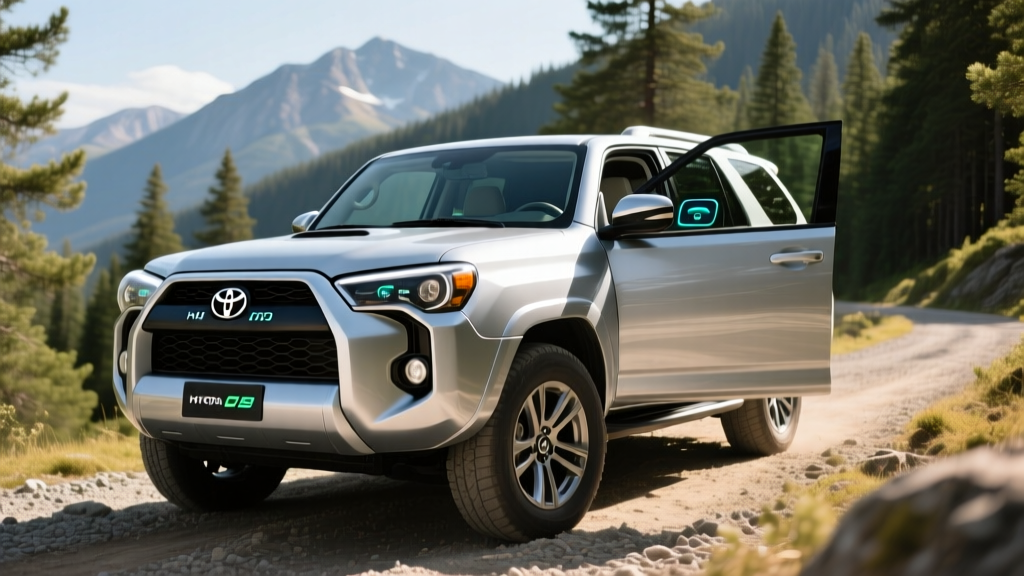
The 2025 Toyota 4Runner marks the first time Toyota's legendary off-road SUV offers a hybrid powertrain. The new i-FORCE MAX turbocharged hybrid slots into the sixth-generation 4Runner lineup, delivering 326 horsepower and a meaningful bump in fuel economy over the base turbocharged four-cylinder. For buyers searching for a Toyota 4Runner hybrid, understanding exactly what this powertrain offers — and what it doesn't — is essential before heading to the dealership.
This guide breaks down the i-FORCE MAX hybrid's EPA fuel economy, real-world MPG expectations, powertrain specs, pricing across trims, hybrid battery warranty, and how it stacks up against both full EVs and conventional gas SUVs. Whether you're eyeing the TRD Off-Road or the top-tier TRD Pro, you'll find the exact numbers you need below.
i-FORCE MAX Powertrain: What Powers the 4Runner Hybrid
The Toyota 4Runner hybrid uses the i-FORCE MAX powertrain, which pairs a turbocharged 2.4-liter inline-four engine with an electric motor integrated into the transmission bell housing. This is not a plug-in hybrid — it's a conventional hybrid (HEV), meaning it generates and recaptures all its own electricity through regenerative braking and engine-driven charging. You never plug it in.
The 4Runner i-FORCE MAX is a conventional hybrid (HEV). It has a small battery pack (under 2 kWh) that assists the gas engine during acceleration and enables brief low-speed electric-only driving. A plug-in hybrid (PHEV) like the Toyota RAV4 Prime carries a much larger battery (~18 kWh), offers 30-40+ miles of electric-only range, and must be plugged in to realize its efficiency benefits. The 4Runner hybrid requires zero behavior change from a gas-only owner.
Here's what the powertrain produces:
| Spec | Figure |
|---|---|
| Engine | 2.4L turbocharged inline-4 |
| Electric Motor | Permanent magnet, transmission-integrated |
| Combined Horsepower | 326 hp |
| Combined Torque | 465 lb-ft |
| Transmission | 8-speed automatic |
| Drivetrain | 4WD (part-time or full-time depending on trim) |
| Hybrid Battery | ~1.8 kWh (NiMH), self-charging |
| Max Towing Capacity | 6,000 lbs |
The 326 hp and 465 lb-ft represent a substantial upgrade over the base i-FORCE turbo four (278 hp / 317 lb-ft). That extra torque, available low in the rev range thanks to electric motor assist, makes the hybrid noticeably more responsive in daily driving and more capable when towing or climbing grades.
EPA Fuel Economy: 4Runner Hybrid MPG Breakdown
The headline question for most shoppers: how many MPG does the Toyota 4Runner hybrid get? Here are the official EPA figures as published on fueleconomy.gov:
| Configuration | City | Highway | Combined |
|---|---|---|---|
| 4Runner i-FORCE MAX 4WD | 23 | 24 | 23 |
| 4Runner i-FORCE (base turbo) 4WD | 20 | 24 | 21 |
The i-FORCE MAX hybrid earns a 23 MPG combined EPA rating — a 2 MPG improvement over the base turbo four-cylinder in combined driving. The city MPG improvement is more pronounced: 23 city vs. 20 city, a 15% gain. This is typical of conventional hybrids, which recapture energy during stop-and-go driving and use electric assist at low speeds where gas engines are least efficient.
Real-World MPG: What to Actually Expect
EPA estimates are measured under controlled conditions. For the 4Runner i-FORCE MAX hybrid, expect:
- City/suburban driving: 22–25 MPG — hybrids often meet or slightly exceed EPA city ratings in moderate-temperature, stop-and-go conditions.
- Highway cruising (70-75 mph): 21–23 MPG — the boxy aerodynamics and 4,800+ lb curb weight work against highway efficiency. Hybrid advantage diminishes at sustained high speed.
- Towing or heavy cargo: 14–17 MPG — towing near the 6,000-lb max will roughly halve your fuel economy.
- Off-road low-range use: 8–12 MPG — low-range crawling burns fuel at very low speeds.
- Cold weather (below 30°F): Expect a 1–3 MPG reduction as the engine runs more frequently for cabin heat and battery conditioning.
Compared to the outgoing fifth-generation 4Runner's 4.0L V6 (16 MPG combined), the new hybrid represents a 44% improvement in combined fuel economy. That's the context that matters: Toyota replaced a thirsty V6 with a turbo-four hybrid that's both more powerful and dramatically more efficient.
Pricing, Trims & Tax Credit Eligibility
The i-FORCE MAX hybrid is available across several 4Runner trims for the 2025 model year. Here's a breakdown of starting MSRPs (destination charge included):
| Trim Level | Starting MSRP (approx.) | i-FORCE MAX Standard? |
|---|---|---|
| TRD Off-Road Hybrid | ~$52,000 | Optional |
| Limited Hybrid | ~$57,000 | Optional |
| TRD Pro Hybrid | ~$65,000 | Standard |
| Trailhunter Hybrid | ~$58,000 | Standard |
Prices are approximate based on Toyota's announced MSRP at launch. Confirm exact pricing with your dealer as configurations change by model year.
Does the 4Runner Hybrid Qualify for a Federal Tax Credit?
No. The Toyota 4Runner i-FORCE MAX is a conventional hybrid (HEV), not a plug-in hybrid or battery-electric vehicle. Under current IRS rules, the §30D Clean Vehicle Credit applies only to plug-in electric vehicles (BEVs and PHEVs) with sufficient battery capacity. Conventional hybrids like the 4Runner i-FORCE MAX, Ford Maverick Hybrid, and Honda CR-V Hybrid do not qualify for any federal purchase tax credit.
Some states may offer minor incentives for hybrid vehicles, but these are increasingly rare as state programs shift toward zero-emission vehicles. Check your state's energy office or department of environmental quality for current programs.
Hybrid Battery Warranty & Long-Term Reliability
Hybrid battery longevity is consistently one of the top concerns for first-time hybrid buyers. Toyota addresses this with one of the strongest warranties in the industry:
- Hybrid Battery Coverage: 10 years / 150,000 miles (whichever comes first)
- Hybrid System Components: 8 years / 100,000 miles
- What's Covered: The hybrid battery pack, inverter, electric motor, and related control modules
- Capacity Threshold: Toyota warrants the battery against defects and abnormal degradation — unlike EV batteries, the small HEV pack is not warrantied to a specific capacity percentage
Toyota's hybrid reliability track record is exceptional. The Prius, now in its fifth generation, has demonstrated hybrid battery packs lasting 200,000+ miles with minimal degradation. The i-FORCE MAX system uses a proven nickel-metal hydride (NiMH) battery chemistry that Toyota has refined over two decades. Unlike larger lithium-ion EV batteries, the 4Runner's small hybrid pack operates within a narrow state-of-charge window, which significantly extends cycle life.
Hybrid Battery Replacement Cost
If the hybrid battery does fail outside warranty coverage, replacement costs for Toyota's hybrid systems typically range from $2,000 to $4,000 for the battery pack itself, plus labor. This is far less than EV battery replacement ($10,000–$20,000+) because the pack is small (~1.8 kWh). Third-party remanufactured batteries are also available at lower cost. Given Toyota's reliability history and the 10-year warranty, battery replacement is unlikely to be a concern for most original owners.
4Runner Hybrid vs. EV vs. Gas: Which Fits Your Needs?
Choosing between the 4Runner hybrid, a full electric SUV, or a conventional gas vehicle depends on your driving patterns, charging access, and priorities. Here's a decision framework:
Choose the 4Runner Hybrid If:
- You want better fuel economy without changing your fueling habits
- You tow regularly (6,000-lb capacity) or drive off-road
- You lack reliable home or workplace EV charging access
- You need proven body-on-frame durability and resale value
- You take long road trips through areas with sparse charging infrastructure
Choose a Full EV (e.g., Rivian R1S, Tesla Model X) If:
- You have Level 2 home charging and want near-zero fuel costs
- Your daily driving is under 250 miles with predictable routes
- You want instant torque, quiet operation, and minimal maintenance
- You qualify for the $7,500 federal tax credit (income/MSRP/sourcing rules apply)
- You rarely tow heavy loads (EV towing range drops 40-50%)
Choose the Gas 4Runner (i-FORCE) If:
- You want the lowest purchase price and the hybrid premium isn't justified
- Your driving is mostly highway, where hybrid gains are smallest
- You plan to keep the vehicle 3-5 years and want simpler maintenance
For most 4Runner buyers, the i-FORCE MAX hybrid is the sweet spot. The ~$2,000–$3,000 premium over the base turbo four pays for itself in fuel savings within 3–5 years for an average driver (15,000 miles/year at $3.50/gallon), while delivering meaningfully better performance (326 hp vs. 278 hp, 465 lb-ft vs. 317 lb-ft).
Pros and Cons of the Toyota 4Runner Hybrid
Pros
- 44% fuel economy improvement over previous-gen V6
- 326 hp / 465 lb-ft — the most powerful 4Runner ever
- No plug-in required; zero behavior change from gas ownership
- 10-year / 150,000-mile hybrid battery warranty
- Body-on-frame capability: 6,000-lb tow, serious off-road chops
- Strong Toyota resale value and reliability reputation
Cons
- 23 MPG combined is still thirsty vs. car-based hybrid SUVs (RAV4 Hybrid: 39 MPG)
- No federal tax credit — conventional hybrids don't qualify
- Hybrid premium adds ~$2,000–$3,000 to MSRP
- Boxy shape and heavy weight limit highway MPG gains
- Not a plug-in — no electric-only commuting range
- Initial model-year availability may be limited at dealers
Frequently Asked Questions
How many MPG does the Toyota 4Runner hybrid get?
The 2025 Toyota 4Runner i-FORCE MAX hybrid with 4WD is EPA-rated at 23 MPG city, 24 MPG highway, and 23 MPG combined. In real-world city driving, owners may see 22–25 MPG. Highway cruising at 70+ mph typically yields 21–23 MPG. Towing significantly reduces these figures.
Is the 4Runner hybrid a plug-in? Can it drive on electric only?
No. The 4Runner i-FORCE MAX is a conventional hybrid (HEV). It cannot be plugged in and does not offer meaningful electric-only range. The electric motor assists the gas engine during acceleration and enables very brief low-speed electric movement (parking lots, traffic creep), but the gas engine is always the primary power source. If you want plug-in electric commuting, consider a PHEV like the Toyota RAV4 Prime (42 miles EV range) or a full EV.
How far can the 4Runner hybrid go on a full tank?
With a 23-gallon fuel tank and 23 MPG combined, the 4Runner hybrid delivers approximately 529 miles of total range in mixed driving. Highway-only driving at 24 MPG yields roughly 552 miles. This is a significant advantage over EVs for remote-area travel and long road trips where charging stations are sparse.
Is the 4Runner hybrid reliable? What does a battery replacement cost?
Toyota's hybrid systems are among the most proven in the automotive industry, with the Prius platform demonstrating 200,000+ mile battery longevity since 1997. The 4Runner hybrid battery is covered by a 10-year / 150,000-mile warranty. Out-of-warranty replacement costs approximately $2,000–$4,000 for the battery pack — far less than EV battery replacement due to the small pack size (~1.8 kWh).
Does the Toyota 4Runner hybrid qualify for any tax credit?
No federal tax credit applies to the 4Runner hybrid. The IRS §30D Clean Vehicle Credit is limited to plug-in electric vehicles (BEVs and PHEVs). Conventional hybrids are excluded. Some states may offer minor hybrid incentives — check your state energy office for current programs.
Should I get the 4Runner hybrid or wait for a 4Runner PHEV or EV?
Toyota has not announced a plug-in hybrid or all-electric 4Runner as of the 2025 model year. Given Toyota's typical product cycles, a 4Runner PHEV (similar to the Tacoma's rumored plug-in variant) could arrive later this decade, but nothing is confirmed. If you need a body-on-frame hybrid SUV now, the i-FORCE MAX 4Runner is the only option in its class. If you can wait 3–5 years and want plug-in capability, monitor Toyota's announcements — but don't delay a purchase if you need the vehicle today.
How does the 4Runner hybrid compare to the RAV4 Hybrid or Highlander Hybrid?
The RAV4 Hybrid achieves 39 MPG combined but is a unibody crossover with 1,500-lb towing and limited off-road capability. The Highlander Hybrid earns 35 MPG combined with three rows and 3,500-lb towing. The 4Runner hybrid trades fuel economy for body-on-frame durability, 6,000-lb towing, locking differentials, and serious trail capability. They serve fundamentally different use cases — the 4Runner hybrid is for buyers who need truck-based capability with improved efficiency, not maximum MPG.