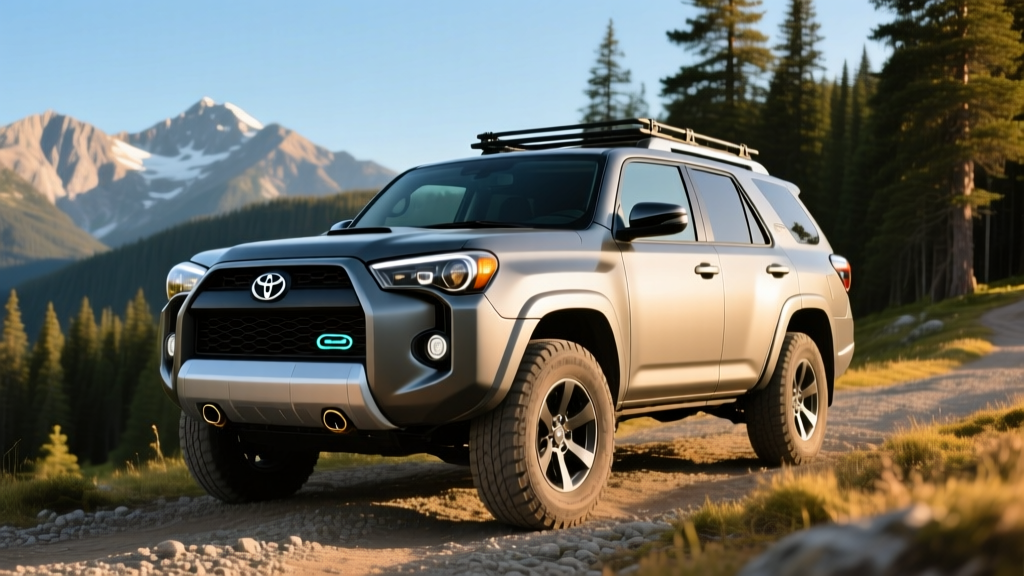
The sixth-generation Toyota 4Runner arrived for the 2025 model year with a complete redesign — and for the first time, a hybrid powertrain option. The i-FORCE MAX hybrid system pairs a 2.4-liter turbocharged four-cylinder engine with an electric motor integrated into the transmission, delivering V6-rivaling torque while squeezing out meaningfully better fuel economy than the outgoing V6. For buyers who need serious off-road capability and towing but want to cut fuel costs, the 2025 Toyota 4Runner hybrid is the most compelling midsize SUV in Toyota's lineup.
This guide breaks down exactly what the i-FORCE MAX hybrid delivers in MPG, performance, and ownership costs — and how it stacks up against a plug-in hybrid or full EV alternative.
HEV vs PHEV: What the 4Runner Hybrid Actually Is
The 2025 4Runner i-FORCE MAX is a conventional hybrid (HEV), not a plug-in hybrid (PHEV). This is a critical distinction that affects how you fuel it, what you pay, and what tax incentives apply.
| Feature | Conventional Hybrid (HEV) | Plug-In Hybrid (PHEV) |
|---|---|---|
| Plug in to charge? | No — charges via regenerative braking and engine | Yes — has a charge port and larger battery |
| Electric-only range | Less than 1 mile at low speeds | Typically 20–45 miles |
| Battery size | Small (~1–2 kWh) | Larger (~13–25 kWh) |
| Federal tax credit (§30D) | Not eligible | Up to $7,500 if requirements met |
| Fueling | Gasoline only | Gasoline + electricity |
The 4Runner's hybrid system is a self-charging HEV. You never plug it in. The 1.87 kWh nickel-metal hydride (NiMH) battery pack recovers energy during braking and deceleration, and the gasoline engine tops it up as needed. The electric motor assists the engine during acceleration and can propel the vehicle solo at very low speeds — think creeping through a parking lot — but it cannot sustain highway driving on electric power alone.
Toyota has not announced a PHEV variant of the 4Runner for the 2025 or 2026 model year. If plug-in capability is a priority, you'll need to look at alternatives like the Jeep Wrangler 4xe or the Toyota RAV4 Prime.
Fuel Economy: EPA MPG and Real-World Numbers
The headline reason buyers choose the i-FORCE MAX over the standard turbo four-cylinder is fuel economy. Here's the EPA-rated breakdown for the 2025 4Runner hybrid, sourced from fueleconomy.gov:
| Drivetrain | City MPG | Highway MPG | Combined MPG |
|---|---|---|---|
| 4Runner i-FORCE MAX (4WD) | 23 | 27 | 26 |
| 4Runner Turbo 4-Cyl (4WD, non-hybrid) | 20 | 24 | 21 |
| Previous-Gen 4Runner 4.0L V6 (4WD) | 16 | 19 | 17 |
The hybrid delivers a 5 MPG combined improvement over the non-hybrid turbo and a massive 9 MPG gain over the outgoing V6 — a 53% improvement. On a 15,000-mile annual driving cycle, that's roughly 150 fewer gallons of fuel per year versus the old V6.
Real-World MPG: What to Expect
Toyota's hybrid systems tend to meet or slightly exceed EPA estimates in city driving, where regenerative braking and electric-motor assist do the most work. On the highway, where the gasoline engine carries the load, expect numbers closer to the EPA sticker or slightly below.
- City / suburban driving: 24–27 MPG — the electric motor's low-speed assist and regen braking shine here.
- Highway cruising (70–75 mph): 24–26 MPG — aerodynamic drag from the 4Runner's boxy shape is the limiting factor.
- Off-road / low-range driving: MPG drops significantly, as with any vehicle. Expect 12–16 MPG in technical terrain.
- Towing (5,000–6,000 lbs): 14–18 MPG depending on trailer weight and terrain.
- Cold weather (below 30°F): Expect a 1–3 MPG reduction as the engine runs more to generate cabin heat and the battery is less efficient.
Range per tank: With a 21.1-gallon fuel tank and 26 MPG combined, the 4Runner hybrid delivers approximately 548 miles of total range before refueling — a substantial figure for a midsize body-on-frame SUV.
Powertrain and Performance Specs
| Specification | 2025 4Runner i-FORCE MAX Hybrid |
|---|---|
| Engine | 2.4L turbocharged inline-4 |
| Electric motor | Integrated into 8-speed automatic transmission |
| Combined horsepower | 326 hp |
| Combined torque | 465 lb-ft |
| Transmission | 8-speed automatic |
| Drivetrain | 4WD (part-time or full-time, trim-dependent) |
| 0–60 mph (est.) | ~6.5 seconds |
| Max towing capacity | 6,000 lbs |
| Hybrid battery | 1.87 kWh, NiMH |
| Charge port | None (self-charging HEV) |
| Fuel tank | 21.1 gallons |
The i-FORCE MAX's 465 lb-ft of torque is the standout figure. That peak torque arrives low in the rev range thanks to the electric motor, giving the 4Runner hybrid strong off-the-line response and confident passing power. It's more torque than the old 4.0L V6 (278 lb-ft) and substantially more than the non-hybrid turbo four (310 lb-ft).
The electric motor fills in the torque gap while the turbo spools up, eliminating the lag that some turbo-only engines exhibit. In practice, the powertrain feels more like a naturally aspirated V6 with an electric boost — smooth, linear, and responsive.
Pricing, Trims, and Tax Credit Eligibility
The i-FORCE MAX hybrid is available across multiple 4Runner trims for 2025. Pricing (MSRP, excluding destination):
- TRD Off-Road (i-FORCE MAX): ~$47,400
- TRD Off-Road Premium (i-FORCE MAX): ~$51,500
- Limited (i-FORCE MAX): ~$55,200
- TRD Pro (i-FORCE MAX): ~$58,500
- Platinum (i-FORCE MAX): ~$59,800
The hybrid premium over the equivalent non-hybrid trim is typically $2,000–$2,500. Given the 5 MPG improvement, most drivers will recoup that cost through fuel savings within 3–5 years depending on local gas prices and annual mileage.
Does the 4Runner Hybrid Qualify for a Federal Tax Credit?
No. The 2025 Toyota 4Runner i-FORCE MAX is a conventional hybrid (HEV), not a plug-in hybrid or battery-electric vehicle. Under current IRS §30D rules, only plug-in electric vehicles (BEVs and PHEVs with sufficient battery capacity) qualify for the federal clean vehicle credit of up to $7,500. The 4Runner hybrid does not have a plug, a large enough battery, or the ability to drive on electric power alone for a meaningful distance.
There is no federal tax credit for conventional hybrids as of 2025. Some states may offer minor incentives for hybrid purchases — check your state's energy or DMV website for specifics.
Battery Warranty, Reliability, and Replacement Cost
Hybrid battery longevity is the top concern for first-time hybrid buyers. Toyota's track record here is among the best in the industry, with millions of hybrid vehicles on the road — many with original batteries well past 150,000 miles.
| Coverage | Term |
|---|---|
| Hybrid battery warranty | 10 years / 150,000 miles (whichever comes first) |
| Hybrid system components | 8 years / 100,000 miles |
| Basic vehicle warranty | 3 years / 36,000 miles |
| Powertrain warranty | 5 years / 60,000 miles |
The 10-year / 150,000-mile hybrid battery warranty applies in all 50 states for 2025 model-year Toyotas. This is one of the longest hybrid battery warranties available and reflects Toyota's confidence in NiMH battery durability.
Battery Replacement Cost
If the hybrid battery does fail outside of warranty, replacement costs for Toyota's midsize hybrid systems typically range from $2,000 to $4,000 including parts and labor at a dealership. Independent hybrid specialists may offer refurbished battery packs for $1,500–$2,500. Given the 4Runner's relatively small 1.87 kWh pack (compared to a PHEV or BEV), costs are well below the $10,000+ figures associated with large EV battery replacements.
Toyota's NiMH chemistry is proven and conservative. Unlike some lithium-ion packs that face thermal degradation concerns, NiMH cells in Toyota's hybrid systems have demonstrated exceptional cycle life. The NHTSA and long-term owner data consistently rank the 4Runner among the most reliable vehicles in its class, and the hybrid system adds minimal complexity risk.
Who Should Choose the 4Runner Hybrid vs an EV or PHEV?
Pros
- 5 MPG gain over non-hybrid; 9 MPG over the old V6
- 465 lb-ft torque — best in the 4Runner lineup
- No plug-in required; fuel anywhere
- 6,000-lb towing capacity maintained
- Proven Toyota hybrid reliability and 10-yr battery warranty
- Full off-road capability (locking diffs, crawl control)
Cons
- No electric-only driving range
- No federal tax credit eligibility
- ~$2,000–$2,500 premium over non-hybrid trims
- Still a body-on-frame SUV — 26 MPG is good, not great
- No PHEV variant available for 2025
Choose the 4Runner Hybrid If:
- You tow a boat, camper, or trailer regularly and need 6,000-lb capacity.
- You drive off-road and need a rugged, body-on-frame platform with proven 4WD systems.
- You want better fuel economy without changing your fueling habits — no home charger needed.
- You plan to keep the vehicle 8+ years and want Toyota's long-term reliability.
- You live in an area with limited public charging infrastructure.
Look at a PHEV or Full EV Instead If:
- Your daily commute is under 35 miles and you can charge at home — a PHEV like the RAV4 Prime (42 miles electric-only) or a BEV could eliminate most gasoline use.
- You want federal tax credit eligibility (up to $7,500 for qualifying BEVs/PHEVs under IRS §30D).
- You rarely tow or go off-road and would benefit from the lower running costs of an EV like the Hyundai Ioniq 5 or Ford Mustang Mach-E.
- You want silent, electric-only driving in city traffic.
Frequently Asked Questions
How many MPG does the 2025 Toyota 4Runner hybrid get?
The EPA rates the 2025 4Runner i-FORCE MAX hybrid at 23 city / 27 highway / 26 combined MPG with 4WD. Real-world city driving may return 24–27 MPG thanks to regenerative braking, while sustained highway driving and cold weather may drop slightly below the EPA estimate.
Does the 4Runner hybrid need to be plugged in?
No. The 4Runner i-FORCE MAX is a conventional hybrid (HEV). Its small battery charges through regenerative braking and the gasoline engine. There is no charge port. You fuel it exclusively with gasoline.
Is there a plug-in hybrid (PHEV) 4Runner?
Not for the 2025 or 2026 model year. Toyota has not announced a 4Runner PHEV. If you need a plug-in Toyota SUV, the RAV4 Prime offers 42 miles of electric-only range and qualifies for partial federal tax credits.
Is the 4Runner hybrid reliable? What does battery replacement cost?
Toyota's hybrid systems are among the most reliable in the automotive industry, backed by a 10-year / 150,000-mile hybrid battery warranty. Out-of-warranty battery replacement typically costs $2,000–$4,000 at a dealership, or less with a refurbished pack from an independent specialist.
Does the 2025 4Runner hybrid qualify for any tax credit?
No. Conventional hybrids (HEVs) do not qualify for the federal §30D clean vehicle credit. Only plug-in electric vehicles (BEVs and PHEVs) are eligible. Some states may offer minor hybrid incentives — check your state's energy office for details.
How much more does the hybrid cost over the non-hybrid 4Runner?
The i-FORCE MAX hybrid typically adds $2,000–$2,500 to the MSRP versus the equivalent non-hybrid turbo trim. With a 5 MPG improvement, most owners recoup the premium through fuel savings within 3–5 years at average mileage and gas prices.
Can the 4Runner hybrid still tow and go off-road?
Yes. The hybrid maintains the 4Runner's full 6,000-lb towing capacity and is available with TRD Off-Road and TRD Pro trims featuring locking rear differentials, crawl control, and multi-terrain select. The added torque from the electric motor actually improves low-speed off-road control.