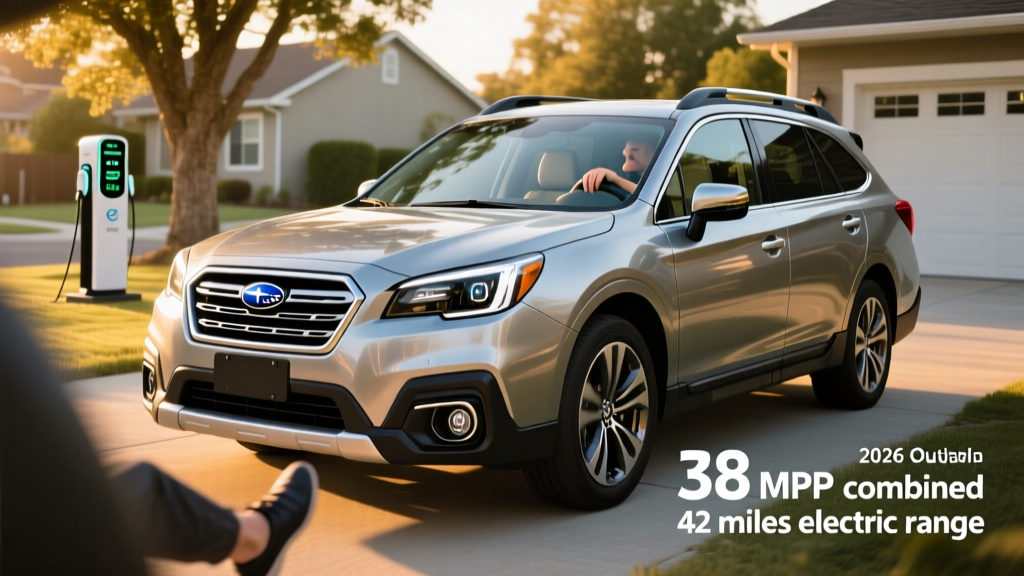
The Subaru Outback has long been the default wagon for outdoorsy drivers who need all-wheel drive, ground clearance, and cargo space without stepping up to an SUV. For the 2026 model year, Subaru continues to offer the Outback with its hybrid powertrain, giving buyers a meaningful fuel-economy bump over the standard turbocharged and naturally aspirated gas models. But with hybrid, plug-in hybrid, and full-electric options proliferating across the market, where exactly does the Subaru Outback hybrid fit — and does it deliver enough efficiency to justify its price premium?
In this guide, we dissect the 2026 Subaru Outback Hybrid's powertrain, real-world and EPA fuel economy, battery longevity, warranty coverage, pricing, and tax-credit eligibility. We also compare it head-to-head against PHEV and full-EV alternatives so you can make an informed purchase decision.
2026 Subaru Outback Hybrid: Powertrain and Specs at a Glance
The 2026 Outback Hybrid pairs Subaru's proven 2.5-liter flat-four (Boxer) engine with an electric motor integrated into the Lineartronic CVT transmission. This is a conventional hybrid (HEV) — it recovers energy through regenerative braking and assists the gas engine, but you never plug it in.
| Spec | Value |
|---|---|
| Powertrain | 2.5L Boxer-4 + electric motor (HEV) |
| Combined Horsepower | ~194 hp (net system output) |
| Drivetrain | Symmetrical AWD (standard) |
| Transmission | Lineartronic CVT |
| Hybrid Battery | ~1.1 kWh lithium-ion (traction assist) |
| Plug-In Required? | No — self-charging via regen |
| Ground Clearance | 8.7 inches |
| Cargo Volume (rear seats up) | 32.5 cu ft |
| Towing Capacity | 2,700 lbs |
| 0–60 mph | ~8.2 seconds (est.) |
Unlike the turbocharged 2.4L XT variant (which produces 260 hp but returns lower MPG), the hybrid prioritizes efficiency. The electric motor fills in low-rpm torque gaps that the CVT and naturally aspirated engine typically struggle with, making around-town acceleration feel more responsive than the base gas Outback.
Fuel Economy: EPA Ratings vs. Real-World MPG
The headline number for the Outback Hybrid is its EPA-rated fuel economy. Here's how it stacks up:
| Variant | City MPG | Highway MPG | Combined MPG |
|---|---|---|---|
| Outback Hybrid (HEV) | 35 | 34 | 35 |
| Outback 2.5L (Gas) | 26 | 32 | 28 |
| Outback 2.4T XT (Gas) | 22 | 29 | 25 |
Source: fueleconomy.gov — verify exact trim ratings for the current model year.
Compared to the base 2.5L gas Outback, the hybrid delivers roughly 25% better combined fuel economy. Over 15,000 miles annually at $3.50/gallon, that translates to approximately $375–$450 in annual fuel savings.
HEV vs. PHEV vs. EV: Which Electrified Outback (or Alternative) Fits You?
One of the most common questions we get: "Should I buy the hybrid, a plug-in hybrid, or go full electric?" Here's how these three electrified approaches compare in practical terms:
| Factor | HEV (Outback Hybrid) | PHEV (e.g., Toyota RAV4 Prime) | BEV (e.g., Hyundai Ioniq 5) |
|---|---|---|---|
| Plug in to charge? | No | Yes (optional) | Yes (required) |
| Electric-only range | None (motor assists only) | 35–42 miles typical | 250–320 miles |
| Total range | ~570 miles (15.1-gal tank) | ~580+ miles combined | 250–320 miles |
| Home charging needed? | No | Recommended for EV range | Essential |
| Federal tax credit (§30D) | No | Up to $7,500 (if eligible) | Up to $7,500 (if eligible) |
| Maintenance complexity | Low — similar to gas car | Moderate — two systems | Low — no engine/oil |
| Best for | No home charging, rural/long trips | Short commutes + road trips | Home charging + mostly under 250 mi/day |
The Outback Hybrid is the right call if: you don't have access to home or workplace charging, you regularly drive in remote areas where charging infrastructure is sparse, or you want better fuel economy without changing any habits. You gas up and go — the hybrid system works transparently in the background.
Consider a PHEV instead if: your daily commute is under 40 miles round-trip, you can install a Level 2 charger at home, and you still want gas-engine range for weekend road trips. The Toyota RAV4 Prime offers 42 miles of electric-only range with standard AWD, though it sacrifices some cargo space and ground clearance versus the Outback.
Consider a full EV if: you have reliable home charging, your daily driving stays under 250 miles, and you want to eliminate gas costs and engine maintenance entirely. The tradeoff: no current EV matches the Outback's combination of 8.7 inches of ground clearance, standard AWD, and wagon-style cargo volume at a similar price point.
Pricing, Trims, and Tax Credit Eligibility
The 2026 Subaru Outback Hybrid is available in Premium, Limited, and Touring trims, with pricing starting in the mid-$30,000s. Here's the approximate MSRP breakdown:
| Trim | Est. MSRP | Key Features |
|---|---|---|
| Premium Hybrid | ~$36,500 | Heated seats, EyeSight, 11.6" touchscreen |
| Limited Hybrid | ~$39,500 | Leather, power liftgate, blind-spot detection |
| Touring Hybrid | ~$42,500 | Nappa leather, ventilated seats, Harman Kardon audio |
Pricing is approximate and based on manufacturer announcements. Verify current MSRP on Subaru's official site.
This is a meaningful financial consideration. A similarly priced PHEV or EV that qualifies for the full $7,500 credit could effectively cost less out-of-pocket than the Outback Hybrid, even if its sticker price is higher. Always calculate your effective cost after incentives, not just MSRP.
Hybrid Battery Warranty, Lifespan, and Replacement Cost
Hybrid battery longevity is the number-one concern for buyers considering any hybrid vehicle. Here's what you need to know about the Outback Hybrid's battery:
- Hybrid Battery Warranty: 8 years / 100,000 miles (whichever comes first)
- CARB States: 10 years / 150,000 miles in states that follow California Air Resources Board emissions rules (CA, CT, MA, ME, MD, NJ, NY, OR, RI, VT, WA, and others adopting CARB standards)
- Capacity Threshold: Warranty covers failure or significant capacity loss below functional thresholds as defined by Subaru
- Powertrain Warranty: 5 years / 60,000 miles
Real-world lifespan data: Modern lithium-ion hybrid batteries in vehicles like the Outback Hybrid typically last 150,000–200,000+ miles before any significant degradation. Because the Outback Hybrid's battery pack is relatively small (~1.1 kWh) and is managed conservatively — never fully charged or fully depleted — the cells experience far less stress than a full EV battery. Many Toyota and Subaru hybrids from the 2010s are still running on their original battery packs well past 200,000 miles.
Replacement cost if out of warranty: If the hybrid battery does eventually need replacement outside the warranty window, expect to pay approximately $2,000–$3,500 for a replacement pack plus labor. This is significantly less than EV battery replacements ($5,000–$20,000+) because the pack is much smaller. Refurbished and aftermarket hybrid batteries are also available at lower cost.
Reliability, Safety, and Ownership Costs
Subaru's hybrid system is relatively conservative compared to Toyota's decades of hybrid refinement, but the Outback's core mechanicals — the 2.5L Boxer engine, CVT, and AWD system — are well-proven. The hybrid components add modest complexity but eliminate the traditional starter motor and reduce brake wear (thanks to regenerative braking), partially offsetting maintenance costs.
Safety: The 2026 Outback comes standard with Subaru's EyeSight driver-assistance suite, which includes adaptive cruise control, lane-keeping assist, pre-collision braking, and lane-departure warning. The Outback has consistently earned top marks from the IIHS (Top Safety Pick+) and the NHTSA (5-Star overall). EyeSight is a SAE Level 2 driver-assist system — it does not drive the car autonomously, and you must keep your hands on the wheel and eyes on the road at all times.
Insurance: Hybrid variants typically carry insurance premiums comparable to or slightly above the gas Outback — roughly $1,400–$1,800/year depending on your profile and state. This is generally less expensive to insure than a comparable EV.
5-Year Estimated Cost of Ownership:
| Expense | Outback Hybrid | Outback 2.5L Gas |
|---|---|---|
| Fuel (15,000 mi/yr × 5 yrs, $3.50/gal) | ~$7,500 | ~$9,375 |
| Estimated Maintenance (5 yrs) | ~$2,800 | ~$3,200 |
| Insurance (est. avg.) | ~$8,000 | ~$7,500 |
| Estimated Depreciation | ~$14,000 | ~$15,500 |
| Total (approx.) | ~$32,300 | ~$35,575 |
The hybrid's fuel savings and slightly better resale value (hybrids are in high demand on the used market) help offset its higher purchase price over five years.
Who Should Buy the Subaru Outback Hybrid?
✅ Choose the Outback Hybrid If:
- You want better MPG without plugging in or changing habits
- You drive in rural or mountainous areas with limited charging infrastructure
- You need AWD, high ground clearance, and wagon cargo space
- Your daily commute involves significant stop-and-go driving
- You plan to keep the vehicle 8+ years (warranty coverage)
❌ Look Elsewhere If:
- You have home charging and want maximum fuel savings (consider a PHEV or EV)
- You want to qualify for the $7,500 federal tax credit
- You want electric-only driving for short commutes
- You prioritize rapid acceleration (the hybrid is adequate, not quick)
- You want a third row or larger SUV (consider the Ascent Hybrid)
Frequently Asked Questions
How many MPG does the Subaru Outback Hybrid get?
The 2026 Subaru Outback Hybrid is EPA-rated at approximately 35 MPG city / 34 highway / 35 combined. In real-world city and suburban driving, many owners report 36–38 MPG thanks to frequent regenerative braking. Highway-only driving at higher speeds may yield 30–32 MPG.
Does the Subaru Outback Hybrid need to be plugged in?
No. The Outback Hybrid is a conventional hybrid (HEV). Its small battery recharges through regenerative braking and the gas engine. You simply fill up at the gas station as you would with any other car.
Is the Outback Hybrid available as a plug-in hybrid (PHEV)?
As of the 2026 model year, Subaru does not offer the Outback as a plug-in hybrid. The Crosstrek previously had a PHEV variant (discontinued after 2023). If you want a Subaru with plug-in capability, you may need to wait for future model announcements or consider a competitor like the Toyota RAV4 Prime.
Does the Subaru Outback Hybrid qualify for any tax credit?
No. The federal §30D Clean Vehicle Credit applies only to plug-in electric vehicles (BEVs and PHEVs) that meet battery-sourcing, MSRP, and buyer-income requirements. The Outback Hybrid, as a conventional HEV, does not qualify. Check your state's incentive database for any local hybrid rebates.
How long will the hybrid battery last?
Subaru covers the hybrid battery with an 8-year/100,000-mile warranty (10 years/150,000 miles in CARB states). In practice, modern hybrid batteries commonly last 150,000–200,000+ miles. Replacement cost out of warranty is approximately $2,000–$3,500.
Is the Outback Hybrid slower than the gas model?
The hybrid produces roughly 194 hp combined, compared to 182 hp for the base 2.5L gas model. Acceleration is similar — around 8.2 seconds 0–60 mph — but the electric motor provides stronger low-speed torque, making the hybrid feel more responsive in city driving. The turbocharged XT (260 hp, ~6.5 seconds 0–60) is noticeably quicker but sacrifices 10 MPG combined.
How does the Outback Hybrid compare to the Toyota RAV4 Hybrid?
The RAV4 Hybrid offers slightly higher MPG (~40 combined) and a lower starting price, but it's an SUV with less cargo length, lower ground clearance (8.1" vs. 8.7"), and a different driving position. The Outback Hybrid's wagon design provides superior cargo versatility for long items and a more car-like ride. The RAV4 Prime PHEV adds 42 miles of electric range but starts around $44,000.