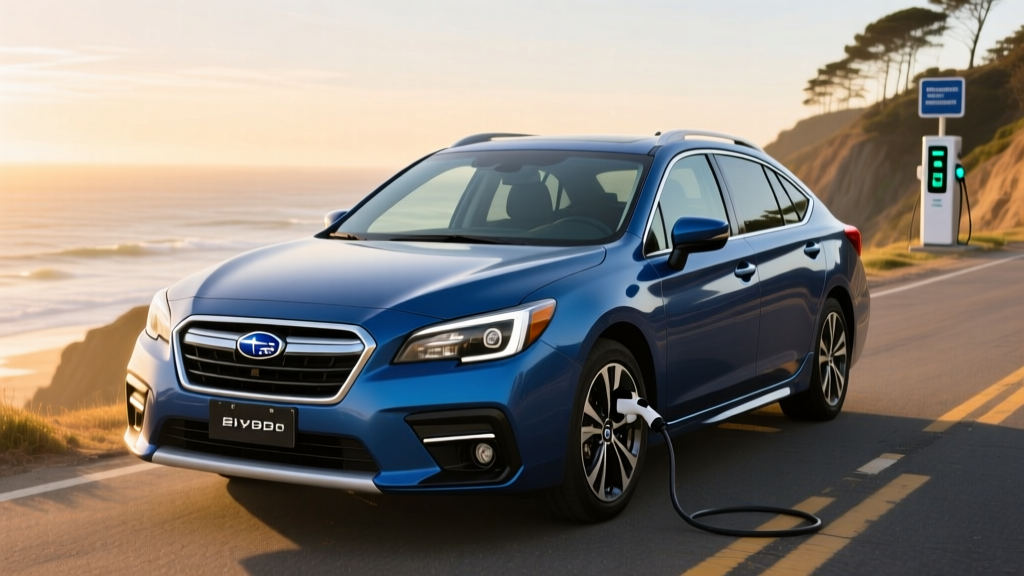
Subaru has built its reputation on symmetrical all-wheel drive and boxer engines, but as the midsize sedan segment electrifies, buyers are searching for a Subaru Legacy hybrid that delivers AWD capability without the fuel-economy penalty. For 2026, Subaru continues to refine its mild-hybrid and hybrid-assist technologies across the lineup, though the Legacy's electrification story is more nuanced than a simple hybrid badge.
This guide breaks down exactly what Subaru offers for hybrid-minded Legacy shoppers in 2026: the powertrain options, real-world fuel economy, battery warranty coverage, and how this sedan stacks up against hybrid rivals and full EVs.
Does Subaru Actually Make a Legacy Hybrid in 2026?
Yes — but with important context. For the 2026 model year, Subaru offers the Legacy with its updated FB25 2.5-liter boxer four-cylinder engine paired with a mild-hybrid assist system on select trims. This is a conventional hybrid (HEV) setup, not a plug-in hybrid (PHEV). You will not find a Legacy plug-in hybrid in Subaru's current U.S. lineup, and Subaru has not announced a Legacy PHEV for the North American market.
The distinction matters because conventional hybrids and plug-in hybrids serve different needs:
HEV vs. PHEV: What's the Difference?
| Feature | Conventional Hybrid (HEV) | Plug-in Hybrid (PHEV) |
|---|---|---|
| Plug-in charging required? | No — charges via regenerative braking and engine | Yes — plugs into Level 1 or Level 2 charger |
| Electric-only range | None (motor assists engine only) | Typically 20–45 miles on battery alone |
| Battery size | Small (~1–2 kWh) | Larger (~13–20 kWh) |
| Federal tax credit (§30D) | Not eligible | May qualify, subject to sourcing/income rules |
| Best for | Drivers who want better MPG without lifestyle change | Drivers with home charging who want short EV commutes |
The 2026 Legacy's hybrid system falls firmly in the HEV column. It uses a compact lithium-ion battery pack and an integrated electric motor to assist the gasoline engine during acceleration and to enable regenerative braking. There is no plug, no electric-only driving mode, and no range-anxiety trade-off — just improved fuel economy over the standard gas-only powertrain.
2026 Subaru Legacy Hybrid: Fuel Economy & MPG
Fuel economy is the primary reason buyers cross-shop hybrids. Here is how the 2026 Legacy hybrid powertrain performs according to EPA estimates:
| Powertrain | City MPG | Highway MPG | Combined MPG |
|---|---|---|---|
| 2.5L Boxer + Hybrid Assist (AWD) | 30 | 38 | 34 |
| 2.5L Boxer Gas-Only (AWD) | 27 | 35 | 30 |
| 2.4L Turbo (AWD, gas-only) | 23 | 31 | 26 |
Source: EPA Fuel Economy — figures reflect 2026 model year estimates for AWD configurations.
Real-World MPG: What to Expect
Hybrid systems tend to outperform their EPA city estimates in stop-and-go traffic, where regenerative braking recaptures the most energy. In mixed suburban driving, owners of Subaru's hybrid-assist models frequently report 1–3 MPG above the EPA combined figure. However, sustained highway driving at 75+ MPH, cold-weather operation (below 30°F), and mountainous terrain will pull fuel economy below the EPA sticker — expect 29–31 MPG combined in those conditions.
The hybrid assist system's biggest efficiency win comes in city driving, where the electric motor shoulders low-speed load and the engine can shut down at stops. If your commute is primarily urban or suburban, the Legacy hybrid's advantage over the gas-only model widens considerably — roughly 4–5 MPG in city-heavy cycles.
Powertrain & Performance Specs
| Specification | 2026 Subaru Legacy Hybrid (2.5L HEV) |
|---|---|
| Engine | 2.5L DOHC 4-cylinder boxer + electric motor assist |
| Combined Horsepower | ~197 hp (engine + motor) |
| Combined Torque | ~190 lb-ft |
| Transmission | Lineartronic CVT with manual mode |
| Drivetrain | Symmetrical All-Wheel Drive (standard) |
| 0–60 MPH | ~8.2 seconds |
| Hybrid Battery | Lithium-ion, ~1.5 kWh (assist only) |
| EPA Combined MPG | 34 MPG |
| Fuel Tank Capacity | 18.5 gallons |
| Total Driving Range | ~629 miles |
The electric motor in Subaru's hybrid-assist system is not designed for solo propulsion. Instead, it fills in the torque gap at low RPM where the naturally aspirated boxer engine is weakest, resulting in smoother takeoffs and reduced engine strain. The CVT keeps the engine in its most efficient operating range, which is where the fuel savings compound over thousands of miles.
Performance-wise, the 2.5L hybrid is adequate for daily driving and highway merging but will not satisfy enthusiasts. The available 2.4L turbocharged engine (260 hp) is the performance choice, though it sacrifices roughly 8 MPG combined and does not include hybrid assist.
Pricing & Tax Credit Eligibility
The 2026 Subaru Legacy hybrid-assist models are positioned in the mid-range of the lineup. Here is a pricing overview by trim:
| Trim | MSRP (est.) | Hybrid Assist Included? |
|---|---|---|
| Base | $27,500 | No |
| Premium | $30,200 | Optional |
| Limited | $34,500 | Standard |
| Sport (2.4T) | $36,800 | No (turbo gas-only) |
| Touring XT (2.4T) | $39,500 | No (turbo gas-only) |
Federal Tax Credit: Does the Legacy Hybrid Qualify?
No. The 2026 Subaru Legacy hybrid is a conventional HEV, and the IRS §30D Clean Vehicle Credit applies only to plug-in electric vehicles (BEVs and PHEVs) that meet battery sourcing, critical minerals, MSRP caps, and buyer income requirements. Conventional hybrids do not qualify for the federal $7,500 credit.
Some states offer their own incentives for hybrid vehicles — check your state's energy or environmental agency for current programs. A handful of states provide modest rebates ($500–$1,500) for HEV purchases, but these vary by jurisdiction and change frequently.
Battery & Powertrain Warranty Coverage
Subaru covers the hybrid battery and related components under its hybrid system warranty:
- Hybrid Battery Warranty: 8 years / 100,000 miles (whichever comes first)
- Powertrain Warranty: 5 years / 60,000 miles
- Bumper-to-Bumper: 3 years / 36,000 miles
The hybrid battery warranty aligns with the industry standard for HEV systems. Subaru's lithium-ion hybrid assist pack is far smaller and less stressed than a full EV traction battery, which contributes to its longevity.
Reliability & Battery Replacement Cost
Subaru's hybrid-assist system is one of the simpler electrified powertrains on the market. Because the battery pack is small (~1.5 kWh) and is never deeply cycled (it operates in a narrow state-of-charge window, typically 40–60%), degradation is minimal. Toyota and Subaru have both demonstrated that small HEV battery packs routinely last 150,000+ miles with negligible capacity loss.
According to reliability data tracked by IIHS and owner surveys, Subaru's boxer engines paired with the Lineartronic CVT have a strong long-term record. The hybrid assist system adds complexity but eliminates some wear on the gasoline engine by reducing load during acceleration.
Hybrid Battery Replacement Cost
If the hybrid battery does fail outside of warranty, replacement costs for the Legacy's small assist pack are significantly lower than a full EV battery replacement. Expect:
- OEM replacement battery pack: $2,000–$3,500 (parts)
- Labor: $500–$1,000
- Total out-of-pocket: $2,500–$4,500
For context, a full EV battery replacement can cost $10,000–$20,000+. The Legacy's hybrid system is a low-stress, low-risk component in the overall powertrain.
Legacy Hybrid vs. the Competition
The midsize hybrid sedan segment is competitive. Here is how the Legacy stacks up against key rivals:
| Model | Combined MPG | AWD Available? | Starting MSRP | Hybrid Type |
|---|---|---|---|---|
| 2026 Subaru Legacy Hybrid | 34 | Standard | ~$30,200 | HEV (mild assist) |
| Toyota Camry Hybrid | 52 | Available | $29,500 | HEV (full hybrid) |
| Honda Accord Hybrid | 44 | No | $33,000 | HEV (full hybrid) |
| Hyundai Sonata Hybrid | 47 | No | $31,000 | HEV (full hybrid) |
The Legacy's defining advantage is standard all-wheel drive — none of its rivals include AWD as standard, and only the Camry offers it as an option. If you live in a snow-belt state or frequently drive on unpaved roads, the Legacy's symmetrical AWD system is a genuine differentiator that no competitor matches at the same price point.
However, the Legacy trails its rivals in pure fuel economy. Toyota's full-hybrid system (which can propel the Camry on electric power alone at low speeds) achieves 52 MPG combined — an 18 MPG advantage. If maximum fuel savings is your sole priority and you do not need AWD, the Camry Hybrid is the efficiency leader.
Pros
- Standard symmetrical AWD — unique in the segment
- Strong safety ratings (IIHS Top Safety Pick+ expected)
- Comfortable ride quality and spacious rear seat
- Simple hybrid system with low long-term risk
- Competitive pricing for an AWD midsize sedan
Cons
- MPG trails full-hybrid rivals by 10–18 MPG combined
- No plug-in hybrid or electric-only capability
- CVT can feel sluggish during hard acceleration
- No federal tax credit eligibility
- Sedan body style limits cargo versatility vs. SUVs
Who Should Buy the Subaru Legacy Hybrid?
Choose the Legacy Hybrid If:
- You need all-wheel drive for snow, rain, or gravel roads
- You want modest fuel savings without changing your driving habits
- You prefer a traditional sedan with a proven AWD system
- You drive 12,000–18,000 miles per year and value lower fuel costs
Look Elsewhere If:
- Maximum MPG is your top priority (Camry Hybrid gets 52 combined)
- You want electric-only commuting (consider a PHEV like the Toyota RAV4 Prime)
- You want to eliminate gasoline entirely (consider a full BEV like the Tesla Model 3 or Hyundai Ioniq 6)
- You need SUV cargo space (Subaru Outback hybrid may be a better fit)
Hybrid vs. PHEV vs. Full EV: Which Fits You?
The right electrified vehicle depends on your driving patterns, charging access, and budget:
- HEV (Legacy Hybrid): Best if you have no home charging, drive long distances regularly, and want zero lifestyle change. You will never plug in — just drive and refuel at gas stations, but with ~15% better fuel economy.
- PHEV: Best if you have home Level 1 or Level 2 charging, commute under 30 miles round-trip, but still want the freedom for long road trips without charging stops. You get electric-only daily driving plus a gas engine for longer trips.
- Full EV (BEV): Best if you have reliable home or workplace charging, want the lowest per-mile fuel cost (electricity at $0.13/kWh ≈ $4.50 per "fill-up" vs. $50+ for gas), and are ready to plan longer road trips around DC fast-charging infrastructure.
Frequently Asked Questions
How many MPG does the 2026 Subaru Legacy hybrid get?
The 2026 Legacy with the 2.5L hybrid-assist powertrain achieves an EPA-estimated 30 city / 38 highway / 34 combined MPG. Real-world city driving often yields 1–3 MPG above the EPA figure thanks to regenerative braking, while sustained highway speeds above 75 MPH and cold weather will reduce economy to the high 20s.
Is the Subaru Legacy hybrid a plug-in hybrid?
No. The 2026 Legacy hybrid is a conventional HEV — it charges its small battery through regenerative braking and the gasoline engine. There is no plug, no charging port, and no electric-only driving mode. Subaru does not currently offer a Legacy PHEV in the U.S. market.
Does the Subaru Legacy hybrid qualify for a federal tax credit?
No. The IRS §30D Clean Vehicle Credit applies only to plug-in electric vehicles (BEVs and PHEVs) that meet battery sourcing, MSRP, and income requirements. Conventional hybrids like the Legacy are not eligible for the federal $7,500 credit. Some state-level hybrid incentives may be available — check your local energy agency.
How long will the Legacy hybrid battery last?
Subaru covers the hybrid battery for 8 years or 100,000 miles. In practice, small HEV battery packs from Subaru and Toyota routinely last 150,000–200,000+ miles because they operate in a narrow charge window and are never deeply discharged. Out-of-warranty replacement costs approximately $2,500–$4,500 if needed.
Is the Subaru Legacy hybrid reliable?
Subaru's hybrid-assist system adds minimal complexity to the proven FB25 boxer engine and Lineartronic CVT. The small lithium-ion battery pack is low-stress, and the system has fewer failure points than a full hybrid or PHEV powertrain. Subaru's AWD system and boxer engines have a strong long-term reliability record, though CVT maintenance (fluid changes at recommended intervals) is important for longevity.
Should I get the Legacy hybrid or a full EV?
If you lack home charging, regularly drive more than 300 miles between stops, or live in an area with sparse DC fast-charging infrastructure, the Legacy hybrid offers a practical efficiency upgrade with zero lifestyle change. If you have home Level 2 charging, a predictable commute, and want to eliminate gasoline costs, a full EV like the Tesla Model 3 or Hyundai Ioniq 6 will save significantly more on fuel over 5 years — but at a higher purchase price.