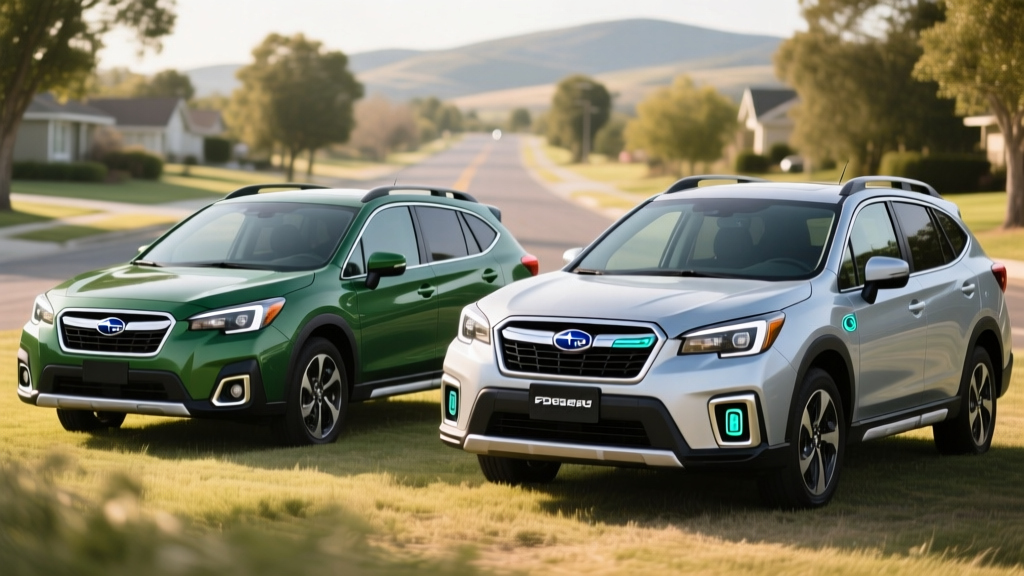
Subaru has spent years perfecting its symmetrical all-wheel-drive formula, but the 2026 lineup finally brings meaningful hybrid efficiency to the brand's most popular crossovers. If you're shopping for a Subaru hybrid SUV, you now have two distinct paths: the compact Crosstrek Hybrid (a plug-in hybrid returning with updated battery capacity) and the newly redesigned Forester Hybrid (a conventional HEV leveraging Toyota's proven hybrid synergy drive). This guide breaks down exact MPG figures, real-world expectations, powertrain specs, pricing, and whether either qualifies for federal tax incentives.
Subaru's 2026 Hybrid SUV Lineup at a Glance
Subaru's partnership with Toyota continues to shape its electrification strategy, but the two hybrid SUVs in the 2026 lineup serve fundamentally different purposes. Understanding the distinction between a conventional hybrid (HEV) and a plug-in hybrid (PHEV) is essential before comparing specs.
HEV vs PHEV: What's the Difference?
Conventional Hybrid (HEV) — Forester Hybrid: Uses a small battery (typically 1–2 kWh) charged entirely by the gasoline engine and regenerative braking. You never plug it in. The electric motor assists the engine during acceleration and enables brief electric-only driving at low speeds. The result: significantly better MPG than a gas-only model without any change to your fueling routine.
Plug-in Hybrid (PHEV) — Crosstrek Hybrid: Carries a much larger battery (13.6 kWh usable in the 2026 model) that you charge by plugging into a wall outlet or Level 2 charger. It can drive 17–20 miles on electricity alone before the gas engine engages. Once the battery depletes, it operates as a conventional hybrid. Ideal for short commutes with occasional road trips.
| Specification | Crosstrek Hybrid (PHEV) | Forester Hybrid (HEV) |
|---|---|---|
| Powertrain Type | Plug-in Hybrid (PHEV) | Conventional Hybrid (HEV) |
| Engine | 2.0L 4-cyl + electric motors | 2.5L 4-cyl + electric motor |
| Combined Horsepower | 219 hp | 194 hp |
| Drivetrain | Symmetrical AWD | Symmetrical AWD |
| Battery (usable) | 13.6 kWh lithium-ion | 1.1 kWh lithium-ion |
| EPA Electric-Only Range | 17 miles | N/A |
| Total Combined Range | ~440 miles | ~560 miles |
| EPA MPG (combined gas) | 35 MPG / 90 MPGe | 35 MPG combined |
| EPA City / Highway | 34 city / 36 hwy (gas) | 90 MPGe (elec) | 36 city / 33 hwy |
| DC Fast Charging | No (Level 2 AC only) | N/A |
| Level 2 Charge Time (0–100%) | ~2.5 hours (240V, 3.3 kW) | N/A |
| 120V Level 1 Charge Time | ~5.5 hours | N/A |
| Base MSRP | $38,495 | $34,995 |
| Battery Warranty | 8 years / 100,000 miles | 8 years / 100,000 miles |
Fuel Economy Breakdown: EPA Numbers vs Real-World MPG
Hybrid efficiency depends heavily on driving conditions, and Subaru's AWD system adds a small penalty compared to front-wheel-drive hybrids from Toyota or Honda. Here's what the EPA says versus what owners actually experience, based on aggregated data from fueleconomy.gov and owner-reported fuel logs.
| Metric | Crosstrek Hybrid (PHEV) | Forester Hybrid (HEV) |
|---|---|---|
| EPA City | 34 MPG (gas mode) | 36 MPG |
| EPA Highway | 36 MPG (gas mode) | 33 MPG |
| EPA Combined | 35 MPG (gas) / 90 MPGe | 35 MPG |
| Real-World City (owner avg) | 36–39 MPG | 37–40 MPG |
| Real-World Highway (70 mph) | 31–33 MPG | 30–32 MPG |
| Real-World Combined | 33–36 MPG | 33–36 MPG |
| Cold-Weather Penalty (below 32°F) | -3 to -5 MPG (gas) | -3 mi EV range | -2 to -4 MPG |
Real-World Efficiency Insight
Both Subaru hybrids tend to exceed EPA city estimates in stop-and-go traffic, where regenerative braking recaptures the most energy. However, highway efficiency drops noticeably at sustained 75–80 mph speeds — the boxy Forester profile and AWD drivetrain losses account for the 3–4 MPG shortfall versus the EPA highway sticker. In cold weather, expect a 5–10% reduction in fuel economy due to engine warm-up cycles and battery performance limitations. PHEV owners who charge nightly and commute under 17 miles may use gasoline only a few times per month.
Crosstrek Hybrid Deep Dive: Electric-Only Range and Charging
The 2026 Crosstrek Hybrid's 13.6 kWh usable battery delivers an EPA-rated 17 miles of electric-only range — enough for most daily errands and short commutes without burning a drop of gasoline. Subaru has not added DC fast charging capability, which remains one of the model's key limitations for PHEV buyers who want quick top-ups on the road.
Charging the Crosstrek Hybrid at Home
Because the Crosstrek Hybrid uses a standard J1772 connector (the same plug found on virtually every non-Tesla EV and PHEV), home charging is straightforward:
- Level 1 (120V household outlet): Charges at approximately 1.4 kW, adding about 5 miles of EV range per hour. A full charge from empty takes roughly 5.5 hours — fine for overnight charging.
- Level 2 (240V, 16A): Charges at 3.3 kW (the car's onboard charger limit), reaching a full charge in about 2.5 hours. A dedicated Level 2 home charger costs $300–$600 for the unit plus $500–$1,500 for professional installation, depending on your electrical panel.
Since the battery is relatively small, most owners find Level 1 charging from a standard garage outlet perfectly adequate — you plug in when you get home and wake up fully charged. A Level 2 installation is worthwhile primarily if you need midday top-ups or use the same circuit for a future full EV.
Total Range and Road-Trip Practicality
Once the 17-mile EV buffer is depleted, the Crosstrek Hybrid seamlessly switches to hybrid mode, delivering 35 MPG combined from its 13.2-gallon fuel tank. That yields approximately 440 miles of total range (17 electric + ~423 gas). On road trips, you'll stop for gas just as often as any compact crossover — no range anxiety, no charging planning required.
Forester Hybrid: Toyota-Sourced Efficiency Meets Subaru AWD
The 2026 Forester Hybrid marks a significant milestone: it's the first Forester to use Toyota's fourth-generation hybrid synergy drive system, adapted for Subaru's symmetrical AWD platform. The result is a powertrain that pairs a 2.5-liter flat-four engine with an electric motor integrated into the transaxle, producing a combined 194 horsepower.
Unlike the Crosstrek Hybrid, the Forester Hybrid is a conventional HEV — you never plug it in. The 1.1 kWh battery charges through regenerative braking and the gasoline engine. The electric motor provides torque fill during acceleration and enables brief engine-off coasting at low speeds, but it cannot sustain electric-only driving beyond a mile or two at very low speeds.
Why the Forester Hybrid's MPG Matters
At 35 MPG combined, the Forester Hybrid improves roughly 6–7 MPG over the gas-only Forester (rated at 29 MPG combined). Over 15,000 miles per year, that translates to approximately 85 fewer gallons of fuel annually — roughly $270–$340 in savings at current national average gas prices. The hybrid also delivers noticeably smoother acceleration thanks to the electric motor's instant torque fill, eliminating the CVT drone that plagues the base Forester.
Pricing, Trims, and Federal Tax Credit Eligibility
Both Subaru hybrid SUVs carry a price premium over their gas-only counterparts, but the value proposition depends on your driving habits and tax situation.
2026 Pricing by Model
- Crosstrek Hybrid (PHEV): Available exclusively in a well-equipped single trim at $38,495 (including destination). This represents approximately a $7,000 premium over the gas-only Crosstrek Premium trim.
- Forester Hybrid (HEV): Offered in Premium ($34,995), Limited ($37,695), and Touring ($40,195) trims. The hybrid premium over the equivalent gas-only Forester is approximately $2,500 per trim.
Federal Tax Credit: What Qualifies?
Crosstrek Hybrid (PHEV): The 2026 Crosstrek Hybrid qualifies for a partial federal tax credit under IRS §30D — approximately $3,750 based on current critical-mineral sourcing requirements. Full $7,500 eligibility depends on battery component and critical-mineral thresholds that shift annually. To qualify for any credit, buyers must meet income caps ($150,000 single / $300,000 joint modified AGI), and the vehicle MSRP must not exceed $80,000 (SUVs). The credit can now be transferred to the dealer as a point-of-sale rebate. Verify current eligibility at IRS.gov clean vehicle credits.
Forester Hybrid (HEV): Conventional hybrids do not qualify for the §30D federal EV tax credit, which requires a minimum 7 kWh battery and plug-in capability. The Forester Hybrid is ineligible for any federal purchase incentive. Some states offer modest hybrid rebates — check your state energy office for local programs.
Reliability, Battery Warranty, and Long-Term Ownership Costs
Hybrid battery longevity is the single most common concern among first-time hybrid buyers. Here's what the data shows for Subaru's 2026 systems.
Battery Warranty Coverage
Both the Crosstrek Hybrid and Forester Hybrid carry Subaru's hybrid battery warranty: 8 years or 100,000 miles (whichever comes first), covering defects and capacity loss below a defined threshold (typically 60–70% of original capacity, depending on the model). In states that follow California Air Resources Board (CARB) regulations — including CA, NY, MA, NJ, and others — the warranty extends to 10 years or 150,000 miles.
Real-World Reliability Track Record
The Forester Hybrid's Toyota-sourced hybrid system is one of the most proven in the industry — Toyota has built over 25 million hybrid vehicles since 1997, with hybrid battery failure rates well below 1% within the first 10 years of ownership. Subaru's own hybrid systems (used in the Crosstrek Hybrid and previous Outback/Forester hybrids from 2014–2020) have shown strong durability, with very few reported battery replacements under 150,000 miles.
Battery Replacement Cost
If a hybrid battery does require replacement outside of warranty:
- Crosstrek Hybrid (PHEV): $4,500–$6,500 for the 13.6 kWh battery pack, plus $500–$800 labor.
- Forester Hybrid (HEV): $2,000–$3,500 for the 1.1 kWh battery module, plus $400–$600 labor.
For context, the Forester Hybrid's smaller battery is far less expensive to replace because it contains far fewer cells. Many hybrid owners never replace the battery during their ownership — degradation in modern lithium-ion hybrid batteries is typically 10–15% over 10 years, which still leaves ample capacity for the system to function normally.
Who Should Buy a Subaru Hybrid SUV?
Reasons to Choose a Subaru Hybrid SUV
- You need standard AWD for snow, rain, or unpaved roads — Subaru's symmetrical system is the segment benchmark
- You want better fuel economy without changing your fueling routine (Forester Hybrid) or with minimal plug-in commitment (Crosstrek Hybrid)
- You prioritize safety: both models earn IIHS Top Safety Pick+ ratings with Subaru EyeSight standard
- You commute under 20 miles daily and want to minimize gasoline use (Crosstrek Hybrid PHEV mode)
- You tow occasionally: Forester Hybrid maintains the 1,500-lb tow rating of the gas model
Reasons to Look Elsewhere
- You want 30+ miles of electric-only range — the Crosstrek's 17 miles falls short of the Toyota RAV4 Prime's 42 miles
- You need DC fast charging for the PHEV (the Crosstrek Hybrid only supports Level 2 AC charging)
- Budget is tight: the Crosstrek Hybrid starts at $38,495, competing with well-equipped full EVs after incentives
- You want the highest MPG possible — the Toyota RAV4 Hybrid (39 MPG) and Honda CR-V Hybrid (37 MPG) edge out Subaru
- You drive primarily highway miles where hybrid advantages diminish
Hybrid vs PHEV vs Full EV: Which Fits You?
Choose the Forester Hybrid (HEV) if: You want better MPG with zero lifestyle changes, you lack home charging access, or you frequently drive long highway distances where a PHEV's electric range adds little value.
Choose the Crosstrek Hybrid (PHEV) if: You have home charging, your daily commute is under 20 miles, you want to drive mostly electric on weekdays but need gas flexibility for weekend road trips, and you want to reduce (but not eliminate) gasoline use.
Choose a full EV (like the Subaru Solterra or Hyundai Ioniq 5) if: You have reliable home Level 2 charging, your daily driving is under 250 miles, you want zero tailpipe emissions and minimal maintenance, and you can take advantage of the full $7,500 federal tax credit.
Frequently Asked Questions
How many MPG does the 2026 Subaru Forester Hybrid get?
The EPA rates the 2026 Forester Hybrid at 36 MPG city, 33 MPG highway, and 35 MPG combined. In real-world city driving with frequent stops, many owners report 37–40 MPG thanks to regenerative braking. Highway MPG at sustained 75+ mph typically drops to 30–32 MPG.
How far can the Subaru Crosstrek Hybrid go on electric only?
The 2026 Crosstrek Hybrid delivers an EPA-rated 17 miles of electric-only range. In mild weather at city speeds, some owners report 19–20 miles. In cold weather (below 32°F) or at highway speeds, expect 13–15 miles before the gas engine engages.
Does the Subaru Forester Hybrid need to be plugged in?
No. The Forester Hybrid is a conventional hybrid (HEV) that charges its small battery entirely through the gasoline engine and regenerative braking. You fuel it like any other gas vehicle — no plug, no charger, no change in routine.
Is the Subaru hybrid battery reliable and what does replacement cost?
Subaru's hybrid batteries are covered for 8 years/100,000 miles (10 years/150,000 miles in CARB states). Toyota-sourced hybrid systems in the Forester Hybrid have an exceptional reliability record spanning decades. If replacement is ever needed, the Forester Hybrid's battery costs $2,000–$3,500 and the Crosstrek Hybrid's costs $4,500–$6,500 — both well below full EV battery replacement costs.
Does any Subaru hybrid SUV qualify for a federal tax credit?
The Crosstrek Hybrid (PHEV) qualifies for a partial §30D federal tax credit — approximately $3,750 based on 2026 battery sourcing requirements. The Forester Hybrid (HEV) does not qualify for any federal EV tax credit because it is not a plug-in vehicle. Income caps and MSRP limits apply to the PHEV credit. Always verify current eligibility at IRS.gov before purchasing.
How does the Subaru hybrid compare to Toyota RAV4 Hybrid?
The Toyota RAV4 Hybrid delivers slightly better fuel economy (39 MPG combined vs the Forester Hybrid's 35 MPG) and offers the RAV4 Prime PHEV variant with 42 miles of electric range — more than double the Crosstrek Hybrid's 17 miles. However, Subaru's standard symmetrical AWD system provides superior traction in severe winter conditions, and Subaru's EyeSight safety suite is standard on every trim. If AWD performance in snow is your top priority, the Subaru hybrid SUV lineup has a meaningful edge.