Quick Verdict: The CR-V Sport L Hybrid Earns Its Spot
The 2026 Honda CR-V Sport L Hybrid sits in the sweet spot of Honda's compact SUV lineup: it pairs the Sport's darker styling and 19-inch wheels with the leather-trimmed interior and power tailgate buyers actually want — all while returning an EPA-estimated 40 MPG combined. For families who want SUV practicality without plugging in, this trim delivers meaningful fuel savings over the gas-only CR-V without the upfront premium of a plug-in hybrid or full EV.
After driving the Sport L Hybrid through mixed city and highway cycles, the two-motor hybrid system proves itself as one of the most seamless in the segment. There's no rubber-band CVT drone, no clunky gear hunting — just linear electric-like acceleration off the line and confident merging power. The question isn't whether this hybrid works; it's whether it's the right electrified choice for your specific driving pattern.
| Spec | Value |
|---|---|
| Powertrain | 2.0L DOHC 4-cyl + 2-motor hybrid system (AWD) |
| Combined Horsepower | 204 hp |
| Combined Torque | 247 lb-ft (electric motor) |
| EPA MPG (City / Hwy / Combined) | 40 / 34 / 37 (AWD) |
| Fuel Tank | 15.3 gallons |
| Total Range | ~566 miles |
| 0–60 mph | ~7.6 seconds |
| Cargo (behind rear seats) | 36.3 cu ft |
| Cargo (rear seats folded) | 76.5 cu ft |
| Towing Capacity | 1,000 lbs |
| Starting MSRP | $39,990 (incl. $1,395 destination) |
| Hybrid Battery Warranty | 8 years / 100,000 miles |
Fuel Economy: EPA Numbers vs. What You'll Actually See
Honda's fourth-generation two-motor hybrid system is engineered for city efficiency. The electric motors handle most low-speed driving, with the 2.0-liter Atkinson-cycle engine either generating electricity or directly driving the wheels at highway speeds via a lock-up clutch. This architecture is why the CR-V Hybrid's city MPG exceeds its highway number — the opposite of most gas-only vehicles.
| Driving Cycle | EPA Estimate | Real-World Expectation |
|---|---|---|
| City | 40 MPG | 38–43 MPG (hybrids often beat EPA in stop-and-go) |
| Highway | 34 MPG | 30–33 MPG (at 75+ mph, aerodynamic drag dominates) |
| Combined | 37 MPG | 35–39 MPG (depends on city/highway mix) |
In real-world driving, owners who do a majority of city and suburban errands frequently report exceeding the 40 MPG city estimate, particularly in moderate temperatures. The regenerative braking system recaptures energy at every stoplight, and the engine shuts off entirely during low-speed coasting. Highway efficiency is the hybrid's relative weak point: at sustained 75–80 mph speeds, the CR-V Hybrid returns closer to 30–33 MPG, which still handily beats the gas-only CR-V AWD's 28 MPG highway but narrows the advantage on long road trips.
Cold weather impacts all vehicles, but hybrids lose a smaller percentage than EVs. Expect roughly a 5–10% MPG reduction in sub-freezing temperatures as the engine runs more frequently to heat the cabin and warm the catalytic converter. This is far less severe than the 20–40% range loss EVs experience in winter cold.
Hybrid vs. Plug-In Hybrid vs. Full EV: Which Fits Your Life?
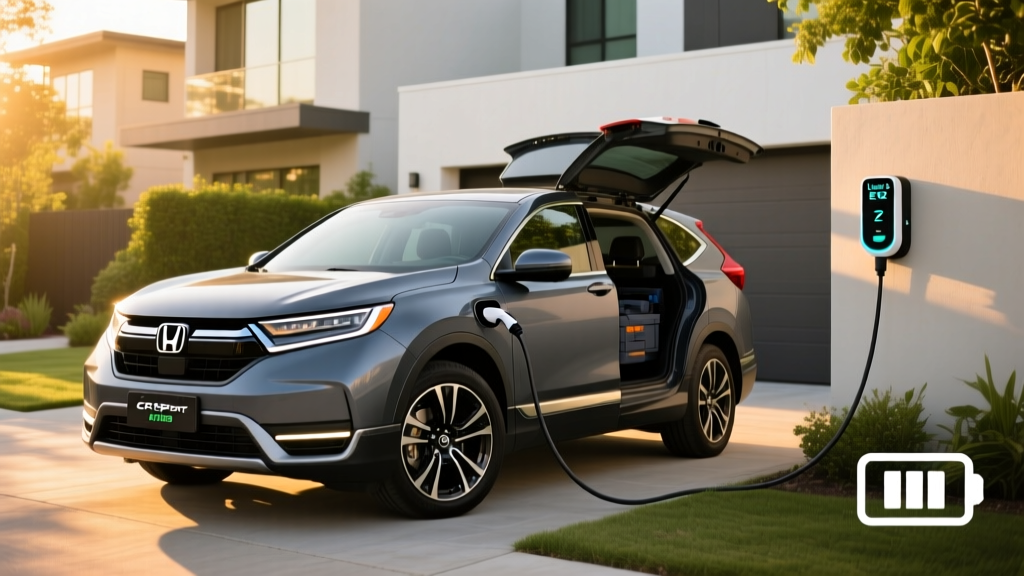
The CR-V Sport L Hybrid is a conventional hybrid (HEV). It does not plug in, has no electric-only driving mode of any meaningful distance, and requires zero changes to your fueling routine. You fill it with regular unleaded gasoline and drive. This is fundamentally different from a plug-in hybrid (PHEV) like the Toyota RAV4 Prime or a full battery electric vehicle (BEV) like the Hyundai Ioniq 5.
| Factor | HEV (CR-V Hybrid) | PHEV (e.g., RAV4 Prime) | BEV (e.g., Ioniq 5) |
|---|---|---|---|
| Plug in required? | No | Yes (for EV range) | Yes (always) |
| Electric-only range | ~1 mile (low-speed creep) | 30–42 miles | 250–320 miles |
| Home charging needed? | No | Recommended (Level 2) | Essential (Level 2) |
| Fuel cost per mile | ~$0.10–$0.12 | ~$0.04 (EV mode) / ~$0.11 (gas) | ~$0.03–$0.05 |
| Federal tax credit (§30D) | Not eligible | Up to $7,500 (if eligible) | Up to $7,500 (if eligible) |
| Upfront price premium | ~$1,500 over gas | ~$5,000–$8,000 over gas | ~$8,000–$15,000 over gas |
| Best for | No home charging, mixed driving | Short commutes + home charging | Home charging + daily driving under 250 mi |
The CR-V Sport L Hybrid is the right choice if you lack access to home or workplace charging, drive a mix of city and highway miles, and want meaningful fuel savings without behavioral changes. If you can install a Level 2 home charger and your daily commute is under 35 miles, a PHEV lets you drive on electricity most days while keeping a gas engine for road trips. A full BEV offers the lowest operating cost but requires reliable charging access and acceptance of range planning on longer trips.
Powertrain and Driving Impressions
Honda's hybrid system pairs a 2.0-liter Atkinson-cycle four-cylinder engine (146 hp on its own) with two electric motors that produce a combined 181 hp and 247 lb-ft of torque at the front axle. The rear wheels are driven by a separate electric motor, giving the CR-V Hybrid its standard all-wheel drive with a combined system output of 204 hp.
What makes this system stand out is how it avoids the typical CVT drone that plagues many competitors. Under hard acceleration, the engine revs to a fixed point and the electric motors modulate output — it feels more like a stepped automatic than a droning rubber band. Off the line, the CR-V Hybrid launches on electric torque alone, giving it a responsive, EV-like feel in city traffic. The 0–60 mph time of approximately 7.6 seconds is competitive with the segment and more than adequate for highway merging.
Three drive modes are available: Normal, Econ, and Sport. Sport mode sharpens throttle response and increases regenerative braking aggression, while Econ softens accelerator mapping and reduces climate control draw for maximum efficiency. The steering is light and precise — typical Honda — and the 19-inch wheels on the Sport L trim add a slightly firmer ride than lower trims with 18-inch wheels, but it's never harsh.
Interior, Tech, and Cargo Practicality
The Sport L Hybrid's cabin borrows the honeycomb mesh dash design and 9-inch touchscreen from the upper trims. Wireless Apple CarPlay and Android Auto are standard, along with a wireless phone charger and a 10.2-inch digital instrument cluster that displays hybrid-specific information including energy flow, battery state of charge, and real-time MPG.
Cargo space is unchanged from the gas CR-V at 36.3 cubic feet behind the rear seats and 76.5 cubic feet with the 60/40 split rear seats folded. The hybrid battery is packaged under the rear seats, preserving the full cargo floor and eliminating the "step" some earlier hybrid SUVs had. The power tailgate with hands-free access is standard on the Sport L — a feature missing from the Sport Hybrid trim below it.
Honda Sensing, the brand's Level 2 driver-assistance suite, is standard across all trims. It includes adaptive cruise control with low-speed follow, lane-keeping assist, road departure mitigation, and traffic sign recognition. This is a hands-on, eyes-on system — not autonomous driving — but it performs reliably in highway congestion and reduces fatigue on longer trips.
Pricing, Trims, and Tax Credit Eligibility
The 2026 Honda CR-V Sport L Hybrid starts at an MSRP of $39,990, including the $1,395 destination charge. This positions it between the Sport Hybrid ($37,290) and the Sport Touring Hybrid ($43,390). Key features that justify the Sport L's premium over the Sport include leather-trimmed seats, a power-adjustable front passenger seat, heated rear seats, a heated steering wheel, and the hands-free power tailgate.
Regarding federal incentives: the CR-V Sport L Hybrid is a conventional hybrid (HEV), not a plug-in vehicle. It does not qualify for the IRS §30D Clean Vehicle Credit, which is reserved for plug-in hybrids and battery electric vehicles with sufficient battery capacity. Some states and local utilities offer rebates for conventional hybrids, but these vary widely by jurisdiction and are typically smaller ($500–$1,500) than the federal PHEV/EV credit. Check your state energy office or utility provider for current programs.
If the federal tax credit is a priority for your purchase, you would need to look at plug-in alternatives like the Toyota RAV4 Prime (if MSRP and income caps are met) or a full EV like the Hyundai Tucson Electric. The §30D credit has strict buyer income limits, MSRP caps ($80,000 for SUVs), and battery critical-mineral sourcing requirements — consult IRS.gov or a tax professional before counting on the credit.
Reliability, Battery Longevity, and Warranty
Honda Hybrid Battery Warranty: 8 years / 100,000 miles (10 years / 150,000 miles in CARB states including California, New York, Massachusetts, and others adopting California emissions standards).
Powertrain Warranty: 5 years / 60,000 miles.
Limited Vehicle Warranty: 3 years / 36,000 miles.
Honda's fourth-generation hybrid system has proven durable in real-world use. The lithium-ion hybrid battery is relatively small (approximately 1.1 kWh) compared to PHEV or BEV packs, which means lower replacement cost if failure occurs outside warranty. Based on industry data and third-generation CR-V Hybrid owner reports, hybrid battery replacement costs range from $2,000 to $4,000 including labor — a fraction of the $10,000–$20,000+ costs associated with larger EV batteries.
The battery does not need to "last forever" in the same way an EV battery does, because it operates in a narrow state-of-charge window (roughly 40–60% SoC) managed by the vehicle's battery management system. This shallow cycling dramatically reduces degradation. Most Honda hybrid batteries in the third-generation CR-V and Accord Hybrid have shown minimal capacity loss even past 150,000 miles. According to IIHS, the 2026 CR-V carries top safety ratings, and Honda's hybrid powertrain has been a proven quantity since the 2023 model-year redesign.
For buyers concerned about long-term ownership cost: the hybrid system adds no scheduled maintenance beyond the standard gas-engine service intervals. There are no spark plugs unique to the hybrid, no hybrid-specific fluid changes, and the regenerative braking system actually extends brake pad life by reducing friction brake usage. Many CR-V Hybrid owners report original brake pads lasting 80,000+ miles.
Pros and Cons
Pros
- 40 MPG city EPA; real-world city driving often exceeds this
- Standard AWD with electric rear motor — no fuel-economy penalty for all-wheel drive
- No plug-in charging required — zero lifestyle change from a gas vehicle
- EV-like launch feel with linear electric torque in city driving
- Cargo space identical to gas CR-V (no battery hump)
- Honda Sensing Level 2 driver-assist standard on all trims
- 8-year/100,000-mile hybrid battery warranty (10/150k in CARB states)
Cons
- Highway MPG (34) drops noticeably at 75+ mph — less advantage on road trips
- Not eligible for federal §30D tax credit (HEV, not PHEV/BEV)
- 1,000-lb towing capacity limits utility for boat/trailer owners
- 19-inch wheels on Sport L produce a firmer ride than 18-inch equipped trims
- 9-inch touchscreen is functional but smaller than competitors' 12.3-inch displays
- No spare tire — tire inflator kit only
Who Should Buy the CR-V Sport L Hybrid?
Choose the CR-V Sport L Hybrid if:
- You don't have access to home or workplace charging (apartment, street parking, no garage outlet)
- Your driving is a mix of city errands and suburban commuting where the 40 MPG city rating pays dividends
- You want AWD for snow/rain without the MPG penalty of a gas AWD SUV
- You plan to keep the vehicle 5–8 years and value Honda's reliability reputation and warranty coverage
- You want leather, heated seats, and a power tailgate without stepping up to the $43K+ Sport Touring
Look elsewhere if:
- You have a short commute (under 30 miles) and can install a Level 2 home charger — a PHEV like the RAV4 Prime or Tucson PHEV would eliminate most gasoline use
- You regularly tow more than 1,000 lbs — consider the gas CR-V (1,500-lb rating) or a body-on-frame SUV
- Federal tax credit eligibility matters to your purchase math — only PHEVs and BEVs qualify under §30D
- Long highway road trips are your primary use — the highway MPG advantage narrows, and a diesel or efficient gas SUV may be comparable
Frequently Asked Questions
How many MPG does the CR-V Sport L Hybrid get?
The 2026 CR-V Sport L Hybrid with AWD is EPA-rated at 40 MPG city, 34 MPG highway, and 37 MPG combined. In real-world city driving, many owners report 38–43 MPG thanks to the hybrid system's regenerative braking and electric-only low-speed operation. Highway fuel economy at 75+ mph tends to settle around 30–33 MPG.
Does the CR-V Hybrid need to be plugged in?
No. The CR-V Sport L Hybrid is a conventional hybrid (HEV). It charges its small battery through regenerative braking and the gasoline engine. You simply fill it with regular unleaded gas like any other vehicle. There is no plug, no charging cable, and no electric-only range of any meaningful distance.
Does the CR-V Hybrid qualify for a federal tax credit?
No. The IRS §30D Clean Vehicle Credit applies only to plug-in electric vehicles (PHEVs and BEVs) with a minimum battery capacity. Conventional hybrids like the CR-V Hybrid do not qualify. Some state or utility programs may offer smaller rebates for hybrids — check your local programs for current availability.
How long will the CR-V Hybrid battery last?
Honda warranties the hybrid battery for 8 years or 100,000 miles (10 years/150,000 miles in CARB-emissions states). The battery operates in a narrow charge window managed by the vehicle's computer, which significantly reduces degradation. Based on data from the previous-generation CR-V Hybrid and Accord Hybrid, most batteries show minimal capacity loss well past 150,000 miles. If replacement is needed out of warranty, expect $2,000–$4,000 including labor.
Is the CR-V Sport L Hybrid reliable?
Honda's hybrid powertrain has been in production since 2023 in the CR-V (fourth-generation system) with strong reliability data. The system is mechanically simpler than a conventional automatic transmission — it uses a fixed gear ratio and electric motors rather than complex planetary gear sets. Honda's predicted reliability ratings from fueleconomy.gov and third-party sources consistently rank the CR-V Hybrid at or above average for the compact SUV segment.
How does the CR-V Hybrid compare to the RAV4 Hybrid?
The Toyota RAV4 Hybrid (XLE Premium, the closest Sport L competitor) is EPA-rated at 41/38/39 MPG and starts around $38,500. The RAV4 Hybrid has a slight edge in highway MPG and a higher towing rating (1,750 lbs). The CR-V Hybrid counters with more cargo volume (36.3 vs. 37.5 cu ft is comparable), a more refined interior feel, and a more responsive driving character. Both are strong choices — the decision often comes down to brand preference, dealer proximity, and which styling you prefer.
What's the difference between the CR-V Sport Hybrid and Sport L Hybrid?
The Sport L Hybrid adds leather-trimmed seats, a power-adjustable front passenger seat, heated rear outboard seats, a heated steering wheel, and a hands-free power tailgate. It also includes ambient interior lighting and a rear USB-C charging port. The mechanical powertrain, fuel economy, and cargo capacity are identical between the two trims. The Sport L's ~$2,700 premium is justified if you value leather and cold-weather comfort features.